Consumer search behavior has fundamentally shifted. If you pay attention to how people find information today, you'll notice they're asking ChatGPT, Perplexity, or Google's AI Overviews rather than scrolling through ten blue links.
So what does that mean if you run a business?
It means your customers are discovering products through AI-generated answers, and if your brand isn't mentioned in those answers, you're invisible regardless of how well you rank in traditional search.
That's what Generative Engine Optimization addresses. And the tools built to help you do it have grown significantly over the past year, from a handful of early trackers to a mature ecosystem of platforms covering everything from basic monitoring to full-stack GEO automation.
In this guide I cover the 13 best GEO tools in 2026, their key features, pricing, and who each one is actually built for.
The GEO tools worth your money in 2026 do more than track brand mentions. They show where and why your brand appears in AI-generated answers from ChatGPT, Perplexity, Claude, Gemini, and Google AI Overviews, and give you a clear path to close the gaps.
The right choice depends on your stage, budget, and whether you prioritize monitoring, content optimization, or full-stack automation.
- Best overall / full-stack: Botric combines AI visibility tracking across six platforms (ChatGPT, Gemini, Perplexity, Claude, Google AI Overviews, and Google AI Mode) with citation analysis and GEO-optimized content generation in one platform, with a free plan available and paid tiers starting at $15/month. Tracking + content creation.
- Best for agentic content optimization: Promptwatch pairs AI visibility and crawl-to-citation tracking across 11 platforms with agents that draft, optimize, and publish content straight to your CMS, including Agent Chat for acting on the data without leaving the conversation, from $95/month. Tracking + content creation.
- Best for enterprise: Profound offers the deepest multi-engine data (10+ AI platforms) with white-glove service, starting at $99/month. Tracking & analysis.
- Best for agencies: Rankscale's credit-based pricing scales across client workloads, tracking 17+ engines from $99/month. Tracking & analysis.
- Best for authority building: AthenaHQ focuses on citation and authority gap analysis for B2B and SaaS brands, from $95/month. Tracking & analysis.
- Best free entry point: GetCito's open-source tracking tool is free to self-host. Tracking only.
- Best simple monitoring: Otterly AI offers no-fuss prompt tracking from $29/month. Tracking only.
What is Generative Engine Optimization (GEO)?
Generative Engine Optimization is the practice of optimizing your content so that Large Language Models (LLMs) can find, understand, and cite it. Generative engine optimization is also called answer engine optimization (AEO) or LLM SEO, all three terms describe the same practice.
The goal is to appear inside AI-generated answers from platforms like ChatGPT, Perplexity, Google AI Overviews, Claude, and Gemini, rather than just ranking in traditional search results.
The difference from SEO is meaningful. SEO earns you a ranked URL. GEO earns you a mention or citation inside the answer itself, before the user ever sees a list of links.
GEO focuses on four core areas:
- Structuring content so AI models can parse and understand it clearly.
- Building entity clarity so AI systems recognize what your brand does and who it serves.
- Tracking whether your brand appears in AI-generated responses for the prompts that matter to your business.
- Identifying citation gaps where competitors are being mentioned and you are not.
What Do Generative Engine Optimization Tools Actually Do?
Generative engine optimization tools track how your brand shows up in AI-generated answers, and help you improve it. At a minimum, they:
- Track which prompts and queries surface your brand across ChatGPT, Gemini, Perplexity, Claude, and Google AI Overviews
- Analyze why competitors get cited more often, or less
- Flag content gaps behind those citation results
- Generate or rewrite content to close those gaps (full-stack tools only)
The core question they answer: is your brand showing up when people ask AI assistants for recommendations in your category, and if not, what needs to change.
Why GEO Tools Are Becoming Essential for AI Search
Traditional SEO tools were not built for this. They track keyword rankings and backlinks. AI GEO tools track something different: whether an AI actually recommends your brand when a user asks a relevant question.
A McKinsey report found that about 50% of consumers already use AI-powered search tools when looking for information. Platforms like ChatGPT, Perplexity, and Google's AI Overviews are increasingly influencing how users discover products, services, and brands.
In traditional search, the goal is to rank high so users click through to your website. In AI search, the model generates a direct response and references only a few sources. If your brand is not included in that response, users may never see it.
Over the past 18 months, dozens of purpose-built GEO platforms have launched, ranging from lightweight monitoring tools for small teams to enterprise-grade platforms with SOC 2 compliance, agent analytics, and multi-LLM tracking across ten or more AI engines. Choosing the wrong one means paying for features you won't use, or missing the capabilities you need most.
Key Features to Look for in a GEO Tool
Before evaluating any platform, get clear on what you actually need. Most generative engine optimization tools fall into one of three categories: monitoring-only, optimization-focused, or full-stack. The right category depends on where you are in your GEO maturity.
Four features separate genuinely useful platforms from those that just relabel SEO dashboards:
- Multi-LLM coverage means tracking real AI-generated answers across ChatGPT, Gemini, Perplexity, Claude, Copilot, Grok, and AI Overviews, not just one or two engines. Partial coverage creates blind spots in categories where different buyer personas use different AI tools.
- Prompt-level tracking means monitoring specific questions your customers actually ask, not just broad brand mention counts. "Best CRM for Series A startups" and "best CRM for enterprise" can produce very different results, and you need visibility into both.
- Citation tracking shows which URLs AI models pull from when they mention your brand or your category. This tells you what content is working and what competitors are getting cited instead.
- Actionable recommendations separate reporting platforms from optimization platforms. Knowing your brand appears in 12% of tracked prompts is far less useful than knowing which content changes would increase that to 30%.
Top 13 Generative Engine Optimization Tools
Below are some of the most well-known generative engine optimization tools built to help businesses improve their visibility in AI search.
Each platform approaches GEO a bit differently, so the right choice depends on what you want to achieve and how you plan to optimize for AI-generated answers.
Best GEO Tools Comparison Table
The table below provides a quick comparison, followed by a detailed review of each platform.
| Tool | Supported AI Engines | Citation Tracking | Content Optimization | Pricing From | Best For |
|---|---|---|---|---|---|
| Botric | ChatGPT, Gemini, Perplexity, Claude, Google AI Overviews, Google AI Mode (6 platforms) | Advanced | AI-ready audits, content generation, recommendations | $15/mo | Startups, SaaS, agencies wanting full-stack GEO |
| Promptwatch | ChatGPT, Claude, Gemini, Perplexity, Google AI Overviews, Google AI Mode, Meta Llama, DeepSeek, Grok, and more (11 platforms) | Advanced | Agentic content optimization, Agent Chat, one-click CMS publishing | $95/mo | Brands and agencies wanting real UI data plus full content automation |
| Goodie AI | ChatGPT, Perplexity, Gemini, Copilot, Claude, Google AI Overviews, and more (11 platforms) | Advanced | Optimization Hub with prioritized SEO, content, and PR recommendations; Agentic Commerce Suite | $399/mo | Mid-market and enterprise teams that need full-cycle AI visibility with revenue attribution |
| Geoptie | ChatGPT, Claude, Perplexity, Gemini, Google AI Overviews, Google AI Mode, Microsoft Copilot (7 platforms) | Advanced | Content generation, content optimization, site audits | $49/mo | Single-brand marketing teams, and agencies tracking multiple clients |
| Profound | 10+ engines incl. GPT, Grok, DeepSeek | Advanced | Marketing agents | $99/mo | Enterprise, regulated industries |
| Conductor | ChatGPT, Perplexity, Google AI Overviews, Gemini | Advanced | AI content creation & optimization | Custom Pricing | Enterprise organizations wanting unified SEO + AEO |
| Rankscale | 17+ engines including ChatGPT, Gemini, Claude, Copilot, Mistral | Deep citation + sentiment | Basic optimization capabilities | $99/mo | Agencies and SEO teams needing granular analytics |
| AthenaHQ | ChatGPT, Perplexity, Claude, Gemini | Advanced | Citation and authority recommendations | $95/mo | B2B brands and SaaS companies focused on authority |
| Peec AI | ChatGPT, Perplexity, Gemini | Brand + source citation tracking | Minimal | $95/mo | Marketing teams needing clean analytics and reporting |
| GetCito | ChatGPT, Gemini, Claude, Perplexity, Google AI Overviews | Advanced | Managed GEO services | Free (OSS) / $599/mo | Managed GEO services, open-source users |
| Otterly AI | ChatGPT, Perplexity, AI Overviews, Gemini, Copilot | Basic | No optimization tools | $29/mo | SMBs and consultants starting with GEO |
| Writesonic | ChatGPT, Gemini, others | Basic | Strong content generation | $249/mo | Content teams producing AI-friendly articles |
| Surfer SEO | Limited | Basic | Strong content optimization | $119/mo | SEO teams already invested in content-led SEO |
1. Botric
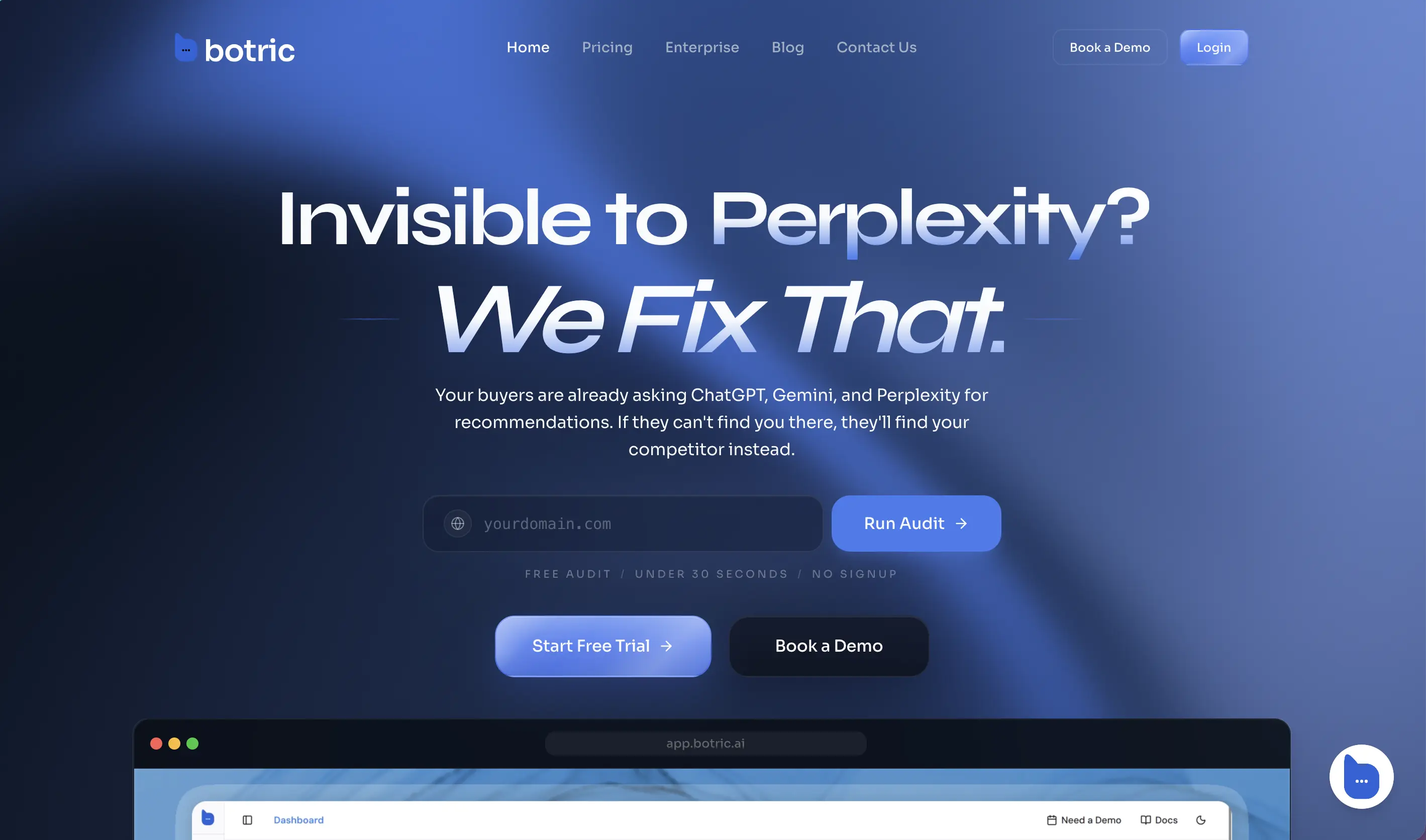
Botric is a full-stack GEO platform built specifically for AI search visibility. It tracks six AI platforms, ChatGPT, Gemini, Perplexity, Claude, Google AI Overviews, and Google AI Mode, and combines prompt tracking, citation analysis, AI-ready site audits, and GEO-optimized content generation in one platform alongside chat agents that handle customer conversations.
What distinguishes Botric from monitoring-only tools is the optimization layer. Rather than showing where you stand and leaving you to figure out next steps, Botric provides structured content recommendations and comparison pages designed to improve citation rates across AI engines. The GEO score gives teams a single metric to track improvement over time.
Key Features
- AI visibility tracking across six platforms: ChatGPT, Gemini, Perplexity, Claude, Google AI Overviews, and Google AI Mode
- GEO score to measure overall AI discoverability
- Prompt tracking for high-intent AI search queries.
- Citation tracking showing which URLs AI answers reference.
- GEO-optimized content generation and AI-ready site audits.
- Multiple agents, including chat and content agents.
- Central dashboard for AI visibility, performance metrics, and reports.
Pricing
Botric's paid plans start at $15 per month for the Bit plan. This tier includes one chat agent, 1,500 plan credits per cycle, 15 prompt tracking slots, 4 blogs generation, site audits, and 60-day message history. Higher plans like Byte ($49/month) expand capacity with 5,000 plan credits, 25 prompts, 12 blogs generation, 90-day message history, and deeper GEO capabilities such as AI-ready site audits, content insights, and expanded prompt tracking.
The Infinity plan ($149/month) is designed for teams managing multiple brands or websites. It includes five workspaces, support for five sites, 15,000 plan credits, generation of up to 40 blogs, up to 150 prompt tracking slots, and advanced AI visibility and growth workflows.
2. Promptwatch
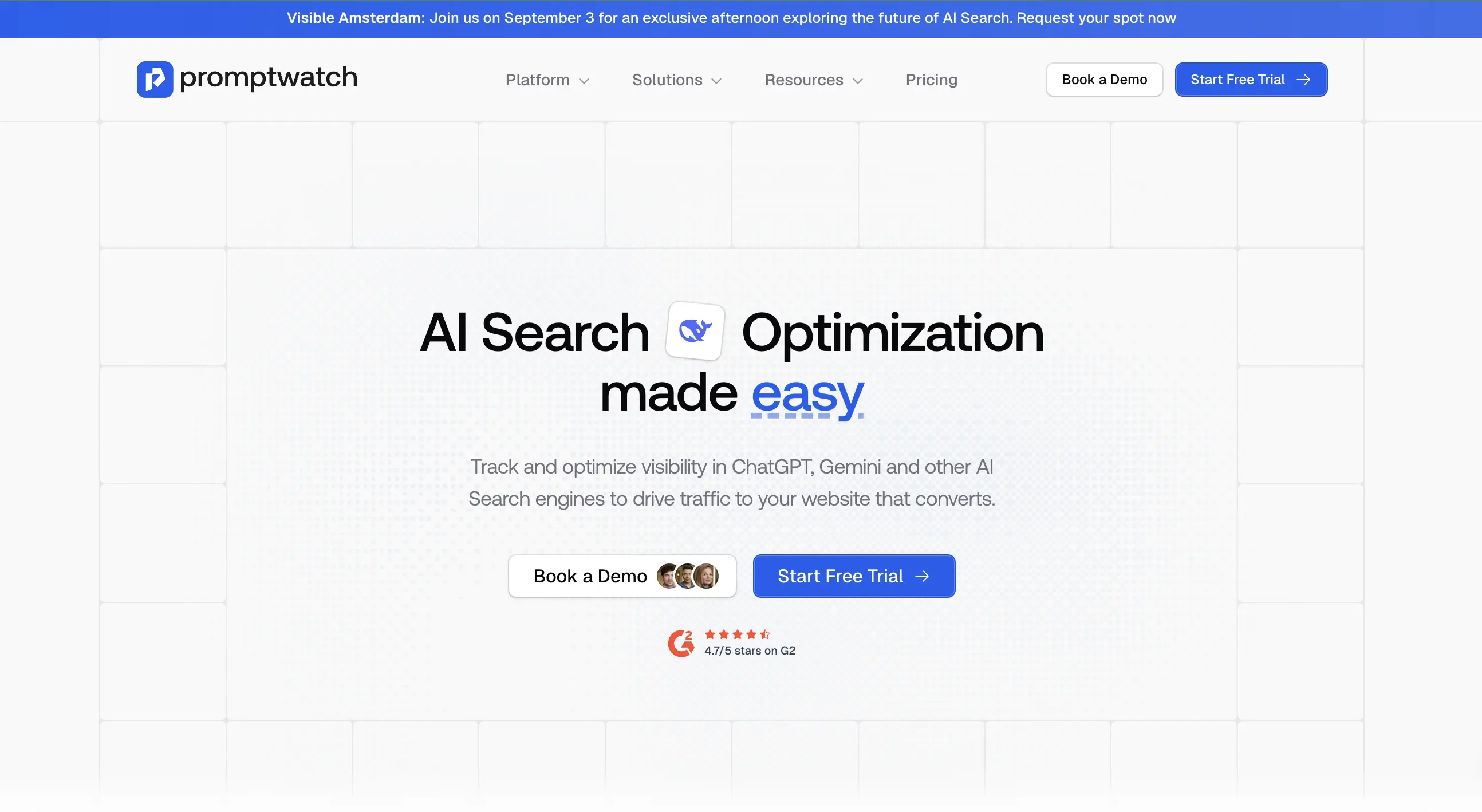
Promptwatch is a full-stack AI Search Visibility and GEO platform built around one idea: monitoring alone doesn't move the needle unless it's connected to what you actually do next. It tracks brand mentions, citations, and AI crawler activity across 11 AI platforms, then closes the loop with agents that draft, optimize, and publish content directly from that data.
What separates Promptwatch from tracking-only tools is the agent layer sitting on top of the data. Content Gap Analysis flags exactly which tracked prompts your site doesn't answer, the Content Agent turns those gaps into AI-optimized drafts grounded in your own citation data rather than generic prompts, and Content Optimization surfaces git-diff style update suggestions for pages that are already live. Once a draft is approved, it publishes to Webflow or Framer in one click — or, in hands-off mode, automatically on a schedule you control. Agent Chat lets teams ask about their AI Search performance in plain language and act on the answer without leaving the conversation.
Key Features
- AI visibility tracking across 11 platforms, including ChatGPT, Claude, Gemini, Perplexity, Google AI Overviews, and Google AI Mode
- Agent Analytics showing the full crawl-to-citation path, not just whether a bot visited a page
- Content Gap Analysis mapping tracked prompts against your indexed site
- Agentic content optimization: the Content Agent drafts new pages, and Content Optimization rewrites live ones with git-diff style suggestions
- One-click publishing to Webflow and Framer, with an optional hands-off mode for scheduled auto-publishing
- Agent Chat, a conversational interface for asking about performance and acting on it directly
- Off-site Mentions plus Reddit and YouTube citation tracking for earned media outside your own domain
Pricing
Promptwatch's Essential plan starts at $95/month (1 project, 50 prompts, 6,000 responses, 5 AEO articles). Professional is $245/month (2 projects, 150 prompts, 18,000 responses, 15 AEO articles, Agent Analytics, state and city-level tracking) and is the most popular tier. Business runs $579/month (5 projects, 350 prompts, 42,000 responses, 30 AEO articles) and moves to a "Book a Demo" checkout instead of self-serve. All paid plans include the full 11-platform model coverage plus MCP and API access. Custom pricing is available for enterprise-scale accounts.
3. Goodie AI
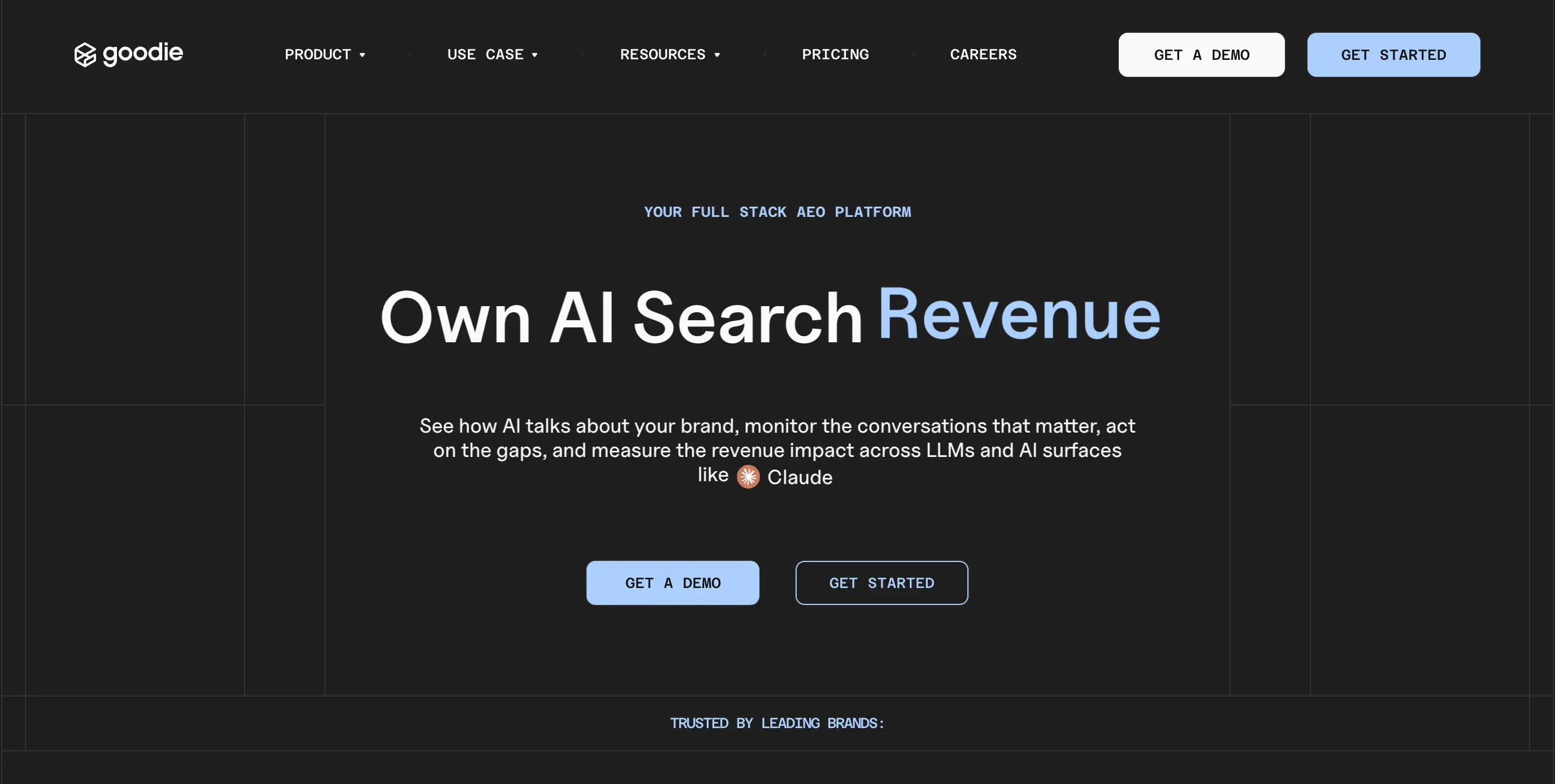
Goodie AI is a full-stack AEO platform built around a closed loop: research, monitor, action, measure. It tracks brand citations, mentions, and sentiment across 11 LLMs, including ChatGPT, Perplexity, Gemini, Copilot, Claude, and Google AI Overviews, running high-volume prompt testing to surface where your brand appears, where competitors are being recommended instead, and which gaps in your content, earned, or technical presence are driving the difference. Where most tools in this category stop at reporting, Goodie AI pairs monitoring with an Optimization Hub that converts visibility data into prioritized actions for SEO, content, and PR teams.
Citation Intelligence identifies which external sources LLMs rely on when generating answers in your category, feeding directly into outreach and digital PR strategy. For ecommerce and commerce teams, the Agentic Commerce Suite tracks product discoverability across ChatGPT Shopping, Google AI Mode, Walmart Sparky, and Alexa+. Attribution closes the loop: Goodie AI measures AI search activity and ties it back to revenue, including zero-click impact that doesn't appear in Google Analytics.
Key Features
- AI visibility tracking across 11 LLMs with high-volume prompt testing
- Optimization Hub converting visibility gaps into prioritized SEO, content, and PR actions
- Citation Intelligence identifying which external sources LLMs rely on in your category
- Agentic Commerce Suite covering ChatGPT Shopping, Amazon Rufus, Walmart Sparky, Google AI Mode, and Alexa+
- Revenue attribution connecting AI search activity to conversions beyond GA4
- Competitive benchmarking across identical prompt environments
Pricing
Goodie AI's pricing starts at $399/month and is designed for mid-market and enterprise teams that need comprehensive AI visibility with full-cycle optimization and commerce capabilities.
4. Geoptie
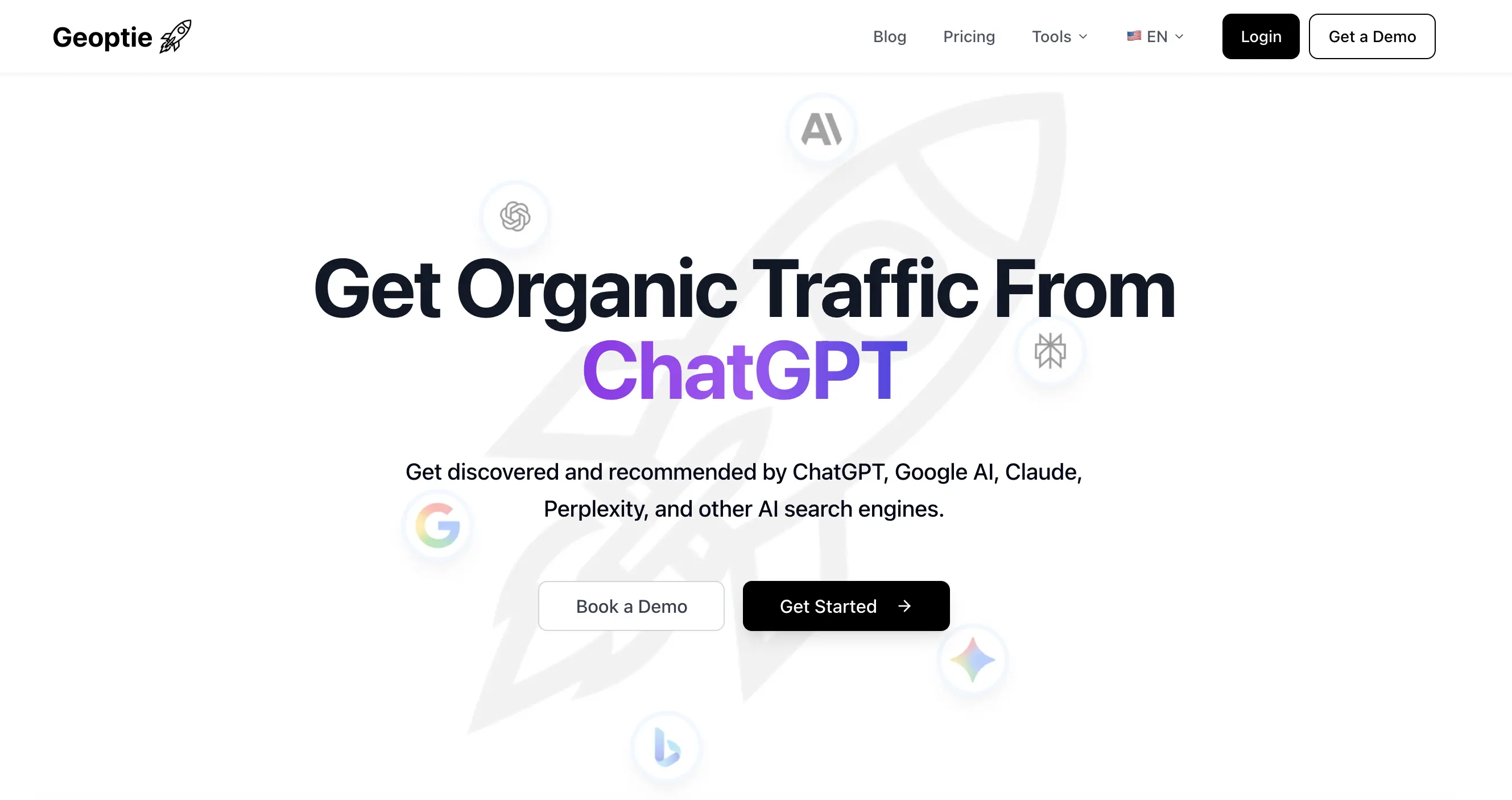
Geoptie is an AI search visibility platform that tracks how answer engines mention and cite a brand, then turns what it finds into the content work needed to close the gaps. It covers seven platforms, ChatGPT, Claude, Perplexity, Gemini, Google AI Overviews, Google AI Mode, and Microsoft Copilot, with any four selectable per brand on every paid plan. That includes the $49 entry tier, which carries 15 tracked prompts and no per-engine surcharge, so a single brand picks the four engines that matter to it without moving up a plan. Nothing is reserved for a higher tier.
For teams running more than one brand, the platform is built on brand workspaces, each with its own prompts, competitors, and engine selection: 10 workspaces with white-label reporting at $99 per month, and no limit on Enterprise. Either way, tracking runs through to execution in the same place. Prompts feed a recommendations engine that turns visibility gaps into prioritized actions, content generation produces publish-ready drafts from the same data, and a content optimizer scores pages already live. Advanced citation analysis, sentiment on every answer, competitor share of voice, and shareable audit reports round out the dashboard.
Key Features
- Seven AI platforms with any four selectable per brand, at no extra cost on any plan
- 15 tracked prompts on the $49 plan, 100 on Professional, 400 on Enterprise
- Advanced citation analysis alongside brand mention tracking
- Sentiment scoring on every tracked answer plus competitor share of voice
- Recommendations engine, content generation, and content optimization in the same platform
- Site audit reports, shareable with clients or stakeholders
- Brand workspaces with white-label reporting, and unlimited seats on every plan
Pricing
Starter is $49 per month with 15 prompts, 2 brand workspaces, and any four engines. Professional at $99 per month covers 100 prompts and 10 workspaces and adds white-label reporting, with 100 extra prompts available at $99 per month. Enterprise at $399 per month covers 400 prompts and unlimited workspaces. Every plan includes unlimited seats, and annual billing is two months free.
5. Profound
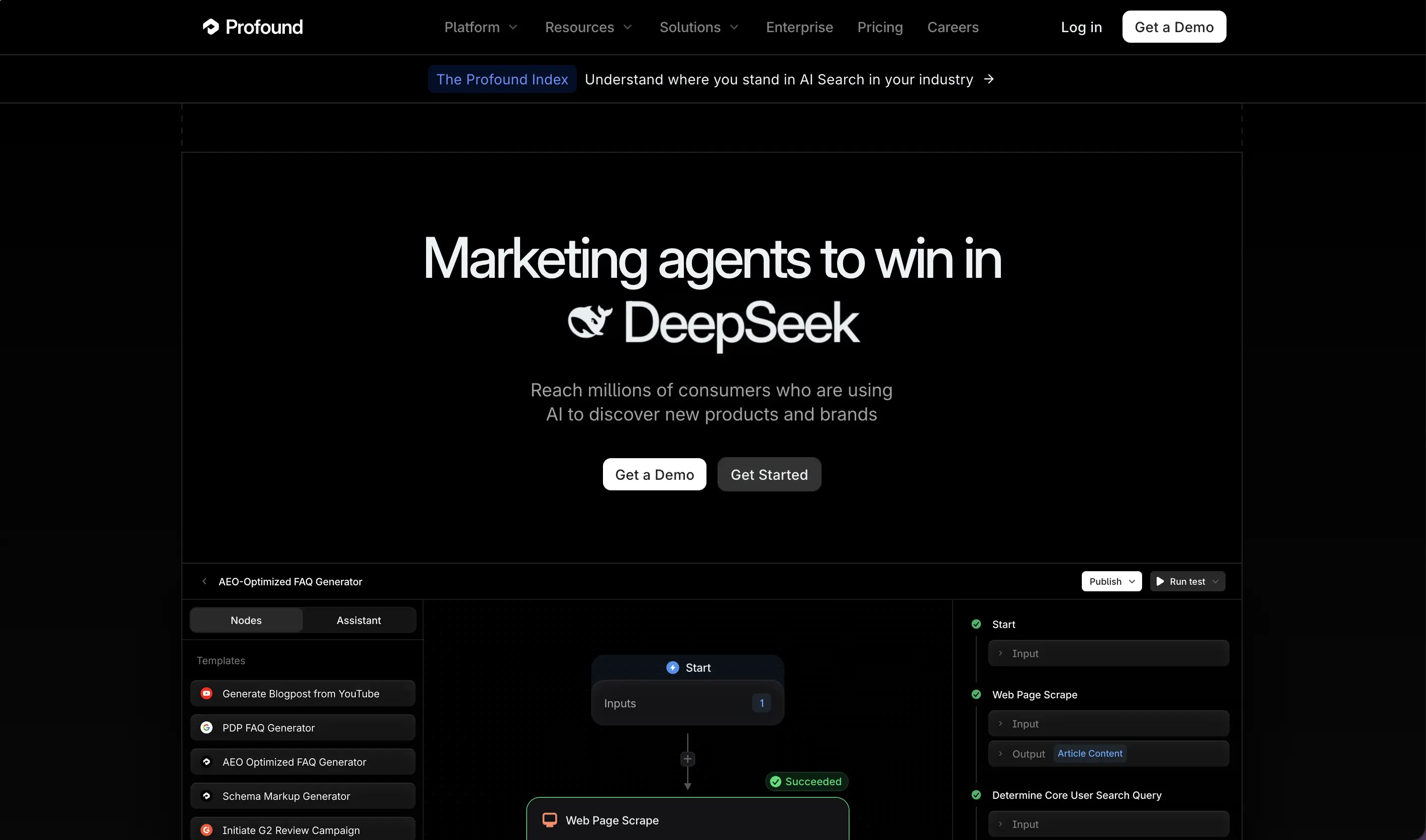
Profound is the most widely recognized enterprise GEO platform in the category. Its three-dimensional data approach sets it apart: real-time AI results across 10+ engines, 400 million anonymized real user prompts via its Conversation Explorer, and AI crawler analytics showing how LLMs access and interpret your site.
The platform analyzes AI prompts, tracks how AI models interpret your website, and provides insights into how often your brand appears in AI-generated answers. It also includes marketing agents that help teams generate and scale content for AI-driven discovery.
Key Features
- Citation tracking for AI-generated responses.
- AI visibility scoring.
- Shows prompt volumes to understand what users are asking AI.
- Agent analytics that monitor how AI systems crawl and interpret your website.
- Autonomous marketing agents for content, demand generation, and brand visibility.
- Multi-platform AI search visibility tracking (ChatGPT, Gemini, Claude, Perplexity).
Pricing
Profound's Starter plan starts at $99/month and includes ChatGPT tracking and 50 tracked prompts. The Growth plan costs $399/month with tracking across three answer engines and 100 prompts. Enterprise plans offer expanded tracking, multi-company support, and custom pricing for larger teams.
6. Conductor
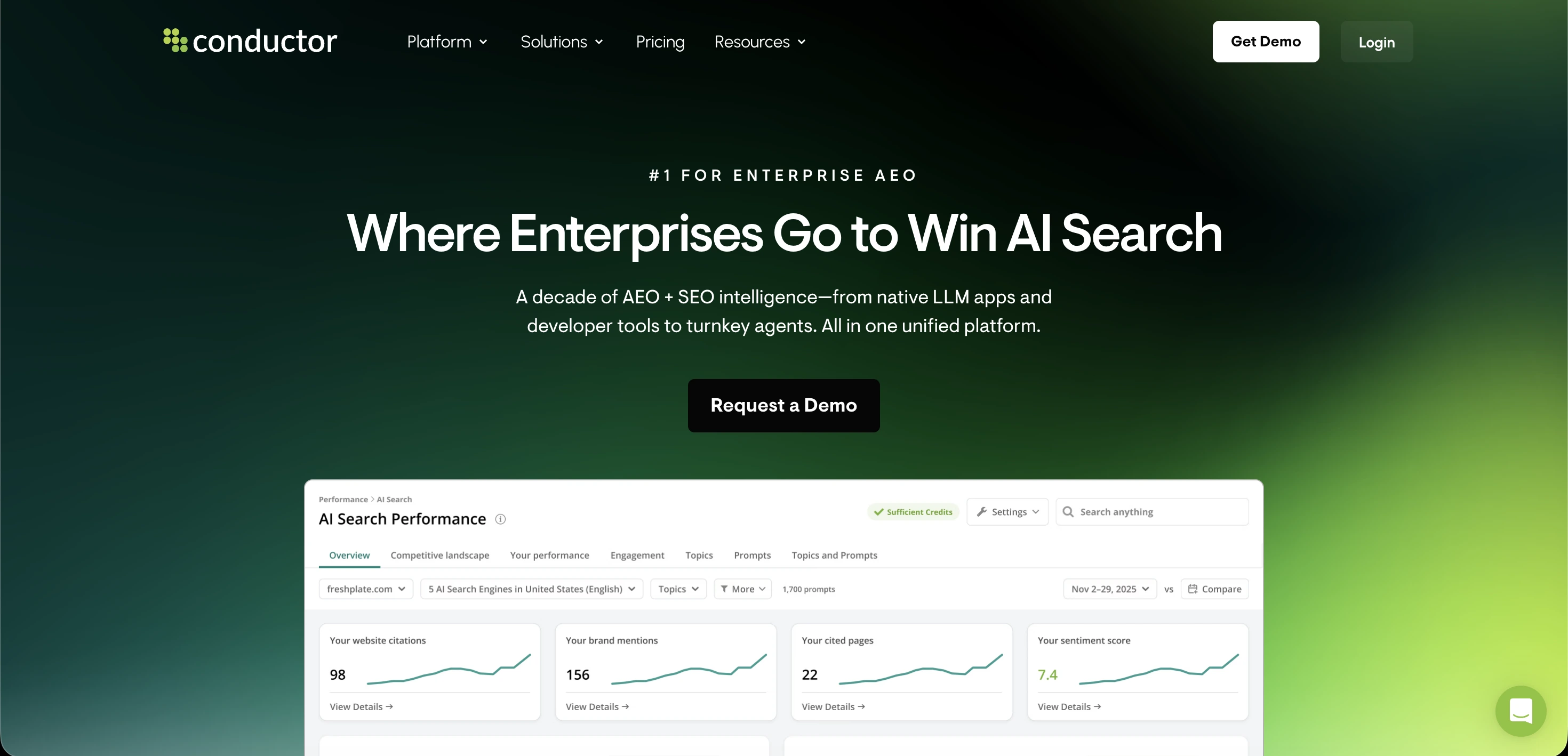
Conductor is an enterprise AEO and SEO intelligence platform built for large organizations that need to unify AI search visibility, traditional organic performance, and content production in a single system.
Rather than treating AI visibility as a standalone metric, Conductor connects it to the same dashboard used for organic traffic, conversions, and revenue reporting, which is its main differentiator from GEO-only monitoring tools.
The platform is organized into multiple connected modules: Conductor Intelligence tracks AI search visibility across ChatGPT, Perplexity, Google AI Overviews, and Gemini alongside traditional keyword and competitive data; Conductor Creator handles AI-driven content generation and optimization at production scale; and Conductor Monitoring provides 24/7 site auditing, alerting, and technical change tracking.
Key Features
- AI search performance tracking across ChatGPT, Perplexity, Google AI Overviews, and Gemini.
- Brand mentions, citations, sentiment, and share-of-voice reporting
- Unified analytics consolidating AI traffic, organic search, and conversion data in one dashboard.
- AI-driven content generation and optimization through the Conductor Creator.
- Technical website monitoring, AI crawler insights, and enterprise reporting.
Pricing
Conductor does not publish fixed pricing. It offers multiple plans, including Essentials with a free trial, while Growth and higher tiers add AI Search credits, expanded reporting, AI-powered content creation, integrations, and additional enterprise capabilities.
7. Rankscale
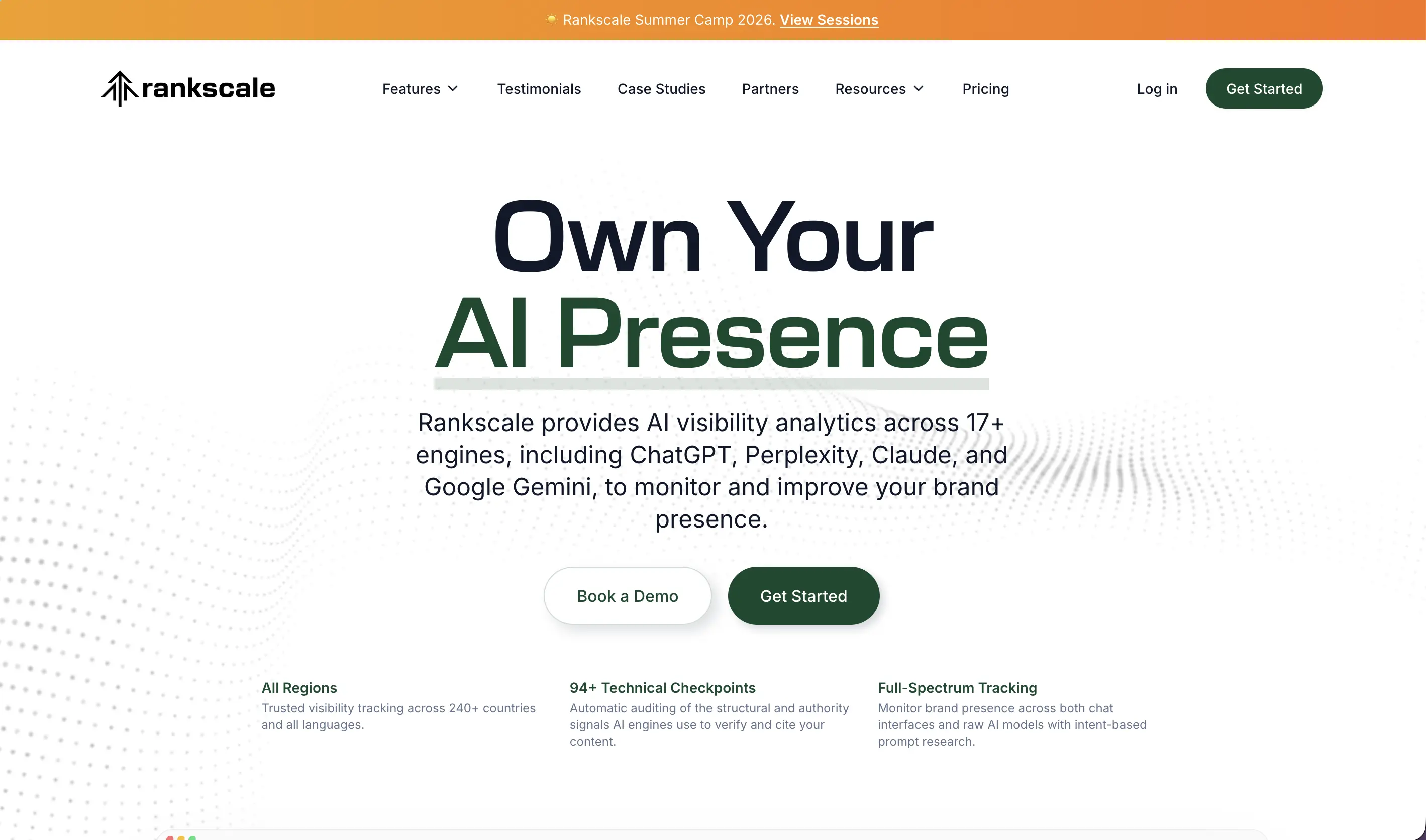
Rankscale is a fast-growing GEO analytics platform tracking AI visibility across 17+ engines including ChatGPT, Perplexity, Claude, Gemini, AI Overviews, Copilot, and Mistral.
What agencies and SEO teams consistently highlight is Rankscale's reporting depth and its credit-based pricing model, which allows flexibility for teams managing multiple clients at different budget levels. Its citation sentiment analysis and competitor benchmarking have made it a strong choice for practitioners who want to go beyond visibility scores into understanding why those scores are what they are.
Key Features
- AI visibility tracking across 17+ engines with 240+ country and language coverage
- Prompt research estimating search volume through semantic reconstruction
- Deep citation analysis connecting source URLs to visibility gaps
- Sentiment analysis tracking brand perception trends by model
- Credit-based pricing flexible for agencies and varied client budgets
Pricing
Rankscale uses a credit-based pricing model. Paid plans start at $99/month for the Pro tier, which includes 1,200 credits, 10 brand dashboards, and up to 4,800 AI responses. Higher tiers include Growth ($385/month) and Enterprise ($780/month), with additional credits, dashboards, API access, and premium support.
8. AthenaHQ
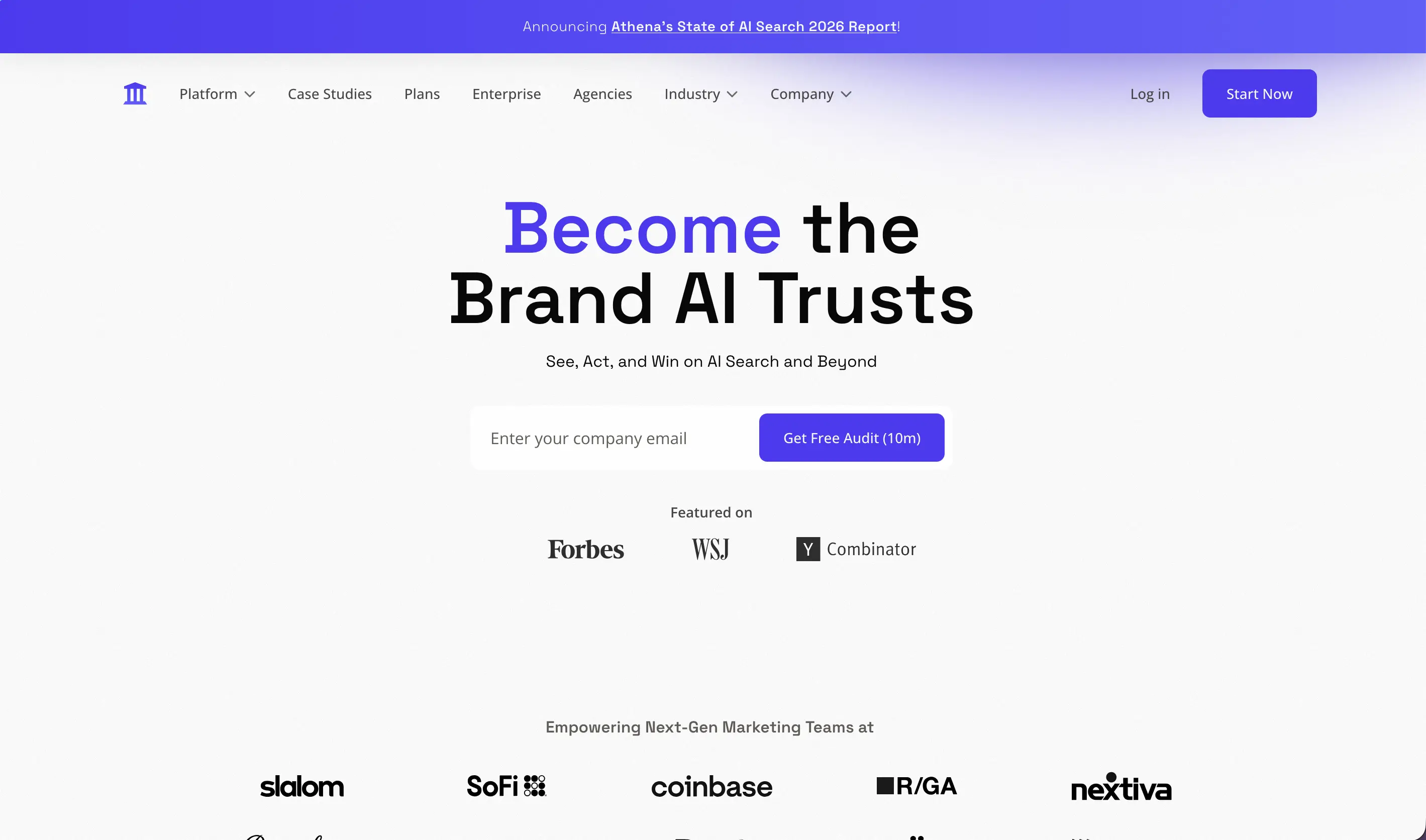
AthenaHQ is a newer entrant in the GEO space, but it's building a strong reputation for its focus on helping brands improve their authority and citation rate in AI-generated responses. It combines monitoring with prescriptive guidance, helping teams understand not just where they stand but exactly what to do next.
AthenaHQ also includes automation features that identify gaps preventing your brand from being cited and suggests actions to improve AI search visibility.
Key Features
- AI citation tracking across major language models.
- Authority gap analysis compared to competitors.
- Content recommendations focused on improving citation likelihood.
- Entity optimization guidance for strengthening brand signals.
- Progress tracking with before-and-after visibility metrics.
Pricing
AthenaHQ's Self-Serve plan starts at $95/month and includes AI visibility tracking across major LLMs. Enterprise plans offer custom pricing with advanced analytics, AI search optimization tools, and dedicated support.
9. Peec AI
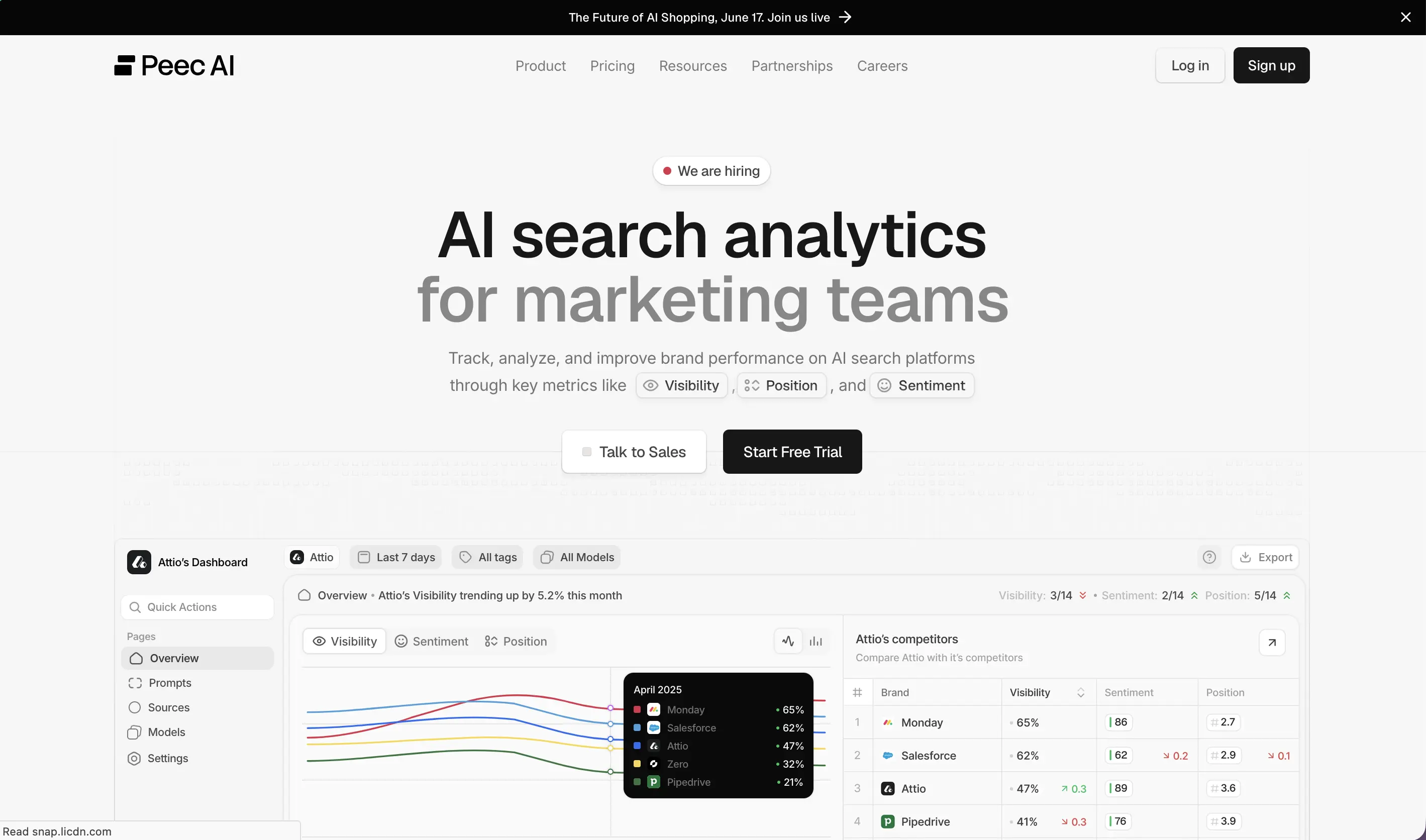
Peec AI is a focused AI search analytics platform for marketing teams. It tracks visibility, position, and sentiment across ChatGPT, Perplexity, and Gemini, and distinguishes between two critically different signals that most platforms conflate: brand mentions (when an AI answer names your brand directly) and source citations (when your content informs an AI answer without naming you).
This distinction matters because many brands are influencing AI responses without receiving credit, and Peec gives you visibility into both scenarios. Its Looker Studio connector, API access, and MCP integration make it straightforward to pull data into existing reporting workflows without custom development.
Key Features
- Visibility, position, and sentiment tracking across ChatGPT, Perplexity, Gemini
- Separate tracking for brand mentions versus source citations
- AI-suggested prompt discovery to surface the queries that matter
- Segmentation by model, country, and funnel stage
- Looker Studio connector, API, and MCP integration
- Daily data refresh across all tracked prompts
Pricing
Peec AI plans start at $95/month for 50 prompts and 1 project. Higher tiers include Pro ($245/month) with 150 prompts and 2 projects, and Advanced ($495/month) with 350 prompts, 5 projects, and Looker Studio integration. Enterprise pricing is available on request.
10. GetCito
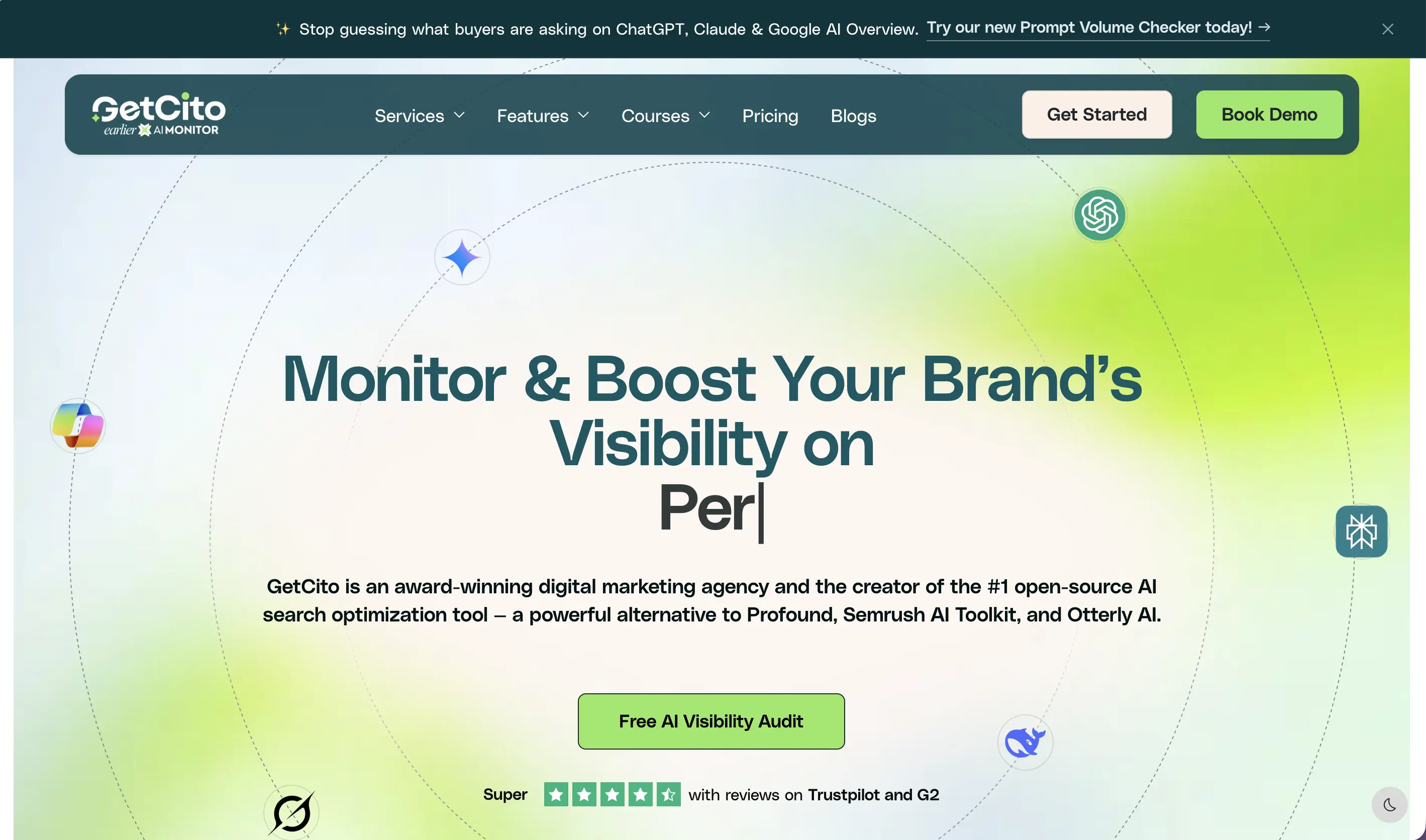
GetCito is an award-winning AI search optimization agency that also offers its own open-source GEO tracking tool, making it unique in this category. GetCito combines platform capabilities with a full human GEO team for brands that want done-for-you execution.
The open-source tool is available free on GitHub under the MIT license. Paid plans layer on a GEO strategist, content writer, frontend developer, backlink acquisition specialist, and community manager alongside the tool, making GetCito the only option in this list that functions as both a generative engine optimization software platform and a managed service.
Key Features
- AI Visibility Checker across ChatGPT, Perplexity, Gemini, Google AI Overviews, Claude, and more
- AI Competitor Radar with trend alerts and competitive footprint tracking
- AI Crawlability Clinic monitoring bot behavior and indexing performance
- Prompt Volume Checker with real-time prompt volume and topic trend analysis
- Open-source tool available free with MIT license
- Managed GEO services combining tool data with human execution
Pricing
The open-source self-host plan is free. Growth plan at $599/month includes 40 prompts, a GEO strategist, 5 content pieces monthly, and structured data implementation. Scale plan at $999/month doubles capacity. Enterprise is custom.
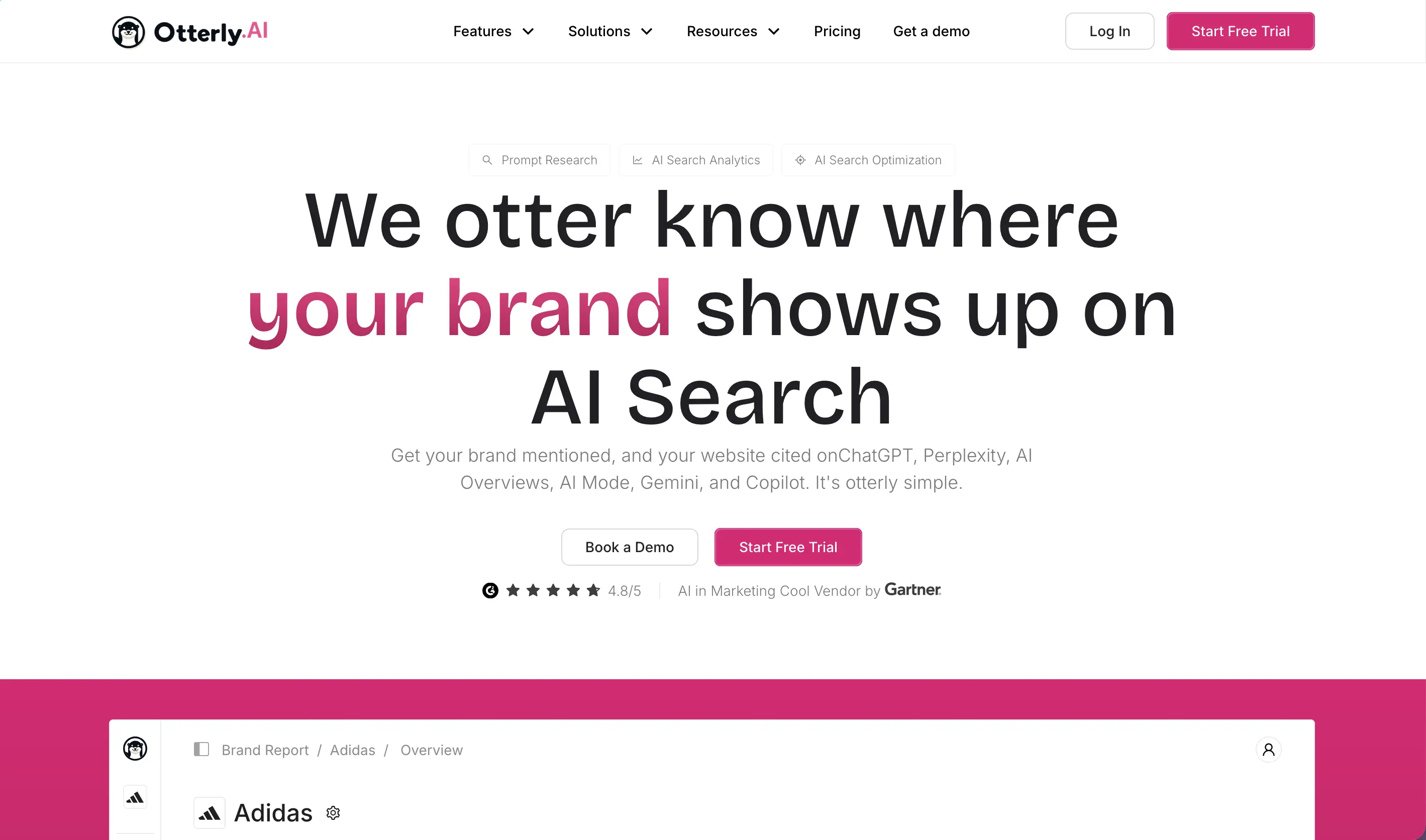
11. Otterly AI
Otterly AI is a focused monitoring tool that does one thing well: tracking brand and content visibility across AI search platforms without unnecessary complexity. It is the most approachable entry point in the category for teams that want to start measuring GEO performance without a long setup or high price.
Automated prompt tracking covers ChatGPT, Perplexity, Google AI Overviews, Gemini, and Microsoft Copilot. The competitor comparison feature shows how rivals perform on the same prompts you're tracking, which makes it easy to identify where you're losing ground without building complex reporting.
Key Features
- Automated prompt tracking across ChatGPT, Perplexity, Bing, and Google AI.
- Brand mention detection within AI-generated responses.
- Competitor comparison on the same tracked prompts.
- Alert system for notable changes in AI visibility.
- AI search monitoring across platforms like ChatGPT, Google AI Overviews, Perplexity, Gemini, and Microsoft Copilot.
Pricing
Otterly AI's Lite plan starts at $29/month and includes tracking for 15 search prompts across platforms like ChatGPT, Google AI Overviews, Perplexity, and Microsoft Copilot.
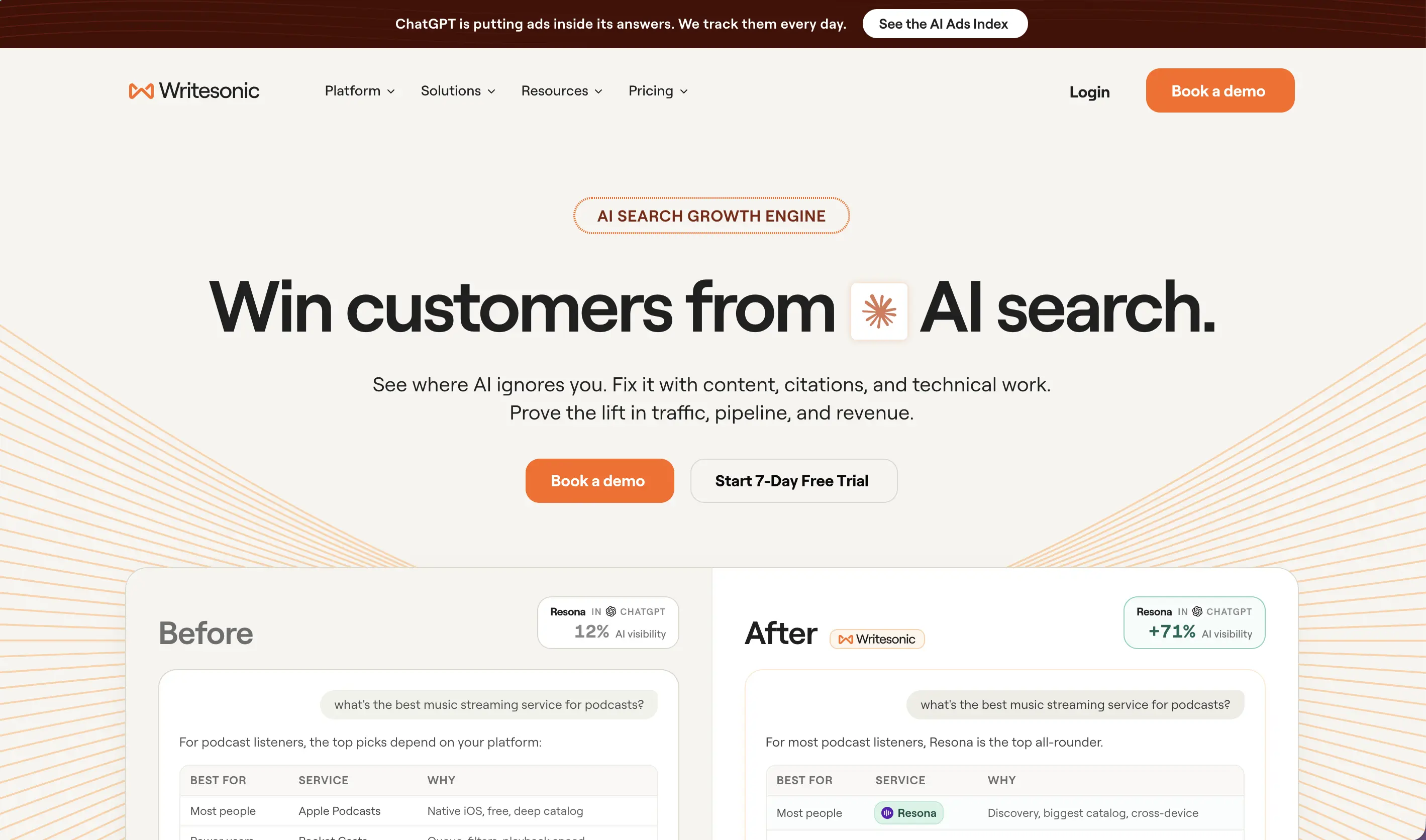
12. Writesonic
Writesonic started as an AI writing platform and has since added GEO-adjacent features for teams focused on content production volume rather than deep monitoring.
For content teams that need to produce AI-optimized articles at scale, the combination of content generation and basic AI visibility indicators covers a practical range without requiring a separate tool.
Key Features
- AI-assisted content generation.
- Basic AI visibility indicators.
- Track visibility across major LLMs, including ChatGPT, Gemini, and other platforms.
- Integrates with popular CMS and blogging platforms.
Pricing
Writesonic's paid plans start at approximately $249 per month for the Professional plan. This tier includes full SEO functionality along with AI search visibility features. Pricing may vary depending on usage limits and additional features.
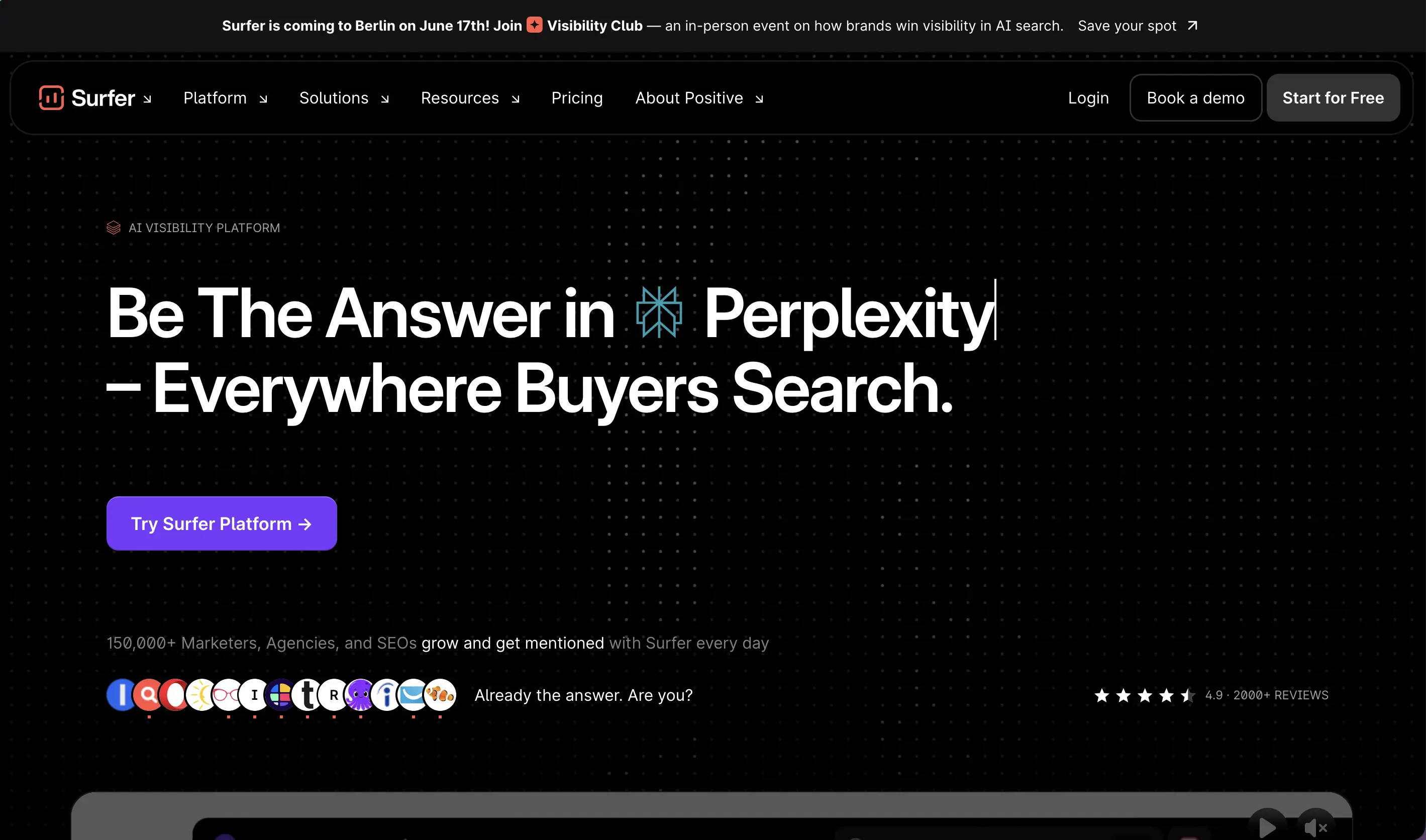
13. Surfer SEO
Surfer SEO is primarily known as a content optimization platform that helps teams create content designed to rank in search engines. Over time, it has expanded its capabilities to support AI-driven search as well.
While Surfer remains fundamentally an SEO tool, its content editor and optimization scoring now factor in the types of structured, comprehensive content that AI engines tend to pull from. If you're already using Surfer for traditional SEO, its GEO-adjacent features are worth taking advantage of.
Key Features
- AI-powered content editor with optimization recommendations.
- SERP and competitor analysis.
- Keyword and topic research tools.
- AI article generation with Surfer AI.
- AI visibility tracking and brand mention monitoring.
- Integrations with platforms like WordPress, Google Docs, and Jasper.
Pricing
Surfer SEO's Standard plan starts at $119/month and includes AI visibility tracking with 25 tracked prompts.
Generative Engine Optimization Tools for Specific Use Cases
Best GEO Tool for SaaS Companies
SaaS buyers often rely on AI tools to compare options, asking questions like "best CRM for startups" or "alternatives to XYZ tool." If your product appears in those AI-generated answers, it can influence purchasing decisions early in the research process. This is why the best AI GEO tools are becoming increasingly relevant for SaaS companies.
The most useful GEO tools for SaaS typically include prompt tracking, citation tracking, and AI visibility monitoring. These features help teams understand which questions matter most, whether their product is being mentioned in AI answers, and how they compare to competitors.
Among the tools listed above, Botric and AthenaHQ are the strongest fits for SaaS companies. Botric combines monitoring with GEO-optimized content generation and multi-LLM tracking across ChatGPT, Gemini, Perplexity, Claude, Google AI Overviews, and Google AI Mode. AthenaHQ provides the most detailed authority gap analysis for competitive positioning in categories where being cited by AI tools directly affects pipeline.
Best GEO Tools for Marketing Teams
Marketing teams need generative engine optimization tools that surface actionable insights without requiring technical expertise to interpret them. The most useful GEO software for marketing teams combines prompt tracking across major AI engines, sentiment analysis showing how AI describes the brand, and content recommendations the team can act on without engineering support.
Peec AI, Botric, and Otterly AI are the most accessible options for marketing teams. Peec AI's clean interface and Looker Studio integration make it easy to pull AI visibility data into existing reporting workflows. Botric's GEO score gives marketing teams a single number to track over time. Otterly AI is the simplest setup for teams that need basic visibility monitoring without a learning curve.
Best GEO Tools for Growth Teams
Growth teams prioritize metrics that tie directly to pipeline: which prompts are driving brand discovery, which competitors are being recommended instead, and which content changes produce measurable visibility improvements. The right GEO tool for a growth team needs prompt-level tracking, citation gap analysis, and enough automation to act on findings without adding headcount.
Botric's AI agents and GEO-optimized content generation make it well-suited for growth teams that want to close citation gaps without building out a separate content operation. Promptwatch's Content Gap Analysis and Agent Analytics are particularly useful for growth teams that need to see the full crawl-to-citation path and turn the gaps it exposes into published pages without adding headcount.
Best GEO Tools for Agencies
Agencies need multi-client workspaces, pricing that scales without locking every client into the same plan, and reporting that can be shared externally without manual reformatting.
Rankscale's credit-based pricing is well-suited to agencies managing different tracking intensities across clients. Botric's Infinity plan at $149/month covers five workspaces at a fixed cost that works for agency economics. GetCito's managed plans bundle a human GEO team with the platform for agencies that want to offer AI search as a service rather than operate it entirely in-house.
Best GEO Tools for Small Businesses
Small businesses don't need enterprise-grade analytics to benefit from GEO. What they need is a clear view of whether they appear when local or category-specific AI prompts are asked, and a practical starting point for improving that visibility.
Otterly AI's Lite plan at $29/month is the most accessible entry point in the category. Botric's Bit plan at $15/month adds site audits and content recommendations to basic monitoring. GetCito's open-source tool is free to self-host for small businesses with technical capacity.
Best GEO Tool for Large Enterprises
Large enterprises with existing SEO and content teams often need AI visibility folded into the same reporting they already use for organic search and revenue attribution, rather than a standalone tracker.
Conductor is one of the strongest choices for organizations that want AI search visibility integrated with enterprise SEO, technical monitoring, and content operations. Profound and Rankscale are strong alternatives for enterprise teams that want a dedicated AI visibility platform without the full organic-SEO suite that comes with Conductor.
How to Choose the Right GEO Tool
The right GEO tool depends on what you want to achieve. Some tools focus on tracking where your brand appears in AI answers, while others help you optimize content so AI systems can understand and cite it.
If your main goal is monitoring, choose a tool that offers AI visibility tracking, prompt monitoring, and citation insights. These features help you see whether your brand is being mentioned in platforms like ChatGPT, Gemini, or Perplexity.
If your strategy is content-driven, look for tools that provide content optimization and AI-friendly content creation to improve your chances of being cited.
Finally, consider the level of insight you need. Some platforms only monitor visibility, while others combine tracking, optimization, and automation to help improve your presence in AI-generated answers.
Monitoring-Only vs. Full-Stack GEO Tools: Which Do You Actually Need
GEO software splits into two categories: monitoring-only tools track where your brand shows up across ChatGPT, Gemini, Perplexity, and other AI engines and hand you the data. Full-stack tools track it and also generate or rewrite content to close the gaps they find.
Choose monitoring-only if you already have a content team or agency and just need visibility into what's being cited. Peec AI and Otterly AI are built this way, tracking and alerts only, no content layer.
Choose full-stack if you'd rather the platform close the gaps itself. Botric, Promptwatch, Geoptie, Conductor, and GetCito pair tracking with real content generation, not just recommendations.
Writesonic and Surfer SEO lean full-stack too, though both started as content tools that added tracking. Rankscale and AthenaHQ sit in between, they'll tell you what to fix without generating the fix.
Not sure which category a vendor falls into? Look at their pricing page. If "content" or "generation" shows up as an actual feature, they're full-stack. If all you see is "tracking" and "alerts," that's your answer, plan to bring in a writer to go with it.
How to Evaluate GEO Tools Beyond a Feature Checklist
A feature comparison table tells you what a tool claims to do. These four questions help you verify whether it actually delivers before committing to a paid plan.
Does it track real AI-generated answers or simulated scores?
Some platforms generate AI visibility estimates without querying live AI engines. The best generative engine optimization tools pull actual responses from ChatGPT, Perplexity, Gemini, and other platforms in real time. Ask the vendor specifically how visibility data is collected.
How many prompts are included at each tier?
Prompt limits vary significantly across platforms at similar price points. Otterly AI's $29/month plan includes 15 prompts. Profound's $99/month Lite plan includes 50. Botric's $49/month Byte plan includes 25. Map your actual tracking needs against what each tier provides before comparing headline prices.
Does the platform cover the AI engines your buyers actually use?
A tool that only tracks Google AI Overviews misses the buyers using ChatGPT or Perplexity. Identify which AI platforms your target audience uses most, then verify each tool covers them.
Can you act on the data within the platform, or does it only report?
Monitoring without the ability to improve has limited value. Check whether the platform provides content recommendations, citation gap analysis, or technical audit guidance, or whether it simply reports a visibility score and leaves next steps to you.
Final Thoughts
AI search is already changing how people discover products and services. More buyers are asking tools like ChatGPT or Perplexity for recommendations instead of browsing through dozens of search results. If your brand isn't showing up in those answers, you're missing important opportunities to be part of the conversation.
Which GEO tool I'd recommend depends on where you are. If you're starting out, platforms like Botric, Peec AI, or Otterly AI give you meaningful visibility without enterprise pricing. If you're managing AI search visibility at scale across multiple clients, product lines, or global domains, Profound, Rankscale, or Conductor provide the analytics depth and organizational scale that volume requires.
The place I'd start is simple. Check whether your brand appears for the questions your customers are asking. Track a few important prompts, see which competitors are being mentioned, and identify where the gaps are.
From there, you can gradually build a stronger strategy. Platforms like Botric are designed to help with that process by combining visibility tracking, citation insights, and optimization tools in one place, making it easier for businesses to understand how they show up in AI-driven discovery.
Key Takeaways
- GEO tools help businesses monitor and improve their visibility in AI-generated answers across platforms like ChatGPT, Gemini, Perplexity, and Google AI Overviews.
- The most valuable platforms combine AI visibility tracking, citation analysis, prompt monitoring, and content optimization instead of reporting metrics alone.
- Choose a GEO tool based on your goals. Some platforms focus on monitoring, while others provide optimization, automation, and AI-powered content recommendations.
- Multi-LLM coverage and prompt-level tracking are essential for understanding how your brand appears across different AI search engines.
- GEO builds on your existing SEO strategy by helping your content become a trusted source that AI systems cite and recommend.
Want to know where your brand actually stands in ChatGPT, Gemini, and Perplexity right now? Botric's free GEO audit shows you your current visibility gaps and exactly what to fix first, no setup required. Get your free GEO audit
If you are still unsure why your site isn't appearing in AI results, start with the fundamentals: read the guide on the 7 reasons your website doesn't show in AI search to diagnose and fix the most common visibility blockers.
Frequently Asked Questions
What are GEO tools?
GEO tools are software platforms that help businesses track, analyze, and improve their brand's visibility in AI-generated answers from platforms like ChatGPT, Perplexity, Google AI Overviews, Gemini, and Claude. They measure whether your brand is mentioned or cited when users ask AI systems relevant questions, and most provide recommendations to improve those results over time.
What features matter most in a GEO tool?
The four capabilities that separate genuinely useful GEO platforms from those that relabel SEO dashboards are: multi-LLM coverage (tracking real answers across ChatGPT, Gemini, Perplexity, Claude, and others), prompt-level tracking (monitoring specific questions rather than just brand mentions), citation tracking (showing which URLs AI engines pull from), and actionable content recommendations. Platforms that only offer a "visibility score" without explaining what drives it or what to do next provide limited practical value.
Which GEO tools help brands appear in ChatGPT answers?
Botric, Promptwatch, Profound, AthenaHQ, Peec AI, Rankscale, GetCito, Otterly AI, and Conductor all track ChatGPT visibility. Among those, Botric, AthenaHQ, and Conductor also provide content recommendations to improve your citation rate rather than just reporting where you currently stand.
What is the difference between GEO and SEO?
SEO focuses on ranking web pages in traditional search engines like Google. GEO focuses on getting your brand cited or mentioned inside AI-generated answers from platforms like ChatGPT, Gemini, and Perplexity. The two disciplines overlap in that strong SEO foundations support GEO performance, but they require different strategies and different tools to measure.
What is a good GEO tool for businesses just starting out?
For businesses starting their GEO journey, Botric ($15/month), Otterly AI ($29/month), and AthenaHQ ($95/month) are the strongest options at accessible price points. Botric offers one of the broadest feature sets at an entry-level price point. Otterly AI is the simplest to set up and understand. AthenaHQ gives the most prescriptive guidance on what to fix, which is valuable when you don't yet know where to start.
How long does GEO optimization take to show results?
Early visibility improvements from content and technical changes typically appear within a few weeks. Consistent citation inclusion for competitive prompts can take several months, depending on how saturated the category is and how aggressively competitors are optimizing. Tracking specific prompts over time is the most reliable way to verify whether your efforts are producing results.
Do GEO tools only monitor visibility, or can they also help create content?
It splits roughly down the middle. Botric, Promptwatch, Goodie AI, Geoptie, Profound, Conductor, GetCito, Writesonic, and Surfer SEO all include some level of content generation or optimization alongside tracking. Peec AI and Otterly AI are monitoring-only by design. Rankscale and AthenaHQ sit in between, offering optimization guidance without full content generation.