Your Google rankings hold steady, but ChatGPT, Perplexity, and Gemini never mention your product, and that gap is quietly costing you demo requests.
Generative Engine Optimization, or GEO, is the practice of structuring content so large language models can find, understand, and cite your brand inside AI-generated answers rather than just ranking a URL.
If ChatGPT recommends three competitors when a prospect asks "best customer data platform for B2B startups" and never says your name, that prospect never sees your site, no matter how well you rank organically.
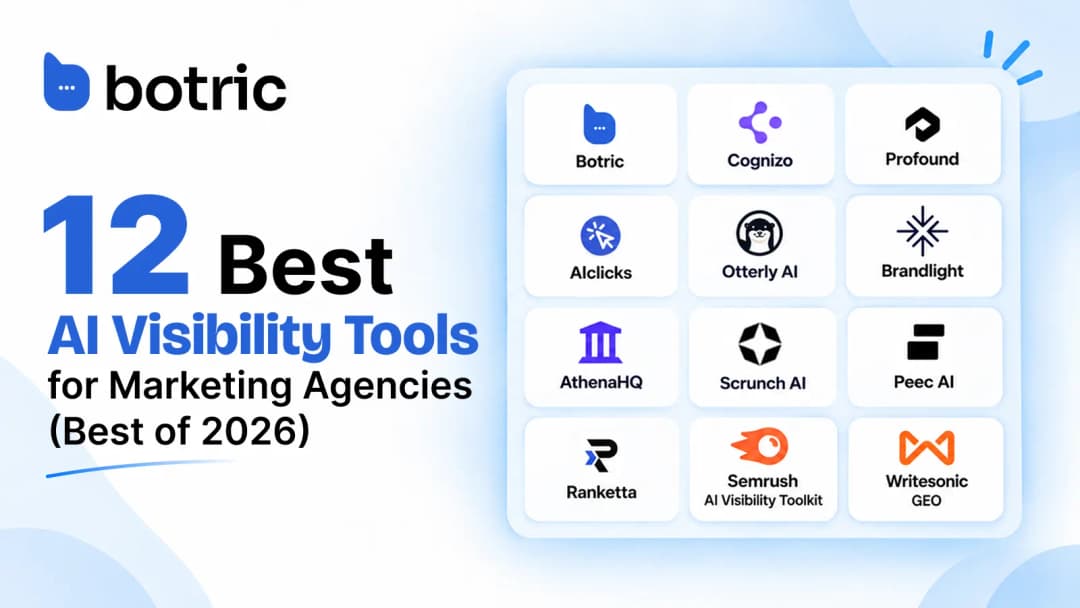
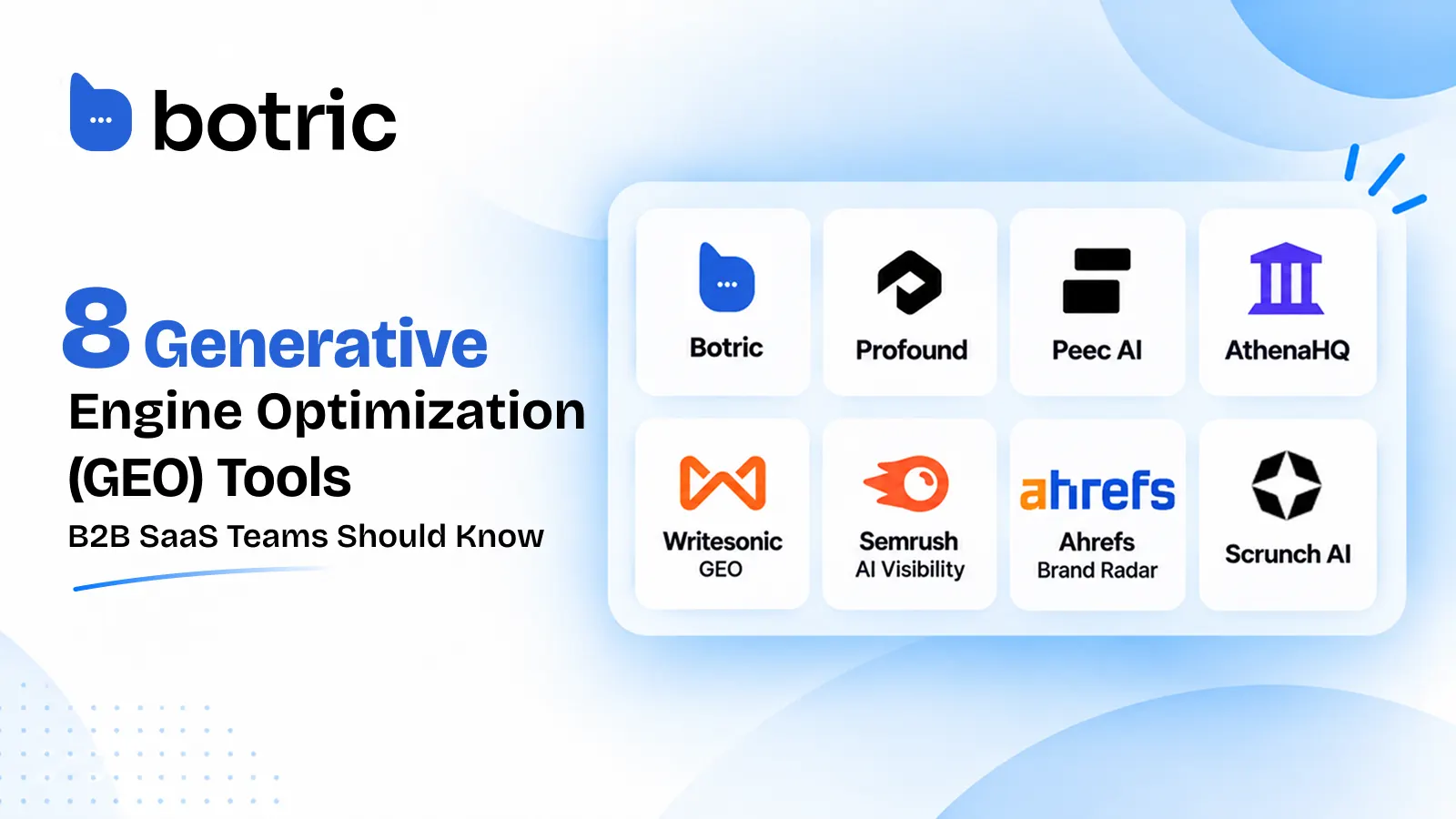
This roundup covers 8 generative engine optimization (GEO) tools B2B SaaS teams should know: what each does, who it fits, and one honest limitation apiece, so you can pick without guessing.
At Botric this is the exact blind spot our audits surface most often: strong domain authority, zero AI citations.
Which GEO tool fits depends on whether you need a monitor that tells you where you stand, or a platform that also drafts the fix.
- Botric: an AI visibility and content platform that tracks citations across ChatGPT, Google AI Overview, Perplexity, Claude, and Gemini, then drafts the articles & pages that close the gaps it finds.
- Profound: AI marketing platform combining prompt-volume data with an agentic content workflow.
- Peec AI: granular, agile content strategy tool for tracking brand mentions across specific LLM versions.
- AthenaHQ: citation-focused monitoring with a free entry tier and an enterprise "Citation Engine."
- Writesonic GEO: combined SEO plus GEO platform with built-in content generation.
- Semrush AI Visibility Toolkit: AI visibility bolted onto an existing SEO suite most SaaS teams already use.
- Ahrefs Brand Radar: AI visibility layered on Ahrefs' web index, strong for citation and backlink context.
- Scrunch AI: audit-heavy platform with an Agent Experience Platform for enterprise rollouts.
Do you actually need a GEO tool yet, or is manual testing enough?
If you're pre-seed or early Series A with under 10 target prompts to track, manual testing is genuinely enough for now.
Open ChatGPT, Claude, Gemini, and Perplexity yourself, ask the five to ten questions your buyers actually type (something like "best category for B2B startups"), and log what comes back in a spreadsheet.
When manual testing breaks down
Manual checks stop scaling once you're tracking more than 15 to 20 prompts across four engines weekly.
Each engine returns different answers depending on session, region, and model version, and a single marketer checking by hand can't catch that drift reliably at volume. You'll miss the exact moment a competitor starts getting cited instead of you.
Signals it's time for a platform
Three signals mean it's time to move off spreadsheets: your team has grown past one marketer, you're seeing competitors named in AI answers where you're absent, or leadership is asking for citation trends you can't produce by hand.
Only about 16% of brands actively track AI search visibility today, according to Botric's analysis of brand vs. competitor tracking, which tells us most teams are flying blind on exactly this question.
How these 8 tools were chosen and scored
Every tool below was scored on five criteria, stated upfront so this reads as transparent rather than vendor-tilted:
- Engines covered: ChatGPT, Claude, Gemini, Perplexity, and others
- Integration breadth: Slack, HubSpot, CMS, reporting tools
- Pricing accessibility relative to company stage
- Whether content generation is included
- Publicly stated compliance or data residency detail: SSO, SOC 2, GDPR
Only features and prices confirmed on each vendor's own pricing page made the cut. You can compare live plan tiers against your own budget on Botric Pricing, which lists cost by team size the same way.
The 8 best GEO & AI Visibility tools for B2B SaaS teams, ranked and reviewed
ChatGPT, Claude, Gemini, and Perplexity each surface and cite sources differently: Perplexity leans heavily on live web citations, Google's AI Overviews pull from its own index, and ChatGPT blends training data with browsing.
A tool that only watches one engine will miss real citations happening on the other three, which is why cross-engine coverage is the first filter below.
Comparison table: engines, best fit, content generation, and pricing
| Tool | Engines covered | Best for | Content generation | Entry price |
|---|---|---|---|---|
| Botric | ChatGPT, Google AI Overview, Perplexity, Claude, Gemini | Visibility Tracking and the content fix for a gap in one workflow | Yes. Articles & Pages | 7-day free trial; Byte $49/mo ($45/mo billed annually) |
| Profound | ChatGPT, Perplexity, Claude, Gemini, Copilot, DeepSeek, AI Overviews | An agent handling both discovery and drafting | Yes | Custom, no published price |
| Peec AI | Up to 13 models, choose 3 on lower tiers | Reacting fast to new model releases | No | $95/mo |
| AthenaHQ | 11 models | Budget-conscious teams testing the category for free | Yes, content optimization agent | Free tier, then $295/mo |
| Writesonic GEO | 10 AI platforms (Enterprise) | Teams needing high-volume AI content plus tracking | Yes, AI articles | $99/mo ($79/mo billed annually) |
| Semrush AI Visibility | ChatGPT, Google AI, Gemini, Perplexity | Teams already inside Semrush for other SEO work | No | $99/mo per domain |
| Ahrefs Brand Radar | ChatGPT, Google AI Overviews, Perplexity, Gemini, Copilot | Teams that already trust Ahrefs' backlink data | No | $50–$250/mo for Custom Prompts, $199/mo for Brand Radar AI |
| Scrunch AI | ChatGPT, Claude, Gemini, Perplexity, Google AI Mode & AI Overviews, Meta | Enterprise teams past their first GEO test | Basic (Starter), Advanced (Enterprise) | $250/mo billed annually ($300 monthly) |
1. Botric
Botric is a hybrid AI visibility and GEO platform built to close the loop, not just report it: it tracks citations across ChatGPT, Google AI Overview, Perplexity, Claude, and Gemini, flags exactly where a brand is missing with Content Gap Analysis, and drafts the pages or articles that close that gap through its Content Agent.
What it does well
- Runs tracking and content generation in one workflow, so a gap identified by Content Gap Analysis moves straight to a page or article drafted by Content Agent, instead of a handoff to a separate writing tool.
- Covers five major answer engines on its top plan, wider coverage than most tools at a comparable price point.
- Prompt Playground lets you test how phrasing changes which brands get cited, before locking a prompt into ongoing tracking.
- Site & GEO Audit checks crawlability, schema, and entity signals in the same platform as citation tracking, not a separate tool.
Where it may not fit
- Built for AI visibility and citation tracking specifically, not as a general RAG or retrieval-infrastructure product, so teams needing custom retrieval pipelines should look elsewhere.
Pricing
Byte tracks ChatGPT, Google AI Overview, and Perplexity for $49/month; Infinity adds Claude and Gemini for $149/month. All the paid plans come with a 7-day free trial.
2. Profound
Profound is an AI visibility platform built around an "AI Marketer" agent rather than a static dashboard, so discovery, drafting, and publishing approval all live inside one workflow instead of a chain of separate tools. It's aimed at teams that would rather hand off both finding the gap and writing the fix to one system.
What it does well
- Identifies content gaps from prompt-volume data, drafts pages to fill them, and pings a human for approval before anything publishes.
- Covers seven engines, ChatGPT, Perplexity, Claude, Gemini, Microsoft Copilot, DeepSeek, and Google AI Overviews, wider than most competitors on this list.
- Answer Engine Insights consolidates visibility, sentiment, and citations across every major engine into one view rather than several reports.
Where it may not fit
- No published pricing, so a smaller team can't self-serve a quote without booking a sales call.
- Its agentic content workflow adds a human approval step before publishing, safer but slower than a tool that drafts and hands off directly.
Pricing
Not published on Profound's site; requires a sales call.
3. Peec AI
Peec AI fits granular, version-level tracking, useful for reacting the day a new model ships rather than waiting for a monthly report.
What it does well
- Tracks brand mentions at the level of specific LLM versions, not just the model family.
- Advanced tier adds Looker Studio integration for teams that already report through that dashboard.
- Prompt discovery surfaces prompts you haven't thought to track yet, based on your brand context and competitor coverage.
Where it may not fit
- Built by a smaller team than enterprise rivals like Semrush or Ahrefs, so its overall brand footprint and domain authority trail those bigger suites.
Pricing
Starter is $95/month for 50 prompts across 3 models; Pro is $245/month; Advanced is $495/month with Looker Studio integration.
4. AthenaHQ
AthenaHQ pairs citation tracking with a genuine free tier and an enterprise-only Citation Engine that reviews claims for source-level accuracy, scaling from a no-cost starting point up to SAML/OIDC SSO for larger teams.
It's built for teams that want to test the category before committing a budget, not just teams already sold on buying.
What it does well
- Essential tier includes $25 in credit and covers prompt and response analysis at no cost, a real free entry point rather than a time-limited trial.
- Enterprise adds SAML/OIDC SSO plus multi-region support.
- Prompt-level logging keeps the exact prompt, full AI answer, and citation position for every tracked query, useful evidence beyond a summary score.
Where it may not fit
- Meaningful volume beyond the free tier requires a jump to the $295/month Starter tier, a real step up for a solo marketer.
Pricing
Essential is free; Starter is $295/month for 3,600 credits across 11 models, per AthenaHQ's plans page.
5. Writesonic GEO
Writesonic GEO started as a content generation tool and has grown a tracking layer on top of it, so one subscription buys prompt tracking and a set number of AI-generated articles instead of two separate vendor contracts.
It fits best for teams whose biggest gap is content volume, not just visibility data.
What it does well
- Basic tier includes 50 tracked prompts and 15 AI articles monthly, cheaper than running a separate tracker and a separate writing tool.
- Enterprise adds SOC 2 Type II and HIPAA compliance, worth knowing if your buyers ask about data handling.
- Query fan-out tracking shows which sub-queries an AI model fires before answering, and which of them mention your brand, a diagnostic most competitors on this list don't offer.
Where it may not fit
- Full 10-platform coverage and the Action Center's agentic workflows are Enterprise-only, gated behind a custom quote.
Pricing
Basic is $99/month, or $79/month billed annually, for 50 prompts and 15 AI articles monthly.
6. Semrush AI Visibility Toolkit
Semrush's AI Visibility Toolkit is a tracking-only module bolted onto Semrush's existing SEO suite, built for teams that already have Semrush open every day and would rather add a report than adopt a new platform.
It doesn't generate content, so a gap it finds still needs a separate writer or content tool to close.
What it does well
- Tracks 25 custom prompts across ChatGPT, Google AI, Gemini, and Perplexity from inside a suite many SaaS teams already log into daily.
- Runs on Semrush's own database of over 317 million tracked prompts and responses, useful for same-week reporting on a new account.
Where it may not fit
- It's an add-on to a broader SEO suite, so a team that doesn't already use Semrush inherits its full interface just to get AI tracking, more overhead than a purpose-built tool.
- No content generation, so a gap it surfaces still needs a separate writing tool or team to close.
Pricing
Base is $99/month per domain for 25 custom prompts across ChatGPT, Google AI, Gemini, and Perplexity.
7. Ahrefs Brand Radar
Ahrefs Brand Radar layers AI citation tracking on top of the backlink and keyword index many SaaS SEO teams already trust, running on Ahrefs' own database of over 475 million tracked prompts.
It's a monitoring product, not a content or optimization layer, so it tells you where you're missing without doing anything about it.
What it does well
- Custom Prompts and the AI Visibility Index both start at accessible price points relative to enterprise tools.
- Layers directly on top of Ahrefs' existing crawl and backlink index, so there's no separate data source to onboard for teams already on Ahrefs.
Where it may not fit
- It's a newer module inside a legacy SEO tool, so GEO-specific workflows are less mature than purpose-built platforms.
Pricing
Brand Radar AI starts at $199/month; Custom Prompt packages run from $50/month (2,500 checks) up to $250/month (25,000 checks) for teams tracking their own prompt sets, per Ahrefs' pricing page.
8. Scrunch AI
Scrunch AI pairs prompt-level visibility tracking with a full technical site audit and its Agent Experience Platform (AXP), which serves AI crawlers a structured version of your site separate from what human visitors see.
It's built for a planned enterprise rollout more than a first test of the category, and its entry tier reflects that with tighter prompt and seat caps.
What it does well
- Starter includes a 7-day free trial, a real trial rather than a demo request.
- Enterprise adds SAML/OIDC SSO, an Enterprise Data API, and expanded scale.
- AXP (Agent Experience Platform) serves a structured, AI-optimized version of your site to crawlers while your human-facing site stays untouched, a layer most tools on this list don't offer.
Where it may not fit
- Starter caps you at 3 user licenses and 350 custom prompts, so growing SaaS teams outgrow it quickly.
Pricing
Starter is $250/month billed annually ($300 month-to-month); Growth is $417/month billed annually ($500 month-to-month); Enterprise is custom-priced.
Which GEO tool fits your startup stage and budget?
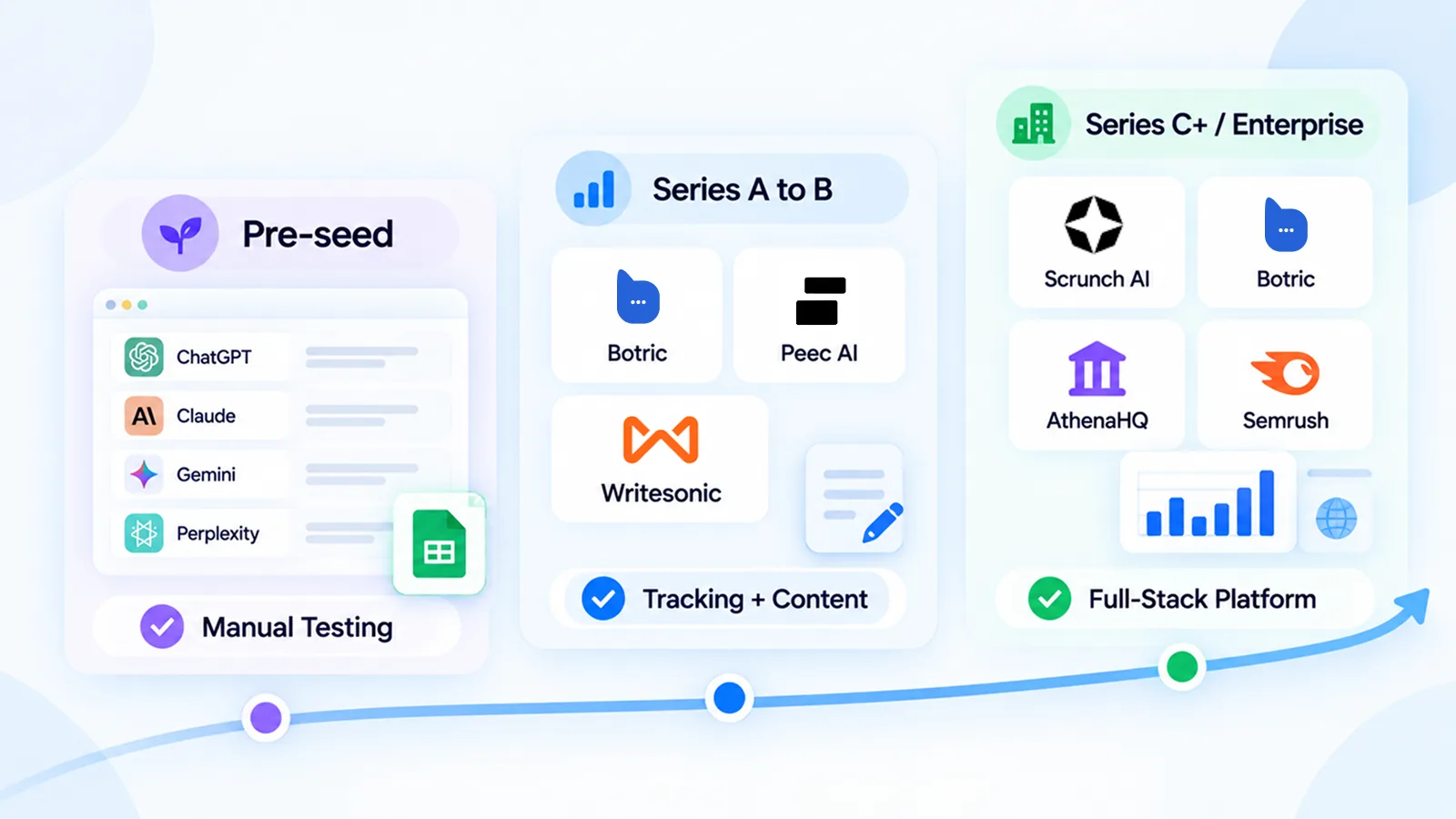
Pre-seed
Skip a paid platform entirely. Run manual prompt tests weekly and use a free entry point like AthenaHQ's Essential tier or Botric's free audit to get a baseline reading without committing a budget.
Series A to B
This is the inflection point for most teams. Budget roughly $49 to $400/month and assign one marketer part-time to own it.
Botric's Byte plan, Peec AI, or Writesonic's Basic tier fit here, since content generation plus tracking in one tool matters when you don't have spare copywriting bandwidth.
Series C+ or enterprise
Budget for a full-stack platform, often $1,000+/month once you add SSO, multi-region tracking, and API access, with a dedicated GEO owner or small team.
Scrunch AI, Botric Enterprise, AthenaHQ Enterprise, or Semrush's Enterprise tier suit organizations juggling multiple brands or regions. Enterprise buyers should also ask each vendor how it checks its own results for accuracy before those results reach a dashboard.
What actually gets a SaaS comparison page cited by AI engines
Ranking a comparison or alternatives page in Google and getting it cited inside an AI answer are two different jobs, and the second one has its own checklist:
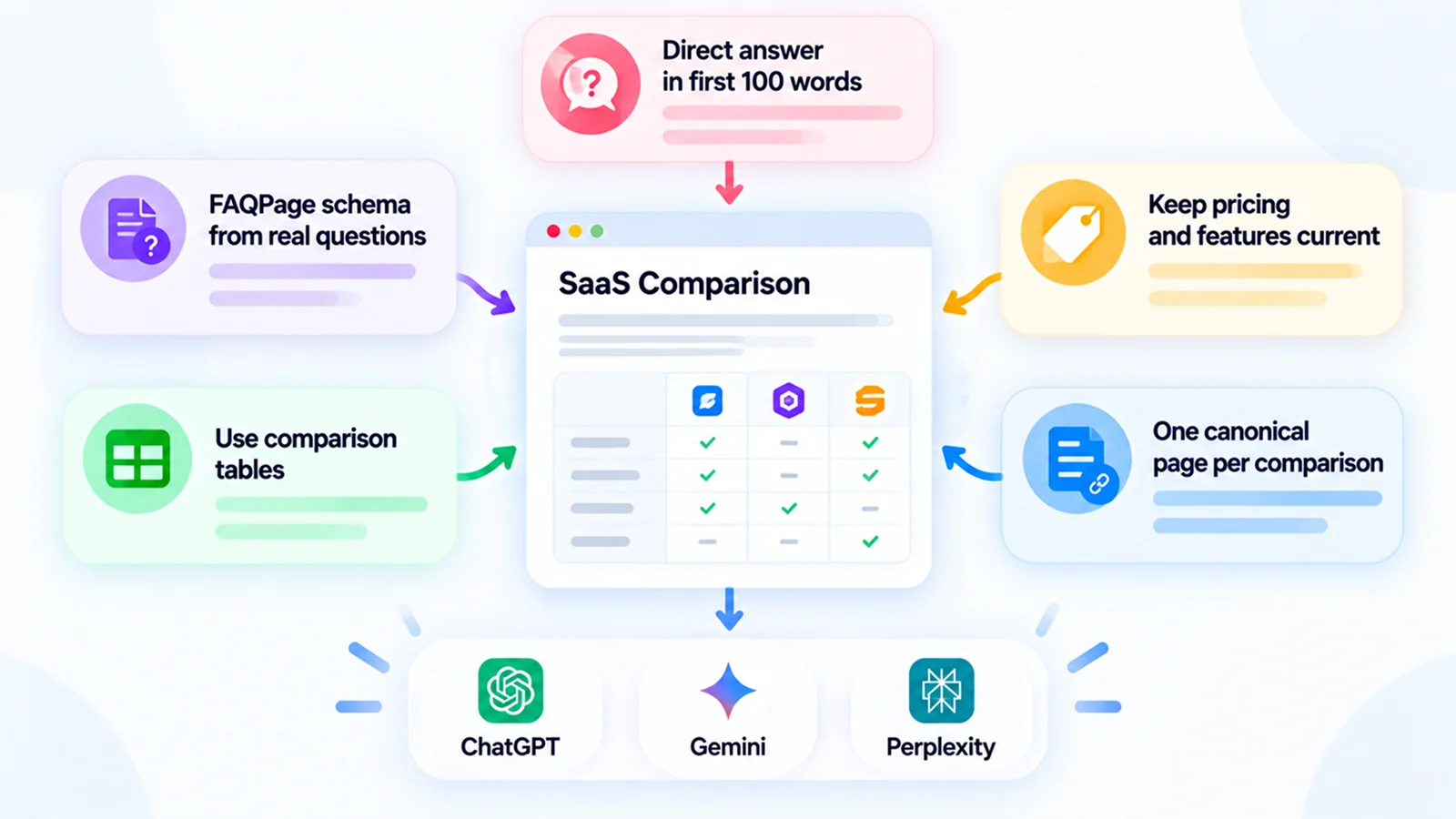
- Answer the exact question in the first 100 words. If the query is "X vs Y, which is better," lead with a direct answer, not three paragraphs of company background first.
- Add FAQPage schema built from real questions, the ones buyers actually type into ChatGPT or Perplexity, not generic FAQ filler.
- Structure the comparison as a table wherever possible. A table gives a model something to extract and quote directly instead of summarizing prose itself.
- Keep pricing, features, and integration details current. A page an AI engine already trusts can lose a citation the moment it reads an outdated number.
- Publish one canonical version per comparison. Multiple near-duplicate pages targeting the same query split the citation signal instead of reinforcing it.
None of this guarantees a citation on any single engine, since ChatGPT, Perplexity, and Gemini each weight fresh content, backlinks, and structure differently.
But a page built this way gives every engine something extractable to work with, which is the actual mechanism behind most AI citations, not luck.
Conclusion
The split among these 8 tools comes down to one question: do you want a monitor, or something that also fixes what it finds? Ahrefs, Peec, and Semrush tell you where you stand today; Botric, Profound, Writesonic, Scrunch, and AthenaHQ pair that same tracking with a way to close the gap, whether that's a drafted page, a content agent, or an optimization workflow.
Start with manual testing if you're pre-seed, move to a lean platform once you're past 15 to 20 tracked prompts a week, and pick a monitor-only tool only if you already have a content team ready to act on what it finds.
Most SaaS teams don't, which is why the tools that close the loop tend to be the better fit past the earliest stage.
- Solid Google rankings don't guarantee AI engines cite you, and the gap between the two shows up directly in lost demo requests.
- Spreadsheet tracking works for early-stage teams but falls apart past roughly 15 to 20 prompts across four engines weekly.
- The 8 tools here split into monitoring-first options (Ahrefs, Peec, Semrush) and platforms bundling content generation with workflow automation (Botric, Profound, Writesonic, Scrunch, AthenaHQ).
- No single engine tells the whole story: ChatGPT, Claude, Gemini, and Perplexity each cite differently, so coverage across all four beats depth on one.
- Most SaaS teams hit the real buy-vs-manual decision somewhere around Series A to B.
Run Botric's free AI visibility audit to see exactly which prompts your buyers are asking where your brand is missing, then check plan-by-plan pricing to size the right tier before you commit a budget line to it.
Frequently Asked Questions
Does GEO replace SEO?
No. SEO gets you a ranked URL, GEO gets your brand mentioned or cited inside the AI answer itself, and most SaaS teams need both running in parallel.
How much does this cost?
Entry tiers run from AthenaHQ's genuine free Essential tier, or Botric's 7-day free trial, up to around $49 to $99/month for lean plans like Botric's Byte tier or Ahrefs Custom Prompts. Mid-market tools such as Writesonic Basic or Peec AI Pro land between $99 and $495/month, and enterprise contracts go custom from there.
How do I track brand mentions across ChatGPT, Gemini, and Perplexity at once?
Say a prospect asks the same question in ChatGPT one day and Perplexity the next: if you're only watching one engine, you'll never know the other conversation happened. You need a tool built for multi-engine tracking rather than one watching a single model. Botric, AthenaHQ, Writesonic, and Scrunch all explicitly track ChatGPT, Gemini, and Perplexity together on their published plans, which closes exactly the gap a single-engine checker leaves open.
At what stage should a SaaS startup invest in this?
Pre-seed teams can usually wait and rely on manual checks. Series A tends to be the real inflection point, once you've got a dedicated marketer and enough prompt volume that spreadsheet tracking starts missing things.
What's the difference between a monitoring tool and a full GEO platform?
A monitoring tool like Ahrefs Custom Prompts tells you where you're cited today. A full platform like Botric, Profound, or Scrunch adds content generation or an optimization agent on top of that, helping you close the gaps monitoring surfaces.
Can user-generated reviews on G2 and Capterra actually affect AI citations?
They can. LLMs trained on public web data often pick up G2 and Capterra review volume as a trust signal, so a category with a large base of user-generated reviews tends to get named more consistently in comparison-style AI answers.
Which of these 8 tools is easiest to start with for a small team?
Botric's free trial or AthenaHQ's free Essential tier. Neither requires a sales call or an annual contract just to get a first read on your visibility.