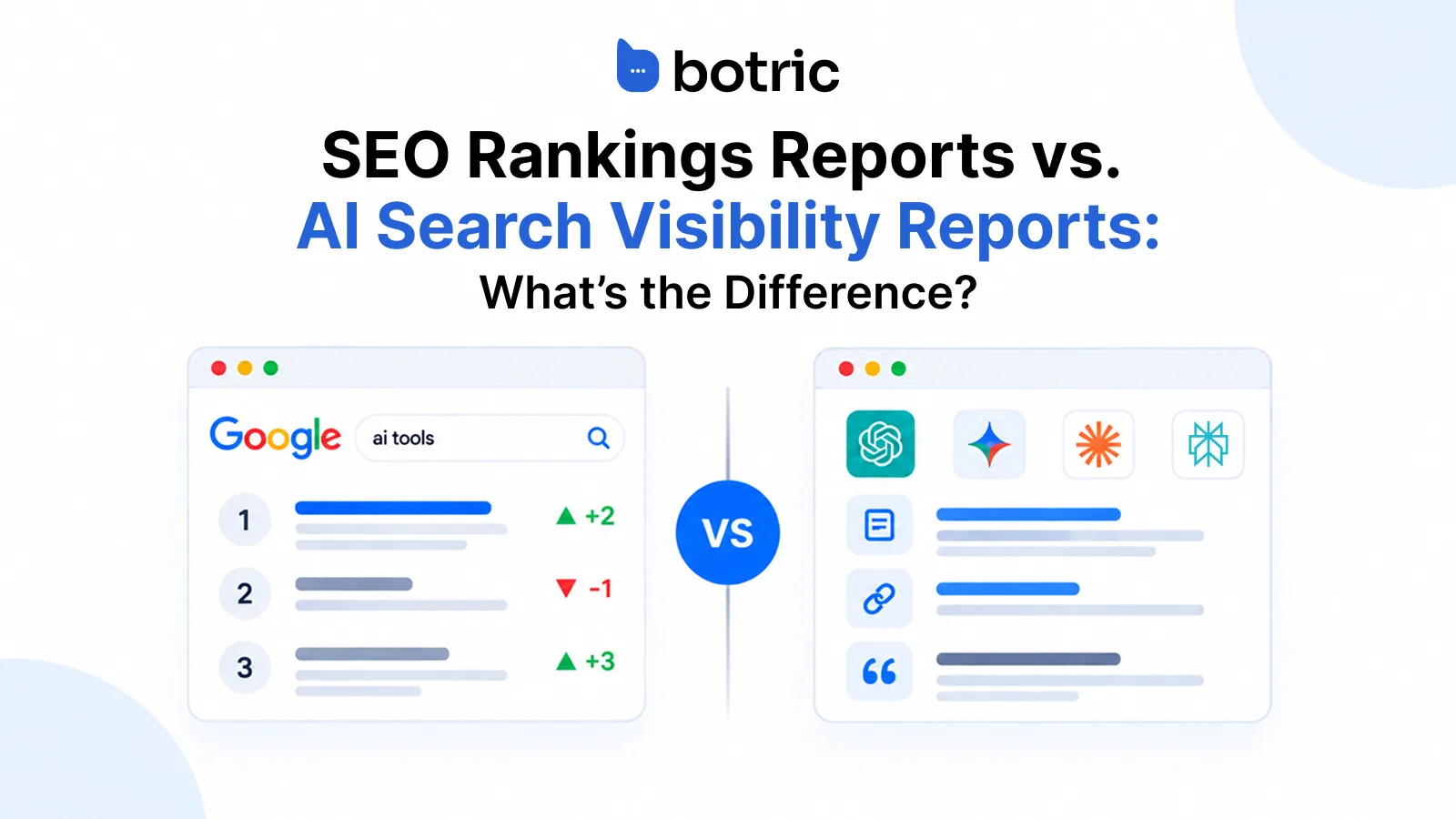
SEO ranking reports show how your website performs in traditional search, but they don't reveal whether your brand appears in AI-generated answers from ChatGPT, Perplexity, Gemini, or Claude.
In this guide, we'll compare SEO ranking reports vs. AI visibility reports, what each measures, and why tracking both gives you a more complete view of your search visibility.
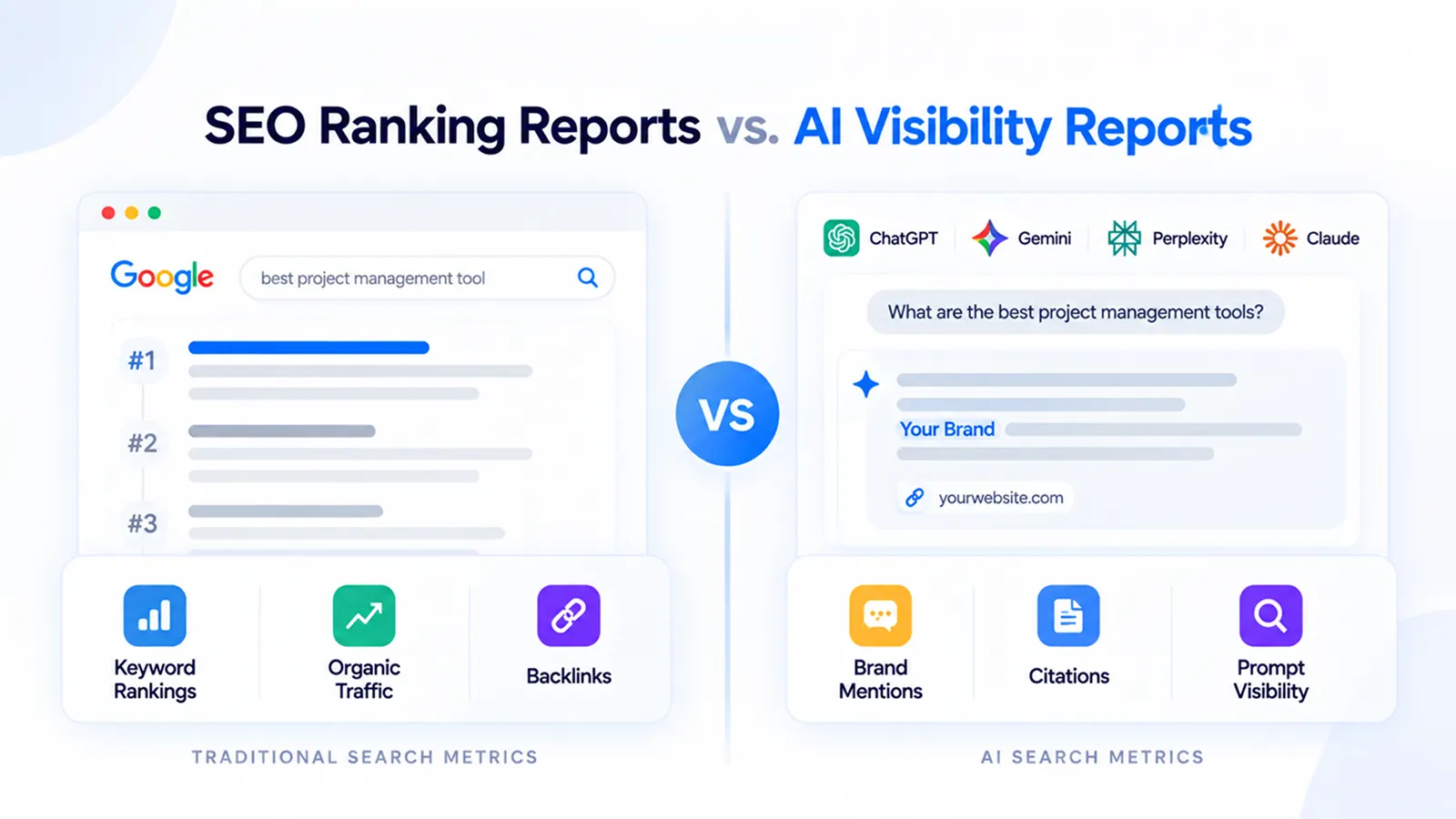
SEO ranking reports measure how your website performs in traditional search results, while AI visibility reports measure whether AI platforms mention, recommend, or cite your brand in their answers.
A complete search visibility dashboard should track:
- Keyword rankings: Where your pages rank for important queries in traditional search.
- Organic traffic: How many visits your website receives from search engines.
- AI citations: How often AI platforms cite your website or content as a source.
- Brand mentions: Whether your company or product appears in AI-generated responses, even without a direct citation.
- Prompt visibility: Which relevant questions and prompts cause AI engines to surface your brand.
- Competitor visibility: Which competitors are mentioned or cited when your brand is absent.
- AI platform coverage: How your visibility differs across ChatGPT, Perplexity, Gemini, Claude, and other AI search experiences.
- Visibility trends: Whether your share of AI mentions and citations is increasing or declining over time.
The key difference is what each report can see. SEO dashboards measure performance in traditional search, but they cannot show whether your brand is appearing in AI-generated answers.
That missing layer is what AI visibility reporting is designed to capture. As traditional search and AI-assisted discovery increasingly operate side by side, businesses need to measure both to understand where their brand is actually being discovered.
At Botric, we often see this gap during AI visibility audits: brands can perform well in traditional search while having little or no presence across major AI engines. Combining SEO ranking data with AI visibility reporting gives you a more complete picture of search visibility than either report provides on its own.
Why Your SEO Dashboard Misses AI Visibility
SEO ranking reports were built to read search engine results pages, not AI-generated answers. They track keyword positions, backlinks, traffic, and crawl data, but they don't monitor what ChatGPT, Gemini, or other AI engines generate.
Search engines crawl and index pages, then rank them based on relevance and authority signals. AI engines work differently. They retrieve information from different sources and combine it into a generated answer. Your website can be used or cited in that answer without the change showing up in your keyword rankings or backlink reports.
That creates a reporting blind spot. Your organic traffic might drop as more people get answers directly from AI, while your brand could actually be gaining mentions or citations inside those answers. Your SEO dashboard can see the traffic change, but it can't see the AI visibility behind it.
That's why AI visibility reporting adds a layer that traditional SEO ranking reports were never designed to capture. In Botric's AI visibility audit data, the average brand scored 6.5 out of 100 for AI visibility, showing how much brand activity can remain outside a traditional SEO dashboard.
How Do AI Visibility Reports Track Mentions and Citations?
AI visibility reports work differently from SEO ranking reports. Instead of tracking keyword positions, they monitor real questions people ask AI tools like ChatGPT, Gemini, and Perplexity.
The report checks whether your brand appears in the answer and, importantly, how it appears.
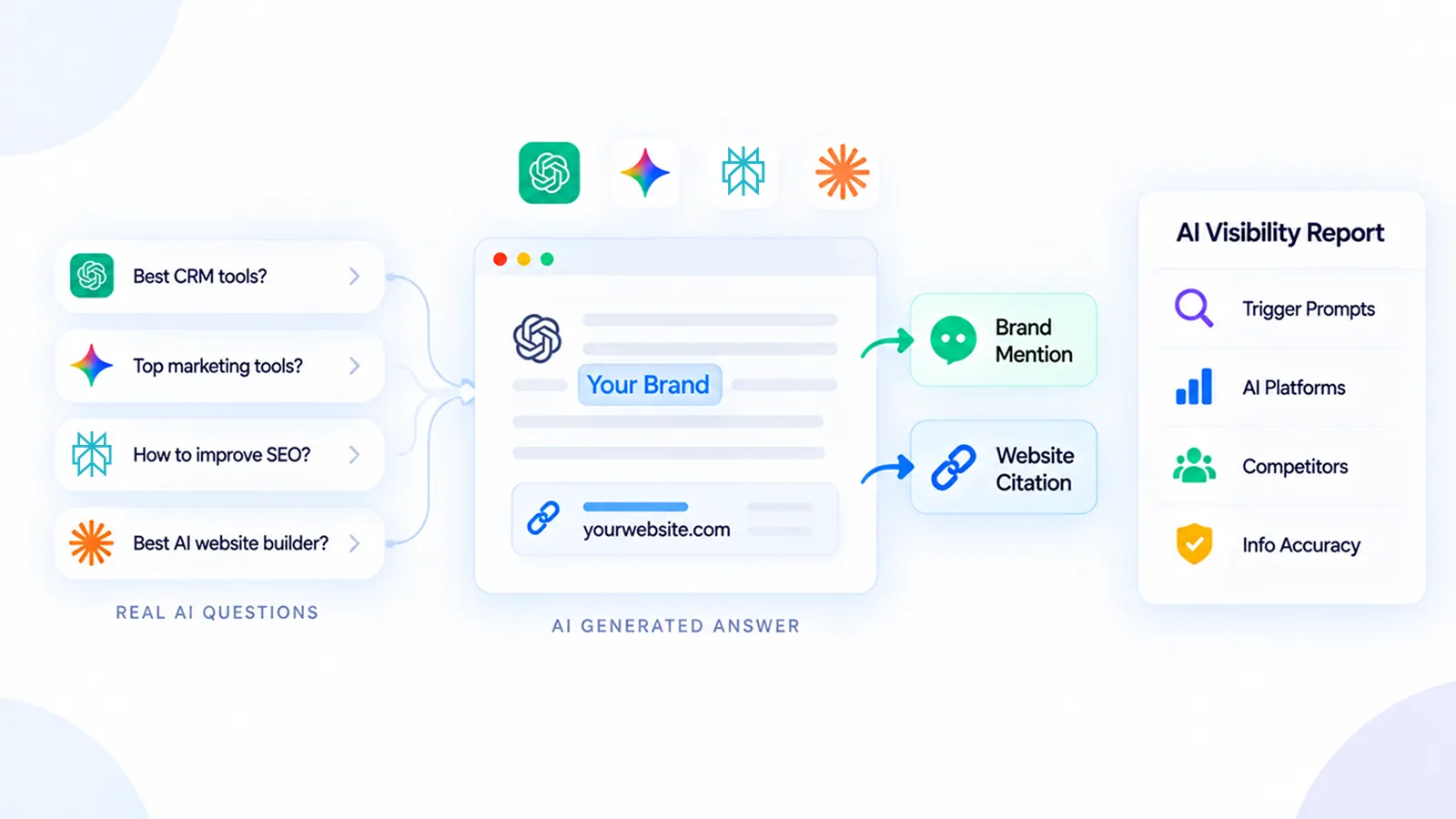
A mention means the AI names your brand. A citation means the AI actually uses or links to your website as a source. That distinction matters because being mentioned doesn't always mean your content influenced the answer.
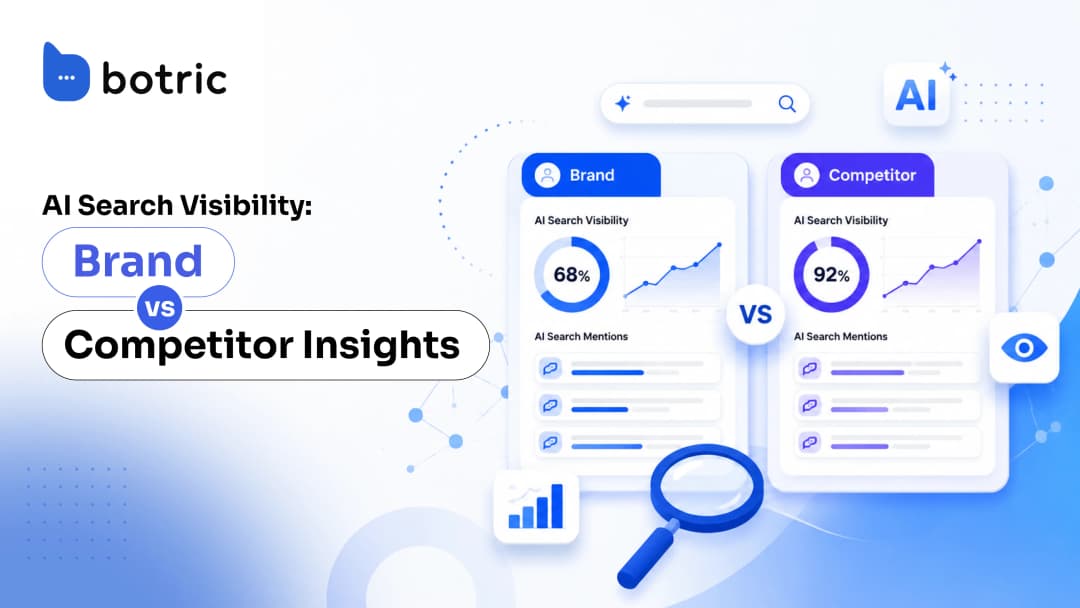
AI visibility reports can also show which prompts trigger your brand, which AI platforms mention or cite you, what competitors appear alongside you, and whether the information about your company is accurate.
This gives you a different view from traditional SEO. SEO ranking reports tell you your position in search results, while AI visibility reports tell you how often and where your brand appears inside AI-generated answers. If you want to compare platforms that provide this type of tracking, this guide covers some of the best tools for tracking and improving visibility in ChatGPT, Perplexity, and other AI search engines.
Which Metrics Should You Monitor Across Both Reports?
SEO ranking reports and AI search visibility reports measure different things, so it makes sense to track both. For traditional SEO, focus on keyword rankings, organic traffic, and backlinks. For AI search, pay attention to citation rate, source prominence, and whether AI platforms describe your brand accurately.
| Metric type | What it tracks | Why it's missing from a pure SEO dashboard |
|---|---|---|
| Keyword rank | Position on a Google results page | N/A (this is SEO's own metric) |
| Organic traffic | Sessions from search engines | N/A (this is SEO's own metric) |
| Citation rate | % of monitored prompts where your brand is cited | SEO tools don't query LLMs at all |
| Source prominence | Whether you're the primary cited source or a footnote | Requires reading AI-generated text, not a SERP |
| brand accuracy | Whether the AI's description of your brand is correct | No SEO equivalent exists |
SEO rankings and AI visibility tell you different things. A strong Google ranking doesn't necessarily mean your brand is being mentioned or cited in AI-generated answers. Tracking both helps you see where your brand is visible and where gaps exist. SEO reports show your traditional search performance, while AI visibility reports reveal how often your brand appears in AI search.
Backlinks and traditional authority still matter, but they don't tell you whether ChatGPT, Gemini, or other AI platforms are actually using your content. This guide on how to improve AI search visibility in 2026 covers ways to improve that side of your visibility.
Platforms such as Botric can also help bring traditional search and AI visibility signals together, so you can see more of the picture without manually comparing separate reports.
SEO Ranking Reports vs. AI Visibility Reports
The difference becomes clearer when you look at the tools available for each type of reporting. Traditional SEO platforms focus on rankings, traffic, keywords, and backlinks, while AI visibility tools focus on mentions, citations, and prompt-level visibility.
SEO Ranking Reports
Dashboards and platforms such as Semrush and Ahrefs track keyword position, organic traffic, and backlink growth inside traditional search engines.
Semrush's SEO plan tracks 500 keywords daily across 5 monitored websites and includes Position Tracking and Site Audit, according to Semrush's subscription documentation. Ahrefs' Starter plan runs on a credit system with a monthly credit allotment across tools including Keywords Explorer and Rank Tracker.
Both platforms have now expanded into AI visibility reporting. Semrush includes tools for tracking AI mentions, citations, prompts, and competitor visibility, while Ahrefs offers Brand Radar for monitoring brand mentions and citations across major AI platforms.
Their main strength remains the ability to combine established SEO data with newer AI visibility insights, giving teams a broader view of how their brand performs across traditional and AI search.
AI Visibility Reports
AI visibility reports are built specifically to track brand mentions and citations across AI answer engines like ChatGPT, Perplexity, Gemini, and Claude.
Botric is an AI visibility and content generation platform that tracks citations and acts on the gaps it finds. It offers a Free plan, with paid plans starting at $15/month and expanding to multi-platform AI visibility tracking across ChatGPT, Google AI Overview, Perplexity, Claude, and Gemini.
Botric combines AI visibility tracking with content generation and optimization, helping teams identify visibility gaps and create content designed to improve brand presence across AI search platforms.
Peec AI tracks brand visibility, mentions, citations, sentiment, share of voice, and position across major AI platforms. It also offers prompt tracking, competitor benchmarking, source analysis, and recommendations for improving AI visibility.
SE Ranking's AI visibility tools focus on tracking brand mentions, citations, sentiment, and competitor performance across AI-generated results, helping teams understand how their brand appears compared with competitors.
Their strength is prompt-level granularity. Instead of simply showing where a page ranks, these reports let you see exactly which buyer question triggered, or failed to trigger, a citation.
Dedicated AI visibility tools focus more deeply on mentions, citations, prompts, and brand presence in AI-generated answers, while traditional SEO platforms provide broader keyword, backlink, and organic search data.
| Criteria | SEO Ranking Reports | AI Visibility Reports |
|---|---|---|
| Best for | Tracking rankings, organic traffic, keywords, and backlinks | Tracking brand mentions, citations, and visibility in AI-generated answers |
| Standout capability | Deep keyword, traffic, and backlink data | Prompt-level mentions, citations, sentiment, and competitor visibility |
| Tools | Semrush, Ahrefs | Botric, Peec AI, SE Ranking, Semrush, Ahrefs |
| Pricing | Varies by platform and SEO plan | Varies by platform, number of prompts, domains, and AI engines tracked |
| Primary focus | Traditional search performance and organic visibility | Brand visibility and citations across AI-generated answers |
The main difference comes down to what you are trying to measure. SEO ranking reports answer, "Where does my website rank in traditional search?" AI visibility reports answer, "Does my brand appear, get mentioned, or get cited when people ask AI tools relevant questions?" Neither view replaces the other; they measure different parts of how people discover brands today.
Which Report Should You Use: SEO Rankings or AI Visibility?
The right report depends on what your business is trying to improve and where your buyers are searching. A brand launching a new product or competing for important Google keywords should focus on SEO ranking reports first. They help you see whether your pages are gaining or losing positions against competitors.
For a B2B software company where buyers increasingly ask ChatGPT or Perplexity to recommend and compare vendors, AI visibility reports should be tracked from the beginning. They show whether your brand is being mentioned or cited in those AI-generated answers.
Most established companies will need both. The key is to give more weight to the report that matches how your customers actually search.
| Buyer channel mix | Recommended primary tracking | Recommended cadence |
|---|---|---|
| Google-heavy (buyers mostly search directly) | SEO ranking reports as the lead metric set, AI visibility as a secondary check | Monthly AI visibility check, weekly SEO tracking |
| AI-heavy (buyers ask ChatGPT or Perplexity to shortlist) | AI visibility reports as the lead metric set, SEO maintained in parallel | Weekly AI visibility tracking, monthly SEO review |
| Mixed (buyers split across both paths) | Both dashboards weighted equally, cross-checked against each other monthly | Weekly for whichever channel is shifting faster that quarter |
Conclusion
SEO ranking reports and AI visibility reports measure different sides of modern search. SEO reports track rankings, traffic, and keywords, while AI visibility reports show whether your brand is mentioned or cited across ChatGPT, Perplexity, Gemini, Claude, and other AI platforms.
Tracking both gives you a clearer picture of how customers discover your brand. To take the next step, explore our guide to Top 4 LLM SEO Optimization Tools in 2026 to see which tools can help you improve and track visibility across AI search.
- SEO and AI visibility measure different things. SEO tracks rankings and traffic, while AI visibility tracks mentions and citations in AI answers.
- Ranking well on Google doesn't guarantee AI visibility. Your brand can perform well in search but still be missing from ChatGPT, Gemini, Claude, or Perplexity.
- AI visibility reports fill that reporting gap. They show which prompts mention your brand, where you're cited, and when competitors appear instead.
- You need both for the full picture. Together, SEO and AI visibility reports show how your brand is being discovered across traditional and AI search.
Want to see what your SEO reports might be missing? Run a free AI visibility audit with Botric to see whether your brand appears across ChatGPT, Claude, Gemini, and Perplexity. Then use the AI brand mentions tracker to see which prompts mention or cite your brand—and where competitors are showing up instead.
If you're ready to improve those results, explore the top LLM SEO optimization tools for 2026 to find the right tools for tracking and improving your AI search visibility.
Frequently Asked Questions
Can I use one tool instead of both?
No. SEO ranking reports measure Google's index, AI visibility reports measure LLM outputs, and one dataset can't stand in for the other.
Do AI visibility reports replace SEO rankings?
Not yet, and probably not for a while yet either. Search still drives real traffic for most businesses, so AI visibility supplements the SEO dashboard rather than replacing it outright.
What metrics should an AI visibility report track?
Key metrics include brand mentions, citation rate, prompt visibility, source prominence, competitor visibility, and brand accuracy.
How often should I check AI visibility metrics?
Weekly checks make sense in categories where buyers lean heavily on AI assistants. Monthly is often enough elsewhere, and the right cadence for you really tracks how often the underlying models get updated.
Which should I set up first, SEO or AI visibility tracking?
Say you've got nothing running yet: start with SEO, since it's foundational groundwork. But if competitors are already showing up in AI answers and you aren't, close that gap in parallel instead of waiting your turn.
Do AI visibility reports replace SEO ranking reports?
No. They measure different types of visibility. SEO reports cover traditional search, while AI visibility reports show how your brand appears across AI platforms.