
89% of B2B buyers now use AI tools like ChatGPT, Perplexity, and Claude to shortlist vendors, often making decisions directly within the AI interface without ever visiting your website. If your brand is not cited in those responses, you are invisible at the exact moment buyers are evaluating options. Unlike traditional search, there is no page two. AI gives one answer.
AI citation tracking is how B2B SaaS companies monitor their presence in AI-generated answers, measure where they stand versus competitors, and close the gaps costing them pipeline. AI-driven search traffic converts at 4.4x the rate of traditional organic search, this guide covers everything you need to capture it.
Before diving into tracking, make sure you understand the root causes of AI invisibility. Our guide on why your brand isn't showing up in AI search results covers the three main blockers most SaaS brands run into.
Key Metrics for AI Citation Performance
Tracking AI citations starts with knowing which metrics actually matter. Not all visibility signals are equal, some reflect reach, others reflect quality and commercial impact.
Citation Frequency
Citation frequency measures how often your brand is mentioned in AI responses for relevant queries. For top-performing B2B SaaS brands, the benchmark is 30% or higher across core queries, with industry leaders pushing beyond 50%.
To account for the non-deterministic nature of AI responses, test 50–100 prompt variations per topic cluster rather than relying on a single query.
AI Share of Voice (AI SOV)
AI SOV is your brand's share of total citations compared to competitors. Calculate it as:
(Your Brand Mentions ÷ Total Market Mentions) × 100
A strong target is an AI SOV that exceeds your traditional market share by 10–20%. If you hold 15% market share but appear in only 8% of AI responses in your category, you have a significant visibility gap worth closing.
Brand Visibility Score (BVS)
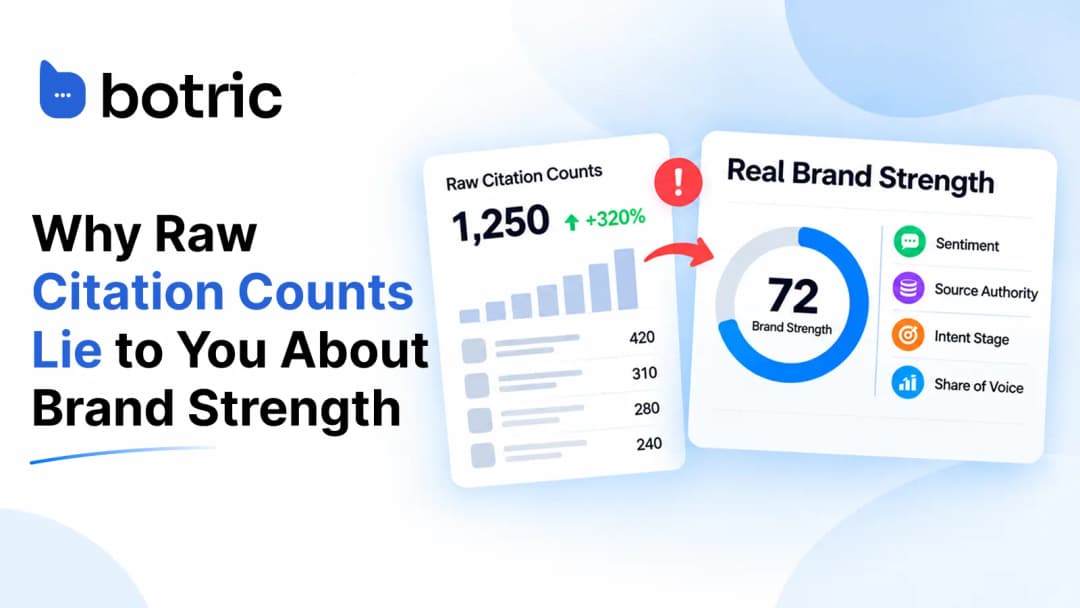
BVS is a composite score that factors in citation frequency, placement quality (lead mention vs. footnote), whether your URL is linked, and sentiment. Being mentioned first in an AI response consistently carries more weight than appearing later, AI systems tend to surface the most confident recommendation first.
Sentiment Analysis
This measures whether AI describes your brand positively, neutrally, or negatively. For B2B SaaS, maintaining at least 70% positive sentiment is important, negative sentiment reduces conversions even when citation frequency is high.
LLM Conversion Rate
This tracks how well visitors from AI platforms convert compared to traditional search traffic. Visitors referred by AI platforms convert at 4.4x the rate of standard organic search, with some analyses showing conversion rates as high as 7% versus 1% for traditional search. Tracking this metric separately in GA4 helps justify investment in GEO efforts.
- Citation Position, How often your brand appears in the top three recommendations
- Prompt Coverage, The percentage of your target queries that mention your brand at all
- Hallucination Rate, How often AI generates inaccurate information about your product (target: under 10%)
- Shadow Set Changes, New competitors or aggregators appearing alongside your brand that haven't shown up in traditional analytics
Benchmark Reference Table
| Metric | Target Benchmark | Tracking Frequency |
|---|---|---|
| Citation Frequency | 30%+ (50%+ for category leaders) | Weekly |
| AI Share of Voice | Traditional market share + 10–20% | Monthly |
| Positive Sentiment | 70%+ | Weekly |
| LLM Conversion Rate | 4.4x higher than traditional organic | Monthly |
| Hallucination Rate | Under 10% | Monthly |
How to Measure and Benchmark AI Citations
Building Your Prompt Library
Start by creating a prompt library of 30–50 queries that reflect how your buyers actually search. Segment them into three categories:
- Top-of-Funnel, Category discovery queries like "best [category] tools for [use case]"
- Middle-of-Funnel, Comparison queries like "[Your Brand] vs [Competitor]"
- Bottom-of-Funnel, Problem-specific queries like "how to [specific pain point] for B2B SaaS"
This segmentation helps you identify where you are visible and where you are losing buyers earlier in the decision process.
Running Standardized Tests
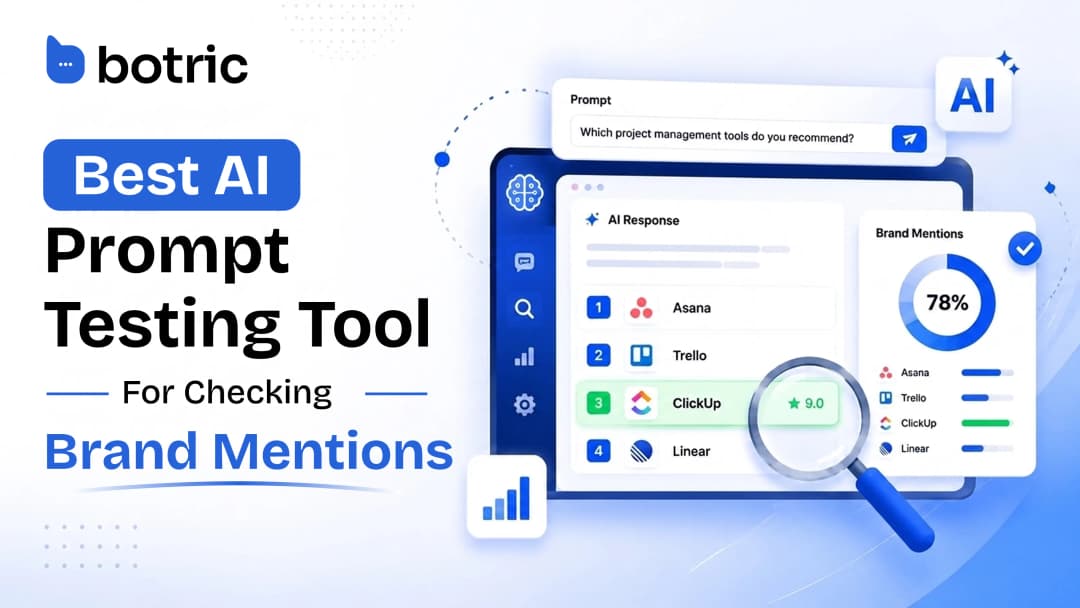
Run your prompt library across each target platform, ChatGPT, Perplexity, Google AI Overviews, Claude, and Gemini, in incognito mode with chat history cleared. AI systems often personalize responses based on prior conversations, so this step ensures you are seeing what a new visitor would see.
Because AI responses are non-deterministic, test multiple samples per query and average the results. A single test is not reliable; a baseline built from 50–100 samples per topic cluster is.
Set up a GA4 custom channel grouping for AI-driven traffic. Navigate to Reports → Acquisition → Traffic Acquisition, then filter by session source for domains like chatgpt.com, perplexity.ai, and claude.ai. These are frequently misclassified as "direct" traffic, which means you are likely underreporting how much AI search already contributes to your pipeline.
Tracking Cadence
For competitive markets, track citation metrics weekly. In more stable categories, monthly is sufficient. The recommended cadence:
- Weekly, Run your core 20–30 queries, log citation frequency and sentiment, monitor competitor shadow set for new entrants
- Monthly, Assess AI SOV trends, review hallucination rate, update content based on citation gaps, evaluate LLM conversion data from GA4
Setting Up AI Citation Tracking: Step-by-Step
Step 1, Define Your Brand Entities
Start by documenting every term AI systems should associate with your brand:
- Primary brand name and all common variations
- Product names and versions
- Key executive names (CEO, founders)
- Common acronyms and abbreviations
- Subsidiary names or related brands
- Industry-specific terms you want to own
Without this list, you will miss mentions that use slightly different naming and your citation count will be understated.
Step 2, Build Your Prompt Library
Create 30–50 queries organized by funnel stage, as described above. Include discovery questions ("best [category]"), comparison queries ("[Brand] vs [Competitor]"), pricing searches, and troubleshooting scenarios. This library becomes your recurring test set.
Step 3, Run a Baseline Audit
Before making any optimizations, establish where you currently stand. Run your full prompt library across all target platforms, log citation frequency, placement position, sentiment, and which third-party sources are being cited. This baseline is what you will measure progress against.
Step 4, Implement Continuous Monitoring
Adopt the weekly and monthly tracking cadence described above. For critical updates, pricing changes, feature deprecations, compliance information, aim to correct inaccuracies in your source content within 48–72 hours of identifying them. AI systems prioritize recently updated content, and outdated material can generate hallucinations that damage brand credibility.
Keep a "citation gap log", a running list of prompts where competitors are cited but your brand is not. Prioritize closing bottom-of-funnel gaps first, as those queries represent buyers closest to making a purchase decision. Create targeted content for each gap and retest after 6–8 weeks.
Advanced Strategies for AI Citation Optimization
Schema Markup and E-E-A-T Signals
Structured data is one of the highest-leverage changes a B2B SaaS company can make for AI citation. Schema markup turns plain-text content into machine-readable labels that AI systems can extract and cite with confidence. 81% of pages cited by AI use schema markup, and implementing it properly boosts citation likelihood by 30–36%.
Use JSON-LD format, it keeps structured data separate from your HTML, making it easier for AI systems to parse without interfering with page rendering.
- FAQPage schema, Pages with this schema are 3.2x more likely to appear in AI Overviews. Keep individual answers between 40–60 words for optimal AI extraction.
- SoftwareApplication schema, Add to product pages with
applicationCategory,operatingSystem, andoffersattributes. Helps AI recommend your software for specific buyer intents. - Organization schema, Establishes your company's identity, founding details, and key contacts. Goes on your homepage and About page.
- DefinedTerm schema, Useful for specialized terminology unique to your product. Helps AI accurately describe your offering in technical or industry-specific queries.
One critical rule: verify all schema with Google's Rich Results Test, schema properties must match your visible page content exactly, or trust penalties will reduce citation likelihood.
"Schema markup has evolved from a search enhancement tool into your primary interface with artificial intelligence.", Zach Chmael, CMO, Averi
Optimizing High-Value Pages for Citability
With structured data in place, the next step is page-level content optimization. The goal is to make it as easy as possible for AI to extract the right answer from the right page.
Direct answer format, Place concise definitions or key answers at the very top of each page section, before supporting context. AI systems extract the clearest, most direct statement, not a summary of the full page. If your answer is buried in paragraph three, a competitor whose answer leads the section will be cited instead.
Scannable structure, Break large topics into clearly defined H2 and H3 subsections. Use bullet points, numbered lists, and comparison tables. Structured content improves AI extraction accuracy by 47% over prose-heavy pages.
Content length, For category and comparison pages, target 1,000–2,000 words. For documentation, prioritize completeness over length. Add a prominent "Last Updated" date and include dateModified in your schema, over 76% of ChatGPT citations come from content updated within the last 30 days.
High-impact page types for B2B SaaS:
- Comparison pages, Include a clean decision matrix and an honest "when our product is not the right fit" section. These transparent elements are frequently quoted by AI because they signal objectivity.
- API documentation, Go beyond parameter lists. Add context explaining why each parameter matters, common use cases, and inline code comments. Technical buyers research via AI too, and well-documented APIs drive high-quality citations.
- Integration guides, Specific, step-by-step integration content answers the precise questions buyers ask AI tools during evaluation. These pages punch well above their weight in citation frequency.
"In Google's AI Mode, half of all citations come from sources that don't rank on the first page of traditional search. Structural optimization can help you get cited even when your rankings aren't at the top.", Leigh McKenzie, Head of SEO, Backlinko
For a full breakdown of the technical and content changes that improve AI visibility, see our guide on why your website isn't appearing in AI search and how to fix it.
How Botric Supports AI Citation Tracking
Core Features
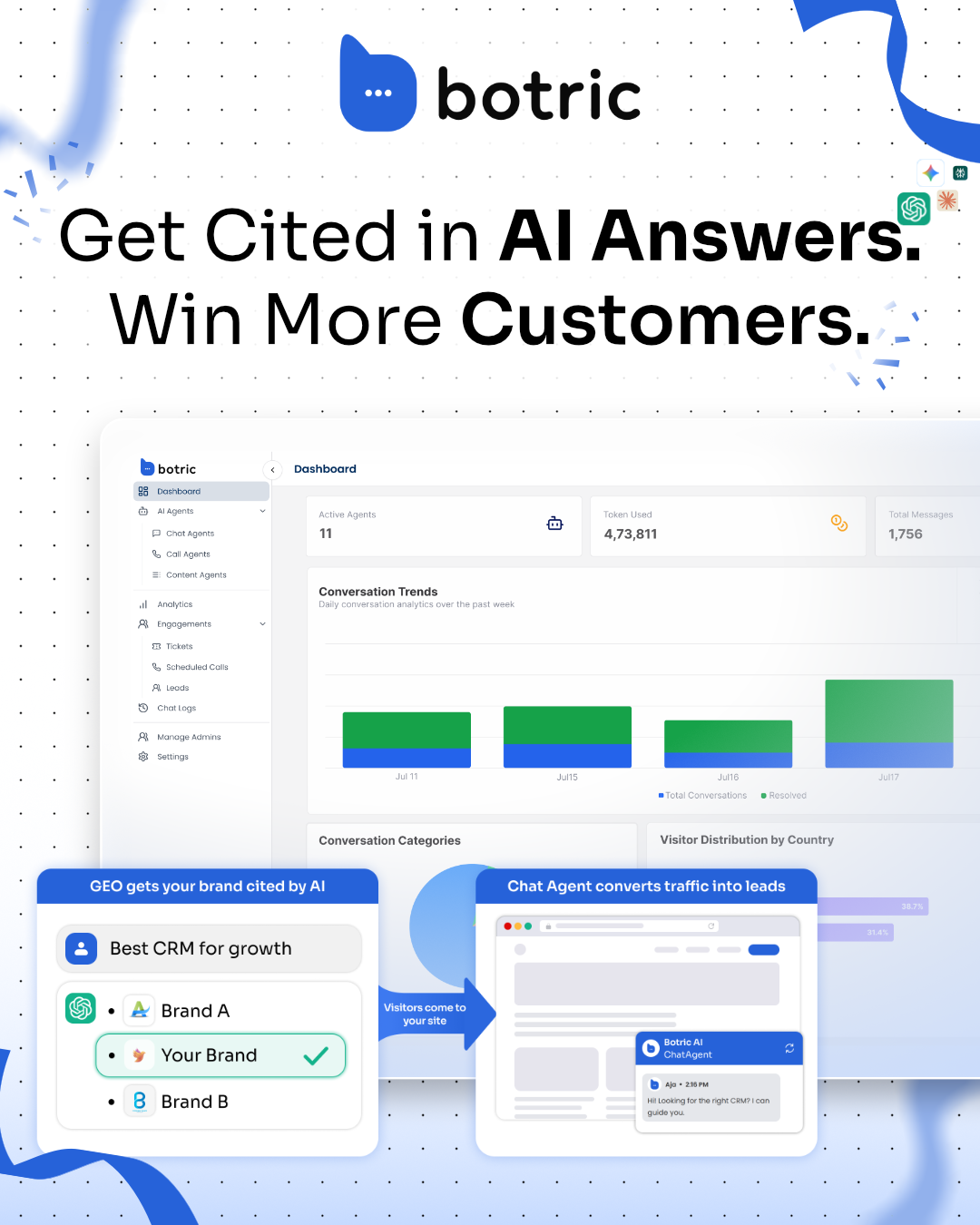
Botric is built specifically for the tracking and optimization workflow described in this guide. Rather than manually running queries across six platforms and logging results in a spreadsheet, Botric centralizes this into a real-time dashboard with daily updates.
AI Visibility Audit, Evaluates how ChatGPT, Gemini, Perplexity, Claude, Google AI Overviews, and Google AI Mode currently recognize your brand. Identifies the specific reasons you are absent from responses and highlights where competitors are gaining citations instead. Companies using this feature report an average visibility increase of 40% after implementing recommendations.
Competitor Benchmarking, Tracks your AI Share of Voice in real time, showing which competitors appear in AI-generated responses for your target queries and which third-party domains are driving their citations. This is the data you need to close the Source Gap.
GEO Optimization Tools, Suggests targeted content improvements, metadata changes, and schema additions to increase citation potential based on actual AI behavior in your category.
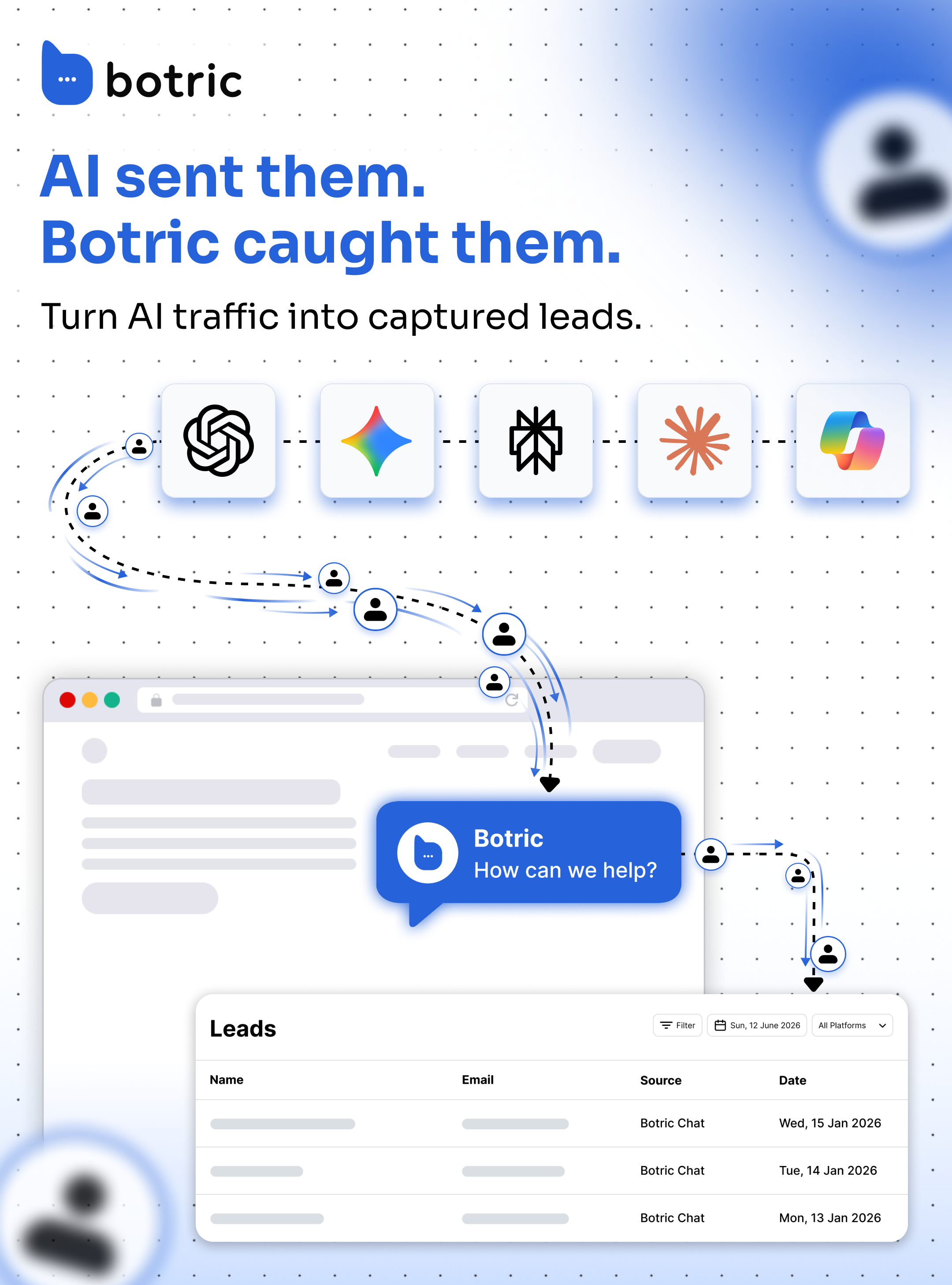
AI Chat Agents, Once citations start driving traffic, Botric's brand-trained chat agents engage visitors immediately in your brand's voice. They handle inquiries, surface buying intent, and route opportunities to your sales team, with a 94% resolution rate and average response time of 2.4 seconds.
"GEO has improved how our brand appears across AI-generated answers, helping us reach users we previously missed through traditional SEO. Combined with automated chat, inbound conversations are now easier to manage and more relevant overall.", Jason Turner, CEO, Digibution Network
Most B2B SaaS companies see their first new citations within 2–4 weeks of implementing Botric's recommendations. Enterprise onboarding, including the AI audit, agent training, and GEO implementation, typically takes about two weeks.
For a broader comparison of AI visibility tools, see our roundup of the best GEO tools available today and the best tools to rank in ChatGPT and AI search engines.
Botric Pricing Plans
| Plan | Price | Key Features |
|---|---|---|
| Free | $0/month | 1 SEO & GEO run (one-time), basic visibility audit, 250 messages/month |
| Bit | $12.5/month (billed annually) | 1 SEO & GEO run/week, citation tracking, 1,500 messages/month |
| Byte | $45/month (billed annually) | 2 SEO & GEO runs/week, unlimited messages, 90-day history |
| Infinity | $136/month (billed annually) | 3 SEO & GEO runs/week, 5 workspaces, 120-day history |
| Enterprise | Custom pricing | Full AI visibility strategy, GEO optimization, dedicated strategist, weekly reporting, CRM integration |
What to Expect and When
Setting realistic expectations helps teams maintain the discipline that AI citation tracking requires.
- Weeks 1–2, Baseline audit complete, schema markup deployed, prompt library established
- Weeks 3–6, First new citations begin appearing as AI systems recrawl updated content
- Month 2–3, Citation gaps identified and addressed; branded search volume often increases 15–30% as a side effect of improved AI visibility
- Month 4–6, Visibility typically increases 3–5x for companies following a consistent weekly monitoring and optimization routine
"AI visibility is not a project. It's a monitoring discipline. The companies that treat it as 'build and forget' will lose ground to the ones that watch, measure, and respond.", Sebastian Mueller, Co-Founder, Ming Labs
The compounding effect is real: improving AI citations increases branded search volume, which strengthens traditional SEO, which feeds more external citations. The brands that start building this foundation now will be significantly harder to displace 12 months from now.
Conclusion
AI citation tracking is not an advanced strategy reserved for enterprise marketing teams, it is a foundational capability for any B2B SaaS company that wants to be visible to buyers in 2026 and beyond. With AI search expected to overtake traditional search by 2028, and platforms like ChatGPT and Perplexity already driving high-converting traffic, the cost of ignoring this channel is measured in real pipeline.
The framework is straightforward: define your brand entities, build a prompt library, establish a baseline, fix your technical blockers, build external citations, and track weekly. Tools like Botric compress this workflow into something a single marketing hire can manage alongside other responsibilities.
Start with a baseline audit this week, everything else follows from that data.
For related reading, explore how Generative Engine Optimization works for businesses, understand why your brand may not be appearing in AI search, or review the best GEO tools available in 2026 to build the right stack for your team.
Key Takeaways
- Citation frequency, share of voice, sentiment, and conversion rate are the four metrics worth tracking.
- Test 50-100 prompt variations per topic, because AI answers change between runs.
- Run a baseline audit first, then monitor on a fixed weekly or monthly cadence.
- Schema markup and strong E-E-A-T signals make your pages easier for AI to cite.
- Expect citation gains over weeks, not days.
Frequently Asked Questions
What is the difference between an AI mention and an AI citation?
An AI mention is when a brand name appears in an AI-generated response, the AI acknowledges the brand's existence or relevance. An AI citation goes further: it directly references or links to your brand's content, positioning you as an authoritative source and sending direct traffic to your site. Mentions build awareness; citations build credibility and drive measurable visits. Both matter, but citation tracking specifically focuses on the latter because citations carry significantly more commercial value.
How do I track AI-driven traffic correctly in GA4?
Set up a custom exploration report using "Page referrer" and "Page title" as dimensions, then apply a regex filter that identifies AI referrers like chatgpt.com, perplexity.ai, claude.ai, and gemini.google.com. These are frequently bucketed as "direct" traffic by default, which means most teams are underreporting AI-driven visits. You can also create a dedicated channel group in GA4 to isolate and analyze this traffic segment independently from organic and direct channels.
What should I optimize first to start getting cited by AI?
Start with schema markup and entity data, Organization schema on your homepage, FAQ schema on your product and documentation pages. These changes make it structurally easier for AI systems to identify and describe your brand accurately. After that, address any robots.txt rules that block AI crawlers. Once those technical foundations are in place, focus on building external citations from platforms like G2, Capterra, and Reddit, where AI systems frequently pull from when forming category recommendations. Expect to see initial citations 6–8 weeks after implementing these changes.
How often should I update my content for AI visibility?
Update your highest-value pages every 90 days at minimum. Over 76% of ChatGPT citations reference content updated within the past 30 days, so freshness is a meaningful signal. Display a visible "Last Updated" date on key pages and include dateModified in your schema. For time-sensitive information, pricing, product features, compliance details, update within 48–72 hours of any change. Outdated content does not just underperform; it can generate AI hallucinations that create inaccurate brand impressions.
How is AI citation tracking different from traditional SEO monitoring?
Traditional SEO tracks keyword rankings, organic traffic, and backlinks, signals that reflect performance in search result pages. AI citation tracking monitors something different: how often your brand is mentioned or cited in AI-generated answers, your share of voice relative to competitors, sentiment in those mentions, and conversion rates from AI-referred visitors. There is very little correlation between the two. A brand with strong Google rankings may be almost entirely absent from AI responses, and vice versa. Both channels need dedicated monitoring strategies.