Marketing agencies need more from an AI visibility platform than a single brand dashboard. When you're managing several clients, you need to separate projects, track prompts across multiple AI engines, produce client-ready reports, and turn visibility gaps into work your team can actually execute.
This guide compares 12 AI visibility and GEO tools for agencies in 2026, including Botric, Cognizo, Profound, AIclicks, Otterly AI, Brandlight, AthenaHQ, Scrunch AI, Peec AI, Ranketta, Semrush AI Visibility Toolkit, and Writesonic GEO.
Twelve tools claim to help agencies with AI visibility, but only three publish pricing actually built around running multiple clients. Here's how the other nine fit in, grouped by what they actually are rather than a flat list of twelve near-identical lines.
- Built agency-first: Botric, Peec AI, Scrunch AI. All of them structured their pricing around per-project or per-workspace client separation from day one, rather than adding it later.
- Tracking plus content in one workflow: Botric, Cognizo, Profound, Writesonic GEO. All four pair visibility tracking with some form of content generation, so a gap it finds can turn into a drafted fix without a second tool. Botric leads this group and this list, tracking ChatGPT, Google AI Overview, Perplexity, Claude, and Gemini in one plan.
- Single-brand trackers with an agency tier bolted on: Otterly AI, AIclicks, Semrush AI Visibility Toolkit, AthenaHQ, Brandlight. All five started, or still function, as single-brand monitoring tools, with agency-facing features layered on afterward: a partner program, a higher tier, or a paid add-on, rather than built into the core product.
- Built for one vertical: Ranketta. Tracks product-level AI recommendations for ecommerce catalogs specifically, not general brand mentions, making it the one tool here that fits only a retail-heavy client roster.
Why single-brand tools fail agencies (and what to demand instead)
Many trackers or visibility tools were designed around one company's data, one login, one report format, and none of that scales to a full client roster.
AI visibility, in plain terms, is how often and how favorably a brand turns up in the citations and mentions that answer engines like ChatGPT, Gemini, and Perplexity actually generate. Bolt a "client" dropdown onto a tool built for a single brand, and five specific things tend to break.
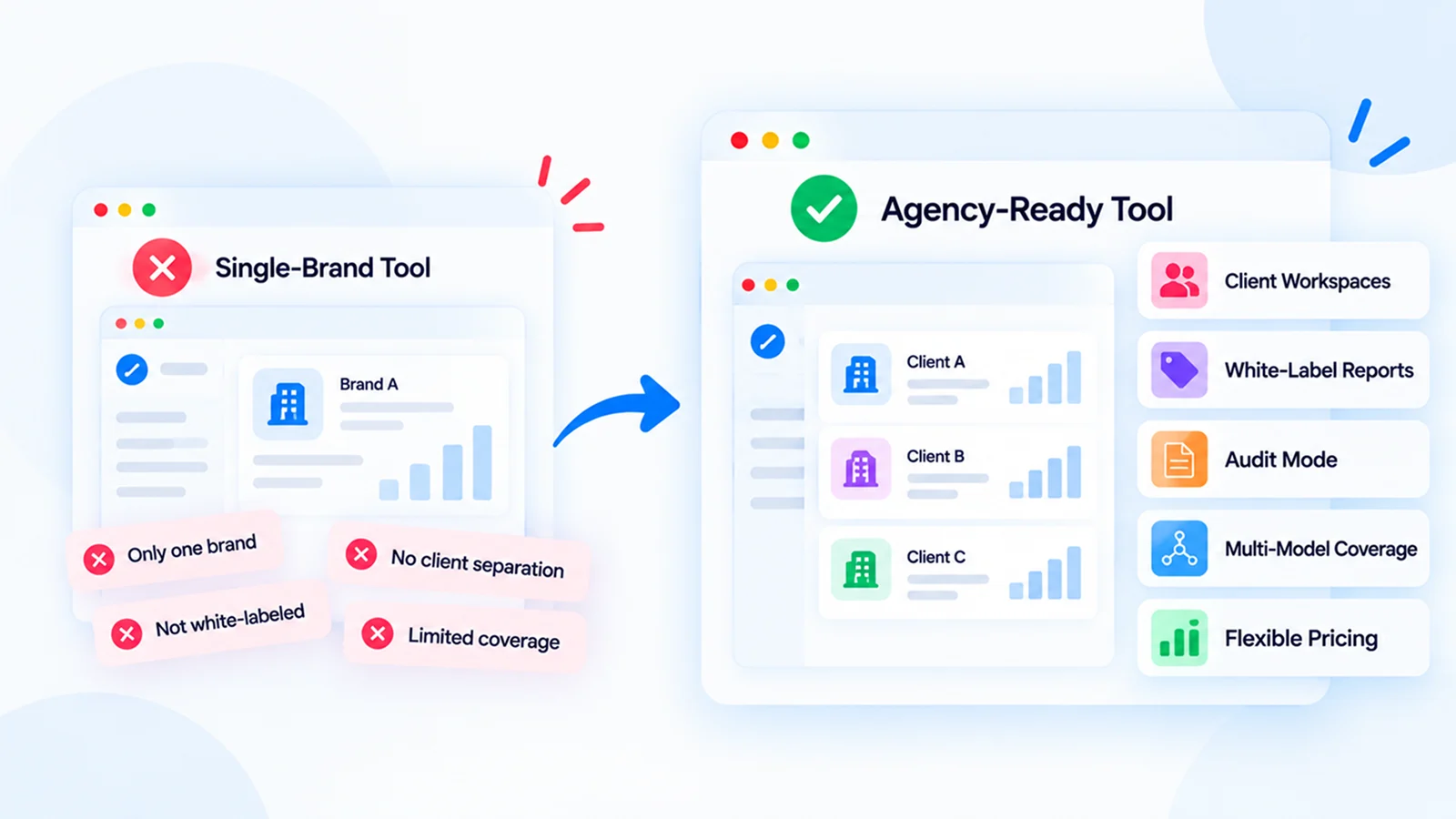
The five non-negotiables
Before you sign a contract, an agency-grade tool needs to clear all five of these:
- Per-client workspaces with no data mixing. Client A's prompts, competitors, and content recommendations should never bleed into Client B's dashboard, even by accident. Agencies often start this search by typing in white label SEO tools, only to find most of that category was never built for GEO at all.
- White-label reporting. Your logo, your color scheme, no vendor name in the PDF footer.
- A pitch or audit mode. Something you can run on a prospect's domain before they sign, showing their AI visibility gap in real numbers.
- Multi-model coverage. ChatGPT alone tells you almost nothing anymore, so you need Gemini, Perplexity, Copilot, and increasingly Claude and Grok in the same dashboard.
- Per-client or per-seat pricing that scales. A flat single-brand price that assumes one domain breaks your unit economics the moment you add client number three.
Miss any of these and the cost shows up in your billable hours, not on the invoice. Botric's Infinity plan is one of the few here that publishes its workspace count (5) directly on the pricing page rather than behind a sales call, which is the transparency this checklist is asking for.
The 12 AI visibility tools agencies should know
A handful of these 12 were designed for agencies from day one. Others are strong single-brand platforms that added an agency-facing tier later. Here's each one, honestly.
Side-by-side comparison: workspaces and pricing
Botric is the only tool here that couples workspace pricing with content generation in the same plan, since that's a real differentiator visible in the table itself.
| Tool | Best for | Standout feature | Per-client workspaces | Billing model | Price tier |
|---|---|---|---|---|---|
| Botric | Tracking, GEO analysis, and content optimization in one workflow | Content Agent drafts articles & pages directly from tracked gaps | 5 workspaces max (Infinity) | Per-tier | Free to $149/mo, custom Enterprise |
| Peec AI | AI search analytics with client-level project management | Prompt discovery surfaces prompts you haven't thought to track | Yes, per project | Per-project | $95–$495/mo |
| Scrunch AI | Audit depth alongside visibility for a single flagship client | AXP serves an AI-optimized version of your site to crawlers | 1 (Starter), custom (Enterprise) | Per-workspace | $250–$417/mo billed annually |
| Ranketta | Agencies whose book of business skews retail or ecommerce | SKU-level tracking of which products AI recommends or skips | Multi-site by tier | Per-site/model | €29–€449/mo |
| Cognizo | Visibility monitoring connected directly to content production | Content Studio + auto-publishing in one closed loop | Custom (Enterprise only) | Per-platform tier | $499–$999/mo, custom Enterprise |
| Profound | Enterprise-oriented AI search intelligence covering research and content | Agents: ready-made templates that research, write, and publish | Not confirmed | Not published | Not published |
| AIclicks | Starting cheap, then scaling into agency resale | Business tier unlocks unlimited websites and white-label client access | 1 website (Starter) | Per-website tier | $59–$499/mo self-serve; agency pricing custom by client volume |
| Otterly AI | Agencies rotating account managers, unlimited seats on every tier | Share of AI Voice and Net Sentiment Score as client-reportable numbers | 1 to unlimited by tier | Per-prompt tier | $29–$489/mo |
| Brandlight | Agencies willing to go sales-led for an enterprise-pitched platform | Partnership dashboard tied to GA4 and CRM attribution | Not confirmed | Not published | Not published |
| AthenaHQ | Claim-level citation accuracy checks, once on Enterprise | Athena Citation Engine drafts fixes autonomously | Custom (Enterprise) | Credits-based | Free–$295/mo, custom Enterprise |
| Semrush AI Visibility Toolkit | Teams already inside Semrush wanting a white-labeled add-on | Pro Report add-on adds white-labeling for $20/month | Per-domain | Per-domain | $99/mo per domain + add-ons |
| Writesonic GEO | Bulk AI-targeted content generation, paired with a separate tracker | Query fan-out tracking shows which sub-queries mention your brand | Not confirmed | Per-tier, plus a separate agency track | $99–$499/mo self-serve; Agency Starter $200/mo, Agency Enterprise custom |
1. Botric
Botric combines AI visibility monitoring with GEO optimization. It tracks how brands appear across ChatGPT, Google AI Overviews, Perplexity, Claude, and Gemini, then connects visibility gaps to GEO audits, content opportunities, and content generation.
Key features
- AI Visibility Score (0–100): rolls up mention, citation, position, and sentiment signals into one number you can trend over time.
- Prompt tracking: Track defined prompts and monitor how visibility changes over time.
- Citation tracking: Shows which sources and pages AI engines cite and where competitors are cited instead.
- Prompt Playground: Test prompts and see how different AI engines respond about the brand.
- Site & GEO Audit: Checks technical and content factors affecting AI discoverability, including crawlability, schema, and entity signals.
- Content Gap Analysis: Identifies prompts and topics where competitors are visible but the brand is missing.
- Content Agent: Turns content gaps into articles, pages, and FAQs.
- Multi-brand workspaces: Infinity supports 5 workspaces and 5 sites, while Enterprise adds custom multi-brand support.
Genuine strengths
- Infinity supports up to 5 workspaces, sites, and admin seats.
- Visibility tracking and optimization workflows are available in the same platform.
- Content and GEO workflows can be used to act on gaps identified through visibility tracking.
- Public pricing makes the workspace and usage limits easy to compare before contacting sales.
Honest limitations
- Public self-serve plans currently top out at 5 workspaces.
- Agencies with larger client rosters need the custom Enterprise plan.
Pricing
Bit starts at $15/month. Byte is $49/month, while Infinity is $149/month and supports up to 5 workspaces and 5 sites.
2. Peec AI
Peec is primarily an AI search analytics platform, with a particularly strong agency workflow. Its agency plans are built around multiple client projects, prompt tracking, reporting, and data access.
Key features
- Prompt discovery: surfaces prompts you haven't thought to track yet, based on your brand context and competitor coverage.
- Citation analysis: shows which sources AI answers actually draw from, not just whether you were named.
- Gap analysis + recommended actions: flags where you're losing and suggests a next step, short of full content generation.
- Per-project structuring: each client sits in its own project, the mechanism behind its agency pricing tier.
- SSO on higher tiers, useful once more than one person at an agency needs access.
Genuine strengths
- Dedicated agency pricing rather than simply adding an agency label to a brand plan.
- Good fit for agencies that need to report on multiple client projects separately.
Honest limitations
- Its core strength is measurement and analysis rather than a full content execution workflow.
- Higher-scale agencies need the higher agency tiers or custom plans.
Pricing
Starter is $95/month for 50 prompts across 3 models, one project; Advanced is $495/month for 350 prompts and 5 projects.
3. Scrunch AI
Scrunch is broader than a conventional AI visibility tracker. Its platform covers monitoring, insights, site auditing, AI traffic analysis, and its Agent Experience Platform (AXP), which serves an AI-optimized version of site content to AI retrieval agents.
Key features
- Prompt monitoring: Track brand presence across prompts, topics, and entities.
- AI visibility: Monitor brand presence, position, sentiment, citations, and share of voice.
- Competitive benchmarking: Compare performance by competitor, persona, topic, and geography.
- Site Maps: a visual, page-by-page view of your site scored by Audit Score, Agent Traffic, and Citations, so you can see exactly which pages are underperforming.
- Page Diagnostics: shows which AI crawlers can actually access a given page, separate from whether it's cited.
- AXP (Agent Experience Platform): serves a structured, AI-optimized version of your site to crawlers while your human-facing site stays untouched, a layer none of the other 11 tools here offer.
- Competitive benchmarking by persona, topic, and geography, not just by competitor name.
Genuine strengths
- Goes well beyond simple prompt tracking into technical AI-crawler access.
- Strong fit for technically complex or JavaScript-heavy sites.
Honest limitations
- AXP is a separate product from the core Monitoring & Insights product.
- Entry tier is limited to one brand workspace.
Pricing
Scrunch's entry tier, Starter, is $250/month billed annually ($300 month-to-month) and includes 5 page audits, 1 brand workspace, and 3 user licenses. Growth is $417/month billed annually ($500 month-to-month) with 5 user licenses; Enterprise is custom. Agencies can apply to Scrunch's Agency Partner Program for separate agency pricing.
4. Ranketta
Ranketta is significantly more specialized than the other tools. It focuses on product-level AI visibility, merchandising, catalog optimization, and AI shopping rather than simply measuring brand mentions.
Key features
- SKU-level tracking: flags which individual products AI recommends or skips, not just whether the brand gets mentioned.
- Confidence-scored merchandising fixes: an agent rewrites product titles, descriptions, and attributes, each proposal carrying a 0–100% confidence score.
- Content Studio: generates listicles, comparisons, and buying guides built directly from the prompts you're tracking.
- Revenue attribution: connects AI-driven traffic and shopping-agent referrals to which products actually sell.
Genuine strengths
- Much deeper product-level functionality than a general brand tracker.
- Strong, direct connection between AI visibility, merchandising, content, and revenue.
Honest limitations
- Less relevant for agencies whose clients are primarily SaaS, professional services, or B2B.
- Product/catalog workflows are unnecessary overhead for clients without ecommerce inventory.
Pricing
Tracker is €29/month; Growth is €199/month for 2 websites and 3 countries; Scale is €449/month for 5 websites.
5. Cognizo
Cognizo focuses heavily on the transition from visibility measurement to content execution. Its platform combines AI visibility tracking, prompt analysis, citation/competitive research, content generation, AI crawler analytics, and content publishing.
Key features
- Content Studio: turns a losing prompt directly into a content brief and draft article, without a separate research step.
- Content agent with auto-publishing: Growth ships 8 AI-optimized articles a month, Pro ships 20.
- Prompt volume data: shows what people are actually asking AI models, used to prioritize which gaps to close first.
- Technical site audits included at every paid tier, not gated to Enterprise.
Genuine strengths
- Strong closed-loop workflow from visibility → gap → content → publishing.
- Useful for agencies that want to minimize the number of separate GEO tools.
Honest limitations
- Pricing is substantially higher than entry-level trackers.
- Multi-brand/workspace limits should be confirmed before committing to a large client roster.
Pricing
Growth is $499/month with 8 AI-optimized articles monthly; Pro is $999/month with 20 AI-optimized articles monthly and full prompt tracking across chosen platforms; Enterprise is custom.
6. Profound
Profound covers more than visibility tracking, combining prompt intelligence, answer-engine analytics, citation analysis, AI crawler analytics, content effectiveness, and automated content workflows.
Key features
- Answer Engine Insights: tracks visibility, sentiment, and citations across every major answer engine from one view.
- Trend Tracking: watches week-over-week shifts in prompt volume to catch a rising topic before a competitor claims it.
- Agents: a library of ready-made content-agent templates that research, write, and publish AEO-formatted content without a custom build.
- Broadest scope on this list, which is also its trade-off: more surface area than most agencies need for simple visibility monitoring.
Genuine strengths
- Very broad research and analytics layer with strong citation/source analysis.
- Prompt-demand data gives agencies another way to prioritize topics.
Honest limitations
- Can be more platform than an agency needs if the goal is simple visibility monitoring.
- Pricing and agency-specific packaging need to be confirmed with sales.
Pricing
Not published on Profound's site; requires a sales call.
7. AIclicks
AIclicks combines AI visibility tracking, competitive analysis, recommendations, sentiment analysis, citation/source analysis, and AI content generation. Its agency offering adds unlimited client workspaces and white-label reporting.
Key features
- Multi-project structure: each client's prompts, competitors, and visibility data stay in a separate project.
- Sentiment + source analysis: scores brand mentions as positive, neutral, or negative, and maps which domains AI models draw from.
- Recommendations engine suggests prioritized fixes; broader content-generation claims beyond that aren't independently confirmed on its public pages.
Genuine strengths
- Relatively accessible starting price compared with enterprise platforms.
- The Business tier's white-label client access lets an agency resell the platform under its own brand.
Honest limitations
- The agency-relevant features (unlimited workspaces, white-label reporting) sit on the $499/month Business tier, well above the entry price most people associate with this tool.
- Engine and prompt-volume limits scale by tier, so confirm the numbers against your client count before quoting.
Pricing
Starter is $59/month; Pro is $189/month; Business is $499/month with unlimited websites and white-label client access. Agency deals beyond that are custom-priced by client volume.
8. Otterly AI
Otterly is now much more than a basic mention tracker. Its platform covers prompt research, visibility analytics, citation tracking, competitive benchmarking, crawlability, content audits, GEO recommendations, multi-country monitoring, reporting, APIs, MCP, and AI advertising/shopping tracking.
Key features
- Share of AI Voice: the percentage of citations you own versus competitors on each tracked prompt, updated daily.
- Net Sentiment Score: ranks tracked topics by best- and worst-performing brand sentiment so you know where to intervene first.
- Website Citation Tracking: logs every cited URL, whether it names you, and which competitor it names instead.
- 7-engine ceiling: ChatGPT, Perplexity, Google AI Overviews, Google AI Mode, Gemini, Copilot, and Claude, with the last three as paid add-ons.
Genuine strengths
- Share of AI Voice and Net Sentiment Score give agencies two client-reportable numbers beyond a simple mention count.
- Every tier, including Lite, includes unlimited team members, which matters if you rotate account managers across clients often.
Honest limitations
- The four core engines (ChatGPT, Google AI Overviews, Perplexity, Copilot) are solid but standard, and Claude, Gemini, and Google AI Mode sit behind paid add-ons rather than being included.
Pricing
Premium is $489/month, the tier most agencies land on. There's no separate agency-priced plan. Premium subscribers can apply for Agency Partner status instead, which adds a larger prompt allowance, white-label reporting, and a pitch mode on top of the same price.
9. Brandlight
Brandlight takes a broader enterprise approach to AI visibility, combining visibility analytics with content intelligence, technical AI discoverability, partnerships, commerce, and AI advertising.
Key features
- Partnership dashboard: visualizes visibility across media, social, review-site, and partner categories, the feature behind its "partnership intelligence" pitch.
- GA4 and CRM attribution: ties AI-referred visibility to downstream revenue and pipeline data, not just mention counts.
- Multi-brand and localization support, built for agencies running several markets or client brands at once.
- Enterprise security posture (SOC 2, GDPR, HIPAA-ready), relevant if a client's procurement team asks.
Genuine strengths
- Markets attribution and partnership intelligence specifically to agencies, a narrower and more agency-specific pitch than most of this list.
Honest limitations
- No pricing is published anywhere on the site; every path routes to a demo or sales contact. Without a published price or confirmed per-client billing structure, you can't stack it against the other tools here without a call first.
Pricing
Not published; sales-led only.
10. AthenaHQ
AthenaHQ combines AI visibility monitoring with competitive analysis, GEO analysis, integrations, recommendation workflows, and deeper citation/claim analysis on Enterprise.
Key features
- Prompt-level logging: keeps the exact prompt, full AI answer, and citation position for every tracked query, evidence you can hand a client directly.
- Share of Voice across 6 AI platforms at once, with geographic and competitor breakdowns built in.
- Athena Citation Engine (Enterprise only): an agent that finds content gaps, drafts fixes, and runs multi-step optimization on its own.
- Credits-based usage (1 credit = 1 AI response) makes cost scale with tracking volume rather than a flat seat price.
Genuine strengths
- The Enterprise-only Athena Citation Engine adds claim review, flagging source-level accuracy issues most trackers don't touch.
- Prompt-level logging gives agencies the exact evidence to show a client, not just a score.
Honest limitations
- Multi-client workspace separation and white-label reporting aren't itemized in the public comparison, so confirm both before assuming Enterprise covers them.
Pricing
Essential is free with a starter credit allowance; Starter is $295/month for a set monthly credit allowance across multiple models; Enterprise is custom.
11. Semrush AI Visibility Toolkit
Semrush's AI Visibility Toolkit brings AI visibility into the broader Semrush environment. It combines AI visibility tracking with competitor analysis, prompt research, sentiment, citations, and AI readiness auditing.
Key features
- Prompt Tracking: daily visibility and average position across ChatGPT Search, Google AI Mode, and Gemini for each tracked prompt.
- Brand Performance suite: reports sentiment and the narratives shaping how AI describes your brand, not just whether you're mentioned.
- Backed by Semrush's own database of over 317 million tracked prompts and responses, a scale advantage over newer entrants.
Genuine strengths
- Runs on top of a 317-million-prompt database rather than a cold start, useful when you need same-week reporting for a new client.
- The Pro Report add-on is an actual agency feature bolted onto an otherwise per-domain product.
Honest limitations
- Pricing is strictly per-domain, so a 10-client agency stacks ten separate domain charges rather than getting a pooled allowance, unless it moves to the custom Enterprise tier.
Pricing
Base is $99/month per domain, billed annually; Pro Report add-on is $20/month.
12. Writesonic GEO
Writesonic's GEO product has evolved beyond content generation. Its current GEO workflow includes AI visibility tracking, citations, competitor analysis, sentiment, prompt research, citation opportunities, Brand Explorer, query fanouts, and content workflows.
Key features
- Custom site audits with configurable page count and frequency, surfacing AI-crawler errors and render issues most trackers don't check.
- AI Articles: a fixed number of AI-generated articles per plan, targeted at prompts where the brand is currently invisible.
- Page-refresh workflow republishes existing pages on a schedule so AI engines re-crawl them, closing the loop between audit and fix.
Genuine strengths
- Built around high-volume content generation, useful if an agency's main need is producing AI-targeted pages at scale.
Honest limitations
- It tracks prompts and generates content, but doesn't clearly demonstrate citation-status attribution as distinct from simply being crawled or indexed, and its entity-signal and schema features are limited.
Pricing
Growth is $499/month, the top self-serve tier. Agencies get a genuinely separate track: Agency Starter is $200/month for short prospect audits, and Agency Enterprise is custom-priced for ongoing client tracking with white-label reporting.
How agencies win new business by showing AI visibility gaps before the contract
Run a visibility audit on the prospect's own domain during the pitch, before any contract is signed, and you can show them exactly where they go missing in AI answers.
Name the losses specifically: which model skips them, which competitor gets cited in their place, and on which exact prompt.
A generic SEO audit points at a keyword gap most prospects have already seen five times over. An AI visibility gap is usually the first time a prospect has seen the problem stated with real numbers attached.
Botric's own free audit works this way, agencies use it to show a prospect exactly which prompts miss them before any contract is on the table.
The pitch works because it's concrete. Run the prospect's domain, show them the prompts where ChatGPT or Gemini names a competitor instead of them, and let the silence do the persuading.
Watching your own name absent from an answer you assumed you'd win tends to move a "maybe next quarter" prospect straight into "when can you start."
How to package and price AI visibility as a service
Match your license capacity to your active roster before you sell anything. Workspace or project caps vary a lot by vendor, some tools cap you at one brand per license, others scale to five or more, so check the actual number on your plan rather than assuming one license covers one client.
Botric's Infinity plan, for instance, covers up to 5 client workspaces on a single license, worth knowing if you're sizing this against a five-client roster. A five-client agency on a five-workspace plan fits comfortably; that same agency on a one-workspace plan needs a bigger tier the moment it signs a second client.
Package it as a retainer add-on to existing SEO work, or as a standalone monthly service. Retainers fit larger, longer-term clients; project pricing fits a one-time audit-and-fix engagement.
Retainers work best when a client already pays for SEO and you're layering AI visibility on top, since the reporting cadence and account relationship already exist. Project pricing suits a first engagement better, an initial audit plus a 90-day fix cycle, before you propose moving them to a retainer once they've seen movement.
The margin math is straightforward: a tool license running $250 to $500 a month per client workspace against $1,500 to $3,000 a month billed for the service leaves you comfortably profitable, as long as the workspace count on your license actually matches your client count.
Who on your team should own AI visibility tracking?
An existing senior SEO hire should own this first, provided they're willing to learn how answer engines retrieve and cite content differently from how Google ranks pages. Generative Engine Optimization, or GEO, is the practice of shaping content so AI systems cite and recommend it.
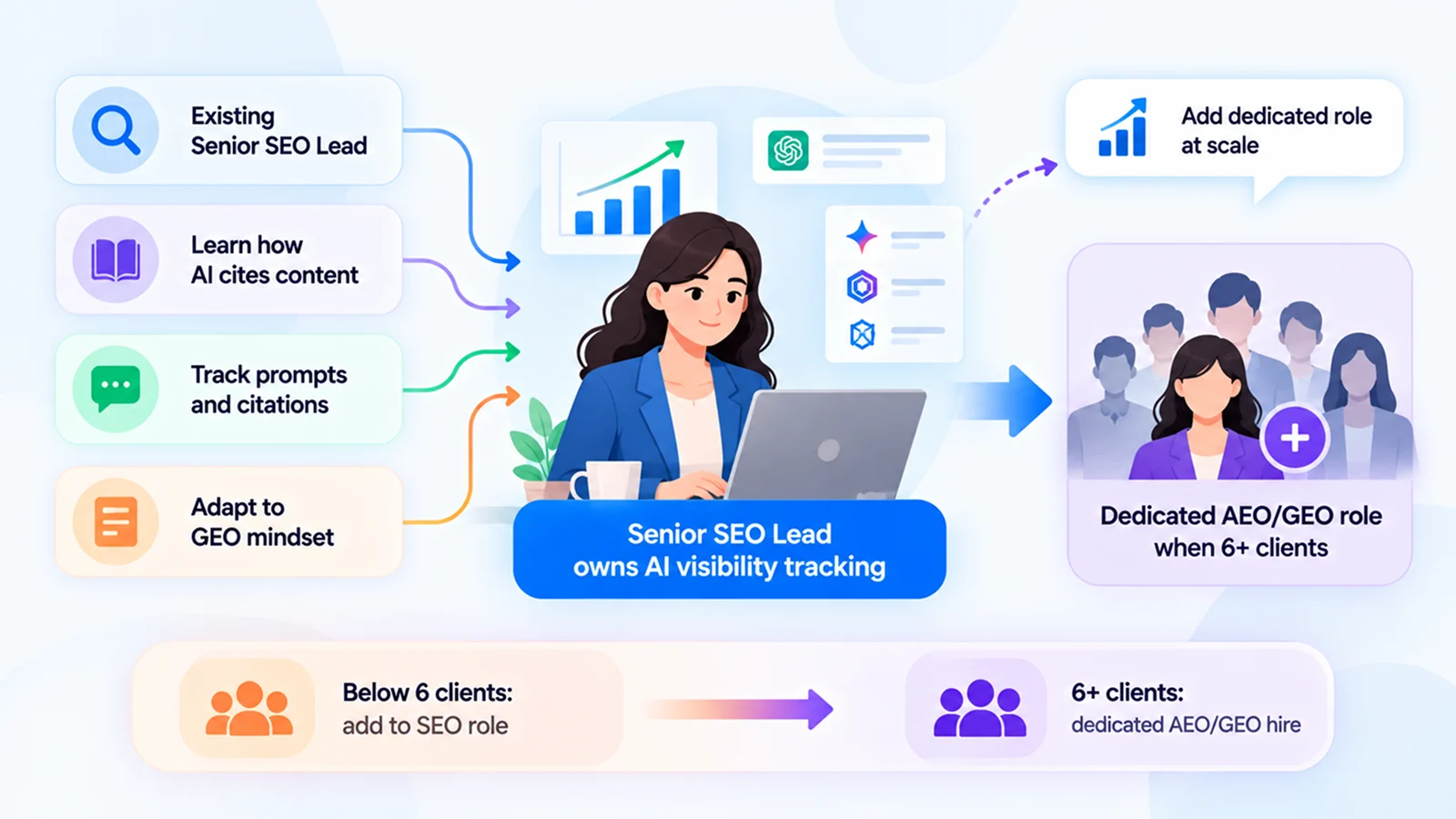
That's a different target than traditional SEO's focus on search rankings, and the shift in mindset takes longer to build than the reporting setup does. Most agencies don't have the volume to justify a dedicated AEO specialist until they're running this as a paid service for six or more clients at once. Below that threshold, it's a skill you add to an SEO role rather than a headcount line.
The ramp time is real, though. An SEO lead who only knows keyword research needs time to get comfortable with prompt-level tracking, citation share, and entity clarity, the kind of technical detail a platform like Cognizo or AthenaHQ documents to explain its own scoring.
Once an agency is running this across a dozen clients rather than as a bolt-on report, a dedicated role starts paying for itself.
Proving ROI honestly
The mistake most agencies make when proving AEO ROI is showing a client a single dashboard score with no baseline behind it. A defensible case for renewal needs three things: a defined starting point, a consistent reporting cadence, and named prompts rather than an aggregate number.
Concretely, that looks like this: pick 10 to 20 prompts a client's actual buyers ask, record who gets named and cited on each one before any work starts, then re-run the same prompts on a fixed schedule, weekly or biweekly, rather than whenever it's convenient.
Being able to show "absent from 3 of 10 prompts in month one, present in 2 of those 3 by month three" holds up in a renewal conversation in a way a single score never does.
Before picking a vendor to run this on, ask for real, verifiable case studies, not just logos on a homepage. Most published case studies in this category are thin: a screenshot, a quote, no baseline.
A vendor that can show a defined baseline measured against later checkpoints on a fixed cadence is showing you reporting discipline you can hand to a client without editing it first, that's a better vendor-selection signal than any feature checklist.
Conclusion
No single tool here fits every agency. Three, Botric, Peec AI, and Scrunch AI, were built agency-first, with per-project or per-workspace models from day one. Most of the rest started as single-brand trackers and added an agency tier later, which tends to show up first as a workspace cap, a missing white-label option, or a sales call where a price should be.
Before committing a client roster to any of these, pilot it on one real client first: confirm workspace isolation actually holds, time how long a white-labeled report takes to produce, and check whether the pricing still works once you're running five clients instead of one.
- Workspace isolation, white-label output, a pre-contract audit mode, multi-model coverage, and pricing that scales per client are what actually separate an agency-ready tool from a rebadged single-brand tracker.
- Botric, Peec AI and Scrunch AI lead on project or workspace structuring among the agency-built tools, while Semrush's white-labeled Pro Report add-on is the standout feature among the generalist platforms.
- New business tends to close faster off a prospect's own absence from a specific AI answer than off any generic keyword gap you could show them instead.
- Match your pricing structure to the client relationship: retainers for ongoing SEO clients layering this on, project fees for a first audit-and-fix engagement before the upsell.
- Run your own pricing math against client count before committing to any platform, combined visibility-and-content or pure tracker alike, using a vendor's published workspace and seat limits rather than a sales call's verbal promise.
See exactly what your current client roster is missing in AI answers today: run the free AI visibility audit at Botric and map your workspace needs against your actual client count before your next renewal conversation.
Frequently Asked Questions
How do agencies prove AEO ROI to a client who's skeptical of AI visibility as a metric?
Show them a before-and-after on specific prompts, not an aggregate score. If a client sees their name absent from three named prompts in month one and present in two of them by month three, that holds up in a renewal conversation in a way a single dashboard score never will.
Should an agency buy a dedicated AEO tool or rely on an SEO platform's AI features?
It depends on volume. A dedicated tool like Botric, Peec AI or Scrunch usually goes deeper on model coverage and citation detail. An SEO platform's AI add-on is fine if you're only running this for one or two clients and don't want to manage a second login.
What should agencies look for beyond a feature checklist?
Ask the vendor directly how they handle data isolation between clients on a shared account. That's the thing that breaks quietly and turns up as an embarrassing screenshot in the wrong client's inbox.
Why do agencies stop renewing AI visibility tools?
Usually the tracking is fine. What wears people down is the reporting. If pulling a client-ready PDF eats 40 minutes of manual formatting every month, the tool turns into a chore instead of a service, and agencies quietly let it lapse at renewal.
Do these tools track the same AI engines?
No. Some cover only a handful of models on entry tiers, like Botric and Peec AI, while others such as Cognizo's Enterprise tier or Otterly's Enterprise tier promise broader or custom coverage. Match the model list to what your clients' buyers actually use before you commit.
How many clients can one AI visibility license realistically support?
Depends entirely on the workspace count in your tier. Botric's Infinity plan covers up to 5 client workspaces on one license, Scrunch's entry tier gives one brand workspace for $250/month billed annually, and Otterly's higher tiers include unlimited workspaces. Check this number specifically rather than assuming one license covers one client.
What does it typically cost to start offering AI visibility as an agency service?
Entry-level tools in this category range from around €29/month (Ranketta's Tracker tier) up through the $250 to $295/month range for agency-capable plans (Scrunch's entry tier, AthenaHQ Starter). Botric's Byte plan sits in between at $49/month if you want tracking and content generation in the same tool rather than two separate subscriptions. A realistic starting budget for testing with one or two clients sits in that same general range depending on which tool you pick.