Knowing which prompts surface your brand across ChatGPT, Gemini, Perplexity, Claude, Copilot, Grok, Meta AI, and Google AI Overviews is the foundation of any real AI visibility strategy.
Most brands skip this step entirely. Without a defined prompt set and a repeatable way to monitor it, visibility gaps go unnoticed until a competitor is the one being recommended instead.
To find which AI prompts mention your brand, you need to track the exact questions users ask across ChatGPT, Gemini, Perplexity, Claude, and other AI platforms. A brand can appear for one prompt and be completely missing for another because AI engines evaluate each query using different sources, signals, and retrieval patterns.
To identify your AI visibility gaps:
- Build a prompt list: Track brand, category, comparison, alternative, problem-solution, local, and buying-intent queries that match your customer journey.
- Run prompts across AI platforms: Compare how ChatGPT, Gemini, Perplexity, Claude, and other AI engines represent your brand.
- Measure visibility signals: Track brand mentions, citations, recommendation position, competitors appearing instead, and source URLs.
- Find missed opportunities: Identify prompts where competitors are recommended but your brand is absent.
- Monitor continuously: Use Botric to automate prompt tracking and measure how your AI visibility changes over time.
AI visibility is not about ranking for keywords. It is about being consistently recognized and recommended when customers ask AI platforms the questions that influence buying decisions.
What Does Prompt-Level AI Visibility Actually Mean for Your Brand?
Prompt-level AI visibility is whether your brand appears, and how prominently, when a specific question is typed into an AI engine. Tracking brand mentions in AI search means monitoring whether your brand shows up inside answers generated by ChatGPT, Perplexity, Gemini, Google AI Overviews, and other LLM-powered answer engines, where inclusion in the generated text is what counts, not a position on a results page.
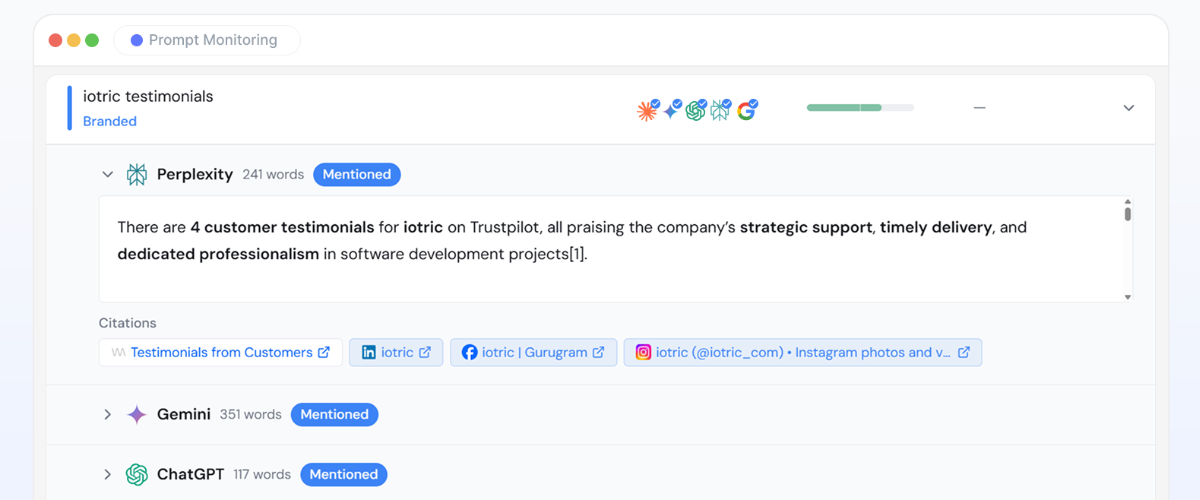
Most brands still measure visibility through Google Search Console, which gives a complete picture of one channel and nothing at all for every other one. GSC sees nothing that happens inside ChatGPT, Perplexity, or Claude, and it captures very little of what Gemini does outside classic Google web search.
The Seven Prompt Types That Drive Business Outcomes
Every prompt your buyer types falls into one of these categories. Each drives different intent, and a blind spot in any one of them is a real gap.
| Prompt Type | Example | Business Outcome |
|---|---|---|
| Brand query | "What is YourBrand?" | Reputation and accuracy |
| Category query | "Best project management tools" | Discovery and consideration |
| Best/comparison | "ChatGPT vs Claude for coding" | Shortlist inclusion |
| Alternative query | "Alternatives to Competitor" | Competitive capture |
| Problem/solution | "How do I reduce customer churn?" | Top-of-funnel authority |
| Local intent | "Best CRM for London agencies" | Geographic relevance |
| Buying intent | "Project management software pricing" | Late-funnel conversion |
Each platform has distinct source preferences, citation mechanics, and content signals. A brand that ranks well in Google AI Overviews can be completely invisible in Perplexity or ChatGPT Search, which is why you need to check prompt brand visibility across all seven types, including the ones that feel obvious.
How Can You Manually Check Which Prompts Mention Your Brand Right Now?
You can start today with no tools: open each AI platform, type a test prompt, and document what comes back. It's slow, but it surfaces gaps you didn't know existed.
The manual process, step by step
- Build your prompt list. Write three to five prompts per category above. For a SaaS company, "best project management tools for remote teams" covers category queries, "alternatives to Asana" covers competitive capture, and "how to manage sprint planning" covers problem/solution.
- Run each prompt across all eight platforms. ChatGPT, Gemini, Perplexity, Claude, Copilot, Grok, Meta AI, and Google AI Overviews/Mode each use different retrieval logic, so the same prompt produces meaningfully different results on each one.
- Log what you find. For each response, record whether your brand is mentioned, whether it's cited with a link, whether it's recommended or just named, what position it holds, and which competitors appear alongside you.
- Pay attention to exact phrasing, because it matters more than most people expect. AI engines respond differently to "best CRM," "top CRM software," and "CRM for small business." Small wording shifts change the output entirely.
Why Manual Checking Breaks Down Fast
Manual prompt tracking loses reliability quickly because AI recommendations are inherently inconsistent. Research found that asking AI tools the same question 100 times produces nearly 100 unique brand lists in different orders. Running five prompts across eight platforms is already 40 checks; running them weekly across 30 prompts is 960 checks a month, and nobody sustains that by hand with any consistency.
The harder problem is that you can't track change over time.
What Insights Should You Track Once You've Identified Your Key Prompts?
Once you have a prompt list, the real work is building a tracking system that separates signal from noise across your top 20 to 30 prompts.
The five metrics that actually matter
Brand mentions vs. citations. These are two different things, and tracking only one leaves a gap. Across all platforms combined, 73% of AI presence can consist of citations without brand mentions. Track only mentions and you miss the citations; track only citations and you miss the brand awareness gap.
AI Visibility Score, or the composite metric that measures how consistently your brand is surfaced and cited across AI answer engines for a defined prompt set, gives you a single comparable figure to track week over week.
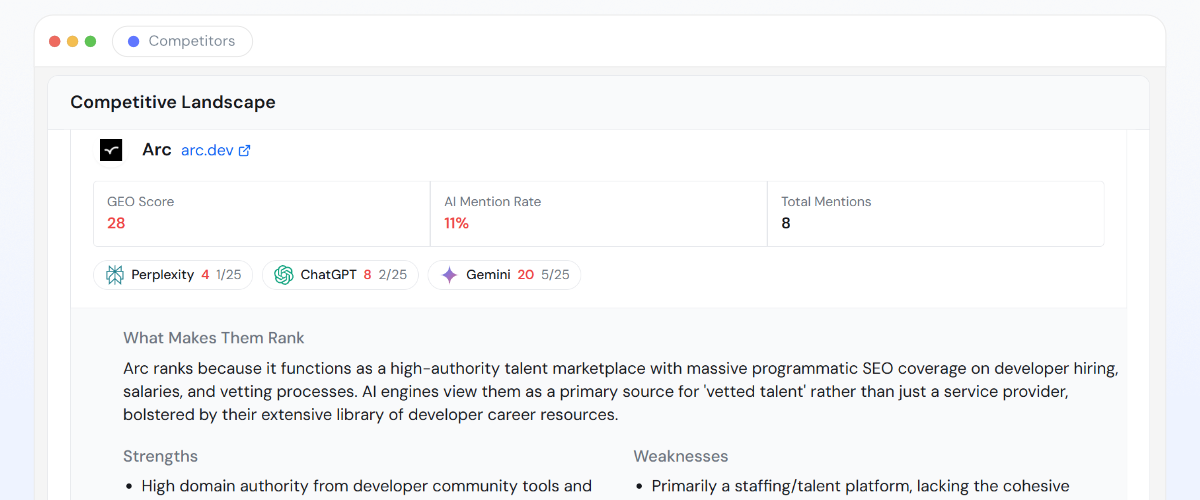
Competitor co-occurrence. Which brands appear in the same response as yours, and in what order? Checking which competitors appear alongside you, and where they sit in the answer, shows you where they show up that you don't.
Prompt opportunities. These are prompts where competitors rank but your brand is absent, and they're your highest-leverage content targets. Identify them, then create or update content that addresses those exact questions so AI assistants have the context they need to include you.
Changes over time. LLM versions update without announcement, and citation behavior shifts with them. The same prompt can produce different outputs depending on phrasing, context, timing, or platform behavior. Monthly logging is the minimum; weekly is better for competitive categories.
Building Your Tracking Sheet
For each prompt, log seven fields: platform, date, mention (yes/no), citation (yes/no), position in response, competitors named, and source URL cited. Mention means your brand is named; citation means it's linked as a source, not the same thing, and worth tracking separately.
Keep prompt wording exact between runs. "Best CRM" and "top CRM software" can return different brand lists entirely, so any variation introduces noise into the comparison.
Twenty prompts across four platforms gives you 80 data rows per run, manageable in a standard spreadsheet. Run it on a fixed weekly or biweekly schedule, and after about two months you have enough data to see whether mentions are rising or falling, which competitors are gaining ground, and where new citation sources appear. That trend line, not any single run, is what tells you if visibility is actually improving.
The catch is upkeep. Every prompt on every platform, every cycle, without gaps, or the trend line becomes unreliable. That consistency requirement is usually where manual tracking starts losing to other priorities.
How Botric Automates This Process
The manual approach above works as a starting point, but it breaks down at scale for the reasons already covered: 960 checks a month for a 30-prompt set, inconsistent AI responses across runs, and no reliable way to catch a citation shift the day it happens.
Botric takes this further by automating prompt runs at scale. Botric's tracking is built specifically for live citation monitoring, which matters when an LLM update changes your category's citation pattern overnight. The prompt set defined using the seven categories above runs on an ongoing schedule across major AI platforms, so results reflect current model behavior rather than a single manual check from weeks ago.
For each tracked prompt, Botric surfaces:
- Brand mentions and citations, tracked separately, showing not just whether a brand appears but whether it's named in the response text or actually cited with a linked source
- Competitor co-occurrence, showing which brands appear in the same response and in what position
- Prompt opportunities, the specific queries where competitors are cited and a brand is absent, which become direct content targets
- Change over time, so a citation drop following a model update is visible immediately rather than discovered in the next monthly review
This turns the spreadsheet-based process described above into a running system, replacing 80 manually logged data rows per cycle with continuous monitoring across the full prompt set.
How Do You Improve Your Brand's Visibility Once You Know Where You're Missing?
Prompt data is only useful if it tells you what to fix. Here's how to translate each gap type into a concrete action.
1. When you're mentioned but not recommended
You exist in the model's knowledge but haven't earned enough authority signals to be cited as the top answer. Experience, expertise, authority, and trust signals remain important indicators of content quality and credibility across search and AI systems. Brands with strong authority signals, including citations from Wikipedia, news outlets, and case studies, are more likely to be referenced, and in-depth blog posts, white papers, and original research give AI engines high-quality content to draw from.
Check which third-party sources the AI cites in that response. Those are the publishers you need mentions from. Publish a response-ready piece on the exact prompt topic, then earn coverage from the sources already in the AI's citation pool.
2. When competitors rank but you don't
This is a content gap. Research confirms that 44.2% of all LLM citations come from the first 30% of page content, so if your page buries the answer, the AI won't extract it. Rewrite the page so the direct answer appears in the opening paragraph, with supporting detail below. Run this check on your own pages before assuming the problem is authority.
For improving your overall AI search visibility, also audit your backlink profile. Domain authority remains a signal that LLMs weigh when deciding which sources to trust, particularly on ChatGPT Search, which pulls from Bing's index.
3. When new LLM versions shift your rankings
Monitor release notes from OpenAI, Google, Anthropic, and Perplexity. Each major model update changes retrieval behavior. Re-run your full prompt set within 48 hours of any announced update and compare results against your baseline. That's the only way to catch a citation drop before it becomes a pipeline problem.
Your Prompt Audit Checklist
Use this to assess your brand right now:
- Brand queries: does your brand appear in the top two names mentioned?
- Category queries: do you appear in the top three recommendations?
- "Best"/comparison queries: are you included when your direct competitors are named?
- Alternative queries: do you appear when users search for alternatives to your competitors?
- Problem/solution queries: is your content cited as the source for your core use case?
- Local intent queries: does your brand appear for your target geography?
- Buying intent queries: is your pricing or demo page cited when users ask about cost?
For a deeper look at how your brand stacks up against competitors across these prompt types, the AI search brand vs. competitor comparison guide walks through the full methodology.
Most teams treat prompt monitoring as a one-time audit. It's the same discipline as rank tracking in traditional SEO, except the "algorithm" updates without a changelog and results vary by session. Build the habit before you need it.
Key Takeaways
- Citation logic differs across AI platforms, so a brand that's well-cited on Perplexity for a given prompt may not appear at all on ChatGPT, making cross-platform monitoring a practical requirement rather than a nice-to-have.
- The seven prompt types (brand, category, comparison, alternative, problem/solution, local, and buying intent) each pull different buyer intent and need separate tracking rather than a single catch-all approach.
- AI responses vary by session, so a one-time manual check tells you where you stood on that day. A fixed prompt set with consistent logging is what reveals actual trends.
- Brand mentions, citations, AI Visibility Score, competitor co-occurrence, prompt opportunities, and change over time together tell the story that any single metric obscures.
- Competitive categories warrant a standing weekly monitoring practice, with a full prompt re-run within 48 hours of any major LLM update, because citation behavior can shift faster than a monthly review catches.
If you want to see exactly where your brand stands across these prompt types right now, run a free AI visibility audit to get a clear picture of your current brand mentions, competitor visibility, and gaps across major AI platforms.
Frequently Asked Questions
How often should I check which prompts mention my brand in AI searches?
Weekly is the practical minimum for competitive categories. AI engine behavior shifts with model updates, and a citation drop can happen between monthly checks without warning. Daily monitoring makes sense only if you're actively running a content or PR campaign and need fast feedback on whether it's moving your prompt rankings.
Does ranking #1 on Google guarantee my brand appears in AI answers?
No. Ranking highly on Google does not guarantee visibility in AI answers. An analysis of 680 million AI citations found that only 11% of cited domains appear across both ChatGPT and Perplexity, while Google AI Overviews and Google AI Mode reference the same URLs only 13.7% of the time despite often generating similar answers. Each AI platform uses different retrieval and citation patterns, which means traditional search rankings can support visibility but do not automatically translate into AI recommendations.
What's the difference between a brand mention and a citation in AI responses?
A brand mention is your name appearing in the AI's prose without a linked source. A citation is when the AI attributes a specific claim to your website and links to it. Mentions build recall; citations drive referral traffic and signal authority to the model. You need both numbers to understand where you actually stand.
Can I check prompt visibility manually without any paid tools?
Yes, for a quick baseline. Open ChatGPT, Gemini, Perplexity, and Claude, run your top ten prompts, and log the results in a spreadsheet. The limitation is consistency: the same prompt run twice can return different brand lists, so a single manual check gives you directional evidence rather than reliable measurement.
Why does my brand appear on Perplexity but not on ChatGPT for the same prompt?
Perplexity's live web retrieval picks it up within hours, while ChatGPT's response still draws from training data that predates your article. Perplexity retrieves from the live web; ChatGPT blends training knowledge with selective web search. The same content can be visible on one platform and invisible on the other for weeks.
What is an AI Visibility Score and how is it calculated?
It's a composite metric that measures how consistently a brand is cited across a defined set of prompts and AI platforms. Our 2026 audit methodology tracks how often AI answer engines cite the brand across monitored prompt runs, then scores that frequency on a 0–100 scale.
Should I prioritize fixing prompts where I'm absent or prompts where I'm mentioned but not recommended?
Fix "mentioned but not recommended" first. You already have some authority signal there, and improving the content or earning one or two additional third-party citations can move you from named to recommended relatively quickly. Prompts where you're entirely absent require building authority from scratch, which takes longer and depends on backlinks and off-site coverage.