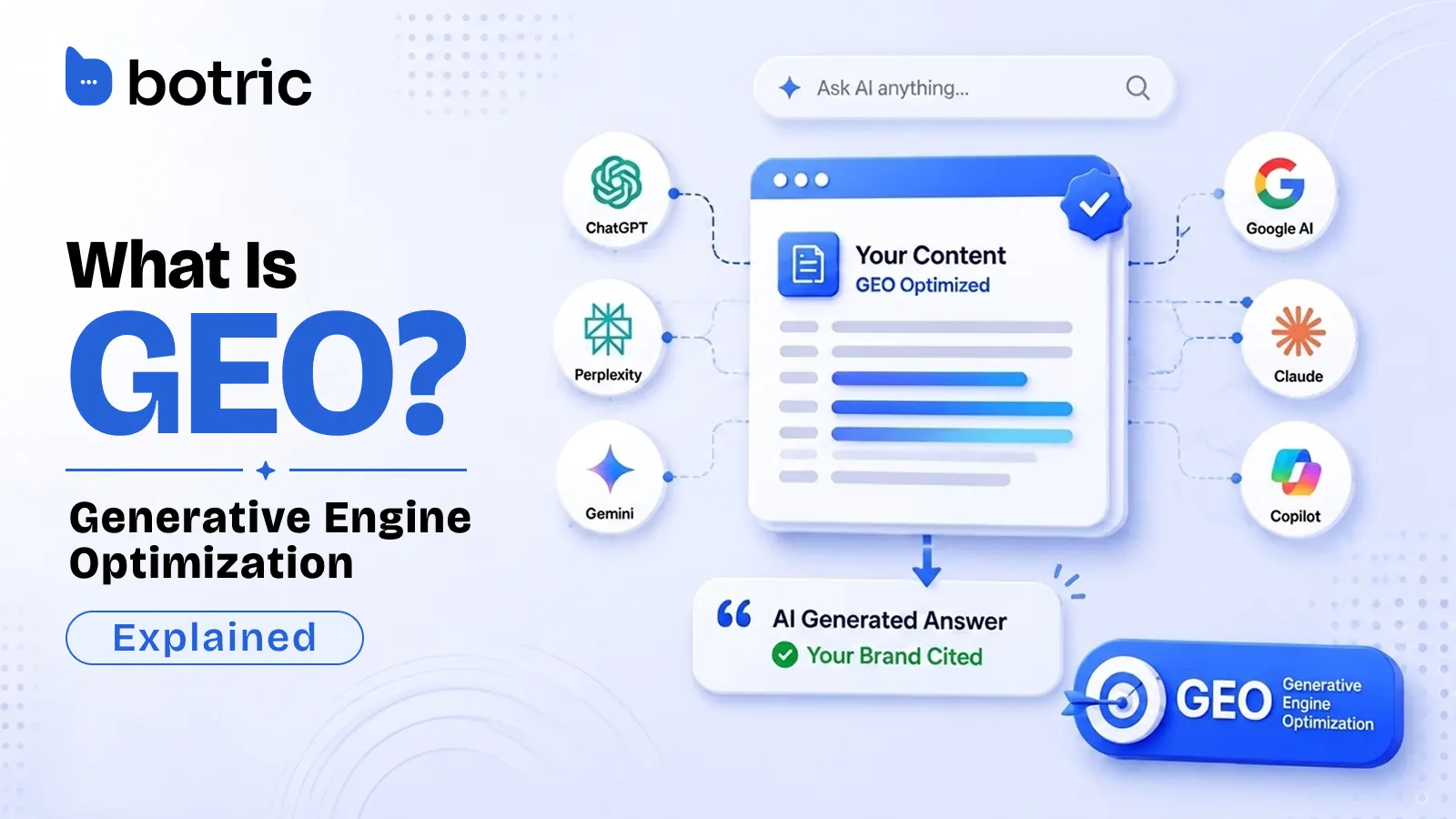
Generative Engine Optimization (GEO) is the practice of optimizing content so AI search engines like ChatGPT, Google AI Overviews, Gemini, Claude, and Perplexity can find, understand, and cite it in their generated answers.
Unlike traditional SEO, which focuses on ranking webpages, GEO focuses on becoming part of the AI-generated response itself.
This guide will help you understand what GEO actually is and how you can use it to get more qualified users and sustainable growth.
Quick Answer
Generative Engine Optimization (GEO) helps your content become more visible in AI-generated answers by making it easier for AI systems to retrieve, understand, and cite. Instead of optimizing only for search rankings, GEO focuses on increasing the likelihood that your content is referenced when people use tools like ChatGPT, Google AI Overviews, Gemini, Claude, and Perplexity.
Effective GEO content is typically:
- Clear and direct, answering the main question early.
- Evidence-backed, using credible sources, research, and original insights.
- Well-structured, with descriptive headings and standalone sections.
- Trustworthy, demonstrating expertise and factual accuracy.
As AI-powered search becomes a primary way people discover information, combining strong SEO with GEO gives your content the best chance of being found, cited, and trusted.
What Is GEO, and Why Does It Matter?
GEO means optimizing for citation selection, not just ranking position. Where traditional SEO earns you a slot on a results page, GEO earns you a place inside the answer itself: the paragraph an AI reads aloud, quotes, or attributes when a user asks a question.
Gartner predicted that traditional search engine volume would drop 25% by 2026, driven by generative AI solutions becoming "substitute answer engines, replacing user queries that previously may have been executed in traditional search engines."
The reality in 2026 is more nuanced than that headline, but the directional shift is real. AI-generated answers are now a primary interface for information, and brands that ignore GEO risk becoming invisible at the earliest stage of the customer journey, before users ever reach a website.
Being cited inside a generated answer is the new equivalent of ranking on page one, except the page itself no longer exists.
How Does GEO Actually Work in Practice?
GEO works because of how AI search systems are built. Most major platforms use Retrieval-Augmented Generation (RAG), a process where the system retrieves relevant web content, extracts the most useful passages, and synthesizes them into a single coherent answer.
Your content either gets extracted or it doesn't.
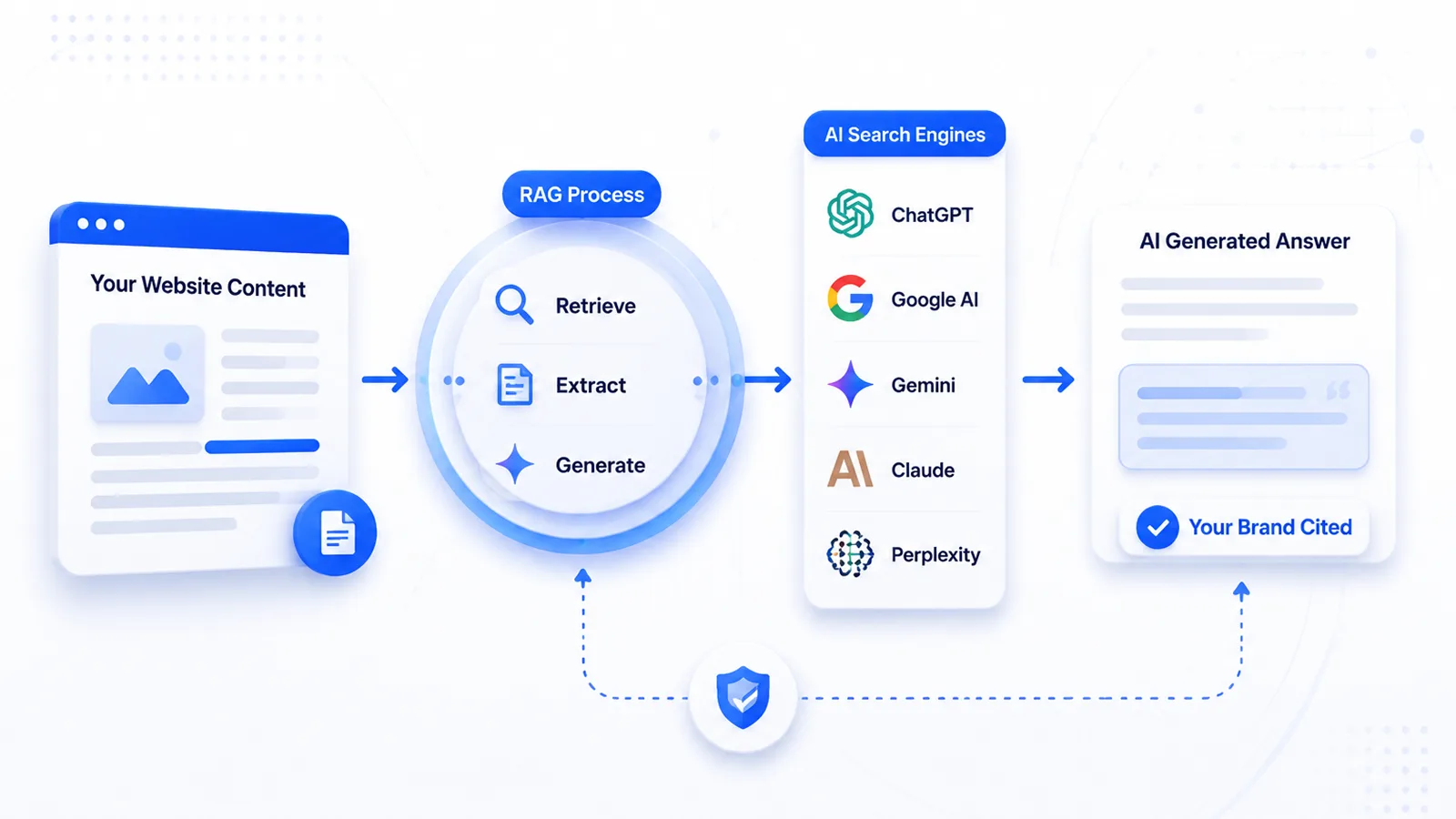
What makes a passage extractable?
Three things determine whether a passage gets pulled into an AI answer:
-
Factual clarity: The claim is specific, verifiable, and doesn't require the reader to infer meaning from surrounding context.
-
Standalone completeness: A single paragraph answers the question on its own. If a reader needs the previous three paragraphs to understand it, an AI engine won't use it.
-
Structural legibility: Clear headings, direct opening sentences, and explicit answers signal to the model exactly what each section covers.
Content written purely to satisfy human reading preferences, with conversational flow and implicit rather than explicit information, gets cited less often.
That's not an argument for robotic, bullet-point-only writing. It's an argument for ensuring that within well-written content, each section contains explicit, standalone statements an AI system can extract and use.
What the research actually found
The academic foundation for GEO comes from a peer-reviewed study by researchers at Princeton University, Georgia Tech, IIT Delhi, and the Allen Institute for AI, presented at ACM KDD 2024. The study introduced the GEO-bench benchmark and tested nine optimization methods across 10,000 queries.
Its headline finding: adding statistics improves AI citation visibility by 41%. The benchmark covered informational, commercial, and navigational query categories, and the platforms evaluated included Bing and Perplexity among others.
The 41% gain was most pronounced in informational queries where verifiable data could be directly extracted, and the researchers noted that the lift was not uniform across all content types, with factually dense, source-attributed passages benefiting most. A page with verifiable, attributed data consistently outcompetes a page making the same claims without evidence, and a 41-point lift is not a rounding error.
The same study found that traditional tactics like keyword stuffing performed poorly in generative contexts. Keywords still matter for discoverability, but they don't determine whether a passage gets cited once the AI has retrieved the page.
Authority signals in GEO
AI systems prioritize information from sources they already trust. High-quality backlinks still matter, but generative optimization evaluates authority differently.
Rather than counting links broadly, AI looks at where citations come from, how often they appear, and which sources vouch for your content. Enterprise-grade case studies, technical documentation, and user-generated reviews on platforms like G2 and Capterra all contribute to the trust signals AI engines use when selecting sources.
Content that cites primary sources rather than restating them secondhand consistently outperforms derivative content.
What's the Difference Between GEO and Traditional SEO?
In organic search, success means appearing in a list of results and earning a click.
In AI search, success means your content is extracted, paraphrased, or quoted directly in the answer, which may or may not include a visible link to your site.
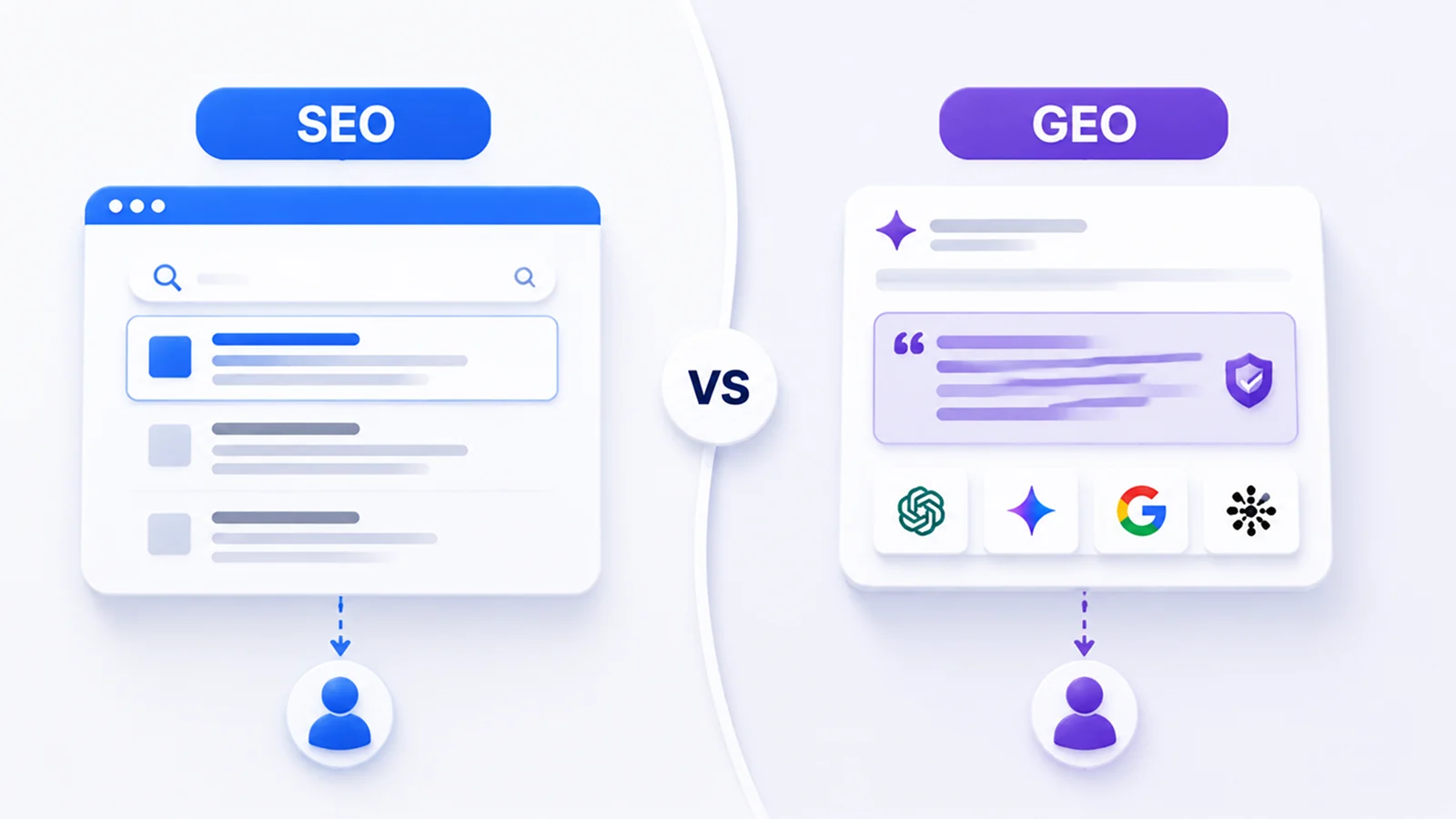
| Dimension | Traditional SEO | GEO |
|---|---|---|
| Goal | Rank on a results page | Be cited inside a generated answer |
| Success metric | Clicks and impressions | Citations and brand mentions |
| Content unit | Full page | Standalone passage |
| Keyword role | Central ranking signal | Useful for retrieval, not citation |
| Authority signal | Backlink count and domain rating | Source trustworthiness and factual density |
| Traffic model | Click-through to your site | Often zero-click; brand cited without visit |
The two approaches aren't mutually exclusive, but they pull in different directions. A page that ranks well and is structured for extraction performs best across both channels. A page optimized only for keyword density will underperform in AI citation environments because RAG uses semantic search to identify concepts.
A page with a term mentioned dozens of times but lacking conceptual clarity will lose to a page that explains the topic thoroughly with supporting examples and clear structure.
For a broader look at the tools practitioners use to manage both, the best GEO tools available in 2026 covers the current landscape.
How to Optimize Content for GEO
GEO is not about writing content for AI instead of people. It's about making your content easier for AI systems to understand, trust, and reference without sacrificing the reading experience.
While every AI platform retrieves and generates answers differently, the content that earns citations tends to follow the same core principles.
1. Answer the Main Question First
Don't make readers scroll to find the answer.
Start every page or section with a clear, direct response to the question you're addressing. AI systems often extract the first complete answer they find, so getting to the point early improves your chances of being cited.
For example, if your heading is "What Is Generative Engine Optimization?", the opening sentence should define GEO before diving into background or context.
2. Structure Content So Each Section Stands on Its Own
AI models don't always use an entire page when generating an answer. More often, they retrieve individual passages.
Each section should answer one specific question completely, without depending on the paragraphs above it for context. If someone reads only that section, it should still make sense.
This also makes your content easier for readers to scan.
3. Use Clear and Descriptive Headings
Headings help both people and AI systems understand what each section covers.
Instead of generic titles like "Overview" or "Why It Matters," use headings that clearly describe the topic.
Examples include:
- What Is GEO?
- How Does GEO Work?
- GEO vs. SEO
- Common GEO Mistakes
- Best Practices for GEO
Specific headings improve readability and make it easier for AI systems to identify relevant information.
4. Support Your Claims With Credible Sources
Evidence builds trust with both readers and AI systems.
Support important claims with credible sources such as academic research, industry reports, official documentation, government publications, or your own first-party data. Whenever possible, cite the original source instead of a secondary summary, as primary sources are generally more authoritative and reliable.
If you have original research, customer insights, or proprietary data, include it where relevant. Unique, evidence-backed content is more likely to earn trust and stand out in AI-generated answers.
5. Demonstrate Real Expertise
AI systems increasingly favor content that offers genuine expertise instead of repeating information already available elsewhere.
Look for opportunities to include:
- First-hand experience
- Original research
- Practical examples
- Case studies
- Expert insights
- Lessons learned from real projects
The more unique value your content provides, the more likely it is to stand out in AI-generated answers.
6. Keep Your Content Current
AI search favors content that is accurate, relevant, and up to date. As industries evolve and new information becomes available, regularly review your most important pages to update statistics, incorporate recent research, replace outdated examples, refresh visuals, and expand sections where needed.
Keeping your content current not only improves its value for readers but also increases the likelihood that AI systems will continue to view it as a reliable source. In many cases, consistent updates over time deliver better long-term results than publishing a page once and leaving it unchanged.
7. Build Authority Beyond Your Website
Publishing great content is only part of the equation.
AI systems also consider how your brand is recognized across the web. Mentions from trusted third-party sources reinforce your credibility and make your content a stronger candidate for citation.
Focus on building authority through:
- Industry publications
- Customer reviews on platforms like G2 and Capterra
- Conference presentations
- Guest articles
- Original research
- Expert interviews
A brand that is consistently referenced by reputable sources is more likely to be trusted by both people and AI systems.
8. Measure Your AI Visibility
GEO is an ongoing process, not a one-time task.
Track how often your brand appears in AI-generated answers, which pages earn citations, and where competitors are being mentioned instead. This helps you understand what's working, identify content gaps, and prioritize future improvements.
The brands that improve AI visibility over time are the ones that continuously measure, learn, and refine their content strategy.
That's exactly what Botric helps you do. Botric enables you to monitor AI citations, track visibility across ChatGPT, Google AI Overviews, Google AI Mode, Perplexity, Gemini, and Claude, identify content gaps, audit your website for GEO opportunities, and measure the impact of your optimization efforts over time.
What Are the Most Common Misconceptions About GEO?
Misconception 1: GEO replaces SEO
It doesn't. GEO complements SEO, extending visibility across AI platforms while SEO covers traditional search.
They serve different discovery paths: SEO gets your page retrieved, and GEO determines whether a passage within that page gets cited. Abandoning one for the other is the wrong move.
Misconception 2: GEO is a set of tricks you apply once
This is where most teams go wrong. GEO isn't a checklist of tags or schema types you bolt onto an existing page. It's a discipline of writing for clarity and citability from the first sentence. Teams that treat it as a one-time technical fix see no improvement.
The ones that restructure how they write, leading every section with a direct answer and backing every claim with a named source, see consistent citation gains over weeks and months.
Misconception 3: Optimizing for AI means gaming the algorithm
GEO works by structuring content to make it AI-friendly, with a focus on authority, clarity, and factual accuracy. Original research, verifiable statistics, and data-driven insights get cited more frequently than unsupported opinions.
The mechanism is straightforward: AI engines are risk-averse systems that cite what they can verify. Write content that's easy to verify, and you become a source worth citing.
For teams thinking about GEO at scale, the enterprise page covers how larger organizations are building AI visibility into their content operations.
Conclusion
GEO is changing what it means to create successful content. Traditional SEO focuses on earning a click from a search results page. GEO focuses on earning a citation inside an AI-generated answer.
To do that, your content must be accurate, self-contained, well-structured, and genuinely useful. The brands that adapt to this shift now will have a significant advantage as AI search continues to grow.
Key Takeaways
-
GEO targets citation selection inside AI-generated answers: individual passages must stand alone, answering a question completely without surrounding context.
-
Factual density drives citations: the Princeton/Georgia Tech KDD 2024 study found that adding statistics to content raised AI visibility by 41%, the largest single-method gain tested.
-
SEO and GEO reinforce each other: search fundamentals get content retrieved; extraction-first writing determines whether it gets cited once retrieved.
-
Keyword stuffing hurts GEO: AI engines reward clear explanations, expertise, and verifiable information over repetitive keyword usage.
-
Consistency compounds results: Publishing extraction-first, citation-ready content over time is far more effective than trying to retrofit older pages.
Ready to see how visible your brand is in AI search? Run a free AI Visibility Audit with Botric to discover where you're being cited, uncover content gaps, and identify opportunities to improve your presence across leading AI platforms.
And if you want to master the strategies behind successful GEO/AI optimization, continue with the GEO Foundations Course, where you'll learn the complete framework for building content that AI systems discover, trust, and cite.
Frequently Asked Questions
Does GEO replace SEO?
No. SEO gets your content retrieved by AI systems in the first place; GEO determines whether a specific passage within that content gets cited in the generated answer. Drop either one and you've left a gap in your visibility strategy.
How long does it take to see AI citations improve after optimizing for GEO?
No fixed timeline exists. Citation patterns typically shift within a few weeks to a few months of publishing well-structured content, depending on how fresh the content is, how directly it answers the query, and how much domain authority the site already carries. A site with thin authority and vague answers will wait longer than one that already ranks and is adding structural discipline on top.
What's the difference between a page that gets cited and one that doesn't?
Consider two pages answering the same question. One opens with a 200-word introduction before reaching the point; the other leads with a single, complete answer sentence backed by a named source. The second gets extracted. The first gets skipped, even if it's longer and ranks higher in traditional search.
Is GEO only relevant for large enterprise brands?
Lower-ranked pages saw the biggest gains in the Princeton KDD 2024 research: pages around position five in search results showed up to 115% improvement in AI visibility from GEO optimization, while top-ranked pages saw minimal change. Smaller brands with well-structured, factually dense content can outperform larger competitors in AI citations.
Do user-generated reviews on platforms like G2 and Capterra affect GEO?
Yes, indirectly. Reviews on G2, Capterra, and similar platforms contribute to the external mention signals AI engines use to assess brand trustworthiness. A brand with consistent, verifiable third-party coverage is treated as a more citable source than one whose claims appear only on its own site.
What role does automated resolution of factual claims play in GEO?
Content that traces claims to primary sources rather than restating them secondhand is one of the clearest trust signals AI engines act on. A passage citing the original study is more likely to be extracted than one that says "research shows" with no attribution.
Can a page rank well in Google but never get cited by AI engines?
Yes, and this surprises a lot of practitioners the first time they pull the data. A page can sit at number one in Google and still never appear in a ChatGPT answer if it lacks the structural elements AI engines prioritize. High rankings and high citation rates are correlated but not identical, which is exactly why GEO requires its own discipline alongside traditional SEO.