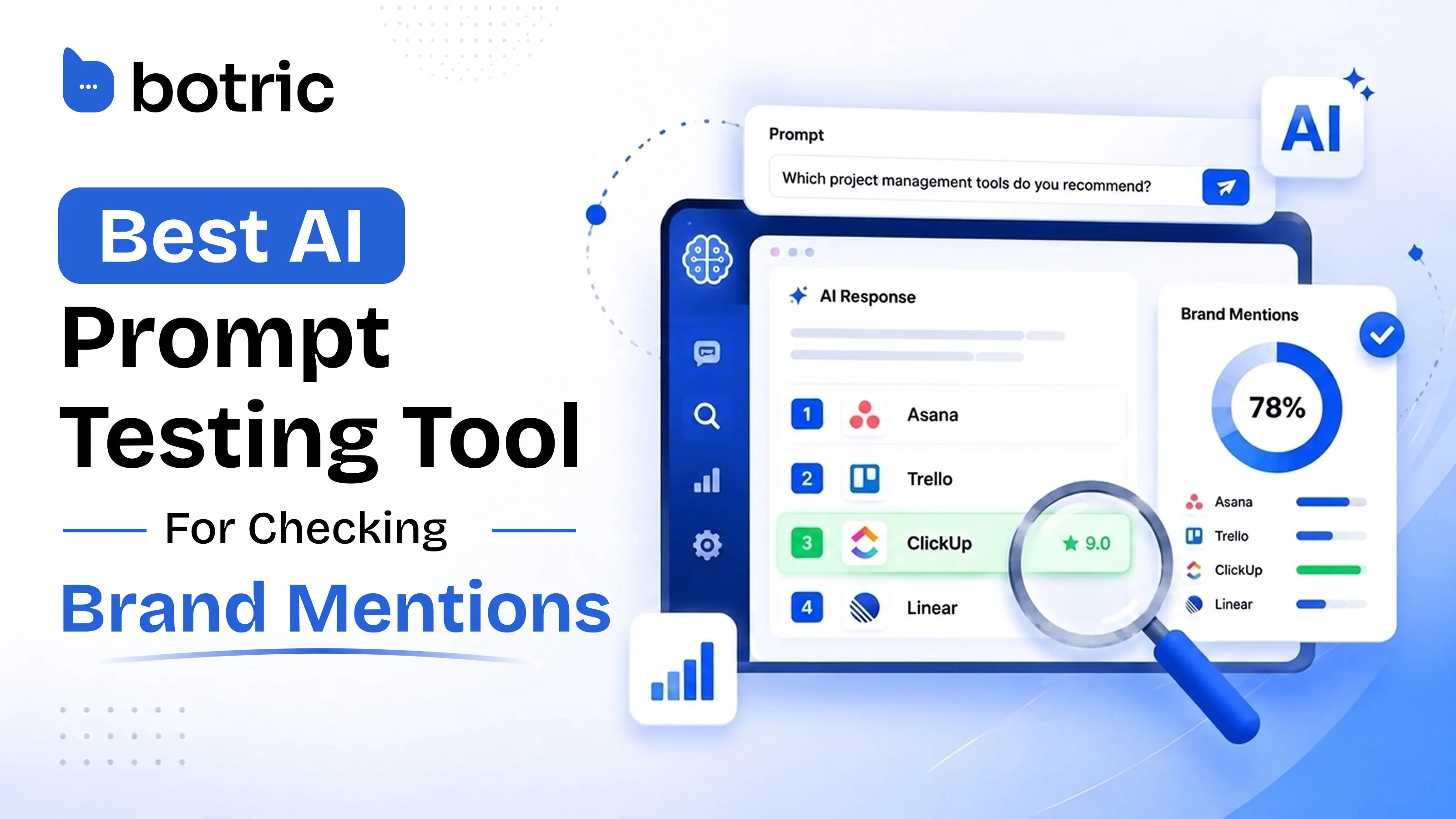
Your brand could rank first on Google and still be invisible to the fastest-growing discovery channel alive. When a buyer asks ChatGPT "what's the best CRM for startups?" your traditional SEO dashboard shows nothing.
The right AI prompt testing tool reveals exactly where you appear, where competitors win instead, and which prompts are worth fighting for. At Botric, this gap is the first thing I measure for every business.
Botric is an AI prompt testing and visibility tracking platform that helps brands discover how they appear across six AI search engines: ChatGPT, Gemini, Perplexity, Claude, Google AI Overviews, and Google AI Mode. It lets teams monitor brand mentions, track AI citations, compare competitor visibility, and identify content gaps that impact AI recommendations.
With Botric, you can:
- Test real buyer prompts to see whether AI platforms mention or recommend your brand.
- Track brand visibility across multiple AI engines from one dashboard.
- Monitor competitor mentions and citations to understand where others are winning.
- Identify content and citation gaps that prevent your brand from appearing in AI answers.
- Turn AI visibility insights into action with GEO recommendations and AI-powered content workflows.
Instead of manually checking AI responses, Botric gives you a repeatable way to measure, monitor, and improve your AI search presence.
Why Prompt Testing Is the Only Way to See Your AI Search Visibility
Prompt testing is the only reliable method for discovering whether your brand appears in AI-generated answers, because those answers are not indexed pages you can crawl. Running structured, repeatable queries through AI engines like ChatGPT, Gemini, Perplexity, Claude, and Google AI Overviews to measure whether and how your brand is mentioned, cited, or recommended is what separates teams with real visibility data from teams guessing.
Traditional rank trackers were built for a world of ten blue links. They track rankings, backlinks, and keyword positions on Google's classic results page, and they're completely blind to AI-generated answers. The gap is widening fast. AI Overviews grew from 34.5% query coverage in December 2025 to approximately 48% by March 2026, and TechCrunch reported that ChatGPT reached about 900 million weekly active users in February 2026, per OpenAI.
When an AI engine answers "best project management tools for remote teams," it cites three to five brands. If yours is absent, you're invisible to that buyer at the exact moment they're deciding. By the time declining traffic reveals the gap, competitors have already captured prompts you were winning.
A strong Google ranking tells you nothing about whether ChatGPT will recommend you. AI answer engines pull from different signals, weigh authority differently, and update their responses far more frequently than traditional search results. A brand ranking first on Google might not appear at all when someone asks Claude for recommendations in the same category.
Prompt testing closes that blind spot. It lets you run the same queries your buyers actually use across every major AI platform simultaneously and see the full response, including which competitors are named and which sources are cited. That data is the foundation of any agile content strategy built for AI search.
What to Look for in an AI Prompt Testing Tool
| Criterion | Why it matters |
|---|---|
| Multi-engine coverage | ChatGPT, Gemini, Perplexity, Claude, Google AI Overviews, and Google AI Mode each cite different sources for the same query |
| Prompt-level detail | Aggregate scores hide which specific queries you're winning or losing |
| Citation tracking | Knowing which URLs AI engines pull from tells you where to invest content effort |
| Competitor benchmarking | Visibility without a competitive baseline is just a number |
| Monitoring cadence | Daily runs catch shifts that weekly snapshots miss |
| Actionability | Tools that only report leave you to figure out what to do next |
How Botric's AI Prompt Testing Works
Botric is a full-stack Generative Engine Optimization (GEO) platform built specifically for AI search visibility. It combines prompt tracking, citation analysis, AI-ready site audits, and GEO-optimized content generation in one platform alongside AI agents that handle customer conversations and content workflows.
The core tracking layer runs across all six platforms, ChatGPT, Gemini, Perplexity, Claude, Google AI Overviews, and Google AI Mode, simultaneously. A Visibility Score (0–100) is built from four components: mention rate (40%), citation rate (25%), position score (20%), and sentiment (15%), calculated per platform and overall, tracked weekly. That composite score is what makes progress measurable rather than anecdotal.
Botric benchmarks your brand against competitors using the same prompts, showing exactly where you're missing from AI answers and which competitors are being recommended instead. It also identifies content gaps, entity signals, and citation opportunities that may be limiting your visibility, then prioritizes recommendations so you know what to fix first.
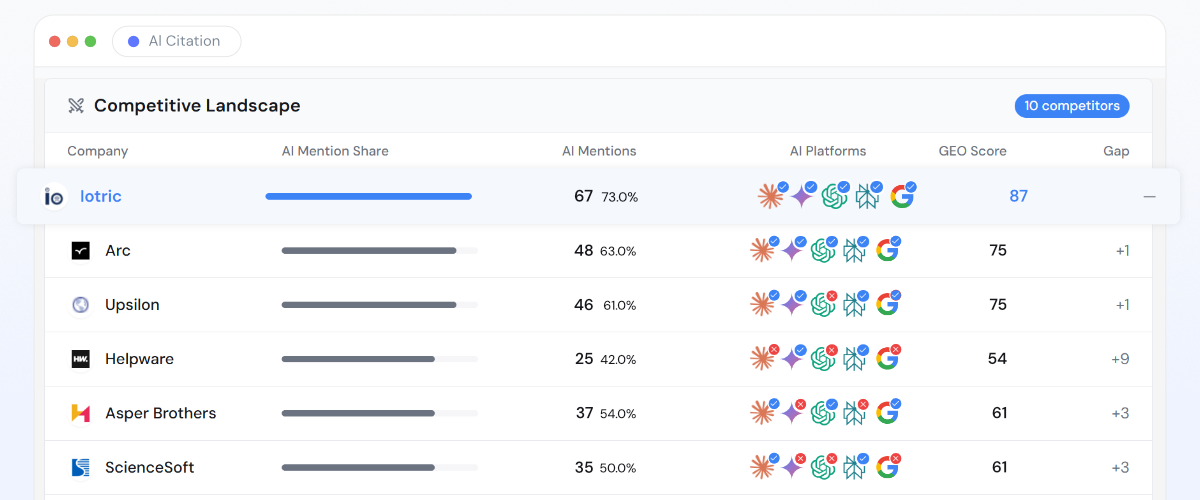
The loop Botric closes is what separates it from monitoring-only tools. The Content Agent analyzes your existing content, identifies the gaps AI keeps citing competitors for, and helps generate the blogs and social posts that close them. When I pull these reports for clients, the pattern is consistent: the citation gap and the fix are almost always a single workflow apart, and keeping them in separate tools is where momentum dies.
For understanding how brand and competitor visibility compare across AI platforms, this integrated approach means you go from "we're missing from this prompt" to published content in one workflow.
How Botric Tests Prompts Across ChatGPT, Gemini, Perplexity, and Claude
Botric surfaces brand mentions by running the same structured prompt set across ChatGPT, Gemini, Perplexity, Claude, Google AI Overviews, and Google AI Mode simultaneously, then capturing the full AI-generated response for analysis.
Organizing Prompts by Search Intent
The prompts that matter most are structured across five intent categories:
- Branded queries: "What is your brand?" or "Is your brand good for use case?"
- Category queries: "Best product category for buyer type"
- Comparison queries: "Your brand vs Competitor"
- Problem-solving queries: "How do I fix specific pain point?"
- Purchase-intent queries: "Which product should I buy for specific need?"
Each category reveals a different layer of your AI visibility. A brand that appears consistently in category queries but disappears in comparison queries has a specific content gap to close, with a clear editorial brief attached to it.
What the Prompt Playground Reveals
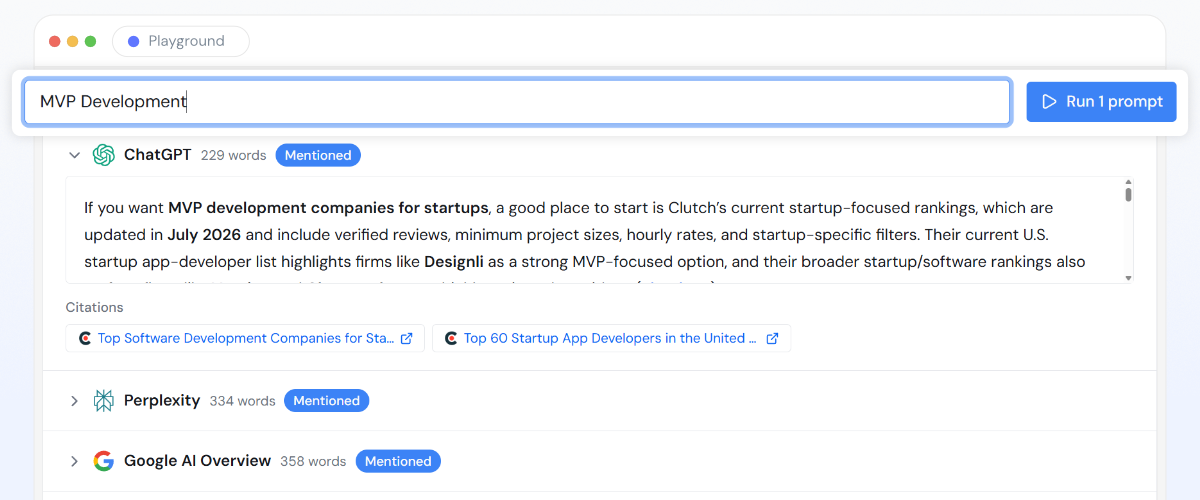
The Prompt Playground is a sandbox where you test prompt variations before committing them to ongoing monitoring. Run "best CRM for startups" and "top CRM tools for early-stage companies" side by side across all four engines and you'll see immediately whether phrasing shifts which brands get cited.
That single insight, that prompt wording changes citation outcomes, is what most teams discover only after months of manual testing.
Botric delivers prompt-by-prompt mention tracking, citation detection, sentiment analysis, and weekly automated re-testing on each. The Competitor Tracking layer shows which brands appear in your place, and the AI Citation Tracking shows which specific URLs those engines are pulling from.
Insights That Change Your AI Visibility Strategy
Botric's AI Visibility Score, Prompt Monitoring, and Competitor Tracking together reveal three things a standard dashboard never shows you.
The Citation Source Gap
Most teams assume their own website is the primary source AI engines cite when recommending them. It often isn't. Citation tracking, whether through Botric or other tools that operate similarly, identifies which domains AI platforms trust most in your category.
Seeing which third-party publications are powering competitor mentions tells you exactly where to focus your earned media and content efforts. If a competitor is being cited from a Reddit thread or an industry comparison article where you have no presence, that's a specific, actionable gap with a clear next step.
Visibility Trends Over Time
Once your project is configured, Botric continuously monitors your AI visibility and reports how your citation share changes over time. Rather than manually re-running prompts every week, you receive ongoing insights into what's improving, what competitors are doing differently, and which content should be updated or created next.
The Competitive Displacement Signal
Consider an agency using Prompt Monitoring to track a client in the HR software category. Over six weeks, a new competitor begins appearing in category queries where the client previously had sole mention. Without continuous monitoring, you'd see that shift only after it had already affected the pipeline.
With it, you can brief your content team on the specific prompts to target before the gap widens. This is the kind of AI search visibility intelligence that turns monitoring data into an agile content strategy.
How to Organize and Act on Prompt Testing Results
The data is only useful if it connects to a workflow. Here is the sequence that works in practice.
Step 1: Establish your baseline
Run your first batch of 20–50 prompts across all five intent categories and note your AI Visibility Score per platform. Most brands checking their score for the first time land in the critical range, meaning minimal to no GEO presence across the engines that matter.
Treat that baseline as your benchmark, and record it before touching anything else.
Step 2: Identify the highest-impact gaps
Prioritize prompts where search intent is purchase-stage (comparison or purchase-intent queries), where a direct competitor appears consistently in your place, and where the cited source is a page you could realistically earn coverage on. Not all missing mentions carry equal weight.
Step 3: Brief your content team
Take the specific prompts where you're absent and the citation sources that are winning, and turn them into content briefs. If Perplexity cites a competitor's comparison page for "best your category for enterprise teams" and you have no equivalent page, that is the brief. Publish it, then re-test the same prompt four weeks later.
Step 4: Monitor and iterate
Most brands see measurable shifts within weeks to months of targeted optimization, though competitive categories may take longer. Improvements depend on content changes, citation building, and AI model updates, so the re-test after publishing is what separates a guessing strategy from a measurable one. Run this check on your own site before taking anyone's word for it.
For deeper guidance on the full optimization cycle, the 2026 guide to improving AI search visibility covers the technical and content layers in detail.
Key Takeaways
- Traditional SEO dashboards can't see AI-generated answers at all, which means prompt testing is the only way to know where your brand actually stands in this channel.
- The same query phrased differently can surface completely different citations across engines, so prompt variation testing is a core discipline, not a one-time audit.
- Citation source tracking turns a vague content mandate into a specific editorial target by revealing which third-party pages are powering competitor mentions.
- A monitoring tool without an action layer produces reports, not results. The tools that connect citation gaps to content production and re-testing move faster.
- For most marketing teams and agencies, Botric AI delivers the best ratio of usable insight to cost.
Your competitors are already appearing in AI answers. Find out why they are getting cited and where your brand is missing. Start your free AI visibility audit with Botric today and uncover the prompts, citations, and opportunities that can improve your AI presence.
Frequently Asked Questions
How often should I run prompt tests to get reliable brand mention data?
Daily automated monitoring is the standard for teams treating AI visibility as a real channel. AI answers shift frequently as models update and new content gets indexed, so weekly snapshots miss competitive movements that happen between runs. If budget is a constraint, daily monitoring on your 20 highest-priority prompts beats weekly monitoring on 100 lower-priority ones.
What is the difference between an AI Visibility Score and a traditional keyword ranking?
A traditional keyword ranking tells you where your page sits in Google's blue-link results for a specific query. An AI Visibility Score measures how often your brand is mentioned, cited, and positively framed across AI-generated answers for a set of prompts. A page can rank first on Google and never appear in an AI response for the same query, because the two measure rank position versus citation presence inside the answer itself.
Is there a free way to start testing AI prompt visibility before committing to a paid plan?
You can run a free AI visibility audit on your own site to see exactly where you stand across ChatGPT, Gemini, Perplexity, Claude, Google AI Overviews, and Google AI Mode before deciding where to focus first. Otterly AI also offers a 14-day free trial with no credit card required. These free options are sufficient for establishing a baseline and not sufficient for ongoing competitive monitoring at scale.
How do I know if a prompt opportunity is worth pursuing?
Prioritize prompts that sit at the purchase or comparison stage of buyer intent, where a competitor appears consistently in your place, and where the AI-cited source is a content type you can realistically produce or earn coverage on. A comparison query where a competitor appears three times and you appear zero times, for a prompt your buyers demonstrably use, is the one to act on first.
What does AI citation tracking actually show, and how is it different from brand mentions?
A brand mention means the AI named your company in its response. A citation means the AI linked to or referenced a specific URL from your domain as a source. Mentions count how often your brand appears; citations track the source URLs those engines reference. A mention without a citation means your brand is named but your domain earns no traffic from it. Citation tracking tells you which of your pages are earning trust with AI engines and which are being ignored, and that's the more actionable signal for content investment.