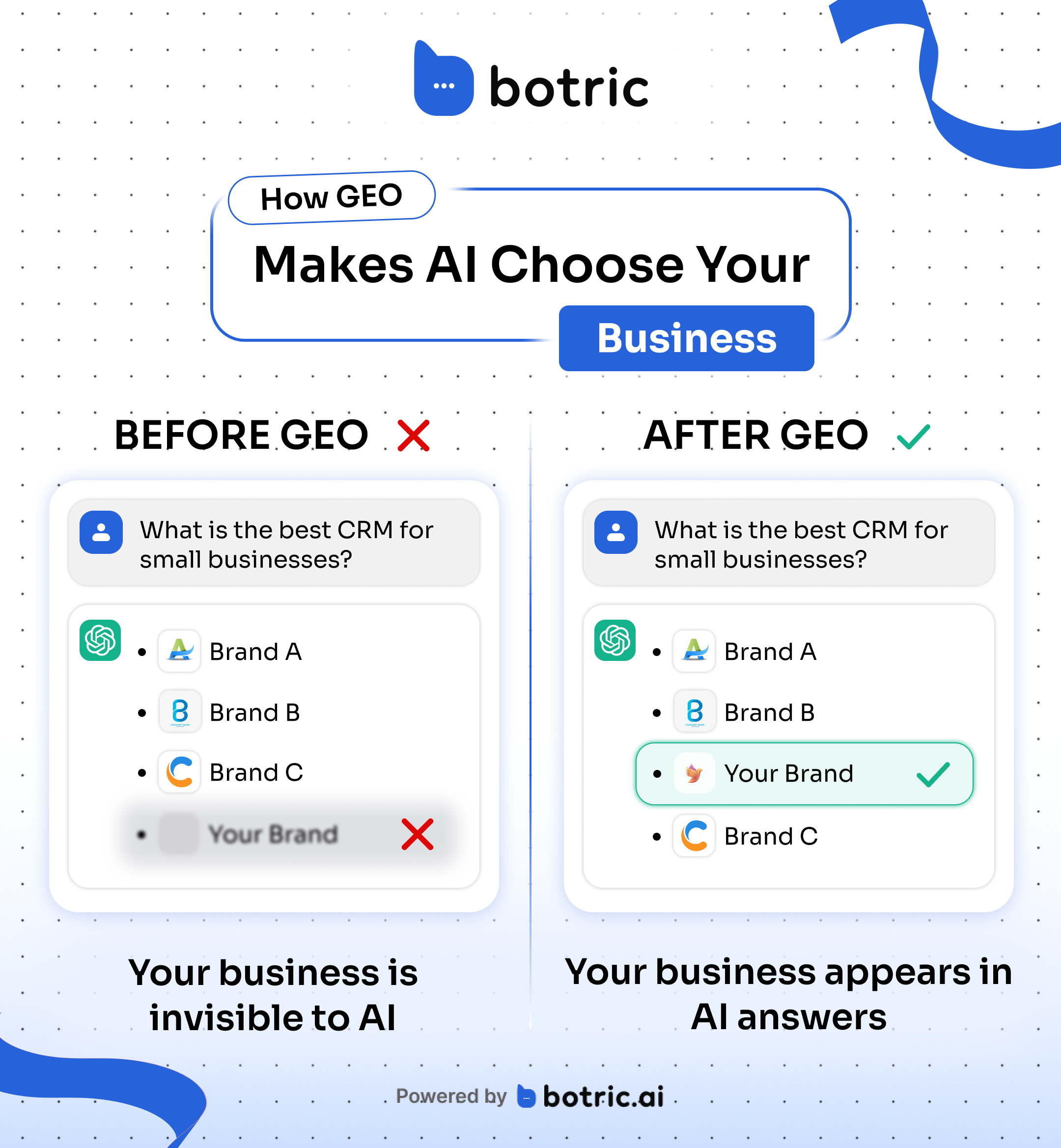
You type a question in AI search that your product directly answers, but your product still does not show up in the answer, and instead your competitors appear.
This is happening to thousands of businesses right now, and most of them have no idea why. AI search has moved from novelty to necessity faster than most teams could adapt. Platforms like ChatGPT, Perplexity, and Google AI Overviews now answer questions directly, pulling from a curated shortlist of sources that users never have to scroll through.
If your website is not in that shortlist, you effectively don't exist for an entire category of searches.
This guide explains exactly why websites go invisible in AI search results, what the underlying mechanics are, and what you can do to fix each problem. Every strategy here is grounded in how these systems actually work.
Check how many of these apply to your site:
- Your robots.txt blocks GPTBot, PerplexityBot, or ClaudeBot.
- Your pages have no schema markup.
- Your content buries answers after long introductions.
- Your brand has no presence on G2, Reddit, Crunchbase, or industry publications.
- You have no author bios or E-E-A-T signals on content pages.
- You have never checked your AI visibility with a tracking tool.
If two or more apply, the seven reasons below explain exactly what is happening and what to fix first.
How AI Search Works (For Ranking in AI Answers)
Before diagnosing why your site is invisible, you need to understand what AI search is actually doing behind the scenes. The mechanics are fundamentally different from traditional search engines.
Google crawls billions of pages, indexes them, and ranks results based on signals like backlinks, keyword relevance, and page authority. When you search, you see a list of links ordered by those signals.
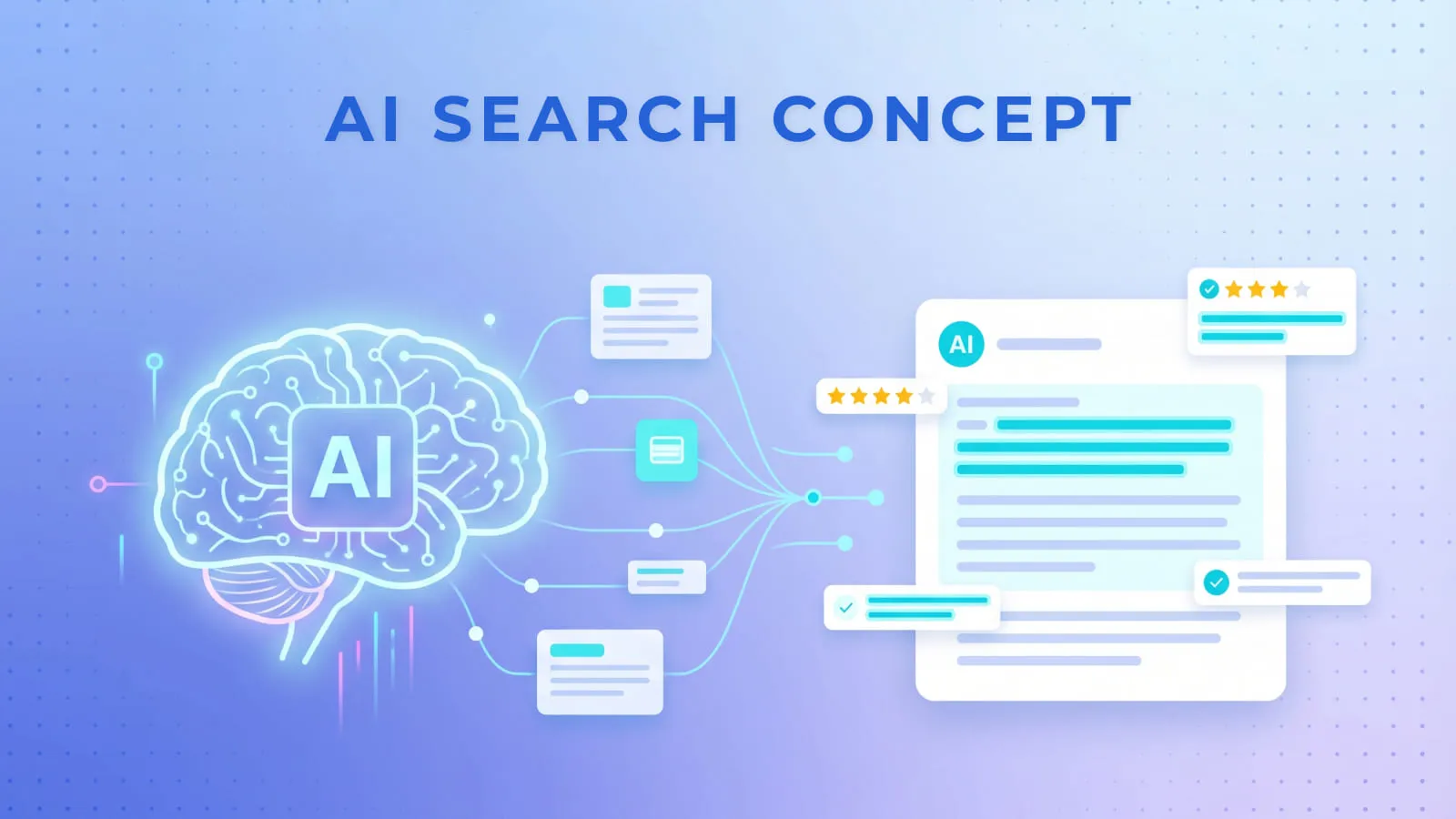
AI search works differently. Large language models like the ones powering ChatGPT and Perplexity are trained on enormous datasets of text from across the web.
When a user asks a question, the model either draws from that training data directly, or uses Retrieval-Augmented Generation (RAG) to pull in fresh web content and synthesize an answer. Either way, the model selects a small number of sources it considers credible and relevant, and weaves them into a single response.
The key difference is the output. Traditional search gives users ten links. AI search gives users one answer with two or three citations. That compression is brutal for visibility. There is no page two. There is no consolation position. Either you're cited or you're not.
GEO vs Traditional SEO: What Actually Matters
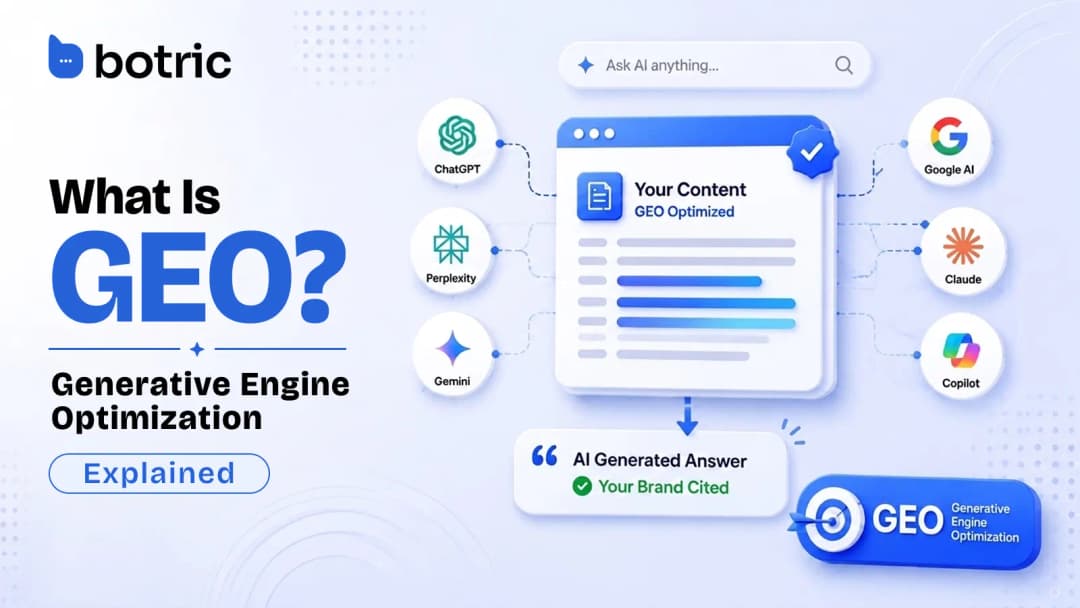
Generative Engine Optimization (GEO) is the practice of optimizing content to appear in AI-generated answers rather than just traditional search result pages.
It shares some DNA with SEO, but the priorities are different enough that treating them as identical will hold you back.
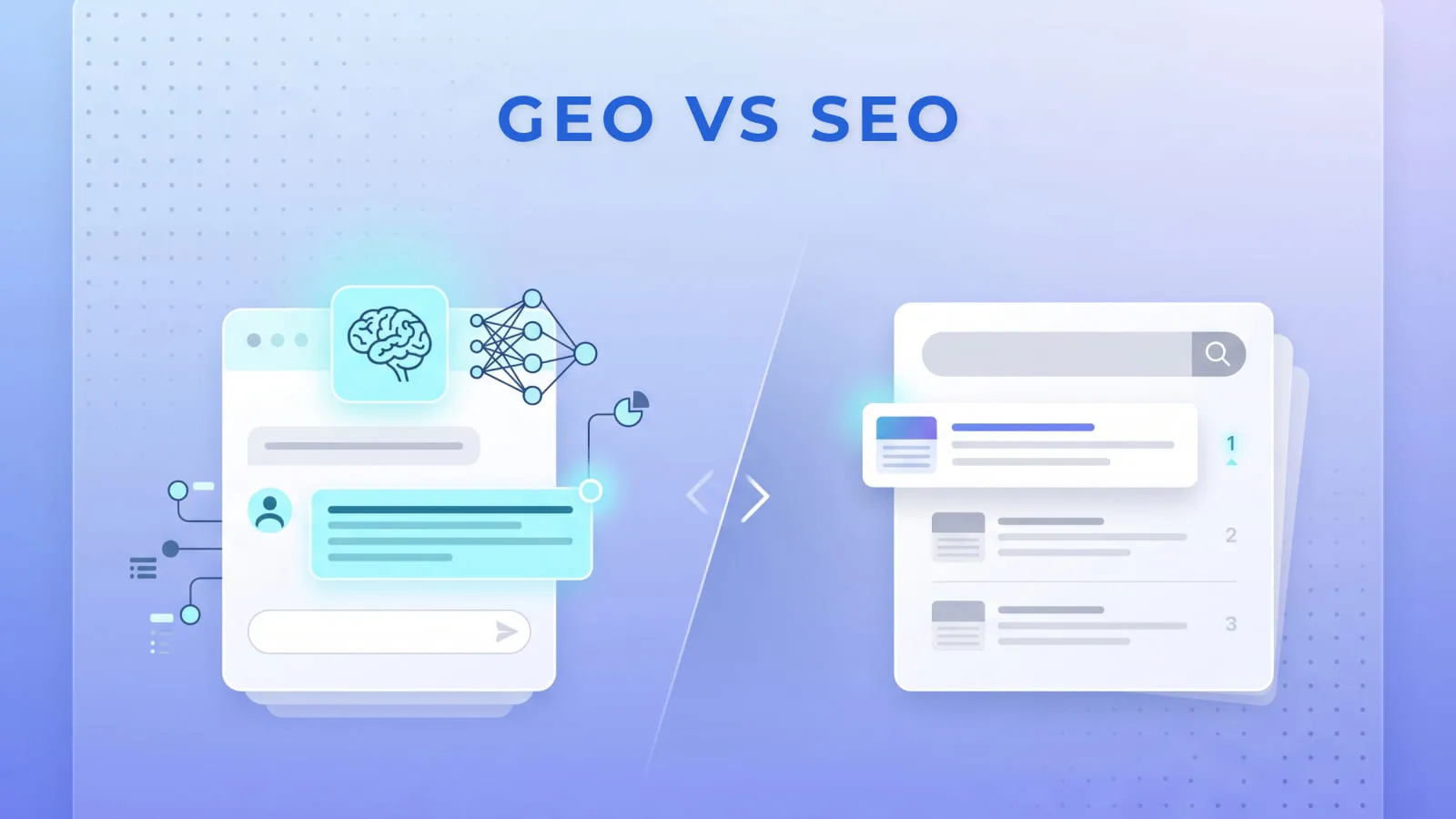
Here is a direct comparison of how the two disciplines differ:
| Factor | Traditional SEO | Generative Engine Optimization (GEO) |
|---|---|---|
| Goal | Rank on search results pages | Get cited inside AI-generated answers |
| Primary signals | Backlinks, keyword density, CTR | Semantic clarity, citability, entity authority |
| Content format | Long-form, keyword-rich pages | Answer-first, structured, scannable sections |
| Crawlers | Googlebot, Bingbot | GPTBot, PerplexityBot, ClaudeBot, CCBot |
| Feedback loop | Rankings in Search Console | AI mention tracking tools like Botric |
| Trust signals | Domain authority, anchor text | E-E-A-T, authorship, off-site mentions |
SEO is about ranking. GEO is about being citable. Both matter, and good GEO reinforces good SEO, but neither can fully substitute for the other.
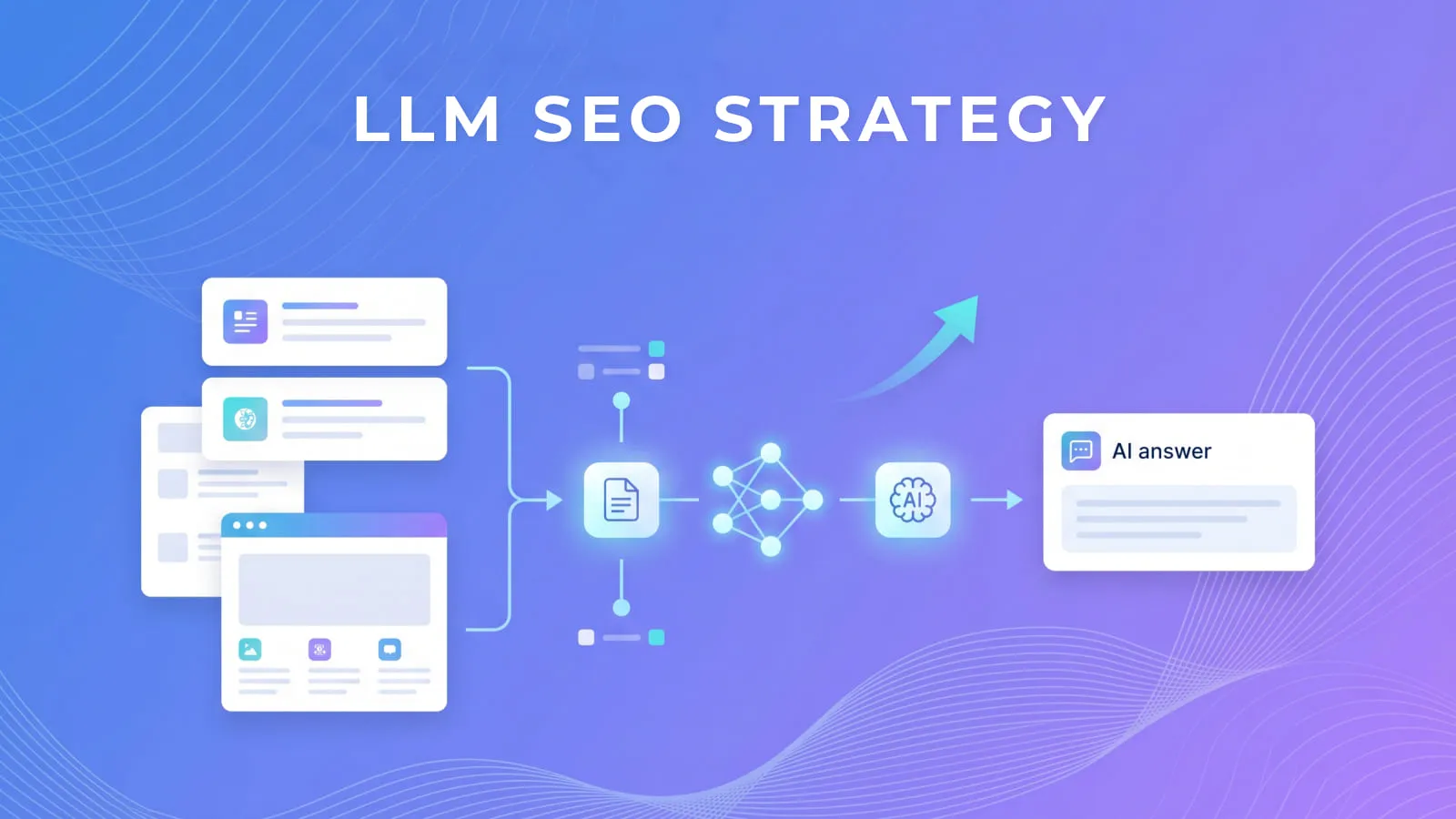
LLM SEO strategy brings these together by treating AI search as its own distribution channel that requires specific content decisions, structural choices, and ongoing monitoring.
The 7 Real Reasons Your Website Is Not Showing in AI Search
Most AI search visibility issues come down to one of seven problems. Some are technical. Some are about content structure. A few are about how your brand is perceived across the wider web. Here is what is actually getting in the way.
Reason 1: AI Crawlers Are Blocked by Your robots.txt File
This is the most common and most fixable problem. Many websites accidentally block AI crawlers through overly restrictive robots.txt rules. GPTBot (OpenAI), PerplexityBot, ClaudeBot (Anthropic), and CCBot are all legitimate crawlers that need access to your pages in order to include your content in AI systems.
If any of these are blocked, you have removed yourself from consideration at a foundational level.
Check your robots.txt file at yourdomain.com/robots.txt right now. Look for any of these:
Blocked (what to fix):
User-agent: GPTBot
Disallow: /

User-agent: PerplexityBot
Disallow: /
Unblocked (what it should look like):
User-agent: GPTBot
Allow: /

User-agent: PerplexityBot
Allow: /

User-agent: ClaudeBot
Allow: /
A blanket Disallow: / rule for all bots will block AI crawlers too, even if they aren't named specifically. This is the most common accidental block pattern.
How to Fix It
- Go to
yourdomain.com/robots.txtand audit every rule - Remove any entries blocking GPTBot, PerplexityBot, ClaudeBot, or CCBot
- Check for blanket
User-agent: *Disallow rules that catch all crawlers - Verify your sitemap is referenced in the file
- Resubmit your sitemap in Google Search Console after making changes
Reason 2: Your Pages Have No Structured Data or Schema Markup
AI systems prefer content that is clearly labeled. Schema markup, particularly FAQ schema, HowTo schema, and Article schema, tells crawlers and models exactly what your content contains. A page with FAQ schema that directly answers a question is significantly easier for an AI to extract and cite than a page with the same information buried in flowing prose.
Google's team confirmed that structured data provides a measurable advantage for AI-generated answers. If your site has no structured data, you are making AI systems work harder than necessary, and they will skip to a competitor whose content is easier to parse.
The schema types that matter most for AI visibility:
- Organization schema goes on your homepage and About page. It establishes your business as a defined entity and connects your web presence across platforms through sameAs properties.
- FAQPage schema marks up question-and-answer content in a format AI systems can extract directly. Pages with FAQPage schema appear more frequently in AI-generated summaries because the content is already structured the way AI tools prefer to deliver it.
- Article schema marks up blog posts with author, publisher, publication date, and modification date. This helps AI systems verify the source and recency of information, both of which influence citation likelihood.
- HowTo schema marks up step-by-step instructional content. For process-driven guides, HowTo schema helps AI systems identify and extract steps for direct use in answers.
How to Fix It
- Add Organization schema with sameAs properties to your homepage and About page.
- Add FAQPage schema to any page with question-and-answer content.
- Add Article schema to blog posts with author name and publication date.
- Add HowTo schema to step-by-step guide content.
- Validate all schema using Google's Rich Results Test before publishing.
- Update dateModified in Article schema every time you revise a page.
Reason 3: Your Content Is Not Written Answer-First
AI models extract answers from content. They do not summarize your entire page or reward you for writing style. If every section of your page starts with a two-paragraph preamble before getting to the point, you are writing for human patience, not for AI citability.
Answer-first writing puts the direct response at the top of each section, then follows with supporting detail. Think of the inverted pyramid structure used in journalism. The headline answers the question. The first paragraph confirms it. The rest adds context.
How to Fix It
- Audit your ten most important pages and rewrite each section opening.
- The first two sentences of every section should answer the question that section addresses.
- Use question-based headings that mirror how customers phrase things in ChatGPT.
- Replace "GEO Platform Features" with "Which GEO platform works best for agencies?"
- Read your headings out loud. If they sound like a real customer question, keep them. If they sound like a category label, rewrite them.
- Avoid long introductions before the main point in every section, not just at the page level.
Reason 4: Your Brand Has No Presence on Reference Sources
AI models learn from the broader web during training, and they retrieve from high-authority sources during inference. Wikipedia, Wikidata, G2, Capterra, LinkedIn, Crunchbase, industry news publications, Reddit threads, and YouTube channels with real audiences all contribute to how an AI perceives your brand's credibility.
A brand that exists only on its own website is essentially anonymous to an AI. Off-site brand presence is how models confirm that you are a real, recognized entity in your category.
The reference sources that carry the most weight by category:
- B2B SaaS: G2, Capterra, Trustpilot, Product Hunt, Crunchbase
- Agencies: Clutch, DesignRush, GoodFirms
- All businesses: Reddit, LinkedIn, industry publications, news coverage
- Local businesses: Google Reviews, Yelp, category-specific directories
How to Fix It
- Claim and complete your profiles on G2, Capterra, Crunchbase, and LinkedIn.
- Build a review request process that generates specific, descriptive reviews (not generic star ratings).
- Contribute guest articles or commentary to publications in your category.
- Participate genuinely in Reddit communities where your buyers have real conversations.
- Pursue press mentions, podcast appearances, and roundup inclusion.
- Monitor where competitors are being cited and build presence in those same sources.
ChatGPT consistently cites G2, Reddit, Trustpilot, Product Hunt, and industry publications when making business recommendations. If your competitors appear in those places and you don't, you are giving AI engines fewer reasons to recommend you and more reasons to recommend them.
Reason 5: Your Site Has Weak E-E-A-T Signals
Experience, Expertise, Authoritativeness, and Trustworthiness (E-E-A-T) are signals that both Google and AI systems use to evaluate content quality. AI models are particularly sensitive to these because they are specifically trying to avoid surfacing unreliable information in their answers.
Weak E-E-A-T looks like: no author bios, no credentials linked to the people writing your content, no clear organization information on your About page, no citations or data sources within your content, and no external sources linking to you as a reference. If your site reads like it was produced by nobody in particular, AI systems treat it that way.
Strong E-E-A-T looks like: named authors with specific credentials relevant to the topic, an About page that explains your organization's background and area of expertise, outbound citations to credible data sources within your content, and a track record of external sources referencing your work.
How to Fix It
- Add a named author with a credentials-focused bio to every content page.
- Rewrite your About page to explain specifically why your organization has authority on the topics you cover.
- Include outbound citations to credible sources within your content to support claims with evidence.
- Add specific statistics and data points throughout your content.
- Build your Google Business Profile and Crunchbase entry as primary entity signals.
Reason 6: Your Content Lacks Semantic Depth
AI search operates heavily on entity recognition. A model needs to understand who you are, what category you belong to, what problems you solve, and how you relate to other entities in your field.
If your content never clearly states your category, your target audience, or the specific problems you address, the model cannot confidently place you in the right context when answering questions.
This is not about keyword stuffing. It is about semantic clarity: being explicit in your content about what your product is, who it is for, what it replaces or improves upon, and how it compares to alternatives buyers are already aware of.
Semantically weak:
"We provide innovative solutions for teams looking to improve their digital performance."
Semantically clear:
"Botric is a Generative Engine Optimization platform for SaaS companies, agencies, and B2B brands that want to improve their visibility in ChatGPT, Gemini, and Perplexity. It competes with platforms like Profound and AthenaHQ and is built for teams that want both AI monitoring and content optimization in one tool."
The second version gives an AI system everything it needs to place your brand in the right context when a user asks a relevant question.
How to Fix It
- Rewrite your homepage description to explicitly state your category, target audience, and key differentiators.
- Audit your product and service pages for vague language and replace them with specific, category-clear descriptions.
- Build a content cluster of at least five to eight pieces covering your core topic from different angles.
- Use consistent terminology across your website, social profiles, and directory listings.
- Name the specific problems you solve, not just the outcomes you deliver.
Reason 7: You Have No AI Visibility Tracking
Perhaps the most underappreciated problem: most businesses have no visibility into how (or whether) they appear in AI-generated answers. They are not tracking which questions should surface about their brand, whether competitors are being cited in their place, or which platforms are ignoring them entirely.
Without that feedback, you are making changes blindly. You might fix your robots.txt, add schema, and rewrite your content without ever knowing whether any of it is working. This is the equivalent of running a PPC campaign without checking conversion data.
AI visibility tracking covers four distinct metrics, and all four tell a different part of the story:
| Metric | What It Measures | Why It Matters |
|---|---|---|
| Visibility | How often your brand appears across tracked prompts | Shows your overall AI search presence |
| Position | Where your brand appears in AI answers relative to competitors | Indicates recommendation strength |
| Sentiment | How AI systems describe your business when they mention it | Reveals whether AI narratives match your positioning |
| Citations | Which specific URLs AI engines pull from when referencing you | Shows which content is working and where gaps exist |
High visibility with negative sentiment is a problem. Strong citations with low visibility means your content is being sourced but your brand isn't being named. Each metric matters independently and together.
How to Fix It
- Identify 10 to 20 prompts your customers actually use when asking AI about your category.
- Run those prompts manually across ChatGPT, Perplexity, and Gemini as an initial baseline.
- Set up dedicated AI visibility tracking with a tool like Botric to automate this across platforms.
- Review visibility, position, sentiment, and citation data at least monthly.
- Use citation data to identify which content is being sourced and which gaps need filling.
- Track competitor visibility on the same prompts to benchmark your progress.
If you're evaluating platforms, see our guide to the Best GEO Tools in 2026 for a detailed comparison of Botric, Profound, Peec AI, Rankscale, and other platforms.
LLM SEO Strategy: How to Improve AI Search Visibility
The full picture comes down to three layers, and all three need attention.
The first layer is technical access. If AI crawlers cannot reach your pages, nothing else matters. Check your robots.txt, verify your sitemap, and confirm your site loads quickly for bots as well as humans.
The second layer is content structure. Your pages need to be written and marked up in a way that makes them easy for AI systems to extract, cite, and trust. That means schema markup, answer-first writing, and clear E-E-A-T signals throughout.
The third layer is brand authority. A well-structured page on an unrecognized brand is less likely to be cited than a straightforward page on a brand with strong off-site presence. Off-site authority work is slower to build, but it compounds over time.
For teams with limited bandwidth, the priority order is:
- Unblock GPTBot, PerplexityBot, ClaudeBot, and CCBot in your robots.txt file.
- Run your top buyer queries across ChatGPT, Perplexity, and Gemini to establish a visibility baseline.
- Add Organization, FAQPage, and Article schema to your highest-value pages.
- Rewrite section openings on key pages so every section answers its question in the first two sentences.
- Complete your G2, Crunchbase, and LinkedIn profiles and build a process for requesting customer reviews.
- Add named author bios with credentials and outbound citations to credible sources across your content.
- Track visibility, sentiment, and citation data monthly with tools such as Botric and use gaps to decide what to improve next.
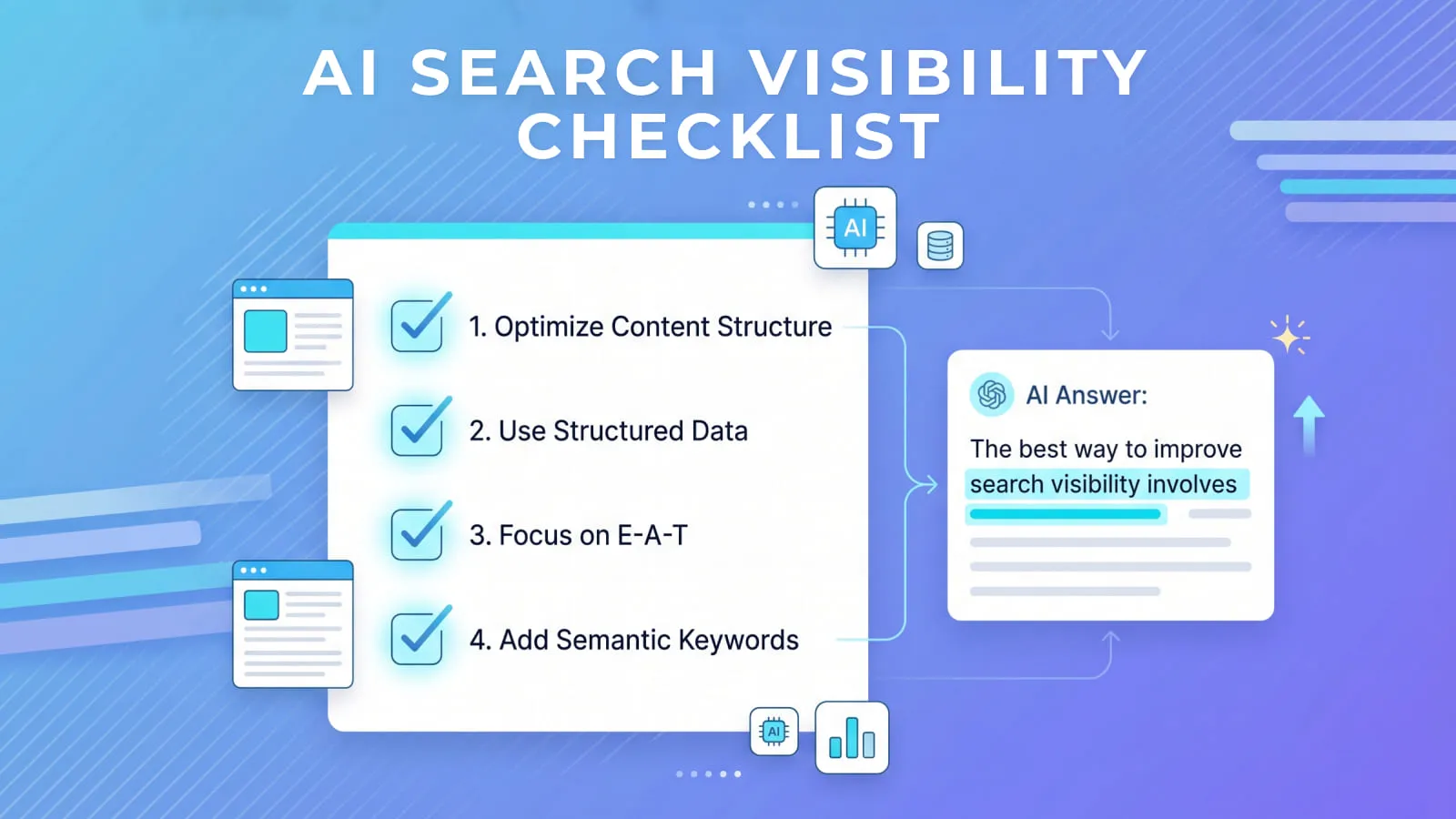
The first three can be done in a single sprint. The rest is ongoing.
This is not a one-time project. AI models update, new platforms emerge, and competitive AI search positions shift. Treating GEO as an ongoing practice rather than a checklist is what separates brands that consistently appear in AI answers from those that remain invisible.
How Botric Helps You Fix AI Search Visibility
Botric was built specifically for the problem this article describes. It monitors your brand across six AI platforms, ChatGPT, Gemini, Perplexity, Claude, Google AI Overviews, and Google AI Mode, tracking the specific prompts that matter for your category and providing citation data showing exactly which URLs are being referenced.
Beyond tracking, Botric gives you:
- AI Visibility Score measuring your overall discoverability across platforms.
- Citation gap analysis showing which competitor content is being cited instead of yours.
- AI-ready site audits identifying the specific technical issues blocking your citations.
- Competitor benchmarking showing your AI Share of Voice against the brands your buyers are also evaluating.
- Content recommendations mapping directly to the gaps in your citation data.
Businesses use Botric to identify citation gaps, benchmark competitors, and monitor visibility across AI platforms. The platform connects the tracking data directly to the actions that improve it, so you're not just measuring the problem but actively closing it.
Conclusion
If your website is not showing in AI search, you are not failing at something obscure. You are missing a distribution channel that a growing number of your potential customers are using as their primary discovery tool.
The seven reasons above are fixable. Blocked crawlers can be unblocked in minutes. Schema can be added in hours. Content can be restructured section by section. Off-site authority builds gradually but deliberately.
The harder part is knowing where you stand before you start fixing things, and knowing whether your fixes are working after you implement them. That is why AI visibility tracking is not an optional step at the end of this process. It is the thing that tells you whether everything else is having an impact.
Start with the technical audit. Fix the obvious blockers. Then use Botric to establish your AI visibility baseline across ChatGPT, Gemini, Perplexity, Claude, Google AI Overviews, and Google AI Mode, so every change you make is informed by actual AI behavior rather than assumptions about what might be working.
Key Takeaways
- AI answers pull from a short list of sources, so partial visibility is not enough.
- Blocked crawlers, thin content, and missing schema are the most common causes.
- GEO optimizes extractable passages, while SEO optimizes ranked pages.
- Fix technical access first, then rewrite pages to answer questions directly.
- Recheck AI answers after each fix to see what actually moved.
Frequently Asked Questions
Why is my brand not mentioned in ChatGPT even though I have a good website?
A good website is necessary but not sufficient for AI visibility. ChatGPT draws from its training data and real-time web browsing, both of which weigh external validation heavily. If your brand only exists on its own website with no third-party mentions, reviews, or press coverage, ChatGPT has no independent corroboration to draw on. The fix is building off-site presence on the platforms ChatGPT cites most: G2, Reddit, Trustpilot, industry publications, and LinkedIn.
How do I check if GPTBot can crawl my website?
Go to yourdomain.com/robots.txt in your browser. Look for any entry containing "GPTBot" with a Disallow rule, or any User-agent: * blanket Disallow rule that would catch all crawlers including GPTBot. If you find either, remove or modify the rule to allow access. You can also use OpenAI's GPTBot documentation to test specific URL access permissions.
Why is my website not showing in Perplexity specifically?
Perplexity uses its own crawler, PerplexityBot, which may be blocked in your robots.txt even if Google and ChatGPT can access your site. Check explicitly for PerplexityBot entries. Beyond crawler access, Perplexity weights real-time web content heavily, so recently published, well-structured content with clear sourcing performs better than older or poorly cited pages.
What is the fastest way to improve AI search visibility?
The fastest wins are technical: unblocking AI crawlers in your robots.txt and adding Organization and FAQ schema to your key pages. These can be implemented in hours and show impact within days to weeks. Content changes and off-site authority building take longer but produce the most durable improvements. Use a tool like Botric to establish a baseline before making changes so you can measure what's actually working.
Can I track whether my fixes are working?
Yes, but not with traditional SEO tools. Google Search Console tracks traditional search rankings, not AI citations. To measure AI visibility you need a dedicated tracking tool that monitors your brand mentions across ChatGPT, Perplexity, Gemini, and other platforms. Botric tracks visibility, position, sentiment, and citations automatically across platforms, and shows how these metrics change over time as you implement improvements.