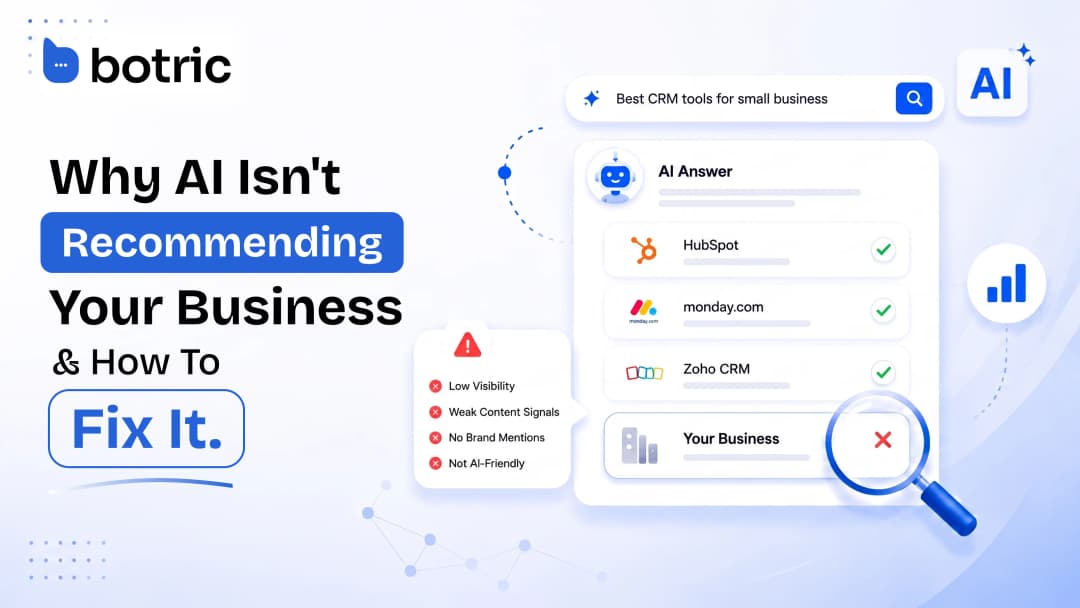
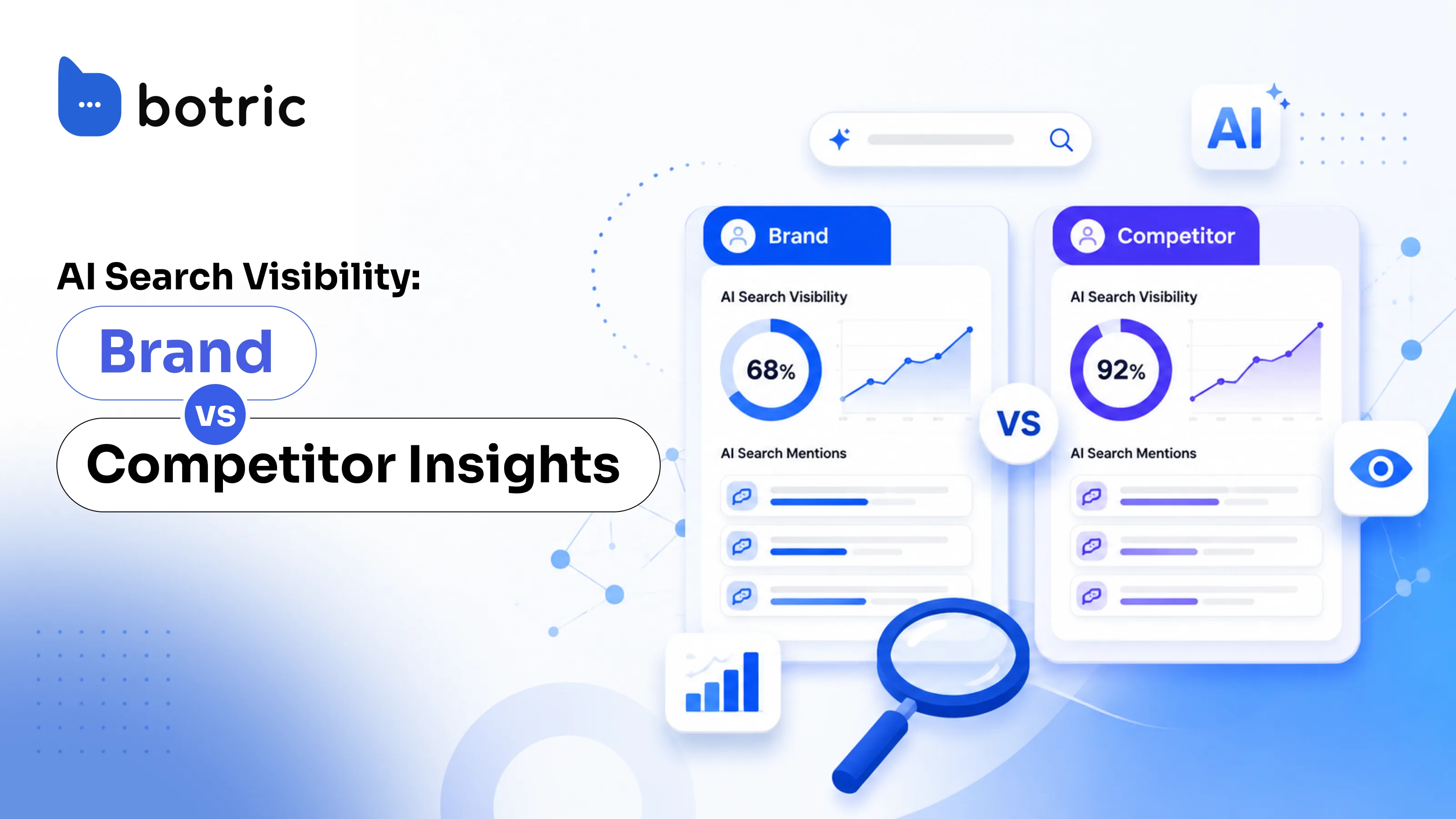
When someone asks ChatGPT, Gemini, or Perplexity to recommend a tool in your category, your brand either shows up or it doesn't. There is no page two. AI search is binary: included or invisible. With over 314 million daily AI users and only 16% of brands actively tracking how AI mentions them, most companies are blind to a channel that converts at 4.4x the rate of standard organic search.
What makes this harder is inconsistency. A brand can appear prominently in ChatGPT while absent from Gemini for the same query, AI models agree on the top recommendation just 43.9% of the time. This article examines two approaches to AI visibility: platforms like Botric that pair monitoring with conversion tools, and broader tracking platforms that cover multiple AI models. Understanding the tradeoffs helps you choose the right tool for your goal.
For foundational context on why brands go invisible in AI search, read our guide on why your brand isn't showing up in AI search results.
How AI Search Visibility Works
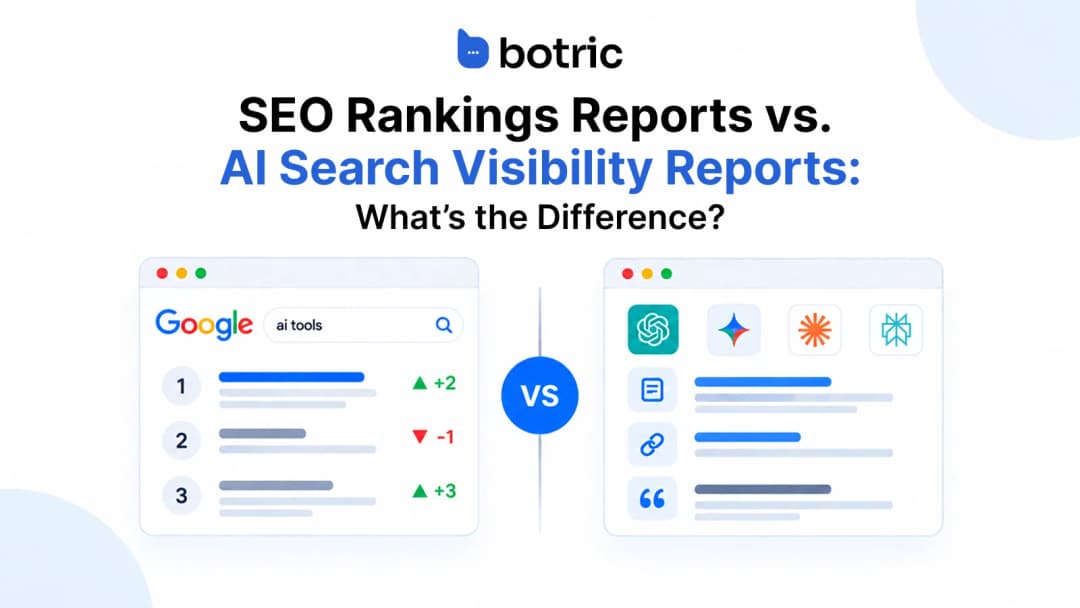
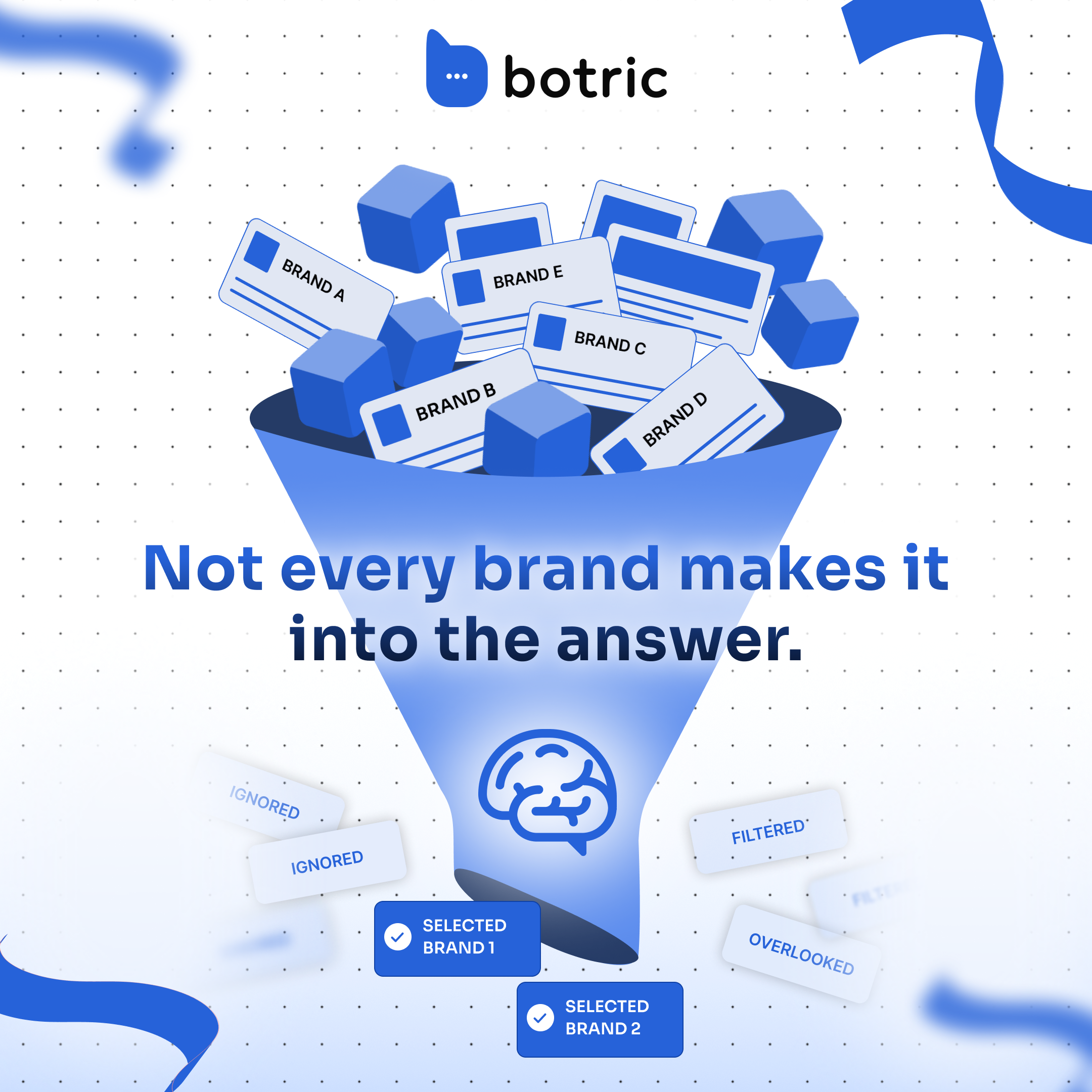
Unlike traditional search, AI tools do not rank pages, they generate answers. When a user asks a question, the AI synthesizes a response from a narrow pool of sources it considers credible and relevant. Your brand either makes it into that response or it does not.
This creates a visibility pattern that is fundamentally different from SEO:
- No ranking ladder, you cannot be position 6 and work toward position 1. You are cited or you are not.
- Platform variation, different AI systems draw from different training data and live sources. Presence in one does not mean presence in all.
- 14.5% inconsistency rate, even for the same query asked twice on the same platform, brands appear inconsistently due to the probabilistic nature of AI responses.
- Citation sources matter more than rankings, the third-party sites AI references are more influential than your direct domain authority
Traditional SEO dashboards cannot capture any of this.
For a comprehensive breakdown of the strategies that drive AI citations, see our guide on how to improve AI search visibility in 2026.
Botric: Visibility Monitoring with Built-In Conversion
Botric is designed to close the full loop, from tracking where your brand appears in AI-generated answers to engaging those AI-driven visitors with an AI chat agent.
AI Visibility Audits
Botric audits your brand's presence across ChatGPT, Gemini, Perplexity, Claude, Google AI Overviews, and Google AI Mode, returning a clear visibility score alongside a gap analysis that identifies exactly where competitors are being cited instead of you.
A practical example: a B2B SaaS company using Botric's managed service grew its AI visibility score from 0% to 72% in 90 days, generating 156 AI citations and a threefold increase in inbound demo requests.
One often-overlooked technical factor: GPTBot accounts for 57% of AI crawler traffic. If your robots.txt file blocks it, whether intentionally or through a default CDN configuration, your content is excluded from OpenAI's index regardless of how well it is written.
After running your Botric visibility audit, cross-check the findings against your robots.txt file. Any Disallow rule that references GPTBot, ClaudeBot, PerplexityBot, or OAI-SearchBot should be removed immediately. This is the most common single-fix that produces rapid visibility improvement.
Citation Tracking
Botric's citation tracking monitors how often and where AI platforms mention your brand compared to competitors. The system sends "Win Alerts" when your brand gains citations for valuable category-specific terms and flags gaps where competitors are consistently cited in your place.
This data feeds directly into Botric's Generative Engine Optimization (GEO) toolset, which surfaces specific content recommendations to help AI systems consistently recognize your brand as an authoritative source in your category.
Sentiment Analysis
Citation frequency is only part of the picture. Botric also evaluates whether AI platforms recommend your brand as a primary recommendation or as a secondary, hedged option, a distinction that directly affects conversion rates from AI-referred traffic.
Weekly competitor tracking reports show how your brand's positioning and citation trends evolve over time relative to rivals. Brands that maintain a consistent optimization program with Botric typically see a 3–5x boost in AI visibility by month six, with measurable movement beginning as early as month four.
Visitor Engagement Impact
Where Botric differentiates most clearly from pure monitoring tools is in what happens after a visitor arrives from an AI citation. The platform includes:
- AI chat agents trained on your brand voice and product details, engaging visitors immediately in your preferred tone
- Conversation-based handoff, the chat agent flags high-intent conversations and hands them to your sales team when a visitor is ready to talk
- CRM integration with Salesforce, HubSpot, and Pipedrive, so conversations flow directly into your existing pipeline without manual handoff
For a step-by-step guide to setting up Botric's AI chat agents, see our article on how to automate brand responses with AI chat agents.
Competitor AI Monitoring Platforms: Broad Coverage, No Conversion Layer
Established AI monitoring platforms like Semrush's AI Toolkit, Trakkr, and Ometrix take a cross-model approach, tracking brand mentions across a wider range of AI systems simultaneously.
AI Visibility Audits
Semrush's AI Visibility Score benchmarks how often your brand is mentioned compared to top industry competitors, with coverage across over 68,000 location and language configurations globally. This makes it particularly useful for brands managing visibility in multiple markets simultaneously.
"AI platforms don't rank pages, they give narratives and summaries. Brand Performance shows you how AI systems talk about your business, giving you the context to steer that perception in the right direction.", Semrush
These audits surface technical blockers that prevent AI crawlers from accessing content, but remediation is handled outside the platform.
Citation Tracking
Trakkr monitors millions of AI interactions daily across eight major models, refreshing data hourly. It identifies which authoritative domains are driving AI recommendations in your category and pinpoints citation gaps where competitors are winning mentions. Given that the top 10 domains account for 34% of all AI citations, identifying which off-site sources drive the most citations, and pursuing placements there, is a high-leverage strategy these platforms help identify.
Sentiment Analysis
Monitoring platforms go beyond counting mentions to evaluate how AI systems describe your brand. Semrush tracks "Key Business Drivers", whether AI associates your brand with attributes like "affordable," "reliable," or "innovative", and flags mismatches between your intended positioning and how AI actually describes you. Ometrix reports an 85% accuracy rate in sentiment analysis of brand mentions within AI responses.
Visitor Engagement Impact
Monitoring-focused platforms integrate with Google Analytics, Slack, and webhooks to connect visibility changes with measurable traffic outcomes. However, they do not include built-in chat agents, conversation tools, or CRM integrations. Translating visibility data into pipeline requires pairing these platforms with separate engagement tools, adding both cost and operational complexity.
Feature Comparison
| Feature | Botric | Competitor Monitoring Platforms |
|---|---|---|
| Audit Ease | Guided setup, thorough audits on paid plans | "Instant analysis" dashboards, minimal setup |
| Citation Tracking | Integrated with GEO recommendations | Advanced tracking, differentiates linked vs. plain mentions |
| Sentiment Analysis | Brand tone alignment and positioning | Tracks sentiment traits ("affordable," "innovative") |
| Visitor Engagement | Built-in AI chat agent, CRM integration | Requires external tools for engagement and conversion |
| Model Coverage | Six platforms: ChatGPT, Gemini, Perplexity, Claude, Google AI Overviews, Google AI Mode | Tracks 8–10+ AI models including Grok |
| Pricing | Free to start; paid plans from $12.50/month | $29/month to $100+/month depending on platform |
How to Choose Between Them
The decision comes down to what stage you are at and what outcome you are optimizing for.
- Monitoring and analysis first, if you are establishing baselines, benchmarking against competitors, or need multi-model coverage across global markets, a dedicated monitoring platform gives you the broadest data set
- Visibility to revenue, if you already understand the problem and want to fix citations, optimize content, and convert AI-driven traffic into pipeline without managing separate tools, Botric's integrated approach removes the stitching-together step
- Both, enterprise teams sometimes use a broad monitoring platform for competitive intelligence while using Botric for content optimization and customer engagement
Monitoring platforms excel at showing you the landscape in detail, where are we visible, where are competitors winning, which domains drive the most citations?
Botric answers a different question: what do we do about it, and what revenue results? The built-in GEO optimization tools, AI chat agents, and CRM integration mean that going from "we have a citation gap" to "we have a meeting booked" happens inside one platform.
"AI search visitors are worth 4.4x the average search visitor in terms of conversions.", Semrush
With AI-referred visitors converting at those rates, the platform you choose should reflect whether you are measuring the channel or actively building it. Measurement without conversion captures insight. Conversion without measurement lacks direction. The strongest approach combines both.
Conclusion
AI search visibility has become a separate discipline from traditional SEO, and one that most brands are not yet tracking systematically. The brands investing in AI citation monitoring and optimization now are building a compounding advantage: more citations lead to more traffic, more traffic leads to more external mentions, and more external mentions lead to more citations.
The choice of tooling depends on your current priority. If competitive intelligence and cross-model monitoring are the goal, dedicated monitoring platforms provide depth. If turning AI visibility into pipeline is the goal, Botric's integrated approach, from audit to citation tracking to CRM-connected customer engagement, removes the need to stitch together multiple tools.
Either way, the first step is the same: establish your baseline. Run a visibility audit across ChatGPT, Perplexity, and Gemini for your 20–30 most important buyer queries. That data turns AI visibility from an abstract concern into a specific, actionable plan.
For further reading, explore how to conduct a full AI visibility audit, see how to track AI citations for B2B SaaS specifically, compare the best GEO tools available in 2026, or review the best tools to rank in ChatGPT and AI search engines.
Key Takeaways
- AI search is binary: your brand is either in the answer or invisible.
- Visibility differs by platform, so track ChatGPT, Gemini, and Perplexity separately.
- The same prompt can return different brands, so judge trends rather than single runs.
- Monitoring shows you the gap; content and citation work is what closes it.
- Benchmark against named competitors to see who is taking the mentions you are missing.
Frequently Asked Questions
How do I know if AI tools are mentioning my brand at all?
The fastest way is manual: take your 10–15 most important buyer queries and run them through ChatGPT, Perplexity, and Gemini in incognito mode. Note whether your brand appears, where it appears (first mention versus secondary), and what competitors are cited instead. For scale and consistency over time, use an AI citation tracking tool like Botric that automates this across platforms and tracks changes week over week. An AI Visibility Score, measuring mention frequency, sentiment, and citation prominence, gives you a single metric to track progress against.
Why does my AI visibility change between ChatGPT and Gemini?
Each AI platform uses different training data, live retrieval sources, and ranking logic. ChatGPT may draw heavily from web search results through Bing's index, while Gemini integrates Google's data differently. The sources each model deems authoritative also differ, a domain that ranks highly in one model's training data may be absent from another's. This is why cross-platform monitoring is important: a 14.5% inconsistency rate in citations means appearing on one platform is not a proxy for appearing on others. Track each platform separately and prioritize the ones your buyers use most.
What should I do first to increase AI citations and conversions?
Start with a baseline audit. Before optimizing, you need to know your current citation rate across your target queries, which competitors are being cited in your place, and whether AI crawlers can even access your site. Check your robots.txt for blocked AI bots, add FAQPage and Organization schema to your key pages, and standardize your brand name and description across all third-party profiles. These three actions address the most common citation blockers and can produce measurable improvement within 4–6 weeks. From there, use citation gap data to identify which content needs to be created or restructured to close the remaining gaps.