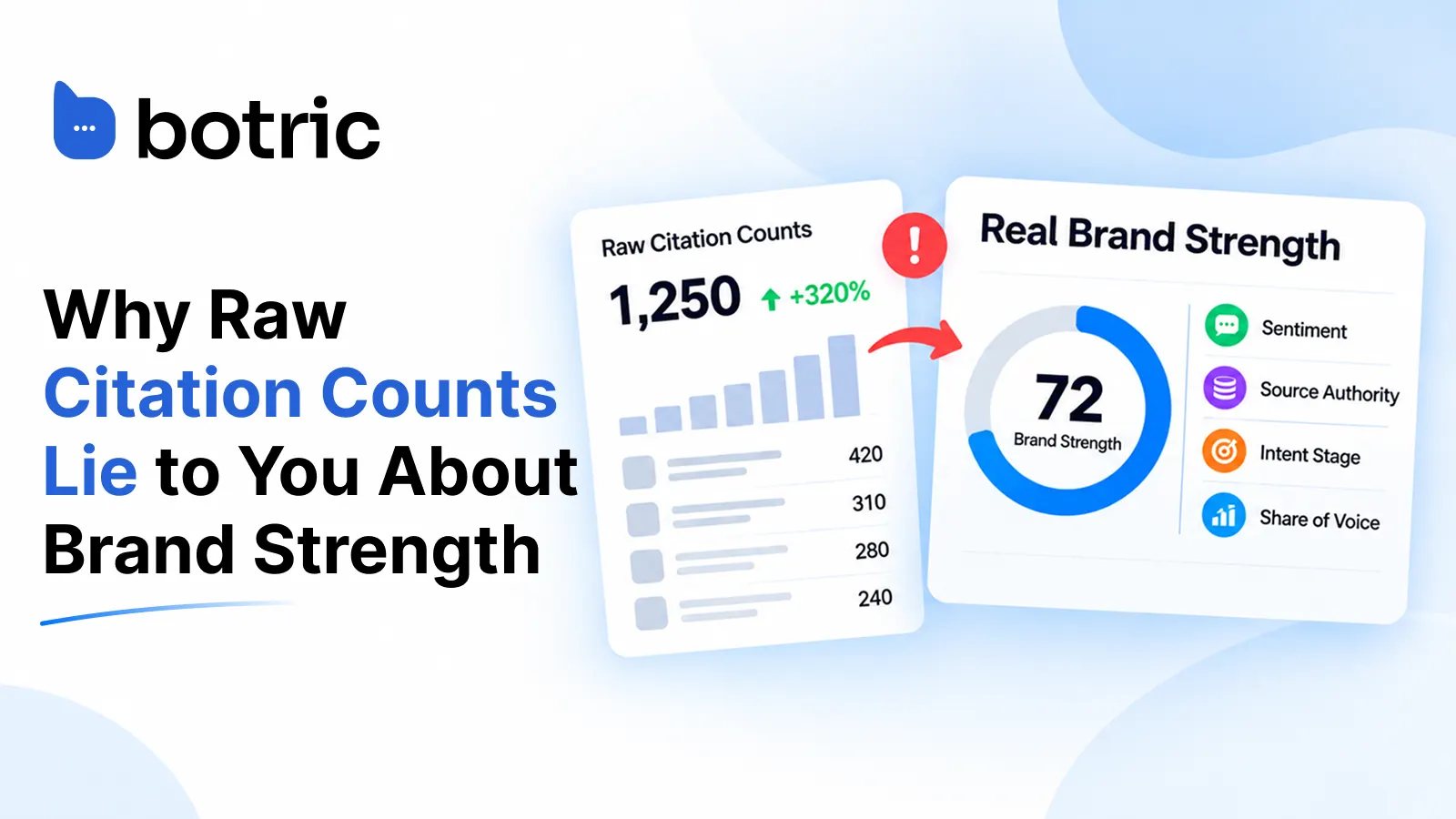
Citation volume alone is a vanity metric because it counts how many times AI engines mention your brand without measuring whether that mention helped or hurt you.
A brand with a high mention count can perform worse than one with far fewer mentions, if those fewer mentions sit inside buyer-intent answers.
A brand can double its AI mention count in a quarter and still lose market share, if those extra mentions sit in generic, top-of-funnel answers while a competitor wins the buyer-intent ones instead. Citation volume can't tell you that's happening. Four signals can:
- Sentiment: is the mention a plain recommendation, or hedged with a warning?
- Source authority: is it coming from a trusted, high-tier source, or a low-trust one?
- Intent stage: is the query top-of-funnel curiosity, or a buyer three steps from a decision?
- Share of voice: how does that stack up against the specific rivals your buyers actually compare you to, not the whole market?
Why citation volume is a misleading measure of brand strength
Citation volume answers only one question: how often did an AI engine say your name? It says nothing about where, why, or to whom.
Citation volume
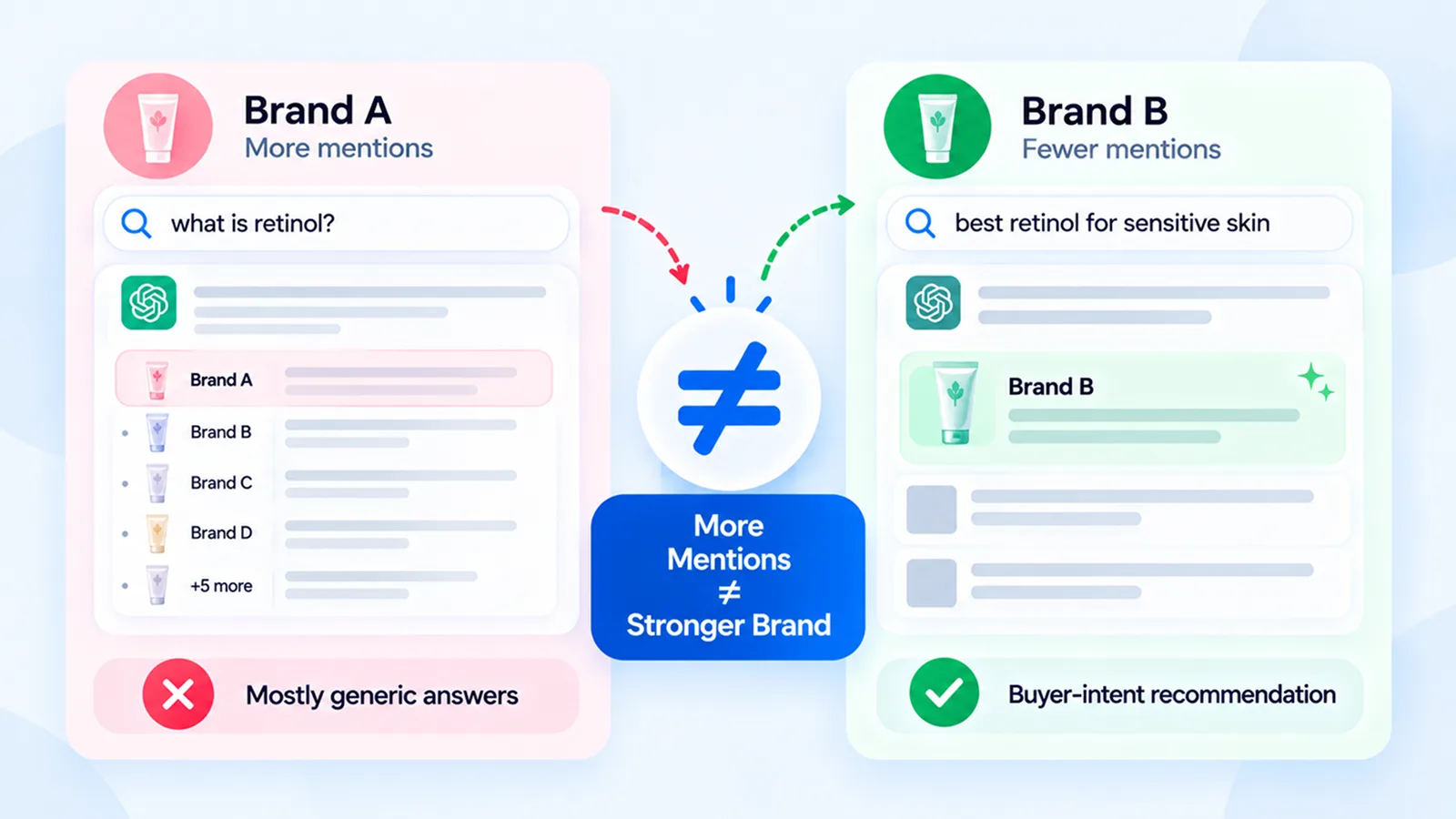
The raw count of times a brand or domain appears across tracked AI responses, with no adjustment for context or outcome. Picture two skincare brands. Brand A shows up often in AI answers, mostly generic "what is retinol" explainers where it's one of nine names listed.
Brand B shows up far less often, but most of its appearances are "best retinol for sensitive skin" style prompts where it's named first and recommended directly. Brand B is winning the business even though its count is a fraction of Brand A's.
This matters because the signal AI engines actually reward is different from footnote presence. What counts is whether your cited content actually shapes the answer, versus sitting in a footnote nobody reads. A citation that doesn't move the answer's substance is a vanity citation, and it's the exact trap volume-only tracking walks you into.
The business cost shows up quietly. Teams celebrate a quarter where mentions rose, then wonder why pipeline from AI referrals didn't move.
If you haven't checked which prompts are actually surfacing your brand, How to Find Which AI Prompts Mention Your Brand walks through the manual method for finding out before you trust any dashboard number.
What actually matters when you benchmark brand mentions?
The metrics that predict outcomes are sentiment, source authority, intent signal, and share of voice within your actual competitive set. Each one changes what a mention is worth.
Sentiment and source authority
A mention wrapped in hedging language ("X is an option, though users report onboarding issues") is worth less than a plain recommendation, even if both count identically in a raw tally.
Source authority compounds this: a mention from a high-authority page carries more weight than one from a low-trust page, the same way backlinks are weighted in traditional SEO.
AI share of voice breaks into two distinct measures worth telling apart: mention-based SOV, your share of the overall conversation, and citation-based SOV, your share of the authoritative sources actually driving AI traffic.
Intent signals and the funnel stage problem
A mention in "what is CRM software" carries almost no purchase intent. A mention naming a CRM as the pick for a small sales team on a tight monthly budget puts a buyer three steps from a decision. Two brands can post identical raw mention counts and sit in completely different competitive positions once you filter for this.
The number that matters isn't a percentage benchmarked against the industry, it's whether the queries triggering your mentions are the ones your actual buyers ask when they're close to a decision, not the top-of-funnel definitional queries everyone gets swept into.
Share of voice in your real competitive set
Share of voice measures your slice of the mentions among the specific rivals your buyers actually compare you to, not the whole market.
If why your brand isn't showing up in AI search results is a question you've been asking, the honest first step is checking whether you're even part of the comparison set AI engines pull from, before worrying about raw volume at all.
How to set up a benchmarking framework that catches what volume misses?
Building a framework that catches what volume misses means defining your competitive set, choosing signal categories, weighting them, then tracking consistently over time.
- Define your real competitive set. Don't just list direct competitors. Include the adjacent tools or content sources AI engines mention when a buyer is still comparing categories, not brands. Citation rate also tends to scale with company size and headcount, so benchmarking your own numbers against a company much larger than you will read as failure even when you're performing normally for your size band.
- Choose your signal categories. At minimum, track sentiment (positive, neutral, hedged, negative), source tier (analyst report, industry publication, forum, social), and intent stage (awareness, comparison, decision).
- Weight signals to your business model. A high-consideration B2B purchase should weight decision-stage intent and source authority heavily. A low-consideration consumer product can weight raw reach more.
- Score and track weekly. Build a simple matrix: rows are competitors, columns are your weighted signals, cells hold a 0 to 5 score per signal per engine. Re-run monthly at minimum, since engines drift and results are non-deterministic run to run.
| Competitor | Sentiment | Source Authority | Intent Stage |
|---|---|---|---|
| Your brand | 4 | 2 | 3 |
| Competitor A | 3 | 4 | 2 |
| Competitor B | 2 | 3 | 5 |
Reading that row by row: your brand earns warm sentiment but weak source authority, meaning the mentions are friendly but come from lower-trust sources. Competitor A trails you on sentiment but leads on authority, so its fewer mentions carry more weight.
Competitor B scores lowest on sentiment yet wins on intent stage, showing up mostly in decision-ready prompts, which is exactly the kind of gap a raw count would never reveal.
Once you can see gaps by signal instead of just by count, the next step is closing them, and how to automate brand responses with AI chat agents covers what happens after a visitor actually clicks through on one of those higher-intent citations.
| Signal | What it measures | Why volume misses it |
|---|---|---|
| Sentiment | Tone of the mention (endorsed vs. hedged vs. negative) | A count treats a warning and a recommendation identically |
| Source authority | Tier of the citing source | A forum post and an analyst report both count as "one mention" |
| Intent stage | Where in the funnel the query sits | Top-of-funnel noise inflates totals without adding pipeline |
| Share of voice | Your slice against named rivals | Absolute count says nothing about competitive position |
What traps do teams fall into when they rely on mention counts alone?
Teams fall into four recurring traps: chasing volume growth while share of voice actually shrinks, treating low-quality mentions as equal to authoritative ones, missing sentiment shifts hidden inside rising totals, and ignoring funnel stage entirely.
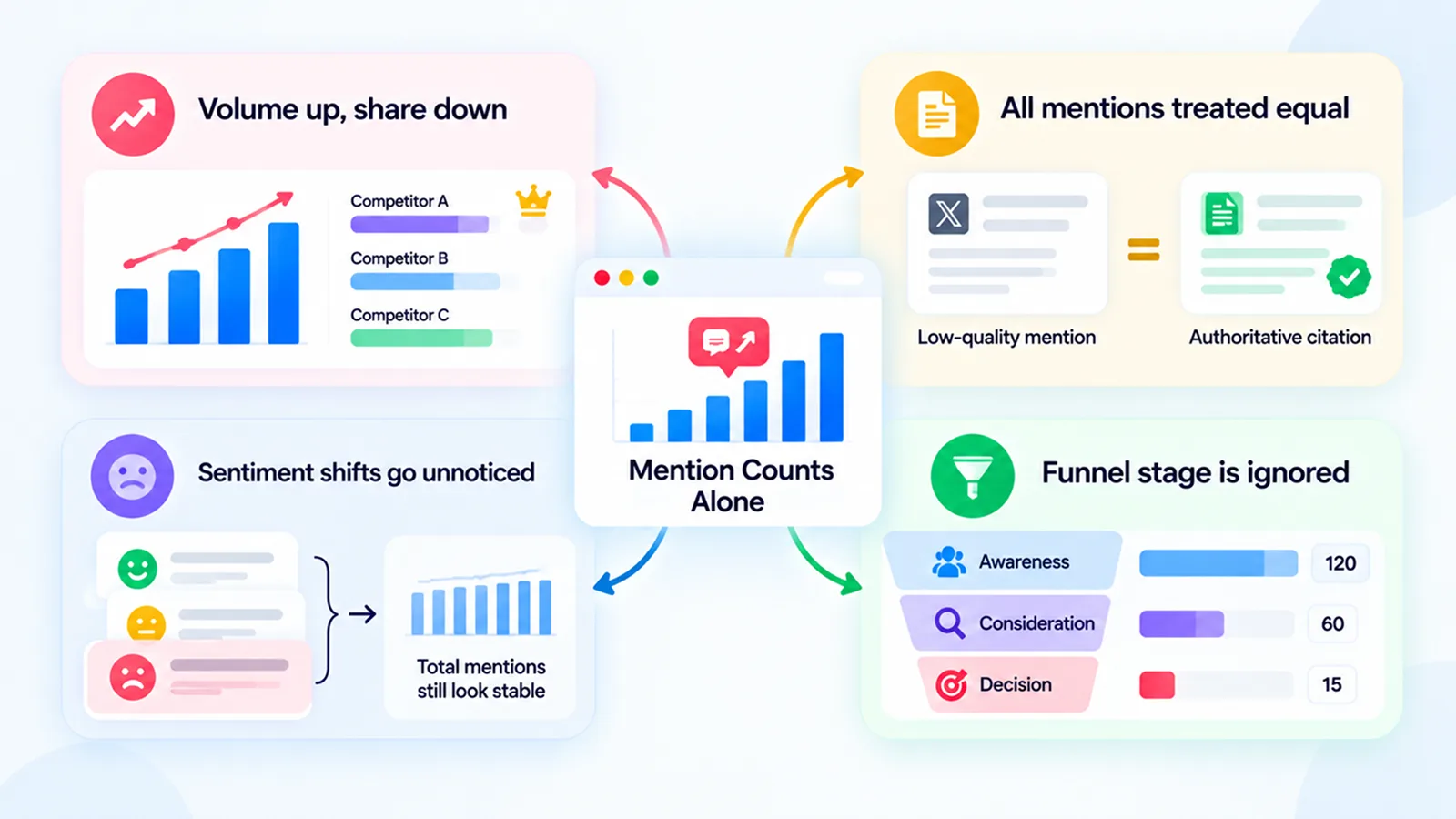
The first is the most dangerous because it looks like success on a dashboard. A brand's mention count climbs in a quarter, but three new competitors entered the space and each is winning a larger share of the decision-stage prompts. Total mentions up, market position down, and nobody notices until a sales team asks why AI-referred pipeline dried up.
The second trap treats every appearance as fungible. A bot-generated retweet mention and a named citation in an industry report get logged the same way in a basic counter, which flattens the exact distinction that predicts revenue.
The third is quieter still: aggregate sentiment can hold steady while a specific, high-visibility answer type turns hostile, and a volume-only view will never surface it, because the math averages the bad news away.
Conclusion
Raw citation counts will keep climbing as more brands get tracked and more engines get added to dashboards, which means the vanity-metric trap only gets easier to fall into, not harder.
The fix isn't more tracking, it's better tracking: sentiment, source tier, and intent stage layered on top of the same mention data you're already collecting.
Start with the gap that matters most to your business. If you're B2B and high-consideration, weight source authority and decision-stage intent first. If reach matters more than trust in your category, weight raw volume higher, but do it deliberately instead of by default.
- A single mention total tells you nothing about whether that mention was persuasive, authoritative, or even relevant to a buying decision.
- Sentiment, source tier, and funnel-stage intent are the three filters that turn a raw count into a usable competitive signal.
- Benchmark against your actual size band and named rivals, not an industry-wide average that mixes solo founders with enterprise leaders.
- Rising mention counts alongside shrinking share of voice is the clearest sign a team is optimizing for the wrong number.
- Teams serious about this should build a weighted scoring matrix now, before another quarter of volume growth masks a real competitive loss.
See where your brand's mentions actually sit, not just how many there are. Run Botric's free AI visibility audit to check sentiment, source authority, and intent stage against your real competitors before your next report goes out.
Frequently Asked Questions
How do I know if my current benchmarking is broken?
If your reports track a single mention count with no breakdown by sentiment, source tier, or query intent, it's broken by omission. A rising number that never correlates with pipeline or trial signups is the clearest tell something underneath it is masking losses.
Should I abandon mention tracking entirely?
No, mention tracking is still the entry signal, the same way impressions matter in advertising, but it needs the layered metrics above sitting on top of it to mean anything for a real decision.
How do I convince my team to move beyond volume?
Show them a scenario, not a lecture: pull two competitors with similar mention totals and demonstrate how differently they score on sentiment and source authority. Numbers convince faster than arguments do.
What's the difference between mention-based and citation-based share of voice?
Mention-based share of voice tracks your slice of the overall conversation, how often your brand comes up at all. Citation-based share of voice tracks your slice of the authoritative sources that actually drive AI traffic, which is the narrower and more predictive number.
Is a 40% mention rate always better than a 10% mention rate?
Not necessarily. A 10% rate concentrated in decision-stage, high-authority citations can outperform a 40% rate spread across generic definitional queries where no purchase intent exists.
Why do two brands with identical mention counts end up in different competitive positions?
Because the count says nothing about which queries triggered the mention or who else was named alongside the brand. One brand named first in five comparison queries beats another buried fifth in fifty generic ones.
What's the fastest way to spot a vanity-metric problem in my own reporting?
Pull your last month of tracked mentions and sort by query type. If most sit in top-of-funnel, non-competitive prompts, your headline number is inflated regardless of how good it looks on a slide.