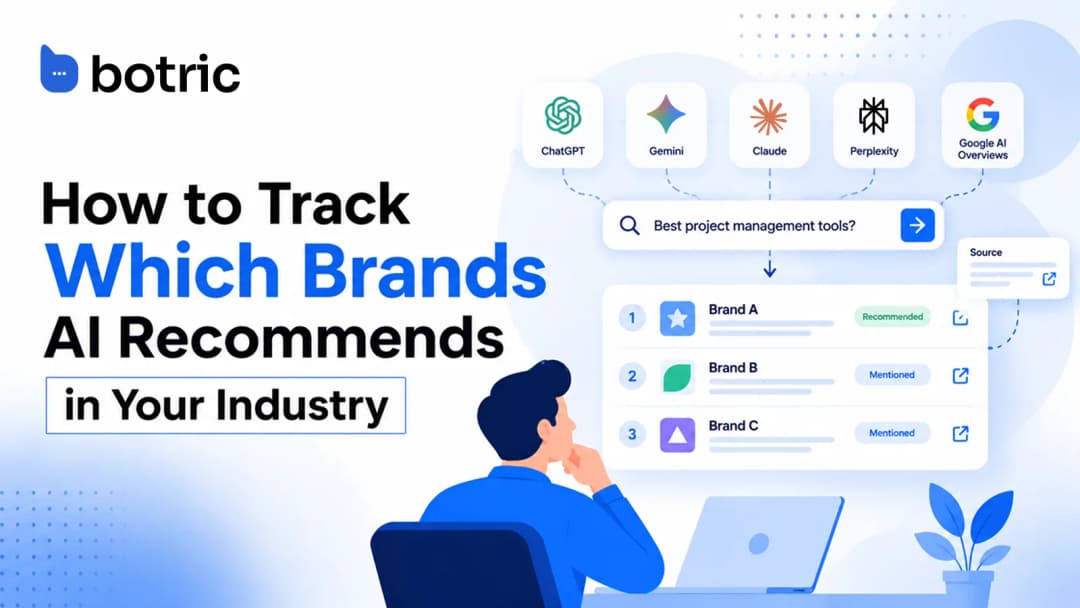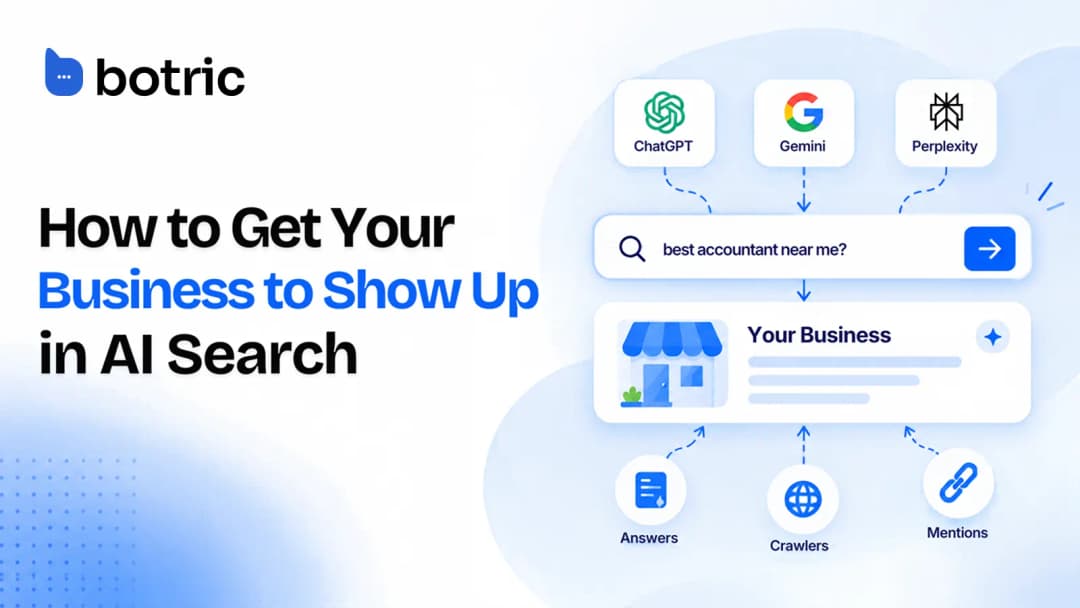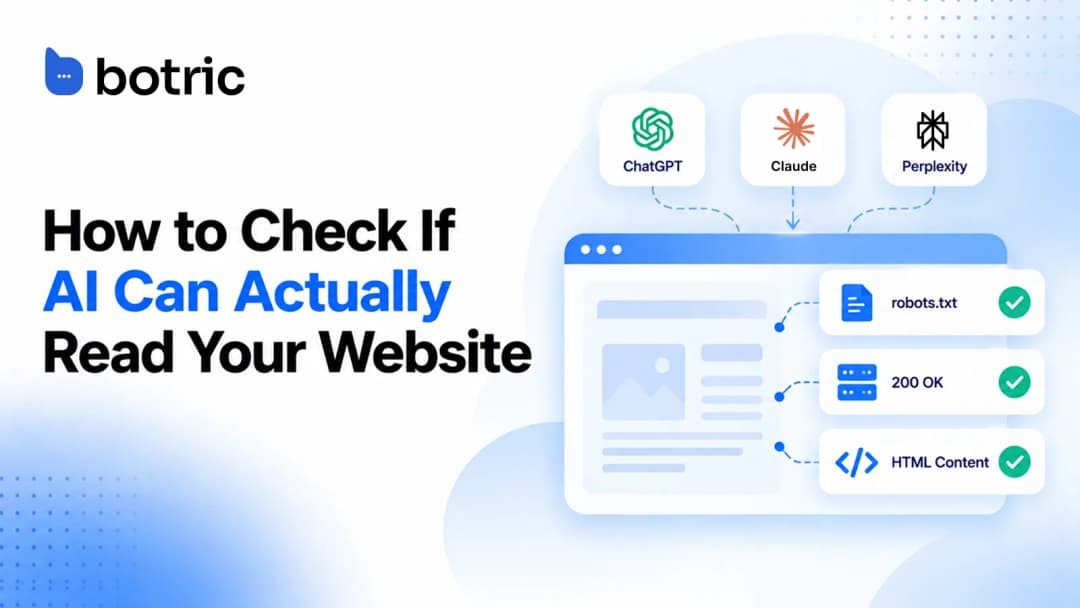
As more people use ChatGPT, Gemini, Perplexity, Claude, and Google AI Overviews to research products and find information, businesses need content that answers the questions people ask these platforms.
Strong AI search visibility starts with understanding those questions, providing useful information, and making that content accessible to search and AI systems.
That creates a different challenge for content teams. It is no longer enough to ask whether a page targets a keyword. Teams also need to know which questions customers ask AI, what information those answers rely on, whether their own content covers the need, and what changes are worth making.
AI content optimization connects those decisions. It covers choosing what to publish, creating helpful and verifiable content, improving existing pages, and measuring whether the work changes AI visibility. It applies to blog posts and educational articles as much as product pages, comparisons, documentation, and case studies.
This guide explains the process, provides a practical framework for deciding what to write or update, and demonstrates how the steps connect inside Botric.
Quick Answer
To optimize content for AI search, start with the questions your customers actually ask, not a checklist of AI-friendly formatting tricks. Identify relevant questions where your brand is missing or other sources are being cited.
Then decide whether a new article, an improved existing page, a product explanation, or stronger supporting evidence would best serve the question.
Create content that answers the question clearly, uses accurate and specific information, makes important claims verifiable, and is accessible to readers and search systems.
After publishing, monitor relevant buyer questions, brand mentions, and cited sources to understand how your content performs across AI search platforms and identify opportunities for further improvement.
What Is AI Content Optimization?
AI content optimization is the process of researching, creating, refining, and maintaining content so that it serves people looking for answers and can be discovered and used by AI-powered search experiences.
The phrase is sometimes used in two different ways:
- Using AI to optimize content: Employing AI to brainstorm, research, structure drafts, edit copy, or identify missing information.
- Optimizing content for AI search: Making website content useful and discoverable when AI systems retrieve sources, assemble answers, or recommend products.
Both can be part of the same workflow, but they are not interchangeable. An AI-generated article can be poorly researched and unhelpful. A carefully written human article can be valuable even if AI was not involved in its creation. What matters is the accuracy, usefulness, relevance, and accessibility of the published content.
Traditional SEO remains important. Useful pages still need to be accessible, linked sensibly, and understandable to search systems. AI search optimization builds on those fundamentals while paying closer attention to answer-level visibility: whether the brand is mentioned, whether the website is cited, and which questions the source actually helps answer.
Google's official AI search optimization guidance emphasizes helpful, original content, crawlability, and established SEO practices. Google does not require special AI-specific markup, llms.txt files, or manually divided content sections for inclusion in its generative Search features.
How to Use Botric for AI Content Optimization
A useful optimization platform should help answer four connected questions: What is missing? What should we create or change? How do we prepare it for publication? Did the visibility change afterward?
Botric's AI Visibility and Content Agent features help businesses identify content opportunities, create and optimize content, and track AI search performance.
1. Find Gaps and Prioritize Recommendations
In AI Visibility (GEO), Botric displays recommendations organized by topics such as brand accuracy, content coverage, search intent, trust, and website structure.
The interface distinguishes impact levels, effort, quick wins, and suggested actions. These help teams form an ordered work queue rather than treating every issue as equally urgent.
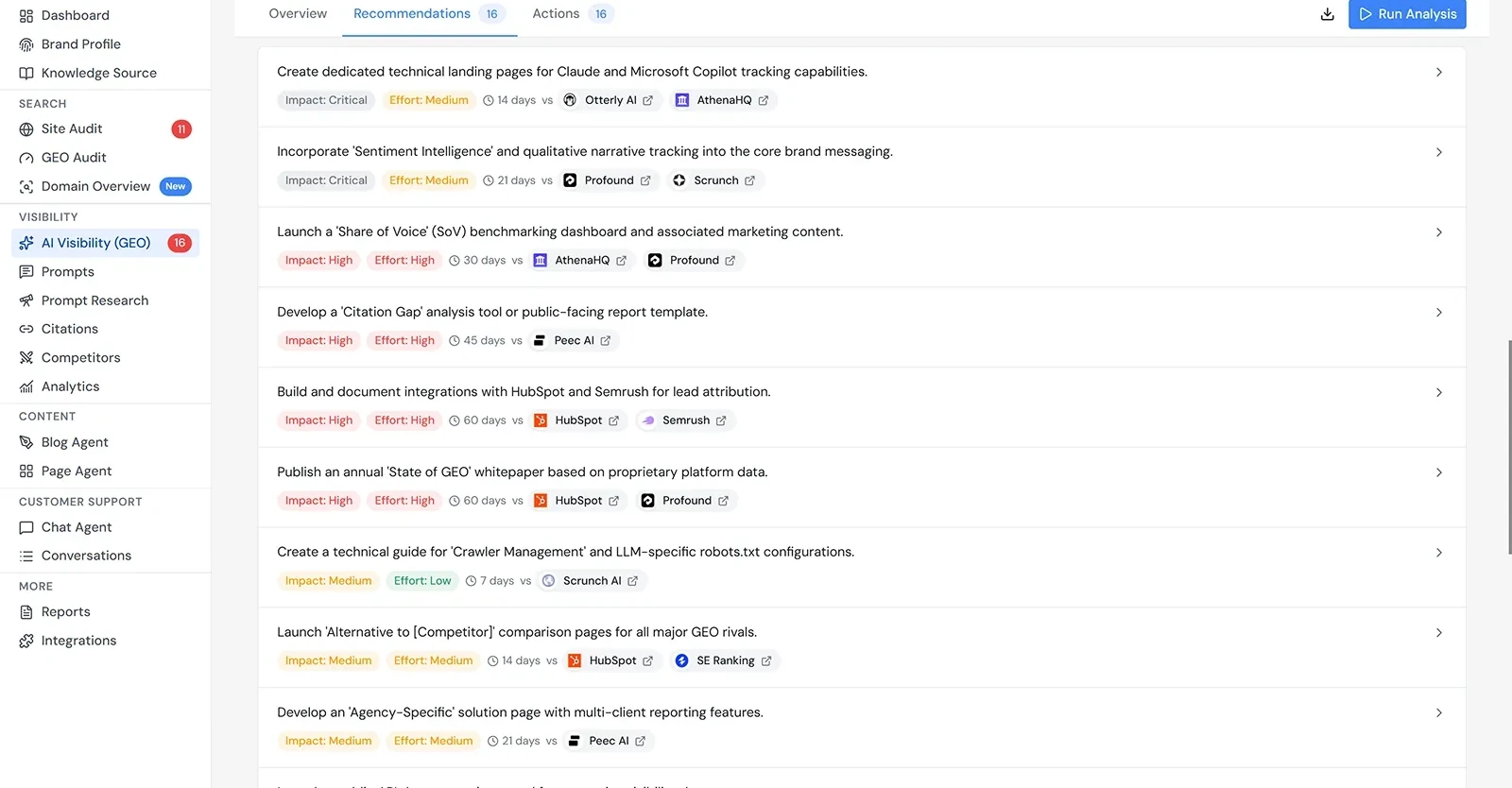
Some recommendations are based on how AI answers describe or omit facts about the brand. Review each suggestion against your actual products and business priorities.
Use Botric's impact and effort estimates to prioritize content improvements based on their relevance, potential value, and implementation requirements.
2. Turn a Relevant Prompt Gap Into a Content Task
The prompt-detail view shows whether the brand was mentioned or cited in monitored responses, the sources available for inspection, and historical checks. The visible interface also offers Send to Content Agent for an identified opportunity.
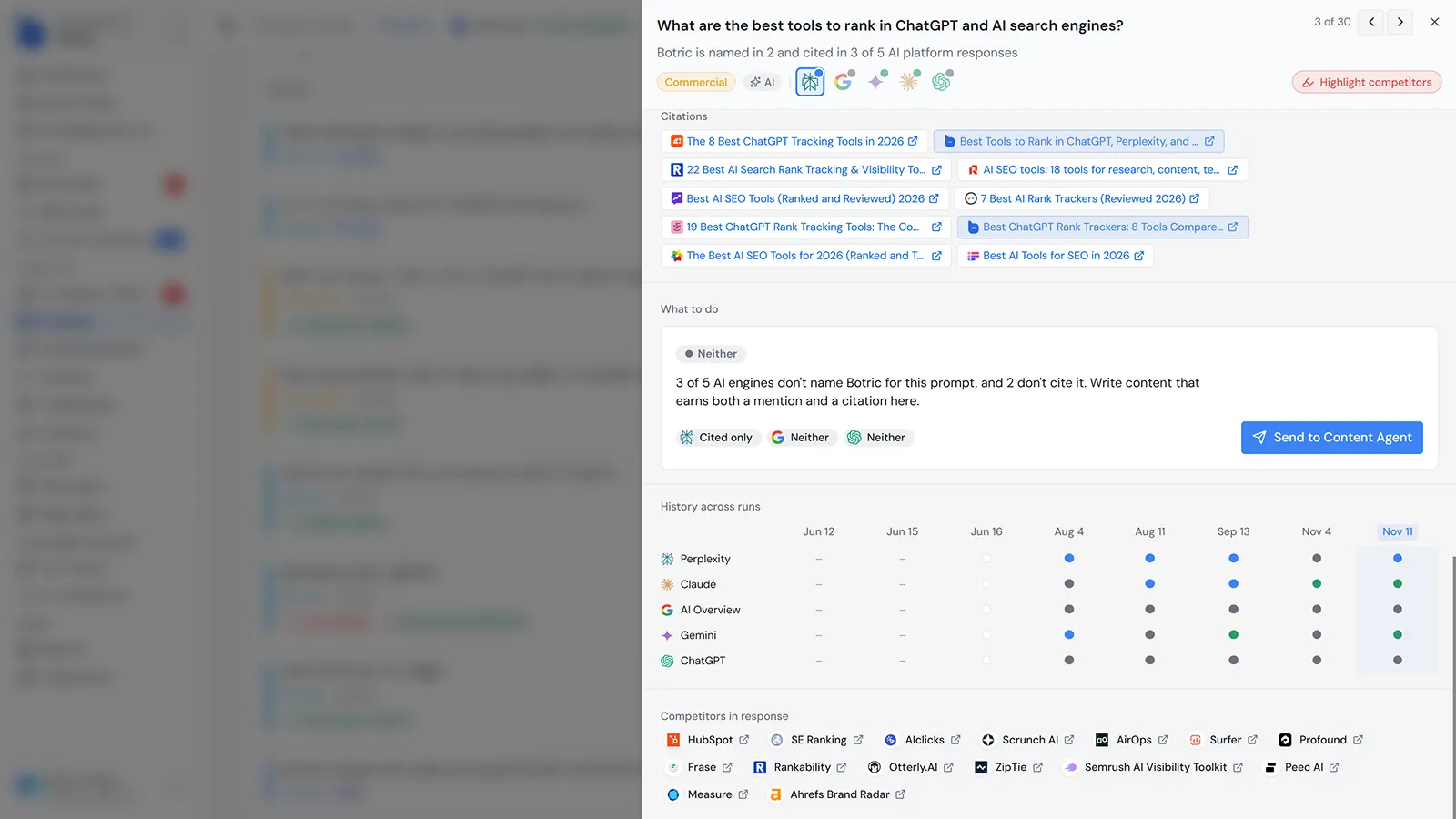
That connection is particularly useful when a question is commercially relevant and the current website lacks a good destination for it. A repeated omission may justify improving an existing page; a clearly different buyer question may justify a new piece of content.
3. Plan and Draft New Articles With Blog Agent
Blog Agent helps users generate SEO- and GEO-optimized blog articles based on their own topics or content opportunities identified through AI visibility tracking.
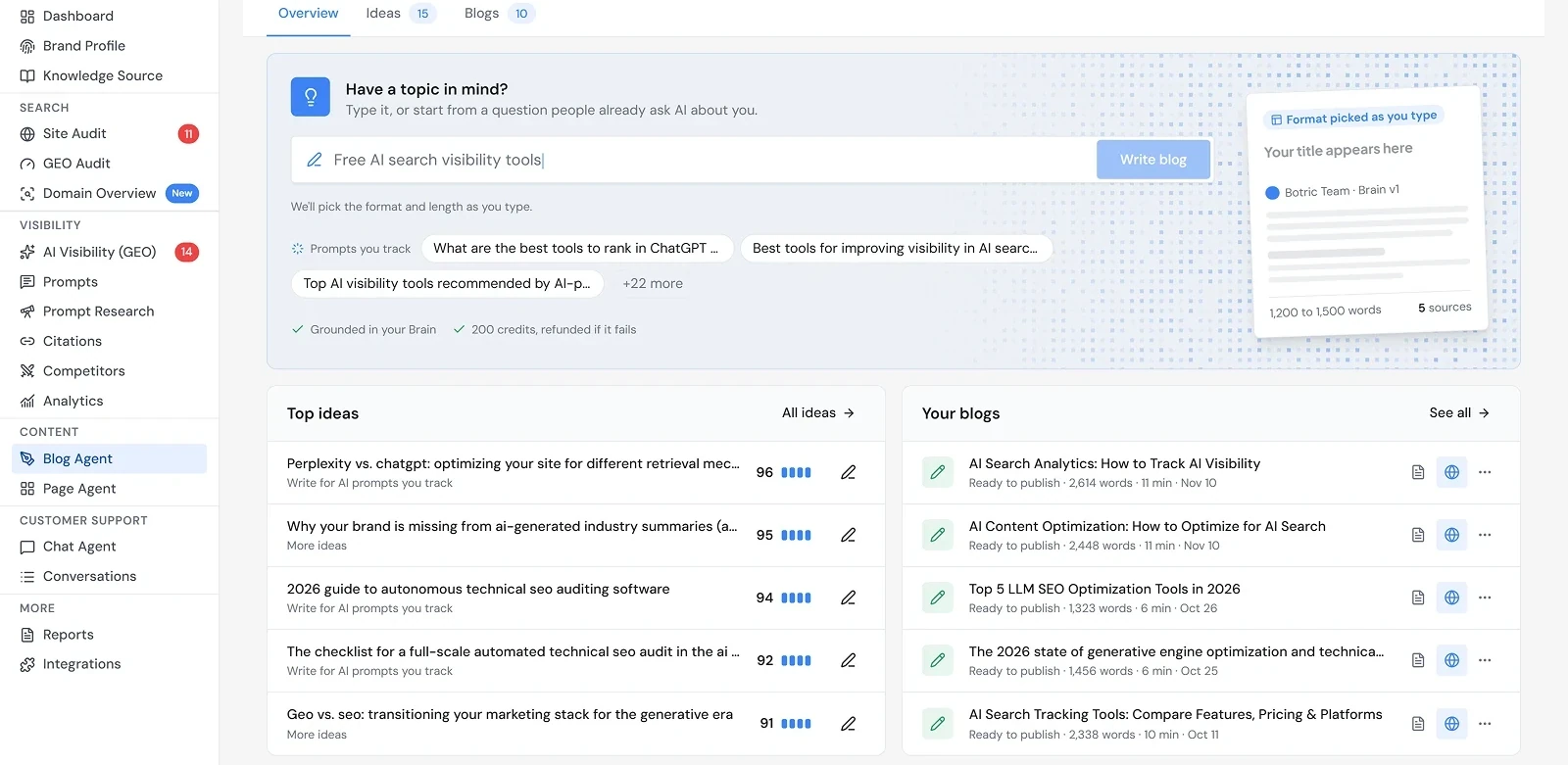
It uses brand context, relevant research, and supporting sources to create structured, comprehensive articles designed for Google Search and AI search engines. Users can review generated content, assess its SEO and GEO scores, and refine articles before publishing.
4. Improve Existing Pages With Page Agent
Page Agent analyzes existing website pages, identifies technical and content issues, and organizes recommendations by severity and page grade. Users can review proposed improvements to metadata, headings, structured data, and other supported page elements, then prepare changes for implementation.
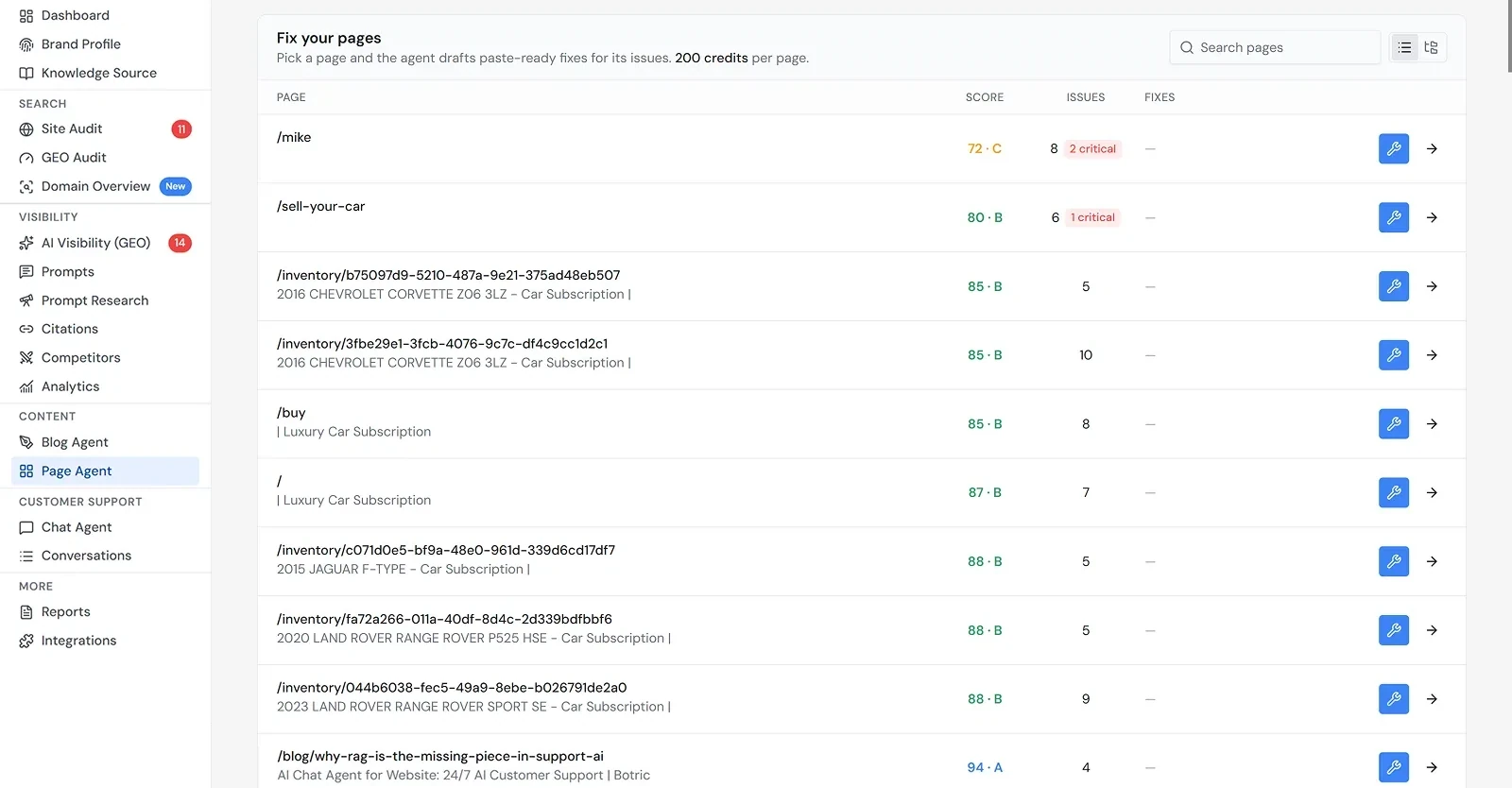
Review Page Agent's recommendations before implementation to ensure each change matches your website and business requirements. Fixing redirects, outdated information, and content issues can improve page quality, accessibility, and discoverability.
5. Publish, Monitor, and Reassess
After publishing or updating the content, use the tracked prompts and citations to examine whether the brand and site appear more often in relevant answers. Look at the exact page URLs cited, the surrounding context, and repeated results over time.
Use website analytics to understand any identifiable traffic effects, without treating referral traffic and AI citations as identical metrics.
Botric connects AI visibility monitoring with content creation and optimization. Insights from tracked prompts, citations, and content gaps help guide the Blog Agent to create new content and the Page Agent to improve existing pages. Ongoing monitoring then helps measure visibility changes and identify the next opportunities for improvement.
How AI Search Engines Extract and Use Content to Generate Answers
AI search systems use different methods to find, retrieve, and interpret information before generating answers.
Depending on the product and the question, an assistant may answer from information learned during training, retrieve fresh sources through search, or combine both. Website content can support AI-generated answers through retrieval and grounding, independently of the model's original training process.
For source-backed answers, a common design is retrieval-augmented generation (RAG). A search or retrieval system finds relevant information and supplies it as grounding context to the language model, which then produces an answer.
Google describes grounding and query fan-out in its guidance for generative AI search; Microsoft's RAG documentation describes how indexes, passages, and language models work together. The exact methods and source-selection rules are different across platforms and are not fully public.
1. Discovery: Can the system access the page?
Before a page can appear as a source in an indexed search experience, a discovery system needs to find and access it. Search engines commonly discover pages through internal links, sitemaps, and other references. Depending on the platform, content may come from an existing search index or from a search or browsing tool used during the answer.
For Google AI Overviews and AI Mode, a supporting page must be indexed and eligible to appear in Search with a snippet. Eligibility does not guarantee inclusion. Important content should be available in accessible page text, served on the intended canonical URL, and not inadvertently hidden behind access restrictions or blocked resources. Other AI products have their own retrieval and crawler rules.
2. Extraction: What information can be read from the page?
After retrieval, a system can process the page's text and available context, including titles, headings, paragraphs, lists, tables, and links. Some systems also process rendered content, documents, or images. Not every answer requires reading an entire document, and the amount of content available to the model depends on the retrieval system.
In many RAG implementations, larger documents are divided into passages or chunks so that relevant parts can be searched and supplied to the model. Search may use keyword matches, semantic representations called embeddings, or a combination.
The important editorial implication is not to force every article into tiny paragraphs. It is to keep essential facts readable, correctly labeled, and understandable without relying on surrounding marketing language. Google explicitly says publishers do not need to manually “chunk” their pages for AI Search.
3. Retrieval: Which information matches the user's question?
When a user asks a question, a search-enabled assistant can look for passages relevant to the intent. Retrieval systems may combine exact terms with meaning-based matching, then rank or rerank the results for relevance.
A page that mentions a topic is not necessarily the most useful source for a specific question: an accurate integration guide, for example, may serve a compatibility question better than a broad product overview.
Some systems also use query fan-out, breaking a complex question into related searches. A buyer asking whether a platform can monitor AI citations alongside website traffic might trigger searches about citation tracking, analytics integrations, and referral attribution. These are possible subquestions, not a public record of the actual searches an assistant will always run.
For content planning, cover the important buyer decisions with a sensible combination of product information, guides, comparisons, and documentation.
Group related fan-out questions into comprehensive content that serves the broader topic, creating separate pages when the search intent is meaningfully different.
4. Grounding: How does the model use the retrieved passages?
In a grounded response, the selected passages or source descriptions are included in the context given to the language model. The model can use them to identify facts, compare information, and form an answer.
Retrieved sources may disagree or omit an important detail, so the resulting answer can be incomplete or inaccurate even when retrieval is working.
This is why verifiable product information matters. If your integration page states what is supported, what requires configuration, and what is not available, it gives both readers and the model clearer evidence than a claim such as “connect everything in one dashboard.” Keep key facts consistent across product pages, documentation, pricing, and supporting articles.
5. Answer generation: What gets mentioned or cited?
The model generates its response using the available context and other information permitted by the product.
A citation may point to a source that supports an explanation; a brand mention may appear without a link; and a relevant retrieved page may not appear in the final answer at all. Retrieval, citation, brand recommendation, and website traffic are separate outcomes.
For example, a guide about measuring AI referral traffic could be cited as an educational source without the assistant recommending the company that published it. Conversely, an assistant could recommend a software product while linking to a third-party comparison rather than the vendor's website. That is why content teams should monitor both what is said and which URLs are used as evidence.
| Stage | What may limit content use | What a publisher can improve |
|---|---|---|
| Discovery | Page is inaccessible, improperly canonicalized, or hard to find | Verify technical access and relevant internal links |
| Extraction | Important facts appear only in ambiguous or inaccessible formats | Make specifications and explanations readable and well labeled |
| Retrieval | Content does not directly serve the buyer's question | Match the page's purpose to a distinct search intent |
| Grounding | Sources contain outdated, incomplete, or conflicting details | Maintain accurate product facts and supporting evidence |
| Answer and citation | Another source is more useful, or the answer does not display a citation | Inspect real answers and cited URLs before deciding what to change |
Find the Content Opportunities That Matter to Buyers
The strongest content opportunities often combine relevant search demand with questions that influence customer decisions.
It may be a question that comes up during a purchase decision but is missing from your website or answered more convincingly by another source.
Start With Real Customer Questions
Look at sales calls, demo requests, support conversations, onboarding friction, site search, customer objections, and relevant Google Search Console queries. Group questions by intent:
| Buyer intent | What the reader needs | Content that may help |
|---|---|---|
| Understand a problem | Explanation, consequences, possible approaches | Educational article or guide |
| Explore a solution category | Capabilities, use cases, selection criteria | Category explainer or use-case page |
| Evaluate a product | Accurate features, integrations, limits, pricing | Product, feature, pricing, or documentation page |
| Compare choices | Clear trade-offs and decision criteria | Comparison article or product comparison page |
| Validate a decision | Real-world evidence, setup details, risks | Case study, methodology, implementation guide |
Branded prompts show how a system describes a company it already knows. Non-branded questions are especially useful for finding discovery gaps, because buyers may not yet know which vendor they want.
For example, you can use Botric's prompt tracking to monitor a buyer question such as "Which tools help track brand citations in AI search?" Review how ChatGPT, Gemini, and other supported platforms respond, which brands appear, and which sources they cite. These insights can help identify relevant questions your existing content has not adequately addressed.
Inspect Mentions and Cited Sources Separately
For a small, consistent set of relevant questions, track which brands appear in AI-generated answers and which URLs are cited as supporting sources. Check across multiple AI platforms and repeat the process periodically, since responses can vary between searches.
When reviewing the results, focus on four possible scenarios:
- Brand mentioned and own site cited: Both your brand and website appear in the answer. Check whether the cited page addresses the buyer's next question or need.
- Brand mentioned, external source cited: Your brand appears, but a third-party website supports the information. Review whether your own pages clearly document the same facts.
- Own page cited, brand not mentioned: AI uses your content as a source without explicitly naming your brand. Check whether the cited page clearly communicates your brand, product, and relevance to the question.
- Neither mentioned nor cited: Your brand and website are absent from the monitored answer. Examine topic relevance, content gaps, discoverability, and results from repeated checks.
A missing citation doesn't necessarily mean your content is poorly optimized. The question may not closely match your page, another source may provide stronger evidence, or the AI platform may simply have selected different sources for that particular response.
Decide Whether to Create, Update, Consolidate, or Leave Content Alone
Before assigning a writer, examine what already exists on your website.
Publishing multiple articles that serve substantially the same search intent can create unnecessary overlap, make internal linking decisions harder, and leave readers unsure which page provides the most complete answer.
| Situation | Better decision | Reason |
|---|---|---|
| An existing page answers the topic but misses important buyer questions | Update | The page has the right purpose; improve its usefulness |
| No page serves a genuinely distinct use case or comparison | Create | A new intent deserves its own destination |
| Multiple articles substantially repeat the same answer | Consolidate | One stronger resource can be easier to maintain |
| The gap comes from outdated product facts | Correct the source page | Canonical product information should be accurate first |
| The topic is low-relevance or already well served | Leave it alone | Not every observed absence deserves content production |
A particularly common mistake is writing a new blog post to correct information that should live on a pricing, feature, integration, or documentation page. Maintain the primary source first, and use supporting articles to add useful explanations.
How to Create Content Optimized for AI Search
Effective AI content optimization starts with a clear understanding of the reader's question. Build each article around useful answers, accurate information, relevant examples, and enough supporting detail to cover the topic properly.
1. Build a Brief Around the Reader's Decision
Before writing, build a content brief around six elements: the target audience, primary buyer question, search intent, related questions, information requiring verification, and the action readers should be able to take after reading.
Review existing website content to avoid creating another page that serves the same intent. For AI search optimization, also examine relevant cited sources to understand which questions and evidence deserve coverage.
Botric's Blog Agent can help turn this research into a draft. Start with a content opportunity identified through AI visibility tracking or enter your own topic, then provide writing instructions, select the audience and language, and add reference links. Review the generated article for accuracy, coverage, and relevance before publishing.
2. Provide Information Other Pages Cannot Easily Substitute
Original screenshots, documented procedures, product specifications, test conditions, customer questions, and case-study methodology can be more valuable than generic claims. Explain what was done and what the evidence actually supports.
If you cite an external statistic, link to its primary source when possible. Do not present estimates as established facts, and avoid repeating unsupported numbers solely because they are common in other GEO articles.
3. Make the Answer Easy to Understand
Use descriptive headings, direct explanations, logical sections, and tables where readers need to compare facts. Introduce the answer promptly, then provide enough context for readers to evaluate it.
4. Review the Draft Like a Subject-Matter Editor
Before publication, check whether every product claim is current, examples have enough context, comparisons are fair, internal links point to the correct destination, and the article actually answers the main question. Remove repetitive sections that offer no new information.
Using an AI writing assistant can speed up drafting, but the editorial review remains essential. Google's published policy cautions against producing scaled, low-value pages regardless of whether people or AI systems generated the text.
How to Improve Existing Content for AI Visibility
Existing articles and website pages can often be improved by identifying missing information, strengthening important sections, and updating content to better address relevant buyer questions.
- Confirm what the page is supposed to accomplish. A how-to guide should teach; a feature page should document the product; a comparison should help readers choose.
- Check factual accuracy and completeness. Look for outdated specifications, missing integrations, ambiguous pricing, unverified claims, and questions the current page leaves unanswered.
- Inspect important sections. Make the main answer findable, replace vague language with specific facts, and add examples or tables only where they improve understanding.
- Check technical access and internal links. Verify that the canonical page is available, content is rendered, and relevant links lead directly to the intended URL.
- Measure after publication. Use the same prompt set and monitoring conditions where possible, then compare repeated observations rather than relying on a single answer.
For existing pages, Botric's Page Agent helps identify opportunities to improve content and on-page SEO. It analyzes pages, highlights issues by severity, and provides suggested fixes for elements such as metadata, headings, and structured data. You can review these recommendations and prioritize changes that improve the page's accuracy, structure, and relevance.
How Different Website Content Should Be Optimized
Different types of website content serve different purposes. Each should be structured around its audience, the questions it answers, and the information readers need to make a decision.
| Content type | What to make clear | What to avoid |
|---|---|---|
| Blog posts and educational guides | Definitions, steps, examples, evidence, related questions | Generic claims and unnecessary repetition |
| Product and feature pages | Who it's for, what it does, limitations, pricing or plan requirements where relevant | Vague superlatives and undocumented capabilities |
| Comparison pages | Criteria, strengths, limitations, accurate product details | Biased or unsupported claims |
| Integrations and documentation | Compatibility, prerequisites, setup, troubleshooting | Outdated steps or unclear version requirements |
| Case studies | Baseline, timeframe, methods, results, caveats | Results without attribution or context |
| FAQs | Genuine customer questions with precise answers | Repeating the article without adding clarity |
A product page that clearly explains an integration may be more useful for an integration-related answer than a generic thought-leadership article. Similarly, a comparison question needs criteria and trade-offs, not another introductory definition.
What Makes Content Useful for AI Search Citations?
Content is more useful as a source when search systems can access it and readers can verify the information it provides. Focus on relevance, factual accuracy, clear explanations, and evidence that directly supports the question being answered.
- Discoverability: Make important content accessible and well connected within your site. Review platform-specific crawler documentation before changing robots.txt rules.
- Relevance: Answer the actual question and its meaningful subquestions, rather than repeating the same target keyword.
- Specificity: Publish product capabilities, conditions, steps, and evidence that readers can verify.
- Trust: Use accurate authorship, clear provenance, appropriate references, and up-to-date details.
- Appropriate structure: Organize content for easy reading. Tables, FAQs, and structured data should reflect the material, not be added as artificial ranking tricks.
- Independent validation: When relevant, legitimate reviews, expert coverage, and third-party explanations may supply useful context, but they should not replace accurate information on your own site.
Google says its AI search features do not require separate AI-specific files or special schema to be eligible. Structured data should match visible content and established feature requirements. Claims that fixed paragraph lengths, fresh publication dates alone, or an llms.txt file automatically produce citations should be treated skeptically.
How to Measure AI Content Optimization Results
Measure AI content optimization results based on what each content update was intended to improve. To evaluate performance, track the following metrics:
- Brand Mention Rate: Measure the percentage of monitored AI responses that mention your brand. Remember that tracked prompts represent a sample, not every search users make.
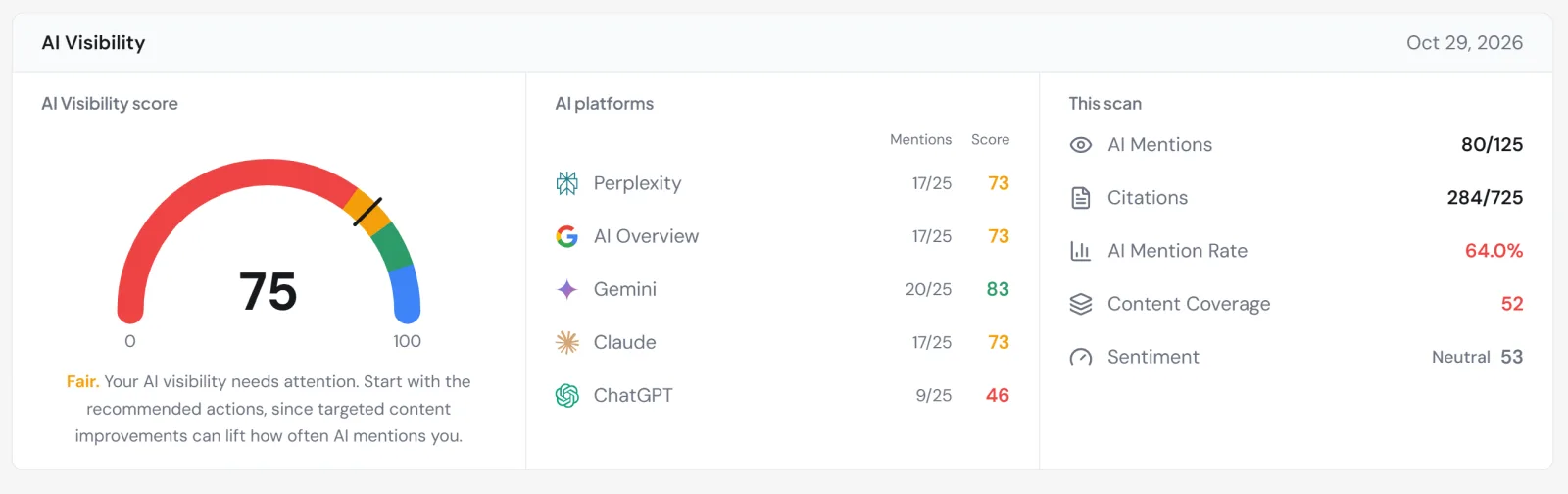
- Owned-Domain Citation Rate: Track how often AI platforms cite pages from your website. A citation indicates that your content was used as a source, but doesn't necessarily mean your brand was recommended.
- Cited URLs: Identify which website pages appear as sources for your target questions. Compare results across AI platforms, since cited pages can change between responses.
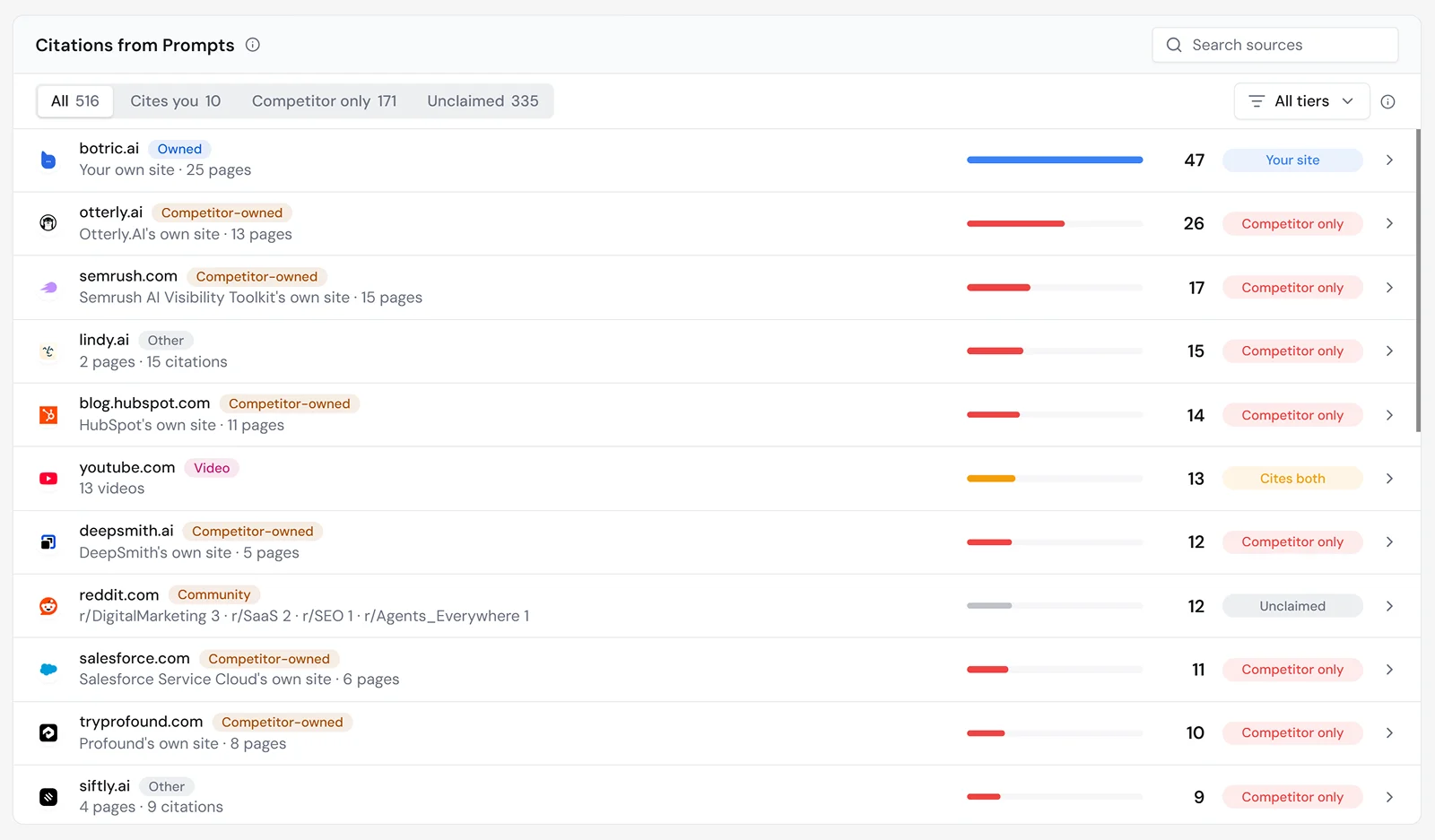
- Buyer-Intent Coverage: Monitor brand mentions and citations for relevant non-branded questions. This helps determine whether potential buyers can discover your brand without searching for it directly.
- AI-Assistant Referrals: Use website analytics to measure identifiable visits from AI platforms and the landing pages receiving that traffic. Keep in mind that analytics cannot capture every interaction influenced by AI answers.
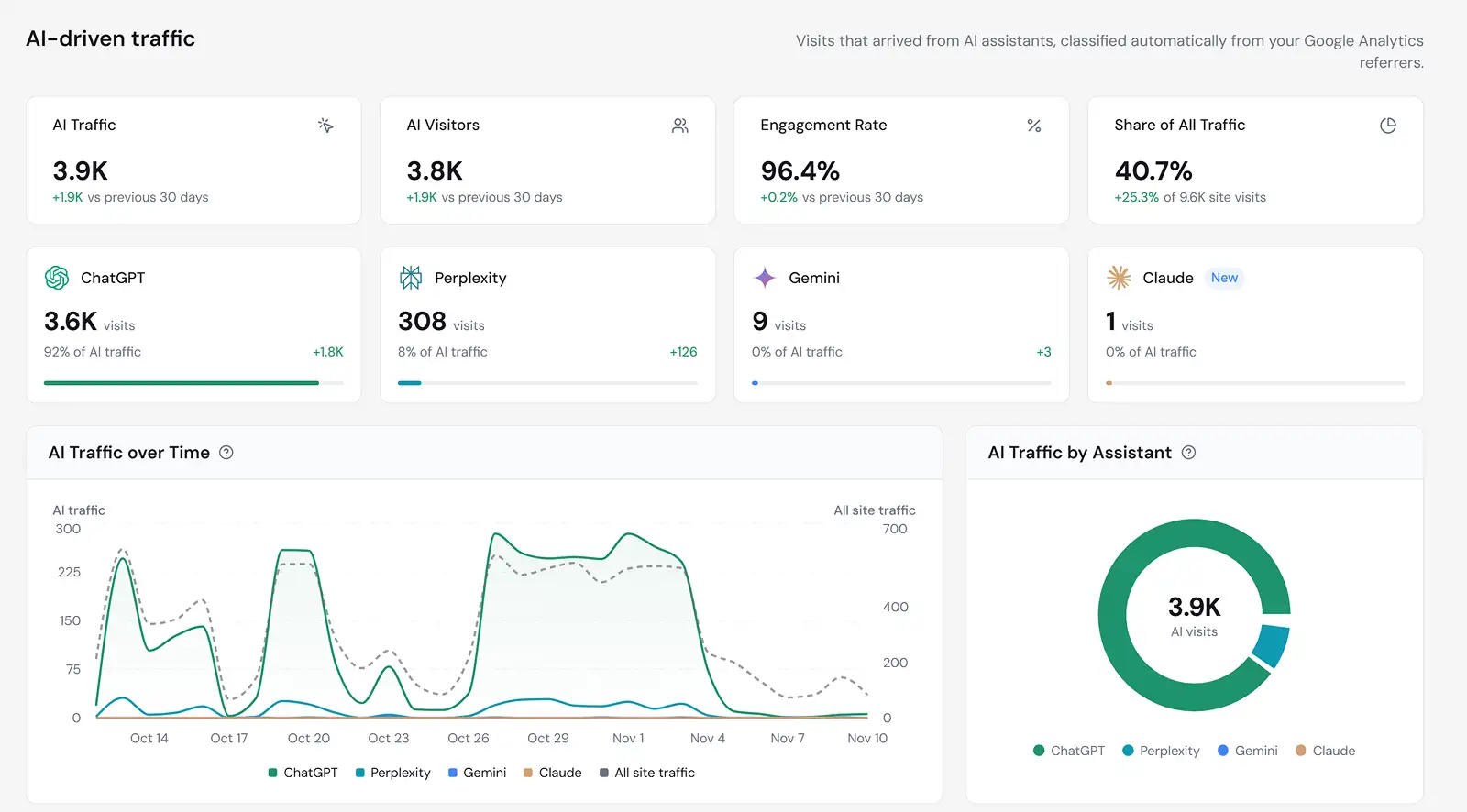
- Qualified Outcomes: Track measurable signups, demo requests, and sales opportunities originating from AI referral traffic. The accuracy of these results depends on your attribution and tracking setup.
For brand mention rate and owned-domain citation rate, calculate percentages using eligible monitored answer runs as the denominator. Record the platforms, prompts, and dates included to make comparisons meaningful.
Also, measure branded and non-branded prompts separately. Strong visibility for searches that already mention your brand can hide weak performance for broader discovery questions where potential customers are evaluating solutions.
Common AI Content Optimization Mistakes
- Writing a new article for every prompt variation. Related questions often belong in the same useful resource; creating near-duplicate pages increases maintenance and cannibalization risk.
- Confusing mentions with citations. An assistant can name a brand without linking its site, or cite a page without recommending the brand.
- Publishing unsupported product information. Outdated features, pricing, and integration details can create inaccurate answers and disappointed buyers.
- Following content scores mechanically. A high draft grade or predicted impact is an editing signal, not proof a page will rank or be cited.
- Over-optimizing formatting. Question headings and tables can help readers, but arbitrary paragraph lengths and AI-specific files do not substitute for useful evidence.
- Evaluating results too narrowly: Compare performance across multiple runs and reporting periods to identify meaningful visibility trends following content improvements.
Conclusion
AI content optimization is about creating useful, accurate, and discoverable content that answers the questions people ask AI search platforms. Start by identifying buyer-intent prompts and content gaps, then create or improve content with clear answers, reliable information, and relevant examples.
With Botric, you can identify content opportunities, track AI mentions and citations, generate articles with Blog Agent, and improve existing pages with Page Agent.
Ready to improve your content's AI search visibility? Explore Botric's Content Agent to identify content opportunities, create new articles, and optimize existing pages.
Frequently Asked Questions
What is AI content optimization?
AI content optimization is the process of planning, creating, and improving content so it answers real questions clearly and is easier to discover and use in AI-powered search experiences. It includes both new content and updates to existing articles and website pages.
How do you optimize content for AI search engines?
Start with relevant buyer questions, review what existing sources answer, publish accurate and helpful information, keep important pages accessible, and track whether your brand or pages appear in monitored AI answers. Prioritize useful answers, reliable information, clear structure, and accessible content, then measure performance across relevant AI search platforms.
How do I optimize content for LLMs without harming SEO?
Keep the core SEO fundamentals: helpful content, clear navigation, technical accessibility, descriptive headings, and relevant internal links. Avoid thin pages made for numerous prompt variations, and make changes because they improve the information people need.
Should I update an existing article or publish a new one?
Update when an established page already serves the reader's intent but needs clearer or more complete information. Create a new page when the question has a distinct purpose that the existing content does not serve. Consolidate pages that substantially duplicate one another.
Does adding schema markup or an llms.txt file guarantee AI citations?
No. Use valid structured data where it fits Google's supported search features and the visible page content. Google does not require a special AI-specific schema or an llms.txt file for inclusion in its generative Search features.
How can I tell whether content optimization is working?
Compare a stable set of relevant prompts before and after publication. Track brand mentions, owned-domain citations, cited URLs, and performance across platforms. Use site analytics for identifiable referrals and qualified outcomes, but do not assume every citation produces a click.