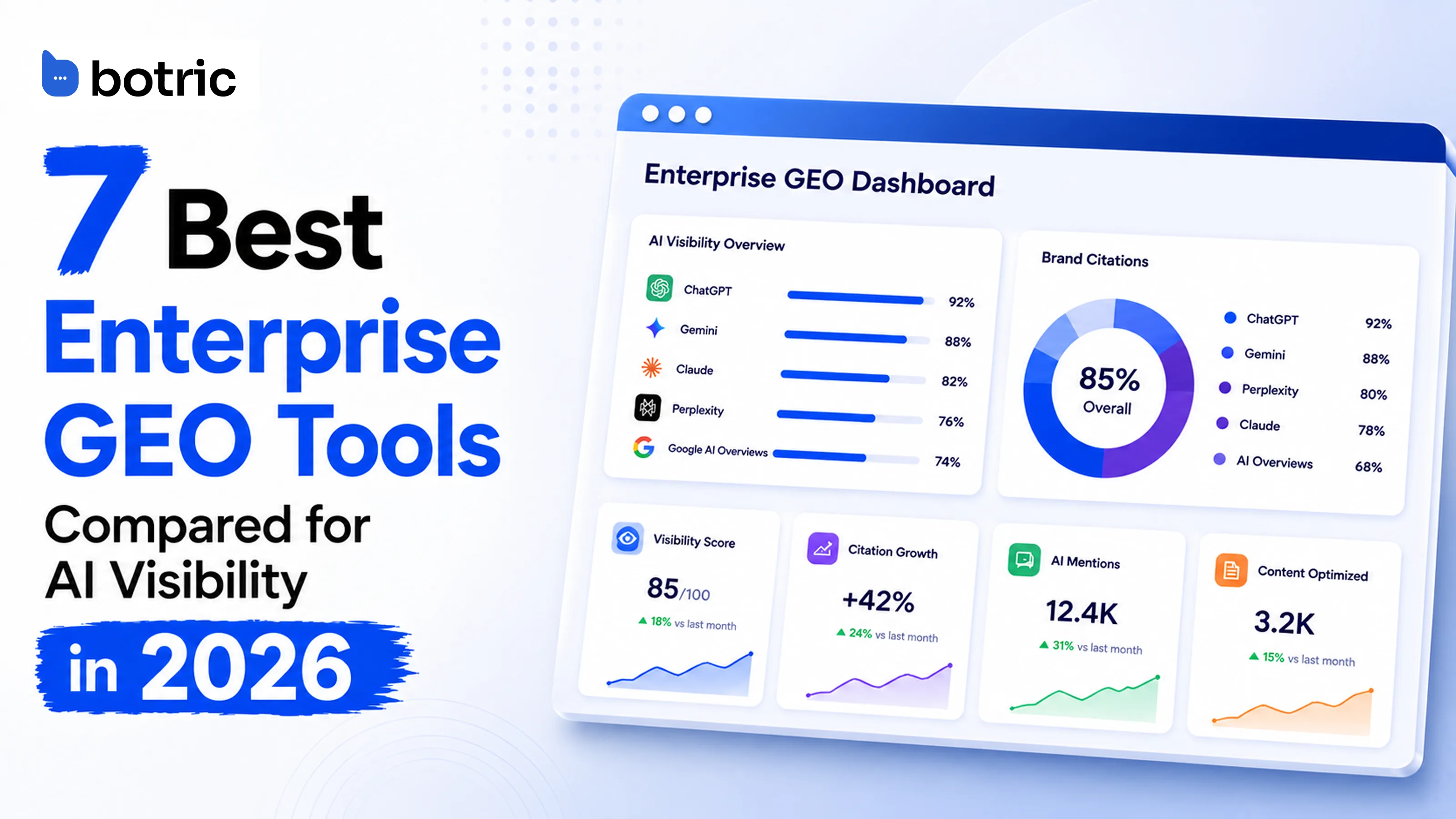
The first AI visibility audit often reveals an uncomfortable truth: even well-known enterprise brands have limited visibility in AI-generated answers. That's where Generative Engine Optimization (GEO) comes in.
GEO focuses on optimizing your content so AI platforms cite your brand in generated answers. For enterprises managing multiple business units, large content libraries, and complex workflows, I'd argue the right platform has to go beyond visibility tracking, to uncovering opportunities, prioritizing fixes, and measuring impact.
Quick Answer: Top Enterprise GEO Picks by Use Case
The enterprise GEO tools I'd put on a 2026 shortlist are Botric, Profound, Rankscale, AthenaHQ, Evertune, Peec AI, and Semrush Enterprise AIO.
These platforms help large organizations monitor AI visibility, track brand citations across AI search engines, manage multiple brands from a single workspace, and optimize content so AI platforms like ChatGPT, Gemini, Perplexity, Claude, and Google AI Overviews are more likely to recommend and cite their business.
The best enterprise GEO platforms can help you:
- Monitor AI visibility and brand citations across multiple AI search engines from one dashboard.
- Manage dozens of brands, business units, or regional websites with centralized workspaces and role-based access controls (RBAC).
- Integrate AI visibility data with CRMs, analytics platforms, BI tools, and enterprise workflows through APIs and custom integrations.
- Identify AI content gaps, strengthen entity signals, and optimize content to increase citations and recommendations.
- Measure competitor visibility, benchmark performance, and prioritize the highest-impact GEO opportunities.
- Meet enterprise security and governance requirements with features like SSO, SOC 2 compliance, audit controls, and scalable reporting.
This guide compares the best enterprise GEO tools based on scalability, security, integrations, AI visibility capabilities, pricing, and ideal use cases, helping enterprise teams choose the right platform for their AI search strategy.
What enterprise GEO tools actually need to handle at scale?
Enterprise-grade AI-visibility platforms earn that label by solving problems that simply don't exist at single-brand scale. The hard requirements fall into five categories.
Multi-brand workspace
A platform that forces separate logins per domain becomes unmanageable at 30+ brands. Purpose-built enterprise tools keep every brand, dashboard, and report inside one account.
Role-based access controls, or RBAC, are the permissioning layer that lets each stakeholder see exactly what they need. Without it, a junior analyst sees the same raw data as the CMO and the legal team, and that's a governance problem before it's a usability problem.
Security and compliance
SOC 2 Type II certification, GDPR-compliant data handling, and SSO (SAML/OIDC) are non-negotiable for regulated industries. Tools that lack these will fail the infosec review before procurement even starts.
API-first architecture
Manual CSV exports break workflows. An enterprise GEO platform needs a REST API that pipes data into your BI stack (Looker, Tableau, Power BI), CMS, and Slack alerts without human intervention. Automated resolution of visibility gaps is what keeps content strategy moving; weekly manual pulls don't.
Pricing that scales with content volume, not per-user seats
A per-seat model that doubles your bill when you add a content team is a procurement nightmare. The tools that win enterprise contracts charge by brand, credit volume, or content scope.
Why do general GEO tools hit a wall when you're managing 50+ brands and 100K+ pages?
Most GEO tools were designed for a single marketing team tracking one brand. That architecture breaks in three specific ways at enterprise scale.
Single-brand limits force account sprawl
A tool that charges per tracked domain becomes unaffordable at 30+ brands. Worse, separate accounts mean separate dashboards, separate billing cycles, and no cross-brand visibility. Your team spends more time reconciling data than acting on it.
No permissioning means no governance
When every user sees every brand's raw data, you lose control over what gets shared with which team. Legal needs to see risk alerts but has no use for competitor intelligence.
Junior analysts need their brand's citation gaps but not executive dashboards. Without RBAC, you're one accidental export away from a data governance incident.
Missing API breaks the whole workflow
Platforms that surface recommendations without integrated editing or publishing tools push every fix back to a manual CMS step. At 100K+ pages, that bottleneck kills agility.
The tools that matter at enterprise scale push data directly into the systems where work actually happens.
The deeper problem is that general tools were never designed for the technical documentation and automated QA requirements that enterprise content teams run. They surface a visibility gap; they don't close it.
The 7 Best Enterprise GEO Tools for AI Visibility
Each tool below is reviewed on the same criteria: multi-brand support, API maturity, security, onboarding effort, and honest limitations.
This article is published by Botric, one of the tools compared here, evaluated on the same criteria as every other platform.
Comparison table
| Tool | Best for | Multi-brand | SSO/Compliance | Pricing floor | Key limitation |
|---|---|---|---|---|---|
| Botric | Full-stack: audit + content + conversion | Yes. Custom Plan available for Enterprise and 5+ workspaces (Infinity). | Custom enterprise tier | Free plan; paid tiers from $15/mo (Bit) up to $149/mo (Infinity); Enterprise custom pricing. | Smaller enterprise customer base than longer-established enterprise GEO vendors. |
| Profound | Enterprise compliance + data depth | Yes (custom) | SOC 2 Type II, HIPAA | Custom (enterprise) | No free trial; sales-led |
| Rankscale | Multi-brand portfolios, agencies | 100 dashboards | Custom enterprise tier | €780/mo (Enterprise) | No PDF exports; UI English-only |
| AthenaHQ | Revenue attribution + action layer | Yes | SAML/OIDC SSO, RBAC | $295/mo (Growth) | Credit model burns fast at scale |
| Evertune | Statistical rigor, brand perception | Yes | No SOC 2 | $3,000/mo | No free trial; no API confirmed |
| Peec AI | Multilingual sentiment tracking | Yes (unlimited seats) | Adequate for mid-market | $95/mo (Starter) | 3-engine cap on lower tiers |
| Semrush Enterprise AIO | Teams already in Semrush ecosystem | Up to 40 sites | Enterprise-grade | Custom (AIO) | US English only; bolt-on GEO |
1. Botric: Best for End-to-End Enterprise GEO
Botric is an enterprise GEO platform that goes beyond AI visibility monitoring by combining GEO auditing, AI-ready content optimization, citation tracking, and AI-powered customer engagement in a single workflow.
Instead of simply showing where your brand is missing from AI-generated answers, Botric helps enterprise teams identify visibility gaps, prioritize fixes, generate AI-friendly content, and measure the impact of those improvements over time.
For organizations managing multiple brands or large content libraries, Botric combines AI visibility tracking with automated content workflows, schema recommendations, entity optimization, and AI citation monitoring.
Enterprise teams can manage optimization from a centralized dashboard while integrating AI visibility insights into existing marketing and sales processes through CRM integrations and dedicated strategic support.
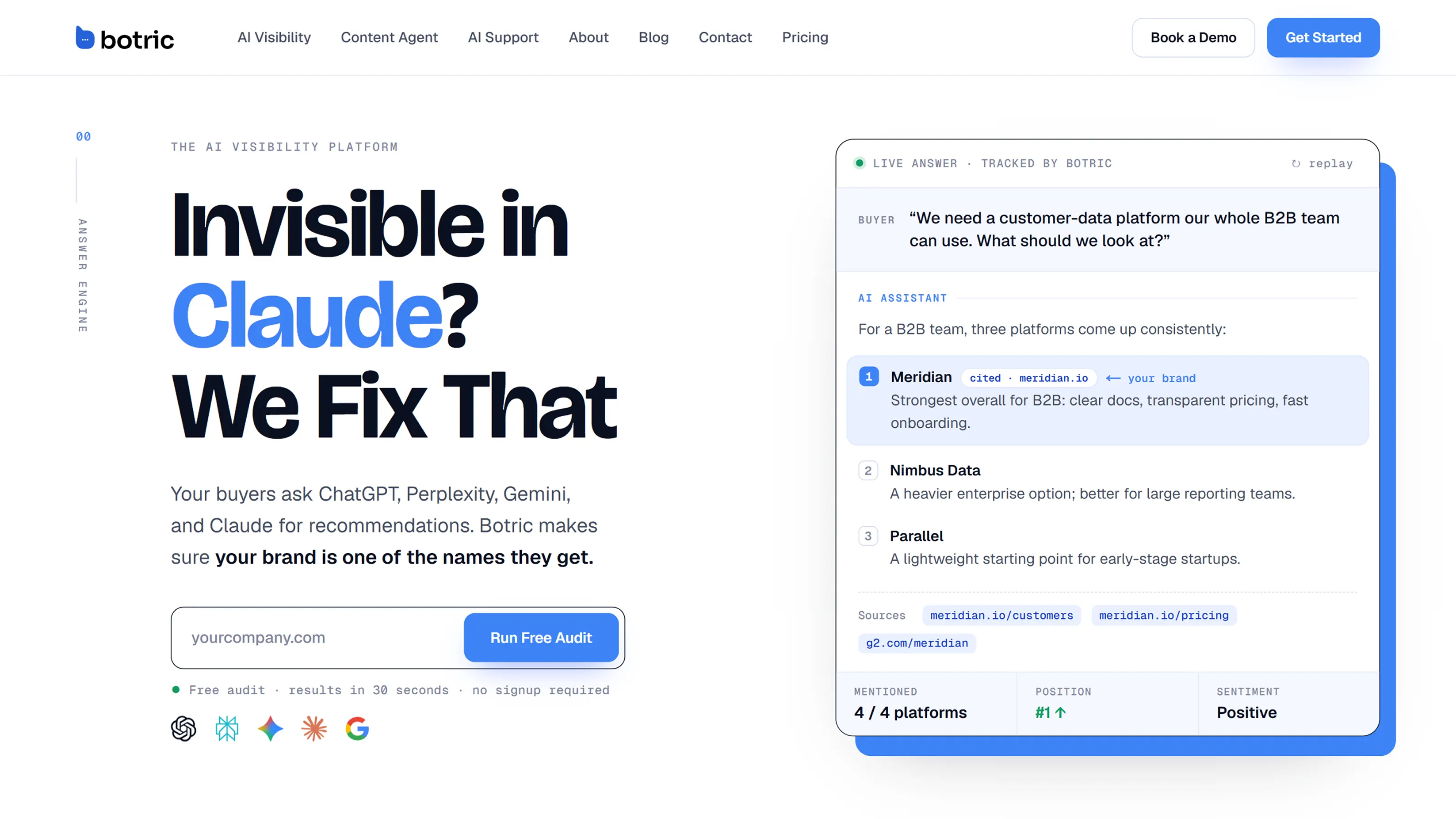
Best for: Enterprise marketing teams, SaaS companies, and agencies looking for an end-to-end GEO platform that combines AI visibility tracking, content optimization, citation monitoring, and AI-powered customer engagement in a single solution.
Honest limitation: Botric's self-serve plans currently support up to five workspaces on the Infinity tier, making them a better fit for growing businesses than organizations managing very large multi-brand portfolios.
While the Enterprise plan supports custom deployments, dedicated strategy, and tailored workflows, organizations with highly complex global operations should confirm workspace, governance, and reporting requirements during the evaluation process.
2. Profound
Profound raised a $96 million Series C at a $1 billion valuation in February 2026, making it the first unicorn in the GEO category. That funding signal matters for enterprise procurement: vendor stability is a real evaluation criterion, and Profound passes it decisively.
The platform provides granular monitoring of how AI systems cite and represent your brand across multiple generative engines, with enterprise-level reporting, role-based access, and compliance workflows that integrate into existing risk management frameworks.
Profound tracks 10+ AI engines with 400M+ prompt insights and holds SOC 2 Type II certification. For legal, financial services, or healthcare brands where AI citations carry compliance risk, that certification is often the deciding factor.
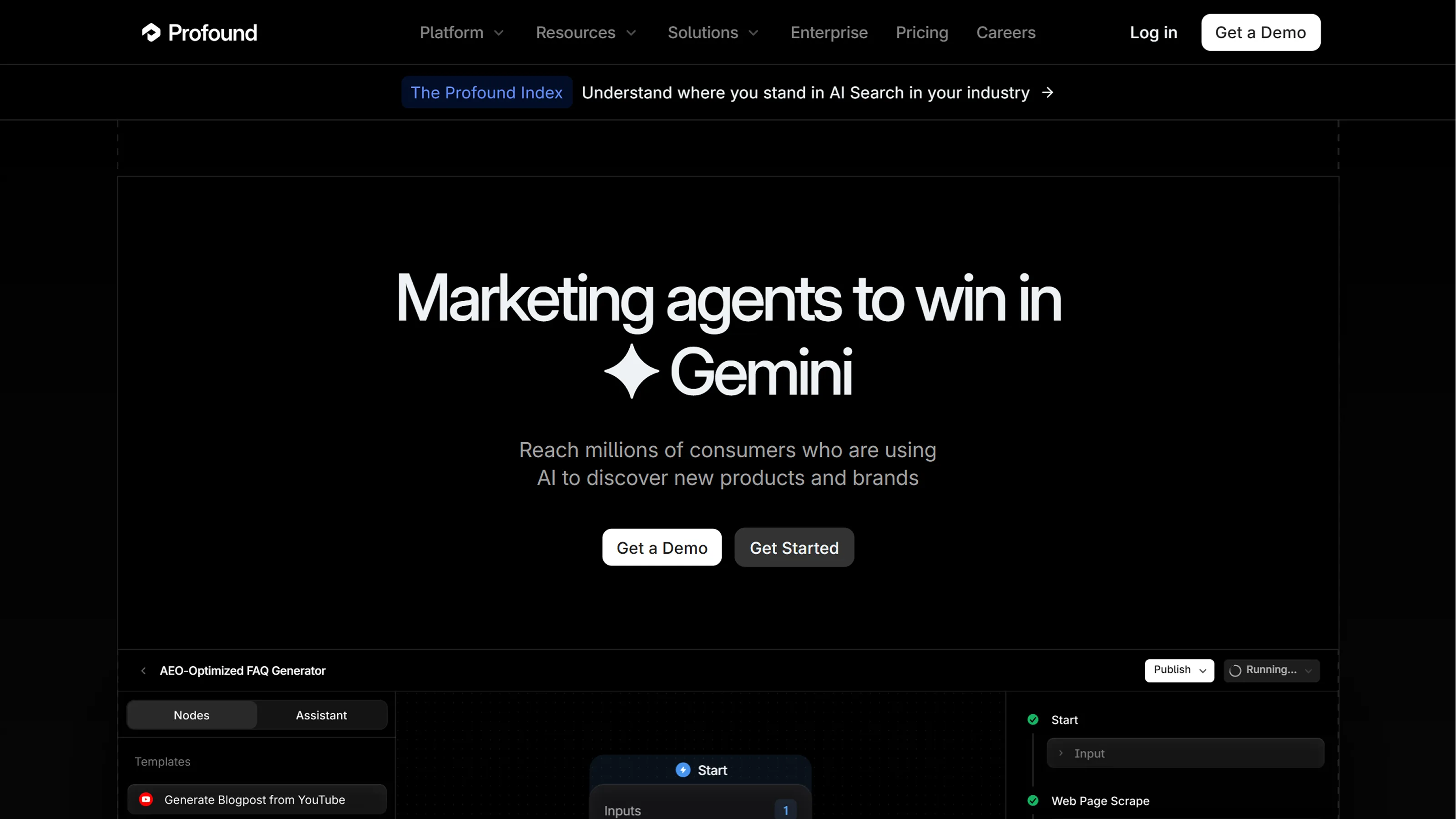
Best for: Large enterprises and regulated industries that prioritize AI visibility monitoring, compliance, governance, and enterprise-grade reporting.
Honest limitation: Profound is expensive, offers no free trial, and requires a sales process. Mid-market teams will find better value elsewhere.
3. Rankscale
Rankscale adds the capabilities large teams need: multi-brand management, role-based access, white-label reporting, 240+ regions and languages, and enterprise-grade AI visibility tracking across 17+ engines in a single account. Procurement gets one predictable line item instead of a matrix of model and user fees, which matters more than it sounds when you're budgeting across a portfolio.
The Enterprise plan costs €780 per month and scales up to 12,000 credits, 200 web audits, 100 brand dashboards, and 48,000 AI responses.
The enterprise client list includes Bosch, UBS, REWE, Dentsu, and WPP Media, which confirms real enterprise adoption rather than aspirational positioning.
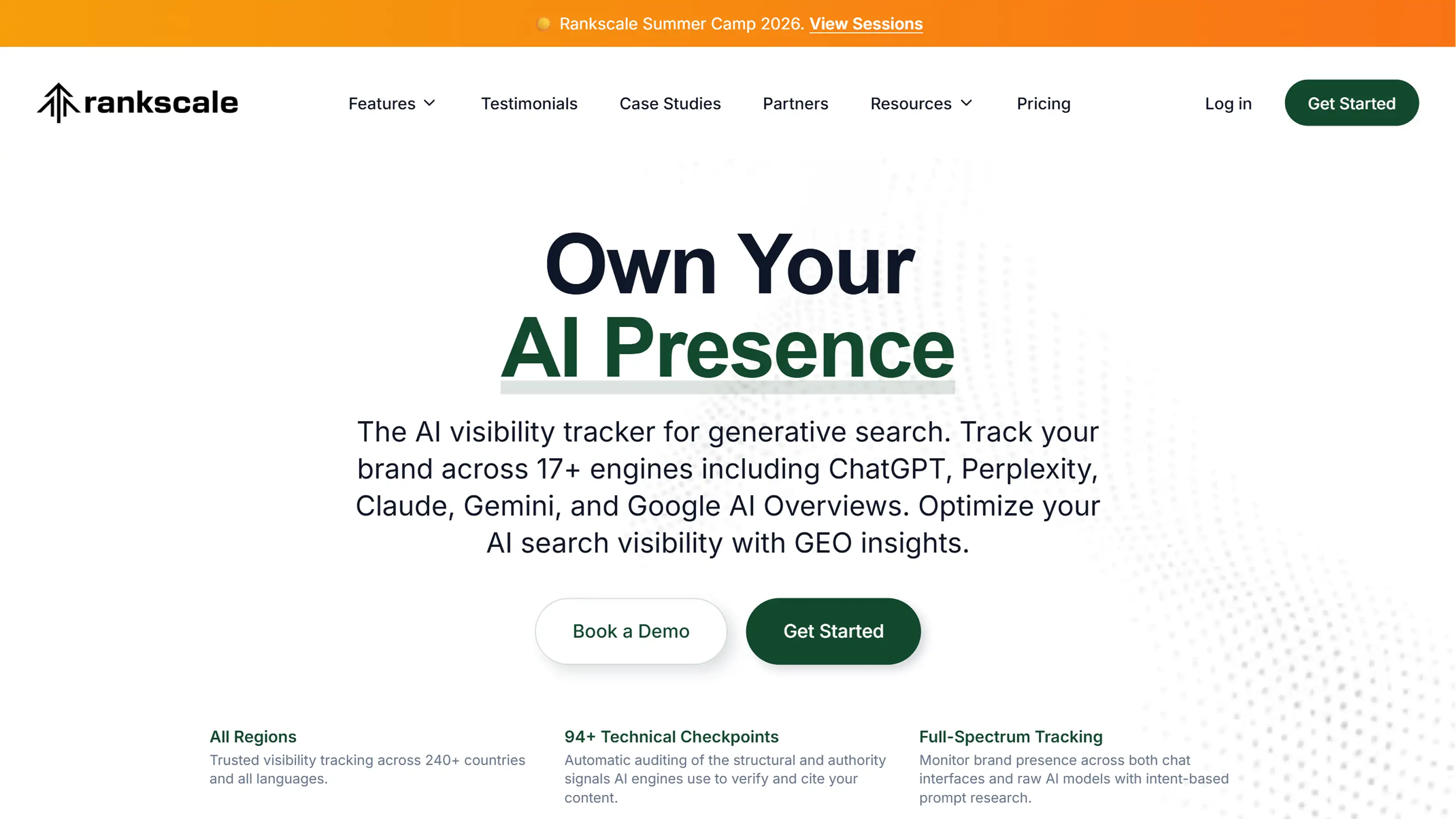
Best for: Organizations, agencies, and multi-brand enterprises that need scalable AI visibility tracking across dozens of brands, markets, and regions.
Honest limitation: The absence of PDF dashboard exports is a recurring frustration in user reviews. Agencies that need polished PDF reports for clients will have to build them manually from Looker Studio or screen captures.
4. AthenaHQ
AthenaHQ was founded by former Google Search and DeepMind engineers Andrew Yan and Alan Yao, which explains the platform's technical depth. The enterprise plan includes SAML and OIDC single sign-on with role-based access controls and unlimited seats.
The standout feature is the action layer. AthenaHQ analyzes your specific vertical to identify AI knowledge gaps, concepts or entities where AI models lack sufficient data to form an opinion about your brand.
If an AI doesn't know your pricing structure, it will hallucinate one. AthenaHQ flags those voids before the model fills them with fiction, which is a meaningfully different problem than standard SEO keyword gaps.
Enterprise plans add Tableau, Power BI, and Looker integrations for the automated reporting workflows enterprise teams actually need.
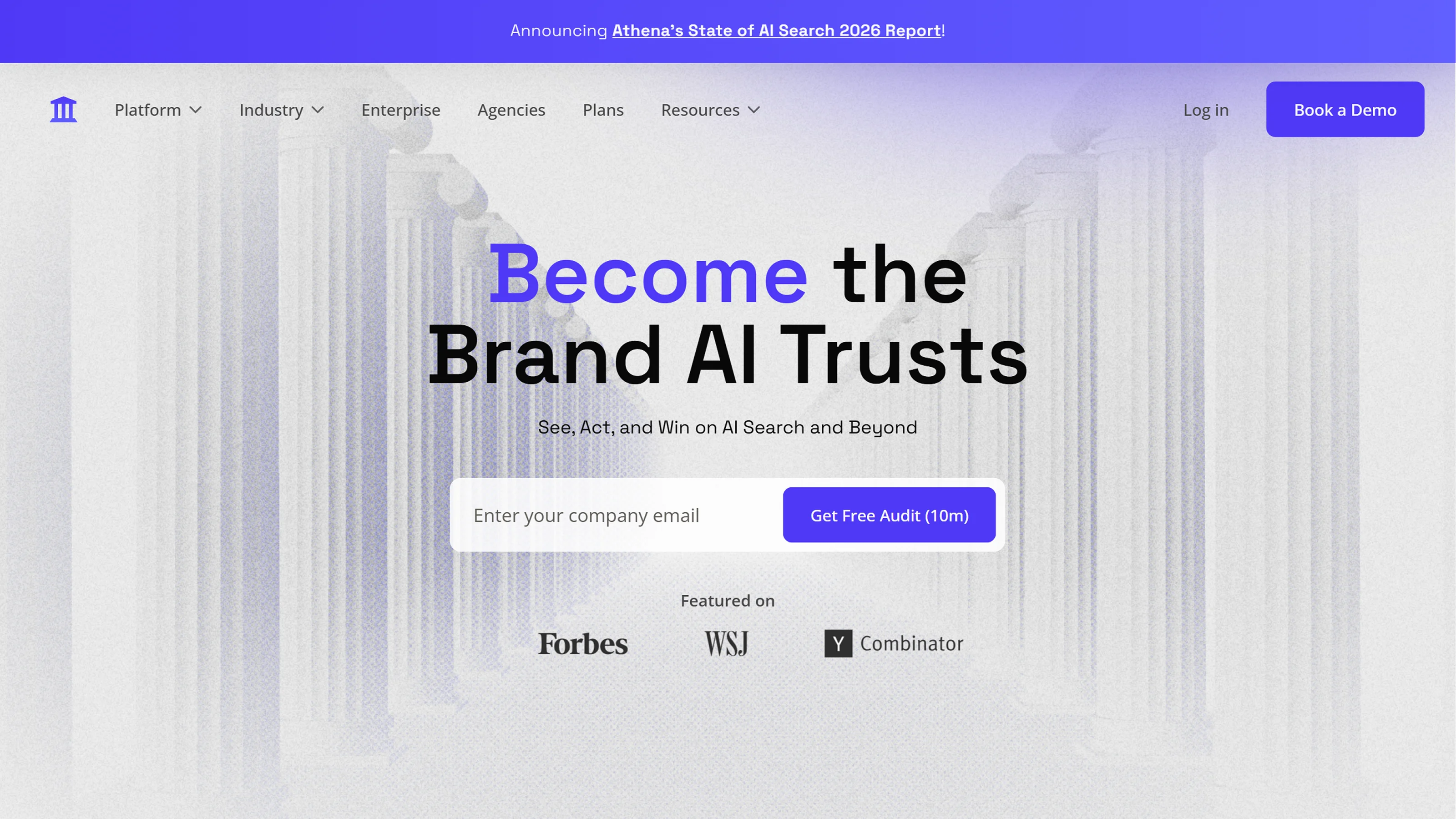
Best for: Enterprise teams that want to connect AI visibility with business outcomes through revenue attribution, advanced analytics, and workflow automation.
Honest limitation: Because each model run and every prompt consumes credits, a serious tracking setup across nine engines can move through a monthly allowance faster than you expect. There's no middle tier between free and $295, which is the single biggest friction point for smaller teams.
5. Evertune
Evertune is built on one idea: statistical significance. Rather than running a handful of manual prompts, it samples each prompt 100 times across 10-plus AI models, blends in daily consumer-app data and a 25-million-person panel, and produces AI visibility figures you can defend to a board.
Evertune was named a Representative Vendor in the 2026 Gartner Market Guide for Answer Engine Visibility Tools. For brands in automotive, pharma, or financial services where AI citations shape consumer perception at scale, that rigor is genuinely worth the premium.
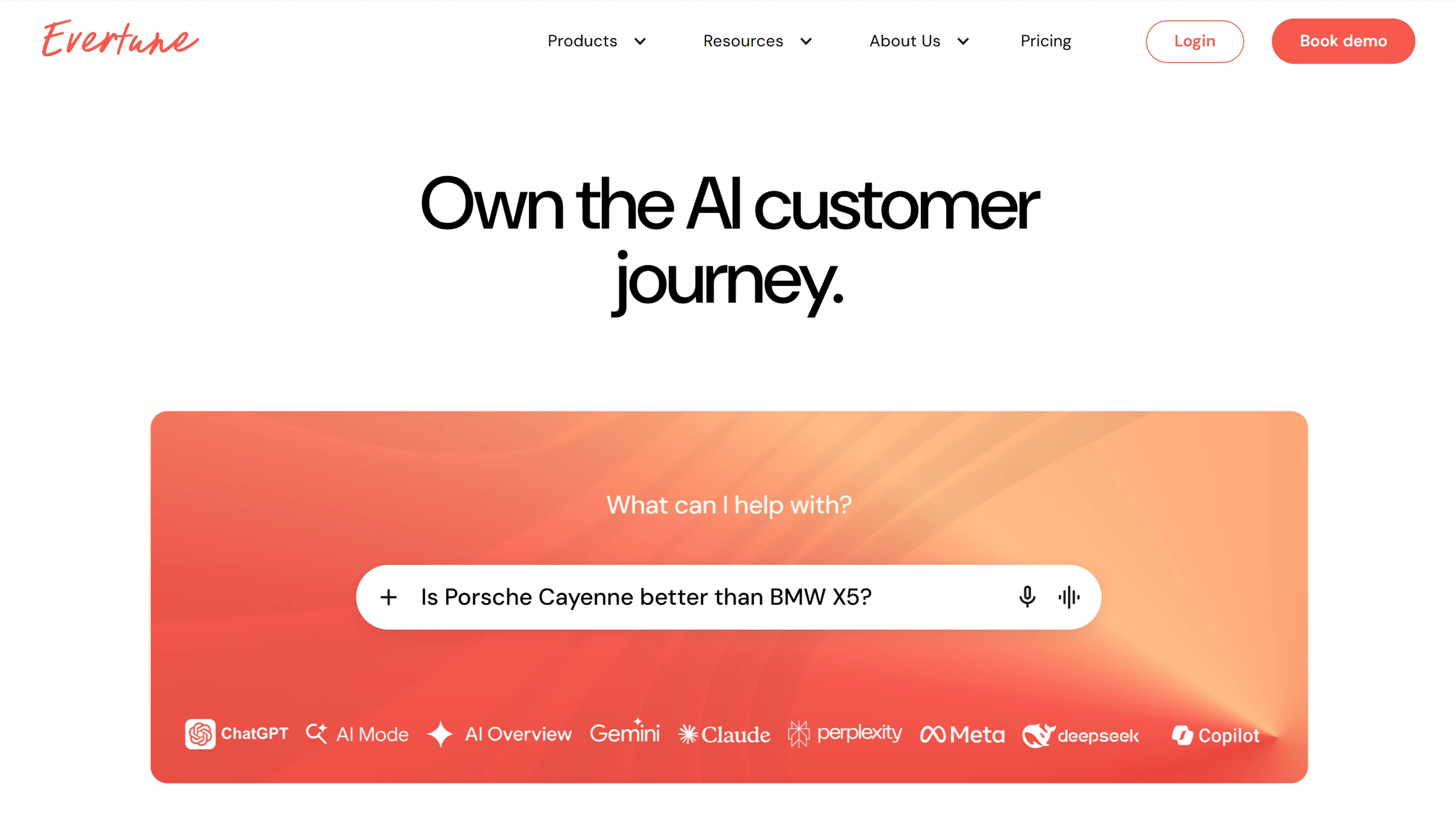
Best for: Data-driven enterprises that need statistically rigorous AI visibility measurement, consumer perception insights, and executive-level reporting.
Honest limitation: Nothing in Evertune's public materials confirms an API or MCP server, so if your plan is to pipe visibility data into your own automation stack, this tool won't support it. At $3,000/month with no free trial, it's also a significant procurement commitment before you've seen the data.
6. Peec AI
Peec AI is one of the more polished trackers in the category, built in Berlin, and its brand-mention sentiment scoring is the capability competitors most often try to match.
Competitor tracking is regional, a real differentiator for multi-market brands that need to compare share of voice across geographies and 115+ supported languages. Every plan from Starter through Enterprise supports unlimited users, which removes the per-seat friction that plagues many SaaS tools.
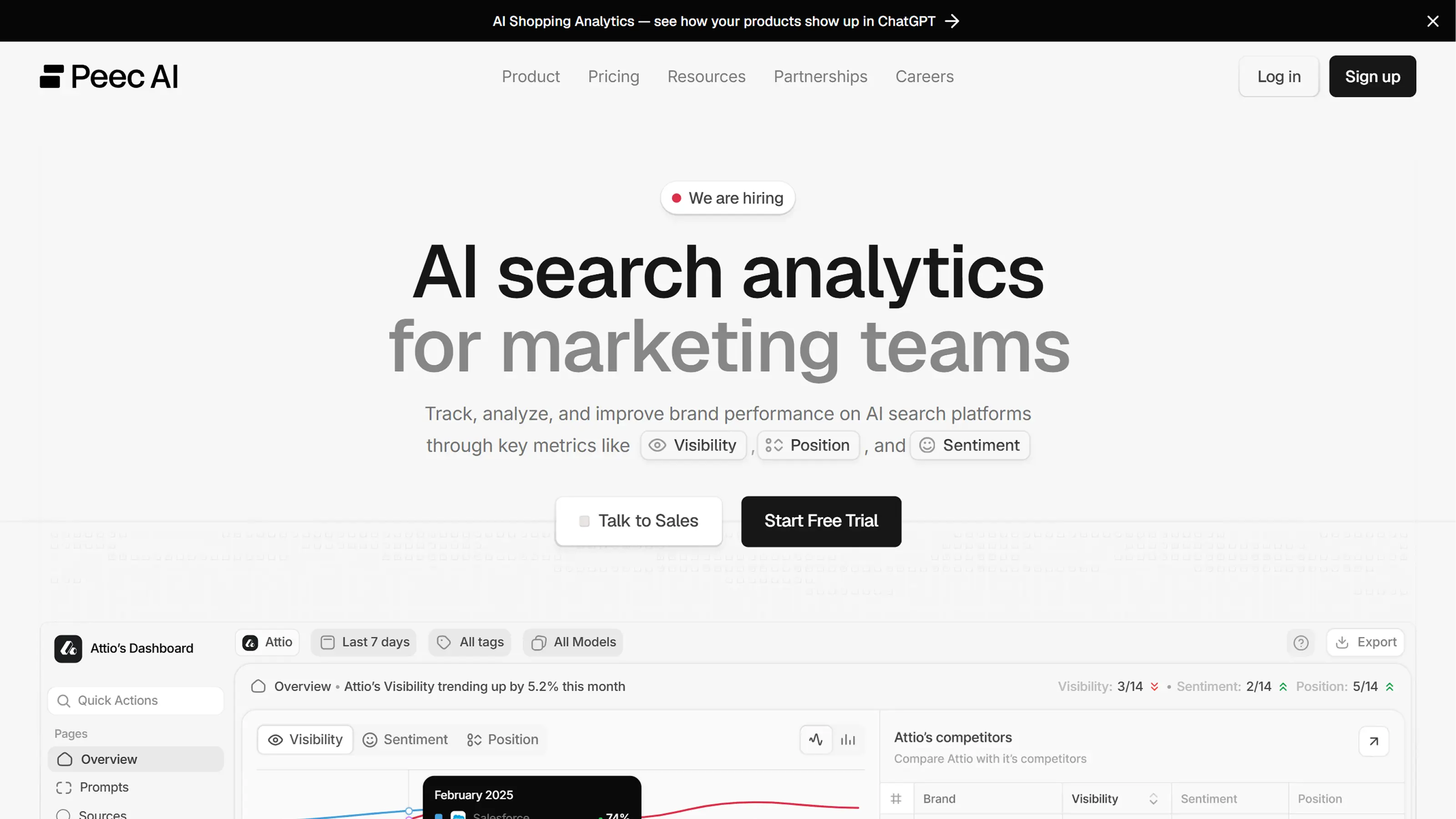
Best for: Global marketing teams and mid-market organizations that need multilingual AI visibility tracking, regional competitor analysis, and unlimited user access.
Honest limitation: API access is Enterprise-only, limiting integration flexibility for mid-market customers. Peec's security posture is adequate for most mid-market companies and agencies, but falls short of what enterprise procurement teams typically require. If your organization mandates SOC 2 attestation, Profound is better positioned.
7. Semrush Enterprise AIO
For larger teams managing multiple brands, markets, or product lines across global regions, Semrush offers Enterprise AIO with the same core AI visibility capabilities at a larger scale and with more granular tracking.
You can track visibility by product, persona, region, and category, analyze the source-level signals shaping AI answers, and get recommendations on what to fix next.
The integration value is real for teams already inside the Semrush ecosystem. One workflow connects keyword research, technical audits, and AI visibility without switching platforms. Semrush's AI prompt database includes 289M+ prompts, sitting alongside its traditional SEO database of 28B+ keywords and 43T backlinks.
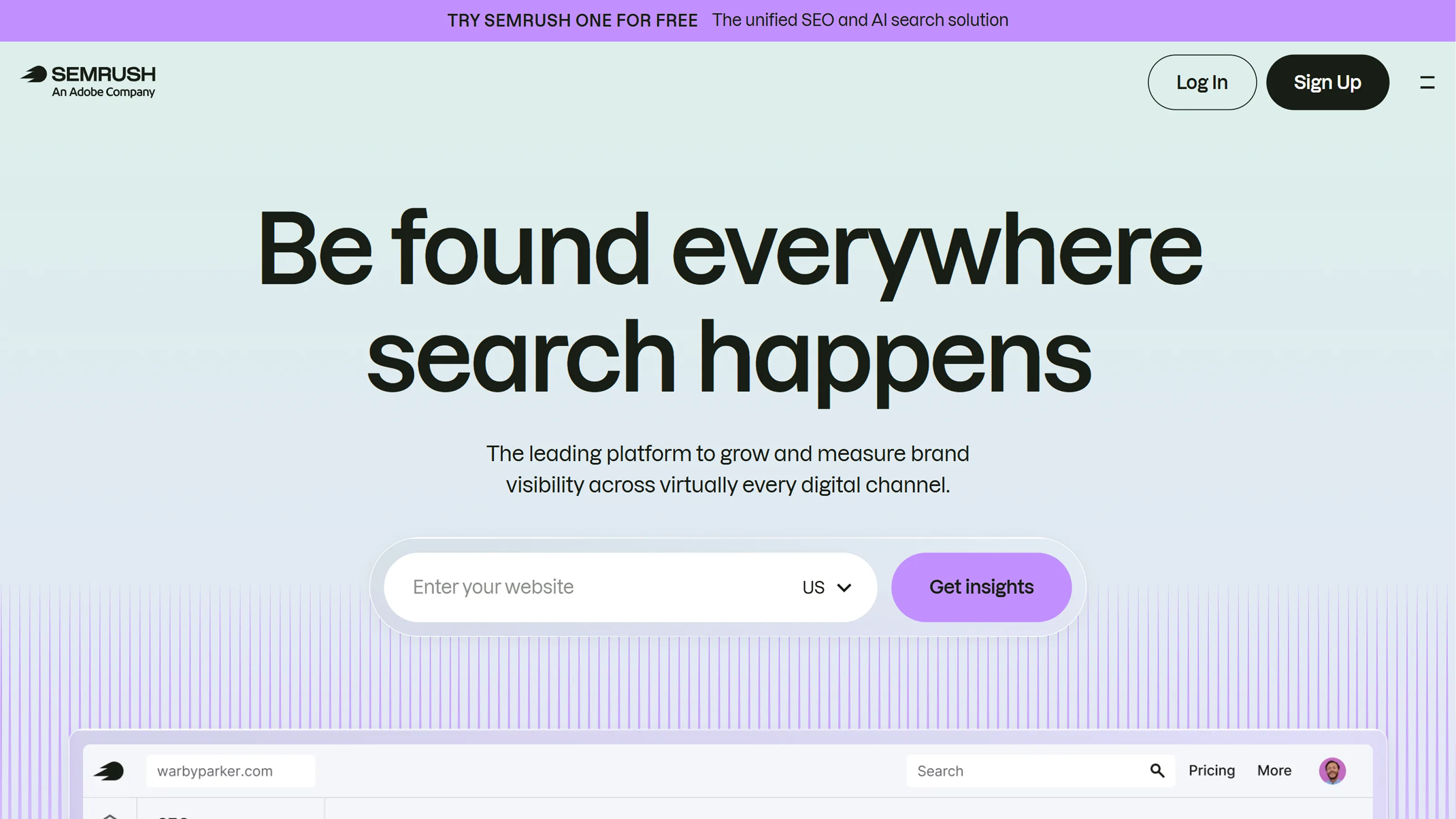
Best for: Enterprises already using the Semrush ecosystem that want to combine traditional SEO, competitive intelligence, and AI visibility tracking in one platform.
Honest limitation: Semrush One's AI Visibility Toolkit covers six markets on its standard plan: US, UK, Canada, Australia, India, and Spain, and generates data in US English only, meaning prompts in Spanish aren't covered in the standard database. For global brands, that geographic ceiling is a structural gap.
What should your procurement and onboarding checklist actually include?
Feature lists are the easy part. The operational reality of enterprise GEO procurement is where most evaluations go wrong.
Contract terms and data ownership
Insist on clarity on three points before signing: who owns your data if you cancel, what the exit clause looks like, and whether the vendor can use your brand's prompt data to train their models. Several GEO platforms are ambiguous on the last point.
Security audit requirements
SOC 2 Type II is the minimum for most enterprise infosec reviews. HIPAA matters for healthcare; GDPR data residency matters for EU brands. Ask each vendor for their attestation timeline and whether they can provide a data processing agreement before procurement closes.
Onboarding timeline
The honest range: self-serve tools like Rankscale and Peec AI can be running in under a day. Botric's enterprise onboarding runs from kickoff to full optimization in two weeks.
Profound's white-glove enterprise onboarding is measured in weeks, not days, and requires a dedicated strategist assignment. Budget accordingly.
The decision framework
If your team is under 10 people or single-brand, general tools at $20 to $200/month are sufficient. For multi-brand, cross-functional, or security-sensitive organizations, the enterprise tier is non-negotiable.
The cost of retrofitting a general tool to enterprise requirements, separate accounts, manual exports, no permissioning, exceeds the price difference within a quarter.
For comparing AI search visibility across brands and competitors, the structural question is whether your platform can hold multiple brand entities in one workspace without conflating their entity signals. Most general tools can't.
Conclusion
Enterprise GEO is no longer just a marketing initiative. It's becoming a core capability for organizations that want to remain visible as AI search platforms increasingly shape how customers discover products, services, and brands.
The right platform depends on your priorities. Some tools excel at compliance and large-scale monitoring, while others focus on content optimization, revenue attribution, or end-to-end AI visibility management, and I'd rather you pick for the job you actually have than for the longest feature list.
When you evaluate enterprise GEO tools, my advice is to look past the feature lists. Consider whether the platform can scale across multiple brands, integrate with your existing technology stack, meet your security and compliance requirements, and help your team turn AI visibility insights into measurable business outcomes. Choosing the right platform today can help your organization build a sustainable advantage as AI-powered search continues to evolve.
Run a comprehensive GEO audit with Botric to identify where your brand is being cited, uncover visibility gaps across AI platforms like ChatGPT, Gemini, Perplexity, and Google AI Overviews, and get actionable recommendations to improve enterprise AI search performance at scale.
Key Takeaways
- Enterprise GEO needs multi-brand workspaces, role-based access, APIs, and security review.
- General GEO tools hit a wall at 50+ brands and 100K+ pages.
- Botric, Profound, Rankscale, AthenaHQ, Evertune, Peec AI, and Semrush Enterprise AIO lead the category.
- Match the platform to your governance and reporting needs, not to the longest feature list.
- Use a procurement checklist covering SSO, data handling, and onboarding support.
FAQs
Can I track multiple brands in one dashboard without separate logins?
Yes. Enterprise GEO platforms should support centralized multi-brand management so teams can monitor multiple websites, products, or business units from a single workspace. Botric's enterprise solution lets organizations manage multiple workspaces, track AI visibility across brands, and collaborate from one dashboard without juggling separate accounts or reporting workflows.
What's the typical onboarding timeline for a large content library?
The timeline depends on the size and complexity of your website, but enterprise implementations generally take longer than self-service tools. Botric's enterprise onboarding typically takes around two weeks from kickoff to full optimization, including workspace setup, GEO audits, AI visibility tracking, integrations, and strategic recommendations to help teams start improving AI search performance quickly.
How do role-based permissions actually work across teams?
Role-based access control (RBAC) allows different stakeholders to access only the information they need. For example, marketing teams can review AI visibility and content recommendations, executives can monitor high-level performance dashboards, and administrators can manage users and permissions. This helps enterprise organizations maintain governance while enabling collaboration across departments.
Can I try Botric before upgrading to an enterprise plan?
Yes. Botric offers a free plan that allows teams to explore AI visibility tracking and GEO capabilities before committing to a larger deployment. As your requirements grow, you can upgrade to higher plans or work with the enterprise team to build a solution tailored to your organization's needs.
What should I look for before choosing an enterprise GEO platform?
Look beyond feature lists. Evaluate whether the platform supports enterprise security, scalable multi-brand management, API integrations, role-based permissions, flexible reporting, and clear data ownership policies. The right platform should not only measure AI visibility but also help your team improve it through actionable recommendations and content optimization.