Imagine spending months creating content that ranks well on Google, only to discover your brand never appears in ChatGPT or Perplexity responses. That's becoming a common problem. Many companies we're seeing today have strong SEO performance but almost zero visibility in AI-generated answers.Which eventually means the buyers you're not reaching.
That's the reality many businesses are beginning to face.
Search is no longer limited to traditional search engines. Millions of people now turn to AI-powered assistants to compare products, discover software, and make purchasing decisions. Instead of scrolling through ten blue links, users increasingly rely on a single AI-generated answer. If your brand isn't part of that conversation, you're invisible at one of the most important stages of the customer journey.
Disclosure: This comparison is published by Botric, one of the two platforms compared here. Both platforms are evaluated against the same criteria.
Otterly vs Botric: Quick Answer
So when we talk about AI Visibility, Otterly and Botric are the two names that frequently come up in these conversations. Although both operate in the AI visibility space, they serve different purposes.
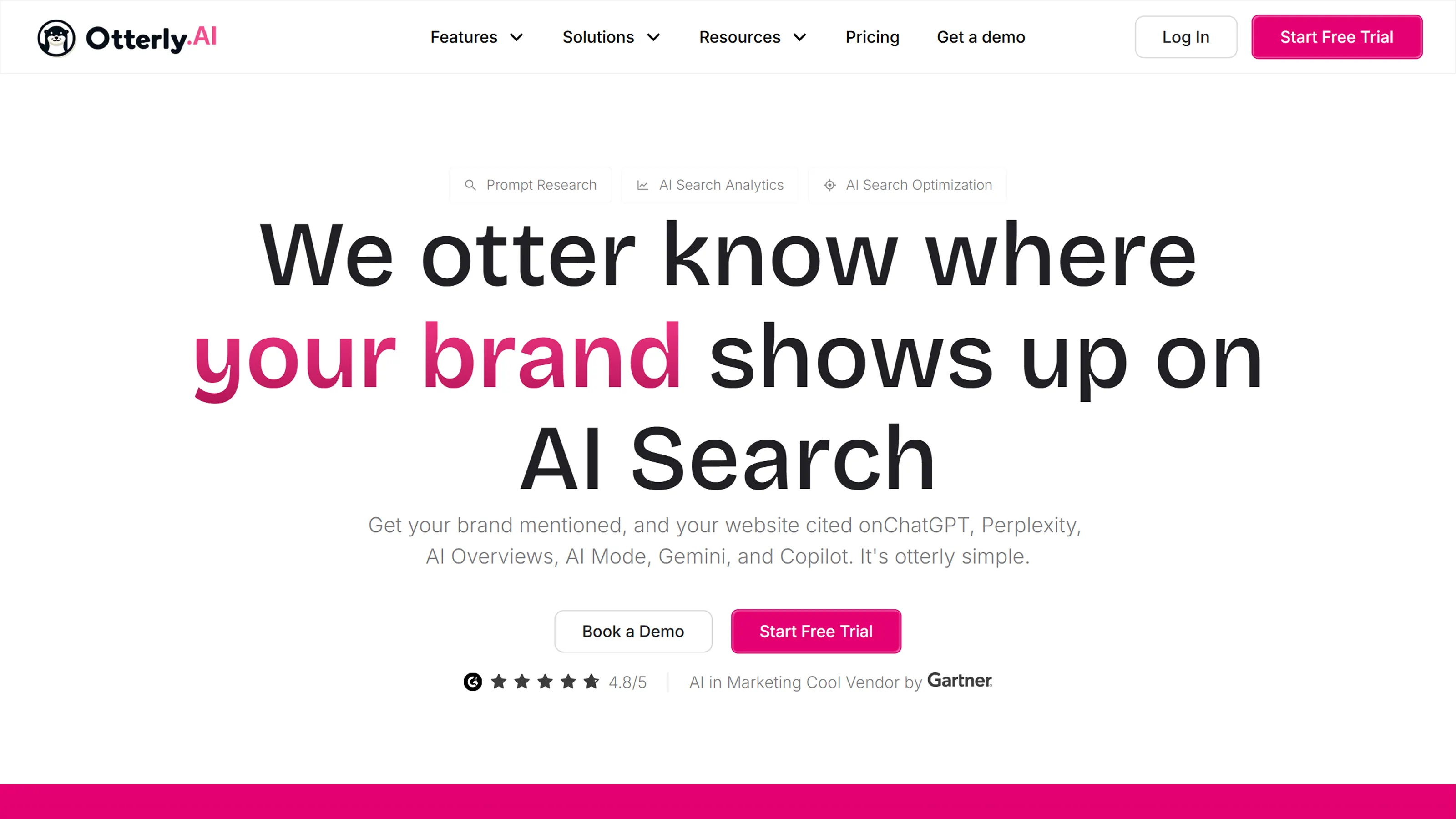
Otterly is designed primarily for tracking AI mentions and citations, making it a straightforward option for teams that want to monitor performance.
Botric, on the other hand, takes a broader approach by combining AI visibility auditing, content recommendations, citation tracking, and visitor engagement into a single workflow, making it suitable for organizations that want to move beyond monitoring and actively improve their GEO strategy.
Otterly
Otterly is a clean, self-serve AI search visibility tool built for marketers and agencies who want to start measuring mentions, citations, and GEO performance quickly. It's one of the easiest platforms in the category to adopt.
Core tracking covers ChatGPT, Google AI Overviews, Perplexity, and Microsoft Copilot, with Google AI Mode and Gemini available as paid add-ons. Prompts are capped tight: 15 on Lite, 100 on Standard.
Pricing runs $29/month for Lite, $189/month for Standard, and $489/month for Premium, with annual discounts bringing those effective prices to $25, $160, and $422/month. A 7-day free trial requires no credit card.
Genuine Limitation
Otterly has limited actionable optimization recommendations and shallow historical data. It tells you where you stand; it doesn't tell you how to move.
Botric
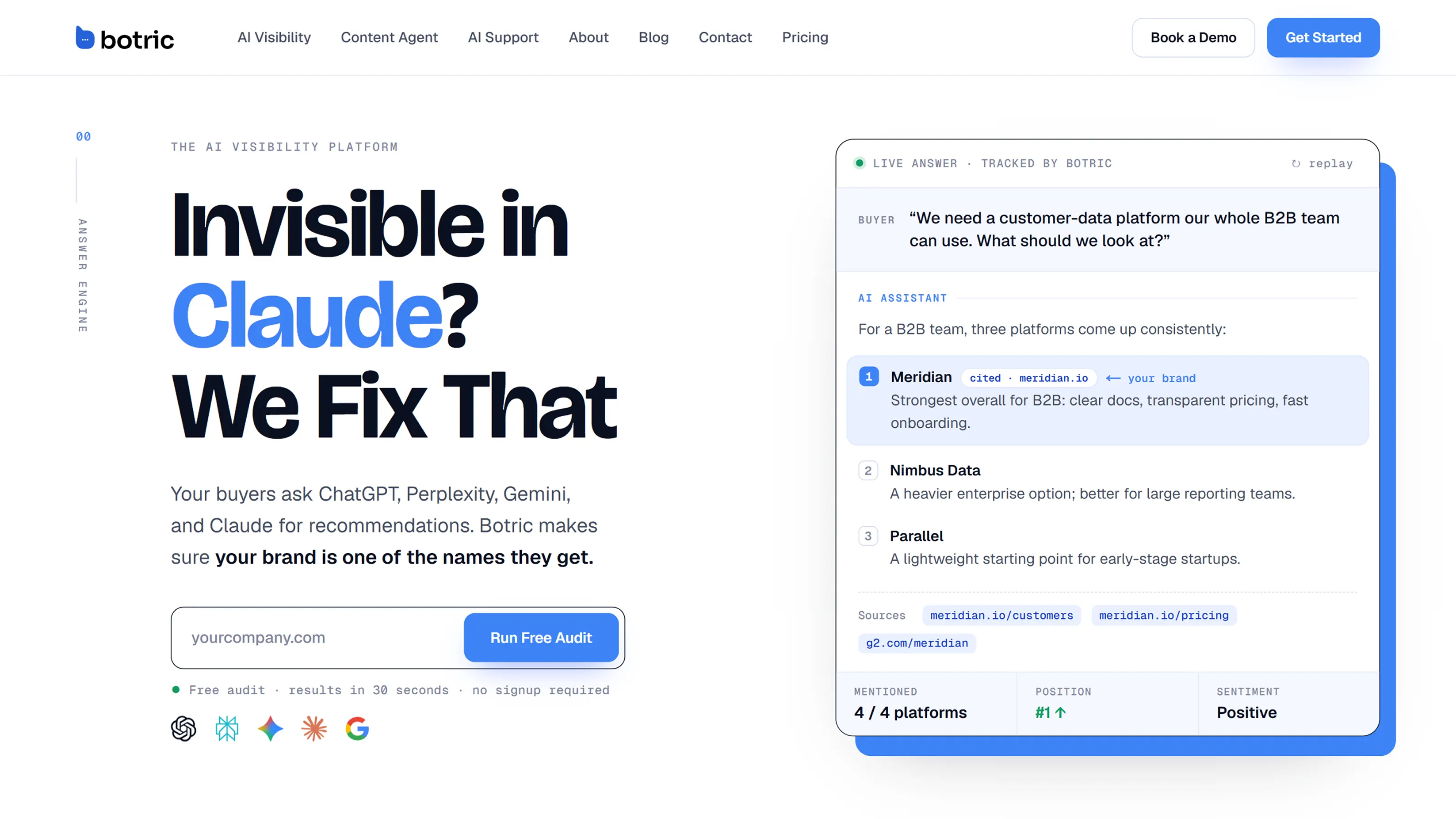
Botric runs the full loop: GEO audit, AI-ready content production, citation tracking, and an AI Chat Agent that engages AI-referred visitors at the moment they land.
The platform starts with a full GEO audit, crawling your indexable pages, scoring structured-data health, and identifying the exact content gaps that cause AI engines to skip your website.
In Botric, you can track AI visibility across six platforms, ChatGPT, Gemini, Perplexity, Claude, Google AI Overviews, and Google AI Mode, monitor prompt-level citations, analyze competitors, and generate AI-ready content recommendations based on what the data reveals.
Botric offers a free plan, with paid plans starting from around $15/month per Botric's own pricing page.
Genuine Limitation
Botric is a newer platform, so its historical AI visibility data isn't as extensive as some long-established competitors. If your team relies heavily on multi-year trend reporting, that's worth weighing carefully.
Otterly answers "are we visible?" Botric answers "how do we get recommended and convert it?" If your team only needs monitoring, Otterly's price ladder is hard to beat. If you need to close the gap and measure revenue impact, Botric's integrated approach is the more appropriate fit.
Quick Comparison Table
Pricing Comparison and Switching Considerations
Common Mistakes When Choosing an AI Visibility Tool?
The biggest mistake is treating AI visibility as a renamed SEO ranking report. A page that ranks first on Google can score zero in AI citation tracking for the same query, and teams that pick a tool based on familiar metrics like domain authority or keyword position often find the data doesn't map to what they actually need to fix.
Mistake #1: Ignoring update lag
LLM versions change frequently, and a tool that ran its last prompt batch two weeks ago may be reporting on a model that no longer exists in production. Ask vendors specifically how often they re-run prompts and which model versions they target before you commit. A weekly cadence is the minimum for meaningful tracking; daily is the standard among the better platforms here.
Mistake #2: Confusing monitoring with action
Monitoring tells you the score. Teams that invest $200/month in a visibility dashboard but have no integrated content strategy to act on the findings are paying for anxiety rather than progress. The quality backlinks from authoritative sources and the structured content that earns AI citations require a workflow behind them. Before choosing a tool, map the gap between "we see the data" and "we can act on it," because that gap is where most programs stall.
Mistake #3: Underestimating the effort to build entity clarity
Entity clarity, meaning the degree to which AI systems unambiguously understand what your brand does, who it serves, and why it's authoritative, is the structural fix that citation data points toward. Tools surface the symptom (low citation rate), but closing the gap requires consistent entity naming across your site, quality backlinks from sources AI engines already trust, and content that answers the exact prompts your buyers are running. No tool automates that work; the best ones make it faster.
For a deeper look at how these platforms compare on AI search visibility across brands and competitors, the structural differences become even clearer.
Best Alternative by Need
Otterly's $29/month Lite plan is hard to beat if all you need is monitoring, especially for a lean team or agency that just wants visibility data in front of clients. Botric's free plan and ~$15/month Byte tier land at a similar price but add the audit, content, and engagement layer on top, which starts to matter once monitoring alone stops being enough.
-
Tightest budget, just starting out: Otterly at $29/month or Botric's free plan.
-
Need full GEO loop (audit + content + conversion): Botric.
For teams looking to improve AI search visibility in 2026, the tool choice matters less than having a structured workflow behind it.
Key Takeaways
-
Otterly's prompt caps and add-on engine costs make it less complete than the headline price suggests, though it remains the lowest-friction entry point for teams that only need monitoring.
-
Botric covers the full GEO cycle from audit through content production to conversion tracking, a structural difference from every pure-play monitoring tool in this comparison.
-
Peec AI earns its place for mid-market teams that want model-specific analytics and Looker reporting without enterprise pricing.
-
Semrush's integrated toolkit makes sense if you're already paying for Semrush; as a standalone AI visibility purchase, the per-domain cost scales poorly against alternatives.
-
If your team has no GEO content workflow behind the tool, start with Botric's free plan or Otterly's trial before committing budget to a platform you won't act on.
Frequently Asked Questions
Can I use Otterly and Botric together?
Yes, and some teams do. Otterly handles lightweight daily monitoring while Botric runs the GEO audit and content production loop. The overlap is in citation tracking, so you'd be paying for duplicate data there. For most teams under $500/month in tool budget, consolidating on one platform makes more sense.
How often should I check my AI visibility scores?
Daily automated tracking is the standard for any brand actively running a GEO program. Manual spot-checks once a week are fine for teams just getting started, but if a competitor gains ground in a key prompt category, you want to know within 24 hours rather than at your next monthly review.
Does Otterly track all the major AI engines on its base plan?
No. Core plans include four AI search engines, and Google AI Mode and Gemini are paid add-ons, so price those extras before comparing Otterly to broader all-in plans.
What's the minimum team size that justifies the cost of these tools?
A solo marketer can extract real value from Otterly's $29 Lite plan or Botric's free tier. The honest question is whether you have the bandwidth to act on what the data shows. A team of one with a clear content workflow will outperform a team of ten that treats the dashboard as a vanity metric.
Do any of these tools have a free tier or trial I can test before paying?
Botric offers a free plan with core features. Otterly offers a 7-day no-card trial, no credit card required.