
AI search is changing how people find brands online. Your customers are getting answers directly from ChatGPT, Gemini, and Google AI Overviews instead of only clicking traditional search results.
That means ranking well on Google isn't always enough, and it's the part I see catch teams off guard most often. Your competitors could be showing up in AI answers even when you rank above them.
AI SEO tools help you track these mentions and citations, understand where competitors are winning, and find opportunities to improve your visibility.
In this guide, I compare the best AI SEO tools for improving your visibility across ChatGPT, Gemini, Google AI Overviews, and other AI search platforms, and tell you which one I'd pick in each situation.
Quick Answer: What Are the Best AI SEO Tools?
The best AI SEO tool depends on what you actually need to track. Some tools focus on traditional SEO and have added AI visibility features on top, while newer platforms are built specifically around AI search.
When I compare AI SEO tools, these are the capabilities I look for:
- AI mentions tracking. See how often your brand appears in answers generated by ChatGPT, Gemini, and other AI platforms.
- Citation tracking. Find out when AI platforms use your website as a source and which pages are being cited.
- Competitor visibility. See which competitors appear for important searches when your brand doesn't.
- Prompt tracking. Monitor the questions and searches your potential customers are asking across AI platforms.
- Actionable insights. A good tool should help you understand what to improve, not just show you another dashboard.
For most businesses, I wouldn't bother tracking thousands of prompts. Start with the searches your customers actually use and see which brands AI recommends.
What Metrics Do AI SEO Tools Actually Track That Traditional Ones Don't?
AI SEO tools track whether and how often your brand gets mentioned inside AI-generated answers, a different job than measuring where your pages rank on a search results page. Four metrics matter most to me, and each measures something a backlink report simply cannot see.
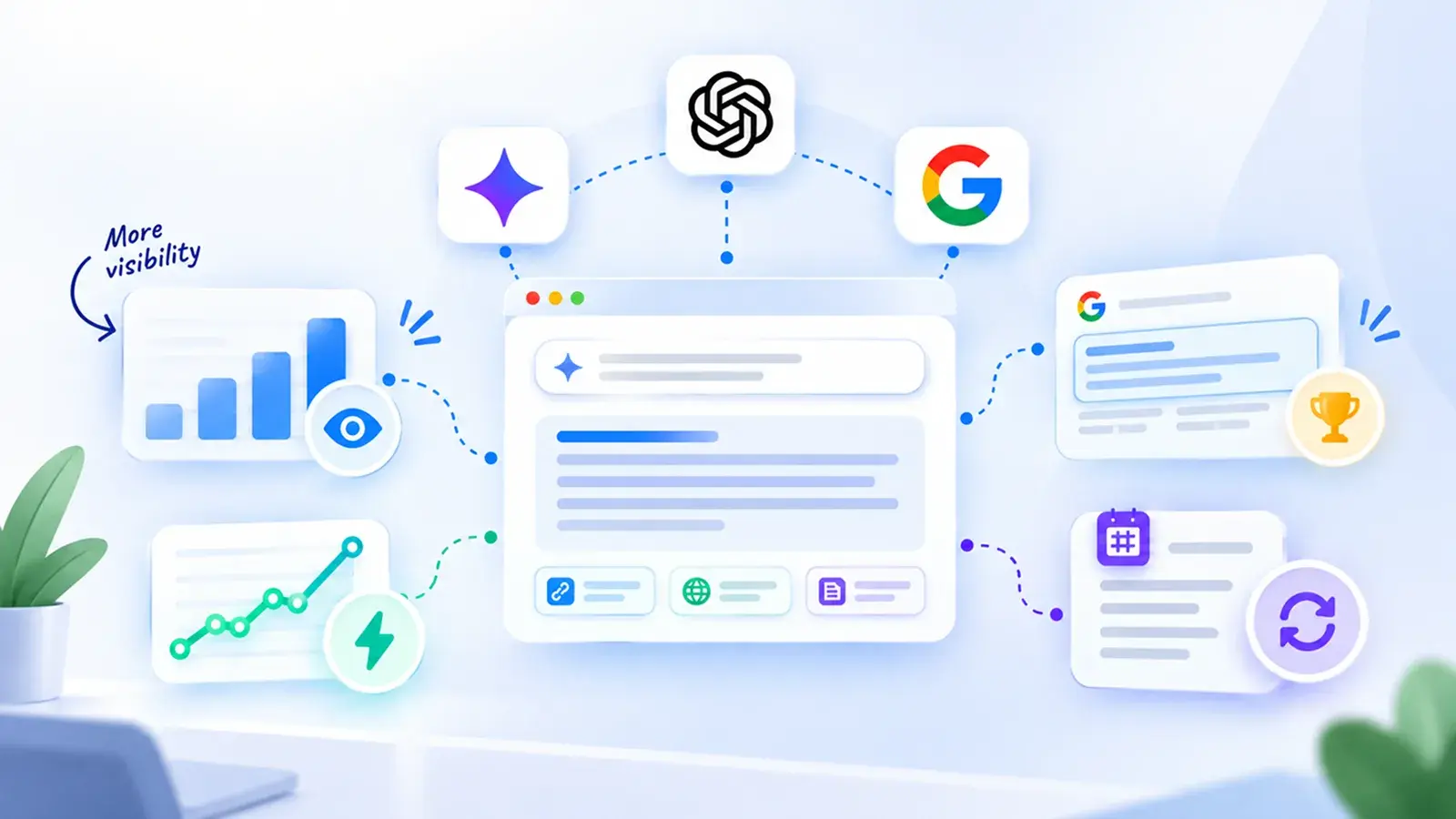
- LLM visibility: how frequently your brand or content appears when real prompts are run against ChatGPT, Gemini, and other assistants.
- AI Overview placement: whether your page gets pulled into Google's synthesized answer block, and at what position within it.
- Mention velocity: the rate of change in citations across model versions, since a GPT update or Gemini refresh can reshuffle who gets cited overnight.
- Content freshness signals: how recently and clearly your content has been updated, which affects whether it feeds into a model's retrieval layer at all.
The Seven Best AI SEO Tools Ranked by Capability and Fit
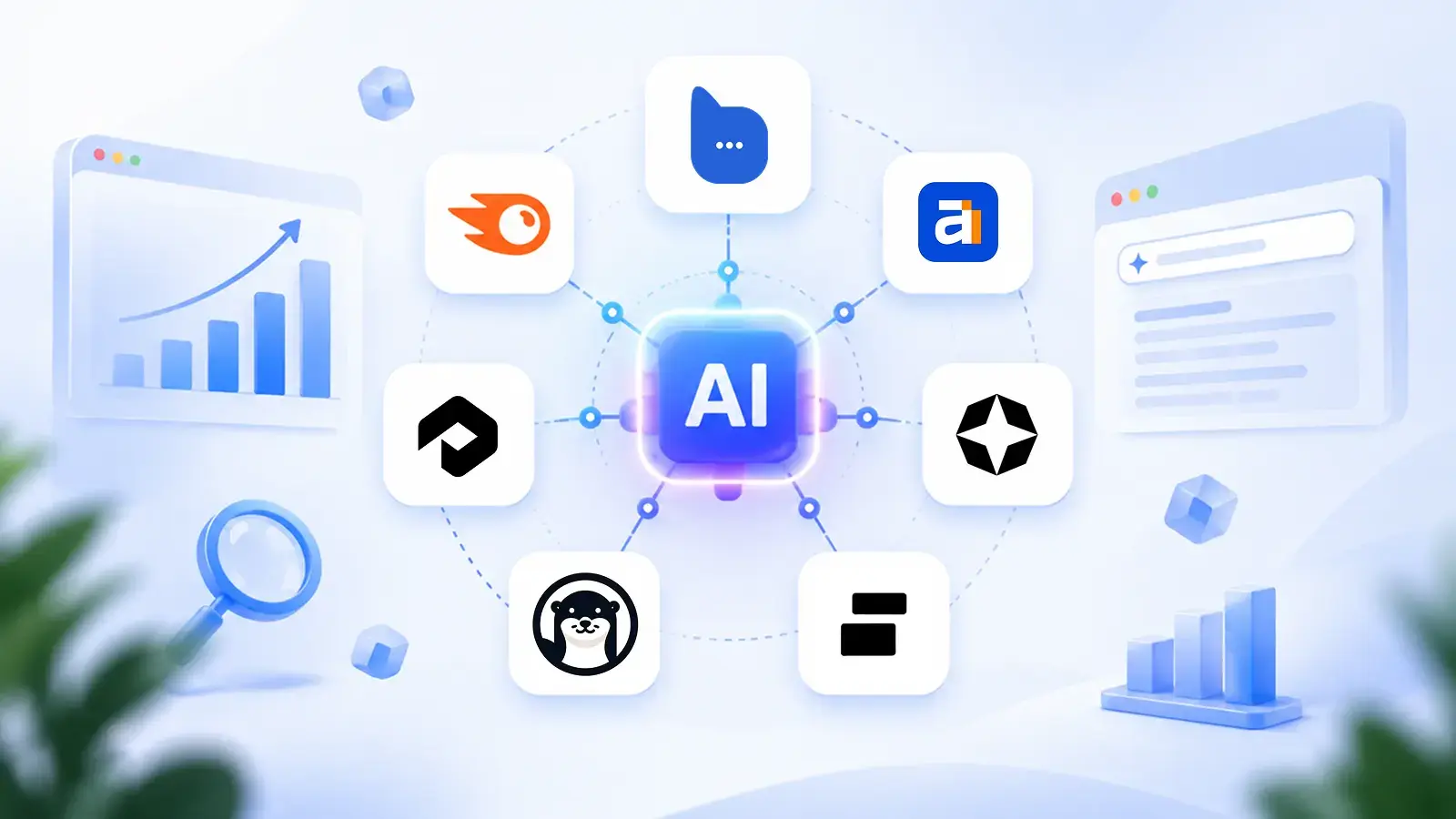
The field worth comparing right now is smaller than most roundups suggest. I'd narrow it to seven: Botric, Semrush, Ahrefs, Profound, Peec AI, Otterly.AI, and Scrunch AI, each built for a different type of user.
| Tool | Best for | Standout capability | Pricing | Key limitation |
|---|---|---|---|---|
| Botric | Brands wanting integrated AI visibility and content generation in one platform | Combines citation tracking across ChatGPT, Gemini, Perplexity, Claude, Google AI Overviews, and Google AI Mode with AI visibility monitoring and content generation for articles and pages | Free forever tier; Bit $15/mo; Byte $49/mo; Infinity $149/mo; Enterprise pricing on request | Full six-engine coverage and the highest prompt allowance only unlock on the Infinity tier |
| Semrush | Teams that already run SEO through Semrush and want AI visibility bolted onto the same dashboard | AI-ready Site Audit plus AI sentiment monitoring layered onto an established keyword and backlink toolkit | SEO plan $139/mo billed annually; Starter SEO + AI Search $199/mo billed annually; Pro+ $299/mo billed annually; Advanced $549/mo billed annually, per Semrush's pricing page | AI Search features are a recent addition to a legacy platform, not a native build |
| Ahrefs | Agencies and in-house teams anchored in backlink data who need AI prompt tracking as an extra layer | Backlink index built from what Ahrefs calls the industry's second-most active crawler, at 493 billion pages and 209 million domains | Lite $129/mo; Standard $249/mo; Advanced $449/mo; Enterprise $1,499/mo requiring annual commitment; Brand Radar AI add-on from $199/mo, per Ahrefs' pricing page | AI prompt tracking is capped low even on paid tiers, just 5 to 20 tracked prompts depending on plan |
| Profound | Enterprise teams that want deeper AI visibility intelligence | Tracks how brands appear across AI answer engines and helps teams understand the sources influencing those answers | Starter $99/mo; Growth $399/mo; Enterprise pricing custom | Can be more complex and expensive than smaller teams need |
| Peec AI | Marketing teams looking for straightforward AI search monitoring | Tracks brand visibility, competitors, prompts, and sources across major AI platforms | Starter $80/mo; Pro $205/mo; Advanced $420/mo; Enterprise custom, requiring an annual commitment, per Peec AI's pricing page (billed annually) | More focused on monitoring than broader SEO workflows |
| Otterly.AI | Smaller teams that want an easy way to start monitoring AI search | Tracks brand mentions, citations, and links across AI-generated answers | Lite $29/mo; Standard $189/mo; Premium $489/mo; Enterprise custom, starting from $1,000/mo, per Otterly.ai's pricing page | Less comprehensive than larger SEO and enterprise AI visibility platforms |
| Scrunch AI | Brands focused on understanding and improving how AI systems represent them | Helps brands monitor their presence in AI answers and understand how their content is being interpreted by AI platforms | Pricing based on business requirements; Core $250/mo; Enterprise custom, per Scrunch AI's pricing page | Better suited to dedicated AI visibility programs than traditional SEO workflows |
Botric
Botric is my top pick for businesses that want to improve their visibility across AI search without dealing with an overly complex SEO platform. I should say up front that I work on it, so weigh that as you read. It tracks how your brand appears across ChatGPT, Gemini, Perplexity, Claude, Google AI Overviews, and Google AI Mode, including brand mentions, citations, prompts, and competitor visibility.
Beyond monitoring, Botric helps you understand where competitors are being recommended instead of you and where new visibility opportunities exist. It also brings AI visibility monitoring and AI content generation together, helping teams create optimized articles and pages around the topics and prompts that matter to their audience.
Key features: AI citation tracking, brand mention monitoring, competitor visibility, prompt tracking, 24/7 AI visibility monitoring, and AI content generation.
Semrush
Semrush combines AI search monitoring with its established SEO toolkit. Teams can track AI visibility while also using Semrush for keyword research, site audits, backlinks, competitor research, and traditional search rankings.
Its biggest advantage is having traditional SEO and newer AI search capabilities within the same ecosystem, making it especially useful for teams already using Semrush.
Key features: AI visibility tracking, AI sentiment monitoring, keyword research, backlink analysis, site audits, and competitor research.
Ahrefs
Ahrefs is best known for its backlink and competitor research capabilities, but it has expanded into AI search monitoring as well. Teams can use its AI features to track brand visibility while using Ahrefs' large backlink and search database to understand authority, competitors, and content gaps.
This makes it particularly useful when AI visibility is only one part of a broader SEO and link-building strategy.
Key features: AI visibility and prompt tracking, backlink analysis, competitor research, keyword research, content gap analysis, and site auditing.
Profound
Profound is built specifically around understanding how brands appear across AI answer engines. It provides deeper visibility into brand mentions, competitors, prompts, and the sources influencing AI-generated answers.
Its more advanced approach makes it a stronger fit for larger companies managing AI visibility across multiple products, markets, or teams.
Key features: AI visibility tracking, prompt monitoring, competitor intelligence, citation and source analysis, and AI answer-engine insights.
Peec AI
Peec AI focuses on making AI search monitoring straightforward. It tracks how often brands appear for important prompts, which competitors are being recommended, and which sources AI platforms use in their answers.
Instead of providing a large traditional SEO toolkit, Peec AI stays focused on monitoring and understanding AI search performance.
Key features: Prompt tracking, brand visibility monitoring, competitor tracking, source analysis, and AI search reporting.
Otterly.AI
Otterly.AI provides a simple way for businesses to monitor how they appear in AI-generated search results. It tracks brand mentions, citations, and links across AI platforms, helping teams see whether their content is being referenced in AI answers.
Its straightforward approach makes it accessible for smaller businesses and teams that are just starting to measure AI search visibility.
Key features: Brand mention tracking, citation monitoring, link tracking, AI search monitoring, and visibility reporting.
Scrunch AI
Scrunch AI focuses on how AI systems understand and represent a brand. It helps businesses monitor their presence in AI answers and identify how their website content is being interpreted and surfaced by AI platforms.
This makes it useful for brands that want to go beyond simply counting mentions and better understand how AI engines perceive their content and brand.
Key features: AI brand monitoring, content interpretation insights, AI visibility tracking, and brand representation analysis.
Which Tool Fits Your Situation
| Reader profile | Recommended tool | Why |
|---|---|---|
| Agency needing deep backlink data for client link-building work | Ahrefs | Its crawler and historical index depth remain the strongest backlink dataset here, useful well beyond AI visibility work |
| Startup wanting AI citation tracking plus a way to act on what it finds | Botric | Combines detailed AI visibility tracking with AI content generation to find gaps and help you fix them |
| Enterprise needing AI visibility across many markets alongside traditional rankings | Semrush | Multi-market Position Tracking and an established keyword database sit in the same dashboard as the AI Search features |
| Marketing team wanting simple AI visibility monitoring | Peec AI | Focuses on tracking prompts, competitors, and brand visibility without a large traditional SEO toolkit |
| Small team getting started with AI search tracking | Otterly.AI, Botric | Provides an accessible way to monitor mentions and citations without starting with an enterprise platform |
| Brand wanting to understand how AI systems represent it | Scrunch AI | Focuses specifically on how brands and their content are interpreted and surfaced by AI systems |
Where Do the Big Players Stumble When It Comes to AI Visibility?
The big players stumble because their AI visibility dashboards were grafted onto platforms built for a different era of search. A massive backlink profile and domain authority still matter, but they no longer decide the whole outcome.
Semrush and Ahrefs both carry enormous historical data advantages, decades of crawl history and hundreds of billions of indexed pages between them, but that scale was built to answer where a page ranks rather than whether an LLM quoted it.
Here's the trade-off I'd want you to sit with. A team that needs deep historical SEO data, multi-market Position Tracking, or an established backlink database to support link-building work gets a genuine, earned advantage from Semrush or Ahrefs' scale, one a newer entrant can't easily replicate.
When the priority shifts toward AI Overview placement, citation tracking across ChatGPT and Gemini, and the support layer that answers the visitors those citations send, an AI-native build like Botric is closer to the job than a legacy dashboard with an AI tab added on.
Conclusion
AI search is changing how people find and compare brands. Ranking on Google still matters, but being visible in ChatGPT, Gemini, and Google AI Overviews is becoming just as important.
The right AI SEO tool will help you track mentions, citations, competitors, and the opportunities you're missing.
While Semrush and Ahrefs are strong for traditional SEO, Botric is my top pick for brands focused on AI visibility, with a simple way to track and improve how your brand shows up across AI search.
The goal is simple, and it's the one I'd hold onto: make sure your brand is visible wherever your customers are searching.
Key Takeaways
- Whether a brand gets recommended now hinges on how often it's cited across ChatGPT and Gemini rather than where it sits in Google's rankings.
- Semrush and Ahrefs bring unmatched historical backlink depth, but their AI features remain add-ons to platforms designed for an earlier era of search.
- Botric pairs citation tracking across six AI engines with AI agents that answer the visitors those citations send, at a lower entry price than either legacy competitor.
- Prompt tracking ceilings vary widely, from 5 prompts on Ahrefs Lite to 150 on Botric's Infinity plan, so match the tier to your real query volume before buying.
- Teams chasing AI Overview and chatbot citations should lead with an AI-native platform; those still building foundational domain authority may want Semrush or Ahrefs' backlink scale as a starting point instead.
Want to see how your brand shows up in AI search? Run a free AI visibility audit with Botric to see where you appear in ChatGPT, Gemini, and other AI platforms, and where your competitors are showing up instead.
Frequently Asked Questions
Which tool is best for tracking brand mentions in ChatGPT?
It depends on your needs. I'd point you to Botric for focused AI visibility tracking, while Semrush and Ahrefs make more sense if you also need a broader traditional SEO toolkit.
Can I try an AI SEO tool for free?
Yes. Some platforms offer free plans or limited trials. Botric has a free tier, while other tools may require a paid plan to access their full AI visibility features.
How often should I track AI visibility?
For most brands, I'd start with weekly tracking. Watch your mentions, citations, competitor visibility, and important prompts over time rather than reading too much into a single result.
Can AI SEO tools help improve my AI visibility?
Yes. Tracking shows where your brand is missing and which competitors or sources are appearing instead. You can use those insights to improve existing content or create content around missed opportunities.