
The best ChatGPT rank tracker depends on what you want to measure and how you plan to use the insights. Unlike traditional SEO tools that focus on keyword rankings, ChatGPT rank trackers measure AI citations, brand mentions, and share of voice across AI-generated answers.
In this guide, I'll compare the leading ChatGPT rank tracking tools, walk through their features, pricing, strengths, and limitations, and help you choose the right solution for your business.
Quick Answer
A ChatGPT SEO tracker or ChatGPT visibility tracker helps you measure how often your brand appears in AI-generated answers.
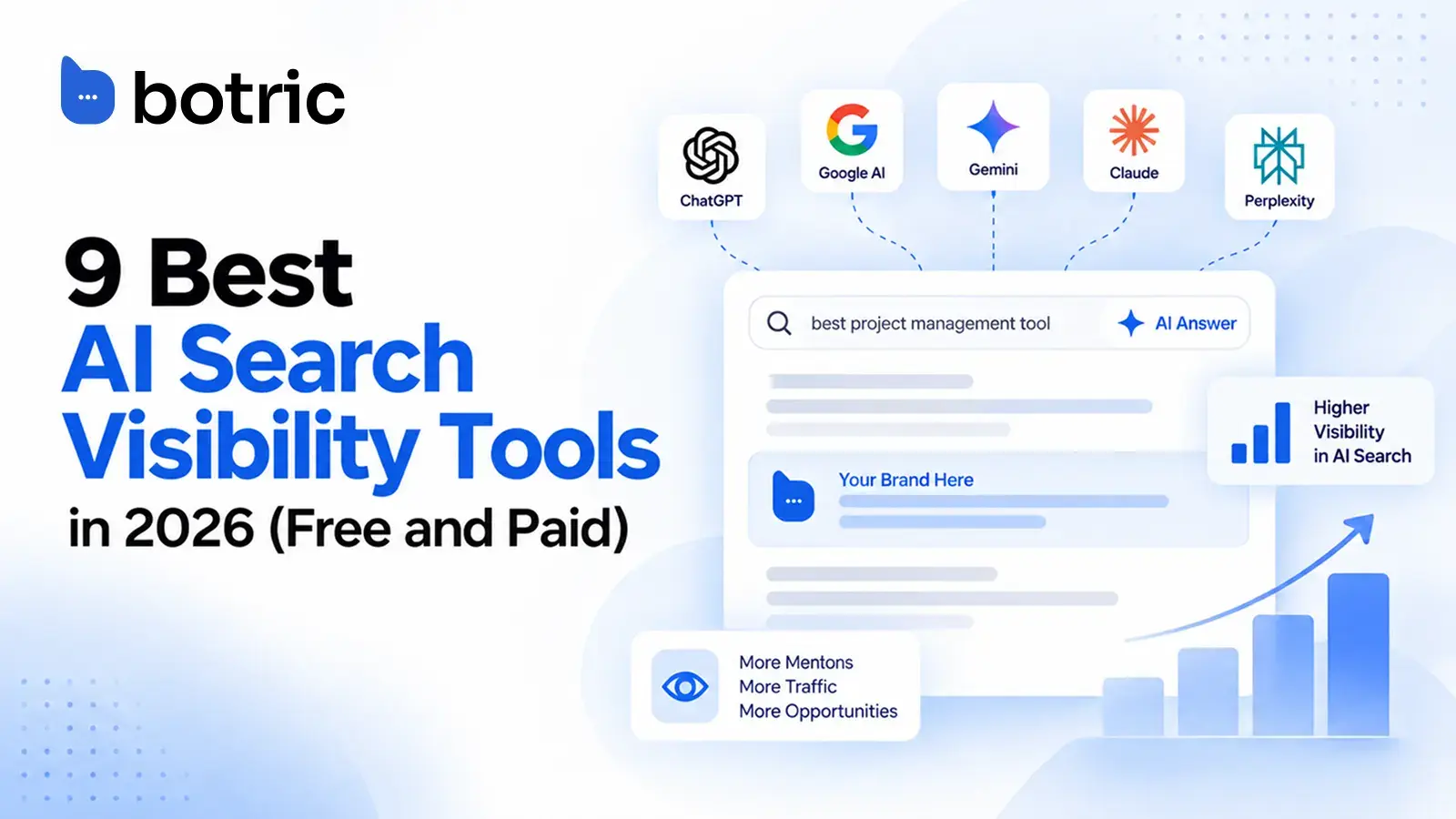
Unlike traditional SEO rank trackers, these tools track brand mentions, AI citations, competitor visibility, share of voice, and the sources AI engines use to answer relevant prompts across platforms such as ChatGPT, Google AI Overviews, Gemini, Claude, and Perplexity.
If you want to track ChatGPT and other AI engines in one place, here are some options:
- Botric: Best for tracking ChatGPT visibility alongside Google AI Overviews, Gemini, Claude, Perplexity, and other AI engines, with GEO audits, competitor analysis, content gap detection, and AI-ready content optimization.
- Peec AI: A strong choice for teams focused on monitoring AI citations and competitor visibility across multiple AI platforms.
- Profound: Built for enterprise teams that need large-scale AI visibility reporting, governance, and analytics.
- Otterly.AI: A straightforward option for businesses starting with AI visibility tracking.
- Scrunch AI: Designed for larger organizations looking for AI analytics, crawler insights, and enterprise reporting.
As AI search becomes a bigger part of how people discover products and services, I'd argue tracking your visibility in AI-generated answers is no longer optional. The right tool should not only show where your brand appears, but also help you understand how to improve your AI presence over time.
What Does a ChatGPT Rank Tracker Actually Measure?
If your Google rankings look fine but you're losing deals to competitors that buyers found through ChatGPT, you're already living the problem these tools exist to diagnose.
AI visibility, or the practice of measuring how often your brand appears inside AI-generated answers, is a fundamentally different signal from a Google ranking.
A ChatGPT rank tracker submits a library of target prompts to AI engines, logs every brand mention, records the position in the response, and tracks which URLs the model cited alongside it.
The output is a citation rate: what percentage of relevant prompts include your brand, and how that shifts against competitors over time. That's your share of voice across prompts.
The two-layer problem every tracker faces
ChatGPT doesn't pull from a single source. ChatGPT Search combines a fine-tuned GPT-4o model with Bing-powered retrieval. Some responses use live web retrieval, while others are generated directly from the model's existing knowledge without performing a web search.
That distinction matters enormously for what a tracker can see. The model's existing knowledge reflects patterns learned from its training data, including editorial publications, Reddit discussions, documentation, and review sites.
Live web retrieval, on the other hand, depends on factors such as Bing indexing, structured data, and content freshness. A tracker running live prompt tests captures the retrieval layer well, but it can't directly audit what's baked into the model's weights. No tool can, and any vendor who implies otherwise is overselling.
A citation database, meaning the structured record of which URLs, domains, and sources an AI engine cites for a given query type, requires running the same prompts repeatedly across model versions to stay reliable, because outputs vary.
Which ChatGPT Rank Tracker Fits Your Actual Workflow?
Every tool in this space claims to track AI visibility. The real differences, as far as I can tell, are in what they do with that data and who they're actually built for.
| Tool | Starting Price | Engines Covered | Content Production Loop | Best For |
|---|---|---|---|---|
| Otterly.AI | $29/mo (15 prompts) | 4 (ChatGPT, AI Overviews, Perplexity, Copilot) | No | Simple AI visibility tracking for a single brand |
| Botric | Forever free plan; paid plans start at $15/month | 5+ engines | Yes | Teams that need tracking connected to content production and pipeline |
| Peec AI | €95/mo | 6 (ChatGPT, Perplexity, Gemini, Copilot, Google AI Mode, AI Overviews) | No | Mid-market teams needing daily monitoring clarity |
| Profound | $99–$399/mo | 1–3 engines depending on plan | No | Enterprise compliance and large citation corpus |
| Scrunch AI | $250/mo (Core) | 4 platforms | No | Regulated industries requiring AI visibility insights |
1. Otterly.AI: A simple starting point
Otterly.AI is a good fit for teams that are just getting started with AI visibility monitoring. Its Lite plan ($29/month) includes 15 tracked prompts across ChatGPT, Google AI Overviews, Perplexity, and Copilot, making it an accessible way to begin measuring AI citations without a complex setup.
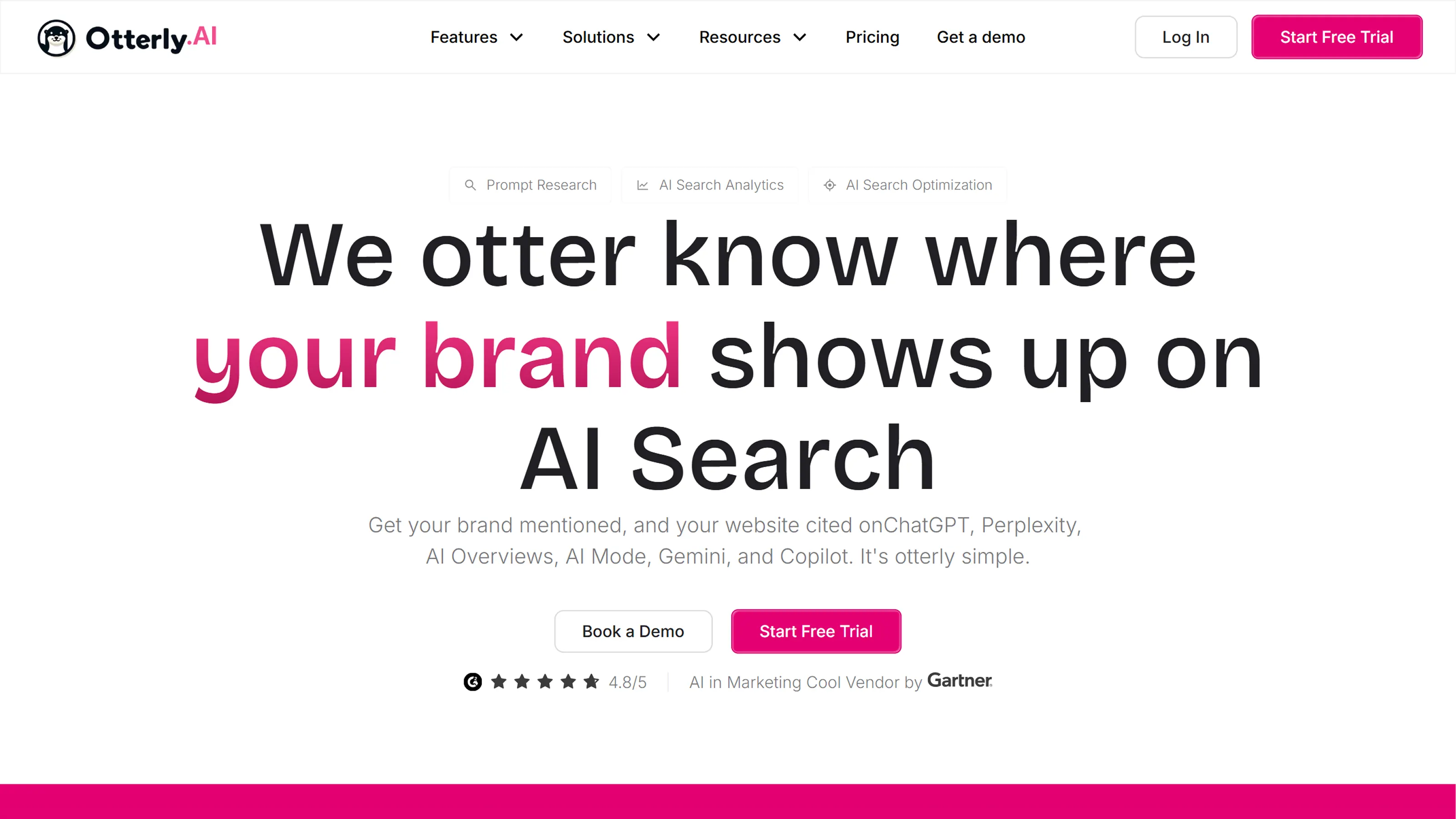
The platform focuses on the essentials, allowing teams to monitor brand mentions across major AI search platforms without the complexity that often comes with enterprise-grade tools. For smaller marketing teams or businesses exploring GEO for the first time, that simplicity can be a real advantage.
As your program grows, though, you may start to outgrow the platform. Teams managing multiple brands, tracking a wider range of AI engines, or needing deeper competitor analysis will likely require a more advanced solution.
The main limitation is that it's designed for simpler monitoring workflows. As your needs expand to include multi-brand management, broader AI platform coverage, or more advanced competitor analysis, you may find yourself needing a more robust solution.
2. Botric: AI Visibility And Citation Tracking
Botric combines AI visibility tracking with citation monitoring, competitor analysis, full GEO audits, and content generation. The platform helps you see where your brand appears across ChatGPT, Google AI Overviews, Gemini, Claude, Perplexity, and other AI platforms, including which sources are cited in AI-generated answers.
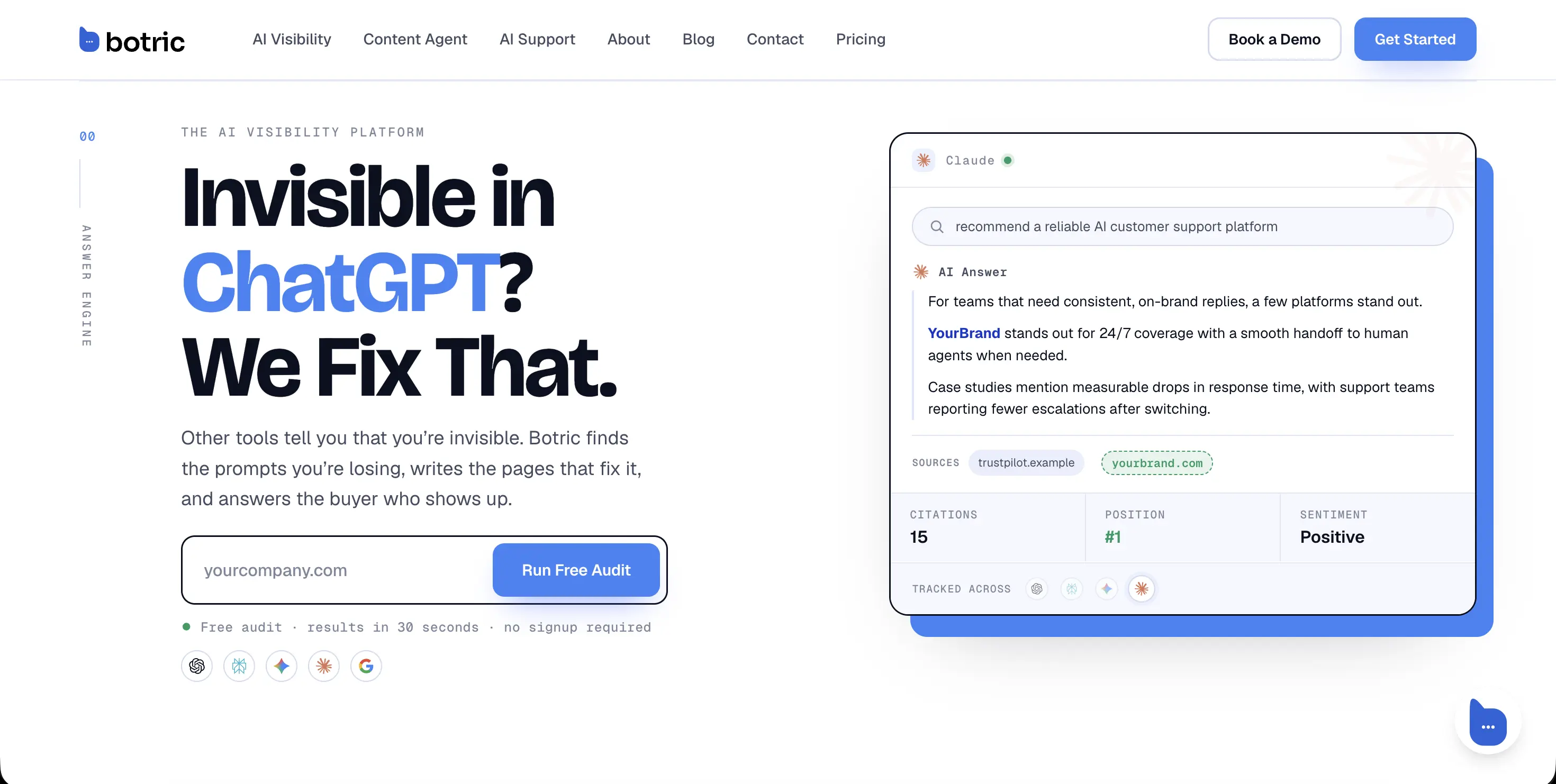
You can track brand mentions and citations at the prompt level, compare your visibility with competitors, identify citation gaps, and see which pages and sources AI engines reference. Its GEO audit also helps identify content and technical issues that may affect your AI visibility.
Compared with the other tools in this list, Botric stands out with a free-forever plan that includes a free ChatGPT rank tracker, letting you monitor AI visibility without paying for a subscription.
The main limitation is that Botric is newer, so its historical AI visibility data may not be as extensive as some established competitors.
However, for teams focused on improving AI visibility today, the combination of tracking, auditing, competitor analysis, and content optimization makes Botric one of the most complete GEO platforms available.
For comparing your brand's AI search presence against competitors, Botric's prompt-level gap analysis shows which competitors are earning citations where your brand is missing.
3. Peec AI: best pure monitoring for mid-market teams
Peec AI is built for teams that want a clear picture of how their brand appears across AI search platforms. You can create a library of target prompts, track brand mentions across ChatGPT, Gemini, Perplexity, Google AI Mode, AI Overviews, and Copilot, monitor citation trends over time, compare your visibility against competitors, and see which sources AI models reference in their responses.
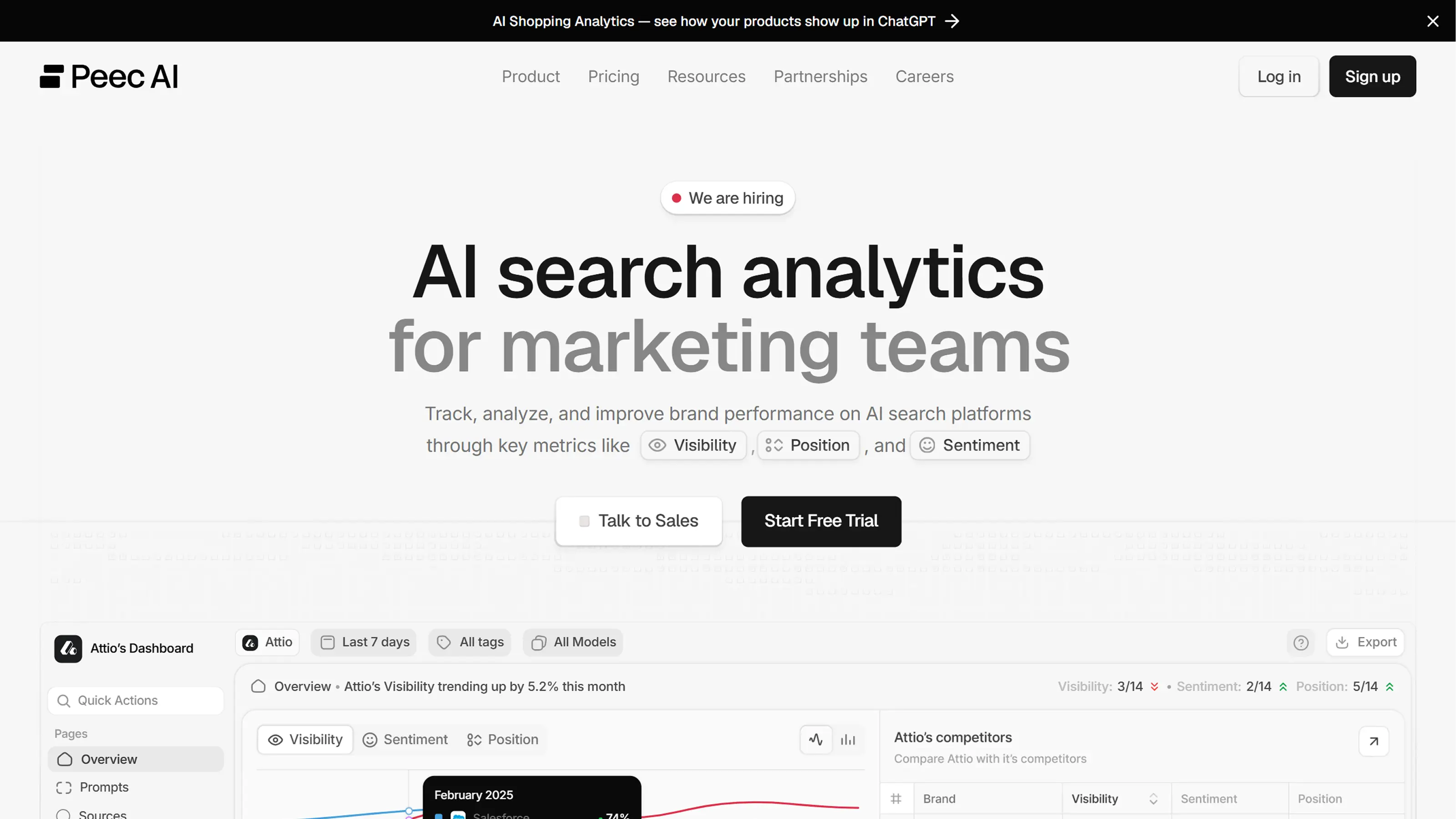
One of Peec AI's strengths is its focus on real-world monitoring. Rather than relying solely on model APIs, it reportedly collects responses through browser-based testing, helping teams see results that are closer to what actual users experience.
The platform has also been quick to expand support for new AI search experiences, including Google AI Overviews, as the market evolves.
The main limitation is that Peec AI focuses on monitoring rather than optimization. It does a great job showing where your brand is being mentioned and how your visibility changes over time, but it doesn't help you identify content gaps, generate optimization recommendations, or create AI-ready content. Pricing starts at €95/month, with a 7-day free trial.
4. Profound: enterprise citation depth
Profound is designed for enterprise organizations that need detailed visibility into how their brands appear across AI platforms. It tracks brand mentions, prompt performance, AI shopping results, and AI crawler activity, giving large marketing teams a broad view of how AI systems discover and reference their content.
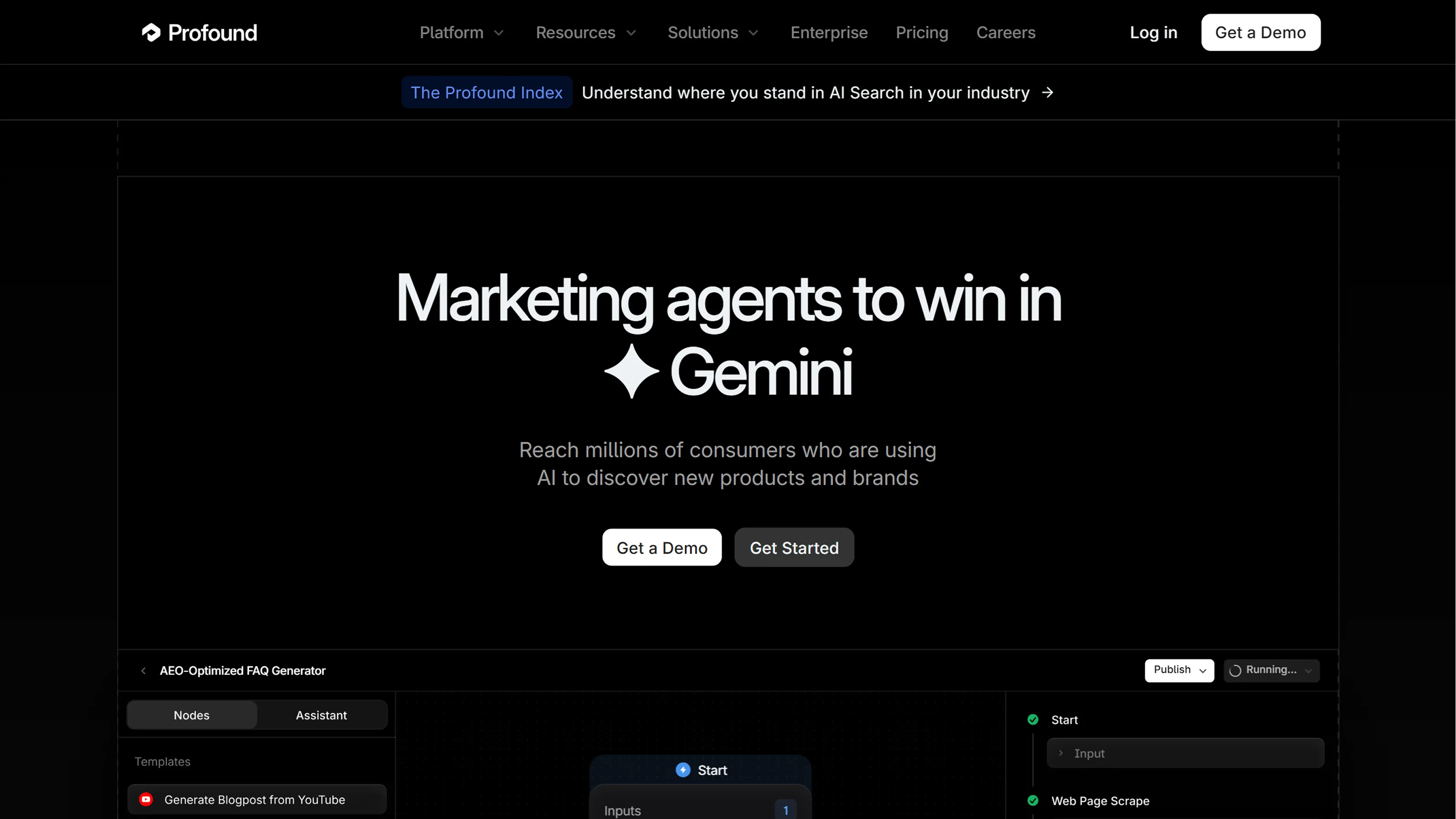
One of Profound's biggest strengths is the scale of its data. The platform analyzes billions of real-world prompts and conversations, making it a strong fit for organizations that need enterprise reporting, governance, and cross-team collaboration.
Plans start at $99/month for ChatGPT tracking, while higher-tier plans expand coverage across additional AI platforms.
The biggest drawback is the onboarding experience. The platform can feel overwhelming for smaller teams, and the 7-day free trial is only available on the $399/month Growth plan. That makes it harder for teams to properly evaluate the platform before making a significant investment.
5. Scrunch AI: for regulated industries and bot traffic
Scrunch AI helps organizations understand how their brands appear across AI search platforms. It tracks AI visibility, monitors brand mentions, analyzes competitors, and provides insights into AI referral traffic so marketing teams can measure how AI search is influencing website performance.
The platform also offers AI crawler analytics, helping you see how bots such as GPTBot, ClaudeBot, and Claude-User interact with your website.
Scrunch AI is best suited for larger organizations that want enterprise reporting and collaboration features. It places a strong emphasis on analytics and monitoring rather than content optimization, making it a good fit for teams that already have established SEO and content workflows.
The main limitation is its pricing. The Core plan starts at $250/month, which can be difficult to justify for smaller businesses, especially when many of its advanced capabilities are aimed at enterprise teams.
How Do ChatGPT Visibility Results Differ from Traditional SEO Rank Tracking?
A Google ranking is a position. A ChatGPT citation is closer to an endorsement. Those have different causes and different fixes.
| Dimension | Traditional SEO rank tracking | ChatGPT visibility tracking |
|---|---|---|
| What's measured | Keyword position (1–100+) | Citation rate, mention frequency, share of voice |
| Primary signal | Backlinks, on-page SEO | Content authority, entity clarity, source reputation |
| Update frequency | Daily crawl data | Per-prompt run (daily to weekly) |
| Competitor view | SERP position gap | Share of voice across prompts |
| Actionable fix | Link building, on-page optimization | Structured content, citation-worthy sources |
| Tool examples | Ahrefs, Semrush | Botric, Scrunch AI, Otterly.AI |
Traditional SEO dashboards can't track the widening gap between organic rankings and AI citations, which is why citation monitoring needs its own dedicated workflow.
Success in ChatGPT visibility looks like your brand appearing in 60–70% of tracked prompts in your category, with positive sentiment, and citations pointing to pages you control. That's a different scorecard from page-one rankings, and it requires a different tool to measure.
For a practical guide to improving your AI search visibility in 2026, the content and technical fixes that move citation rates are more specific than most SEO checklists suggest.
Is ChatGPT Rank Tracking Worth the Cost for Your Team?
Pay for it if your buyers are already using ChatGPT to research your category. That's the honest test.
If your target queries are the kind that trigger live web search (commercial, comparison, "best X for Y"), you're already being cited or not cited right now, and you don't know which.
Teams that should pay:
-
Brands in competitive SaaS, fintech, or professional services categories where ChatGPT is a discovery surface
-
Content-heavy teams running an agile content strategy who need to know which pieces are earning citations
-
Agencies managing multiple brands that need integrated reporting across clients
Teams that should wait:
-
Niche B2B brands with very low ChatGPT mention rates in their category. If your buyers aren't asking ChatGPT about your product type yet, tracking a 0% citation rate weekly is noise.
-
Small teams without the bandwidth to act on the data. A monitoring dashboard you don't have time to respond to is a recurring cost with no return.
The ROI signal to watch: when your citation rate moves after a content change, you've confirmed the loop. Until that happens, you're paying for awareness.
The most common reason tracking doesn't pay off is a sequencing problem: teams run the audit, identify the gaps, and then don't publish remediation content within 60 days. By then a model update has shifted the citation landscape and the audit is stale.
The first measurable citation lift typically appears 6–10 weeks after publishing structured remediation content. Teams that move faster than that window close gaps before competitors notice them; teams that stall past it often need to re-audit before they can act.
You don't necessarily need to pay to start tracking. You can use Botric's free plan to track your brand's visibility in ChatGPT and see where you appear in AI-generated answers before deciding whether you need more advanced tracking.
Conclusion
The best ChatGPT rank tracker is the one your team will actually act on. Peec AI is a strong option for teams focused on monitoring. Profound covers citation volume and enterprise compliance. Otterly.AI is a good entry point. Scrunch AI is a strong fit for enterprises that need AI visibility analytics, crawler insights, and reporting.
Botric suits teams that need tracking connected to content production and a clear path from citation gap to closed pipeline.
Pick the wrong one and you'll spend three months staring at a dashboard that tells you you're invisible but offers no path to fixing it. The tool that shows you the gap and helps you close it is worth more than the one with the biggest prompt library.
Key Takeaways
-
ChatGPT trackers measure citation rate and share of voice across prompts. They complement SEO tooling rather than replacing it.
-
Roughly half of ChatGPT queries never trigger a live web search, so trackers capture the retrieval layer but can't audit what's embedded in model weights.
-
Different tools solve different problems. Some focus on monitoring, while others combine tracking with GEO audits, competitor analysis, and content optimization.
-
The best value comes from acting on the data. Tracking AI visibility only matters if you use those insights to improve your content and citations.
-
A tracker only earns its cost if your team has the bandwidth to act on citation gaps. A dashboard you don't respond to is a subscription.
-
Teams that need citation tracking connected to content production and pipeline conversion should evaluate Botric, where the audit, content output, and visibility tracking run as one loop.
Knowing your AI visibility is only the first step. The real opportunity comes from understanding what's driving citations and turning those insights into better content.
With Botric, you can track AI citations, monitor competitors, identify content gaps, and optimize your website for AI search, all in one platform. Start with a free AI Visibility Audit and discover your biggest opportunities.
Frequently Asked Questions
How often should I check ChatGPT visibility results?
Weekly is the right cadence for most ongoing programs. Day-to-day swings are typically modest, and a weekly review gives you a cleaner signal for content, PR, and partnership decisions without the noise of mostly unchanged daily snapshots. During a campaign or an incident, daily checks earn their keep.
Is a ChatGPT brand mention worth more than a Google ranking?
It depends on the query. Picture a buyer typing "best CRM for startups" into ChatGPT at the moment they're about to shortlist vendors. A mention there reaches them with no competing links on the page. A Google ranking on the same query sits alongside nine other results. The mention is narrower in reach but lands at a higher-stakes moment in the decision.
Do any of these tools offer a free tier or trial?
Yes. Botric offers both a free GEO audit and a free plan. Otterly.ai offers a 7-day free trial. Peec AI offers a 7-day trial starting at €95/month.
What's the difference between Botric and Peec AI for a content team?
Say your team publishes a new comparison page. Peec AI will tell you within 24–48 hours whether it's being cited in ChatGPT responses. Botric surfaces the same citation data, then routes the gap into a content brief, produces the AI-ready asset, and tracks whether the citation rate moves afterward. One stops at the diagnosis; the other runs the treatment.
Why do two ChatGPT trackers sometimes report different citation rates for the same brand?
Both numbers can be correct, because the tools are measuring different things. One may be testing the live web-search layer while the other hits the training-data layer. Different prompt sets, model versions, and scraping methods all produce legitimately different outputs. The figure that matters is the trend within a single tool over time, not a figure lifted from a different platform's methodology.
Can ChatGPT rank trackers track Google AI Overviews?
Some do, but not all. Platforms like Botric, Peec AI, and Otterly.AI include Google AI Overviews alongside ChatGPT and other AI search engines. Always check which AI platforms are supported before choosing a tool, as coverage varies significantly.