Answer engine optimization, or AEO, is the work of improving how your brand appears when people ask AI platforms for answers, recommendations, comparisons, and solutions.
For example, someone may ask ChatGPT, “What is the best project management software for a remote team?” The answer may mention your brand, cite your website, recommend a competitor, or leave you out entirely.
Traditional SEO tools do not always show what happens inside AI-generated answers. AEO tools fill that gap by tracking brand mentions, citations, prompt performance, and content opportunities across ChatGPT, Gemini, Google AI Overviews, and other AI platforms.
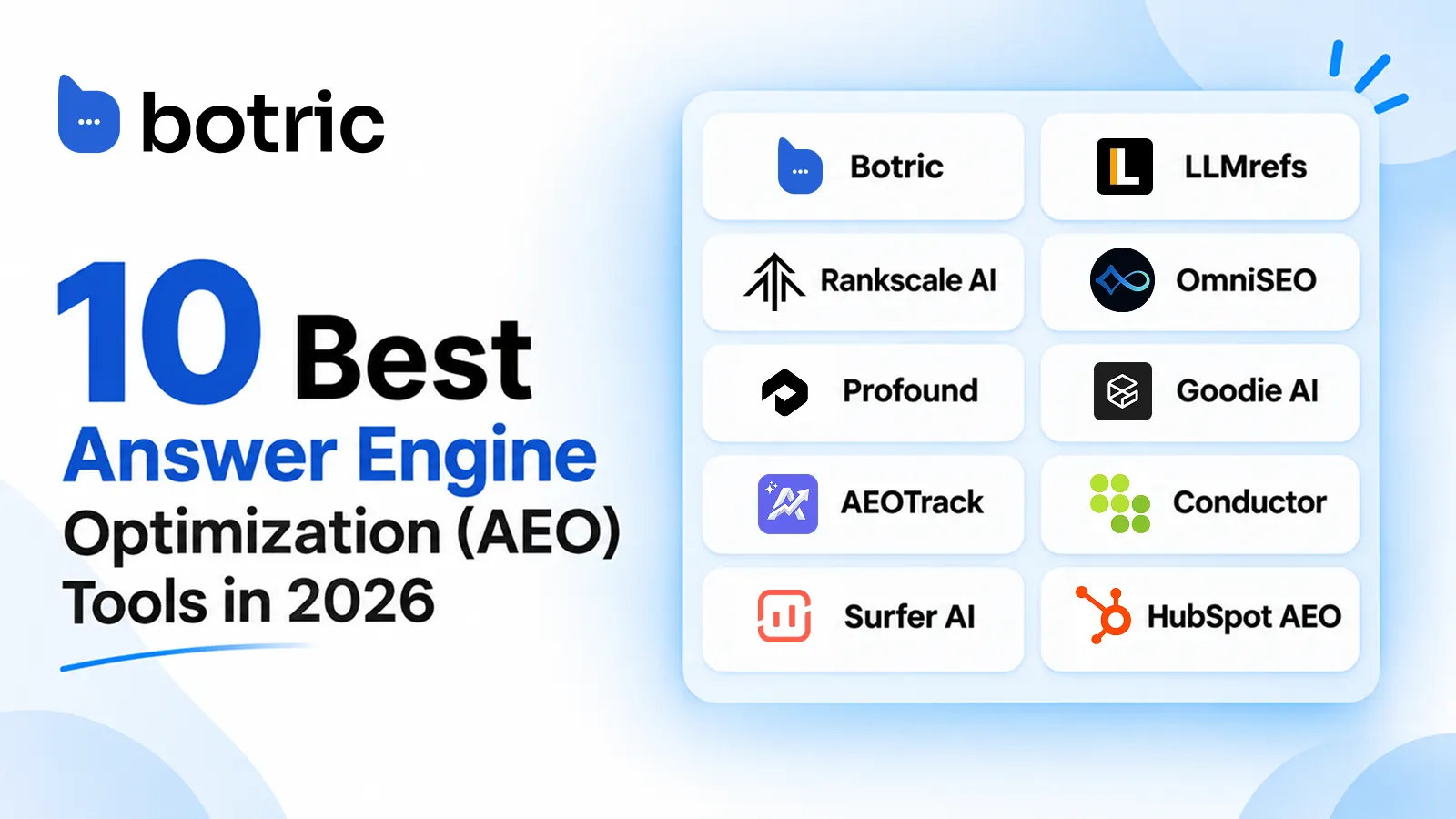
In this guide, we compare 10 AEO tools based on platform coverage, prompt tracking, citation and competitor analysis, content workflows, reporting features, and overall value.
Quick Answer: Which AEO Tool Is Best?
The best AEO tool is not the one that tracks the most platforms. It is the one that shows why you are missing from important answers and helps your team act on the data.
Here are five strong options for different use cases:
- Botric: Best for teams that want a full-stack AEO platform for AI visibility tracking, citation analysis, competitor research, content optimization, and content creation in one place.
- LLMrefs: Best for SEO teams and agencies that want broad AI platform coverage and a keyword-led way to track AI visibility.
- Rankscale AI: Best for agencies and advanced teams that need flexible tracking schedules, white-label reporting, dashboards, exports, API access, and multi-brand reporting.
- OmniSEO: Best for SEO teams that want to research AI prompts, understand prompt volume, track citations, and find content opportunities across major AI platforms.
- Profound: Best for enterprise brands that need advanced AI search intelligence, AI crawler analytics, referral attribution, and enterprise integrations.
Other options include Goodie AI for teams managing multiple AEO tasks, AEOTrack for reporting with SEO integrations, Conductor for enterprise SEO and AEO, Surfer AI for content optimization, and HubSpot AEO for existing HubSpot users.
Disclosure: Botric is our product. We included it in this comparison using the same evaluation criteria as the other AEO tools.
How We Evaluated These AEO Tools
We compared these AEO tools based on the features that matter most for improving visibility in AI search.
We looked at how well each tool helps businesses track their brand across AI platforms, understand competitor visibility, and take action on missed opportunities.
We evaluated each tool based on:
- AI platform coverage: Which AI platforms the tool tracks, such as ChatGPT, Gemini, Perplexity, Claude, Google AI Overviews, and other AI search surfaces.
- Prompt tracking: We looked at whether teams can track important buyer questions, create their own prompts, organize them by topic or intent, and monitor changes in visibility over time.
- Mentions and citation tracking: Whether the tool tracks simple brand mentions, source citations, recommendations, sentiment, positions, and the pages or domains that influence AI answers.
- Competitor analysis: Whether it helps you compare your visibility with competitors and identify the prompts, topics, and sources where they perform better.
- Content Generation and Optimization: Whether the tool helps teams move from insight to action through content gaps, content generation, technical fixes, or optimization workflows.
- Reporting and team features: We considered workspaces, client reporting, exports, white-label dashboards, APIs, collaboration, integrations, and support for multiple brands.
- Pricing and overall value: Whether the tool’s platform coverage, features, prompt limits, and team capabilities provide good value for its price.
We reviewed each tool’s official website, product pages, documentation, and pricing information. Features, platform coverage, and pricing can change, so check the provider’s website before making a final decision.
Below, we break down each AEO tool by its core features, strengths, limitations, supported AI platforms, and pricing to help you choose the right fit for your team.
1. Botric
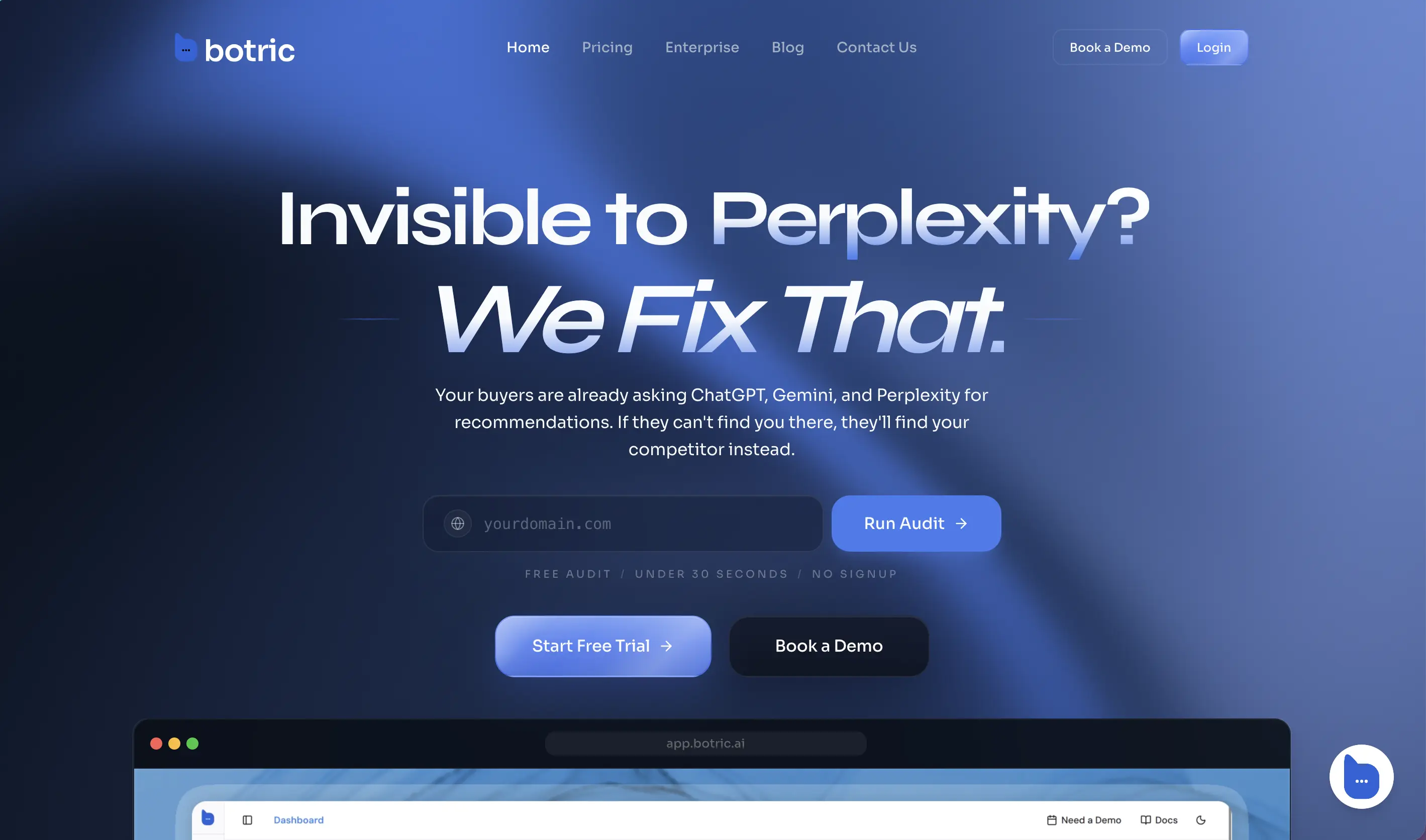
Botric is a complete AEO platform built for teams that want to do more than monitor AI mentions. It helps brands track how they appear across AI search platforms, understand why they are missing from important answers, and take action to improve their visibility.
The platform brings AI visibility tracking, prompt monitoring, citation intelligence, competitor analysis, GEO audits, content optimization, and content generation into one workflow. Teams can see which prompts they are losing, identify the competitors and sources winning those answers, fix technical or content gaps, and monitor the impact over time.
Botric is best for businesses that want one platform to measure, improve, and manage their AI search visibility across ChatGPT, Gemini, Claude, Perplexity, and Google AI Overviews.
Key Features
- AI Visibility Dashboard: See an overall AI Visibility Score alongside mentions, citations, mention rate, content coverage, and sentiment. Botric also breaks performance down by AI platform, so teams can see where they appear most often and where they need to improve.
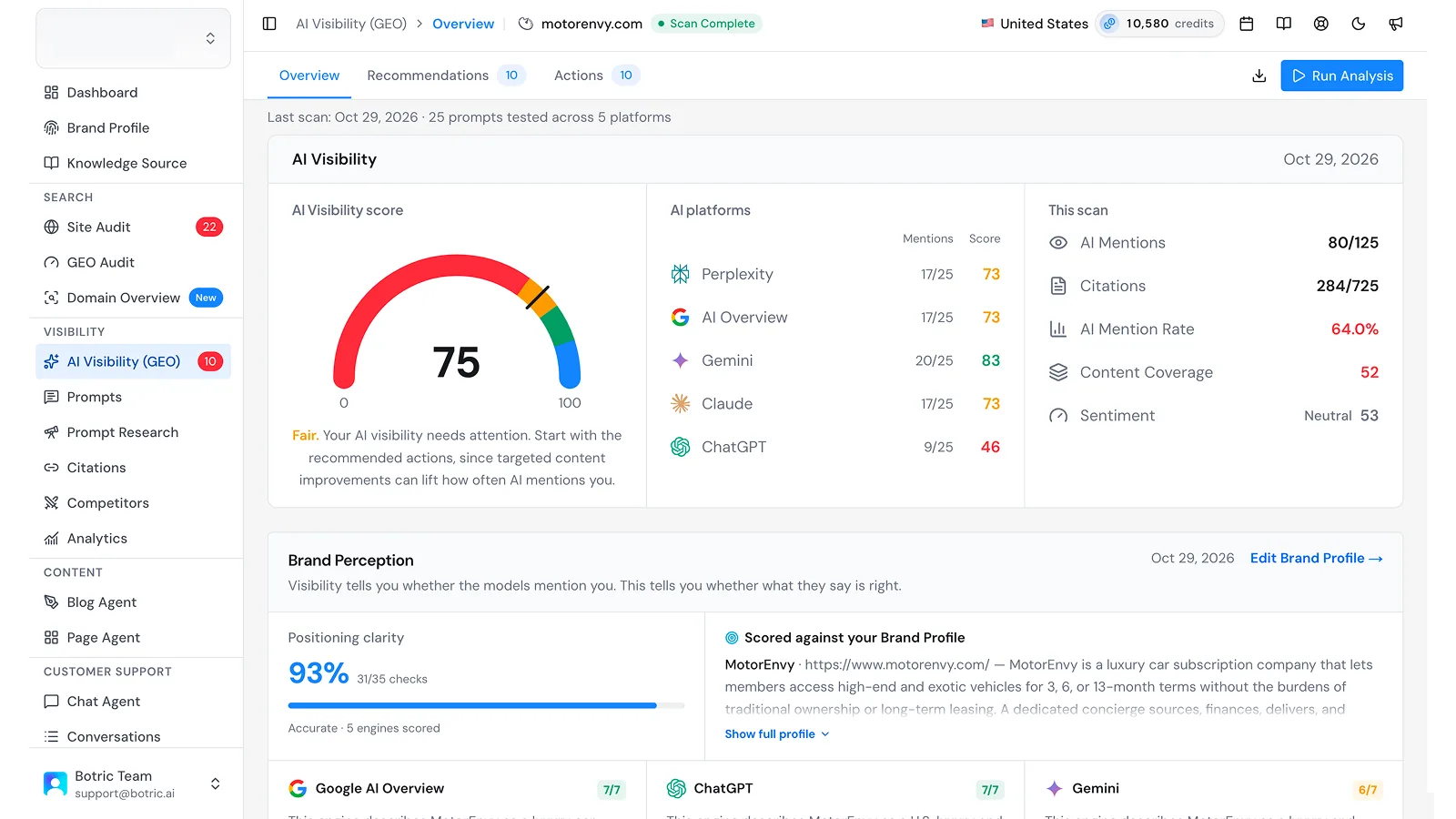
- Priority Recommendations: The platform turns visibility data into an action plan. It highlights high-impact fixes and shows the content opportunities those changes could unlock, helping teams focus on work that is most likely to improve AI visibility.
- Prompt-Level Tracking: Track the questions people ask across supported AI platforms and see whether your brand was mentioned, cited, or left out. Each prompt also shows the competitors that appeared, visibility changes since the last scan, and its intent, such as commercial, general, or branded.
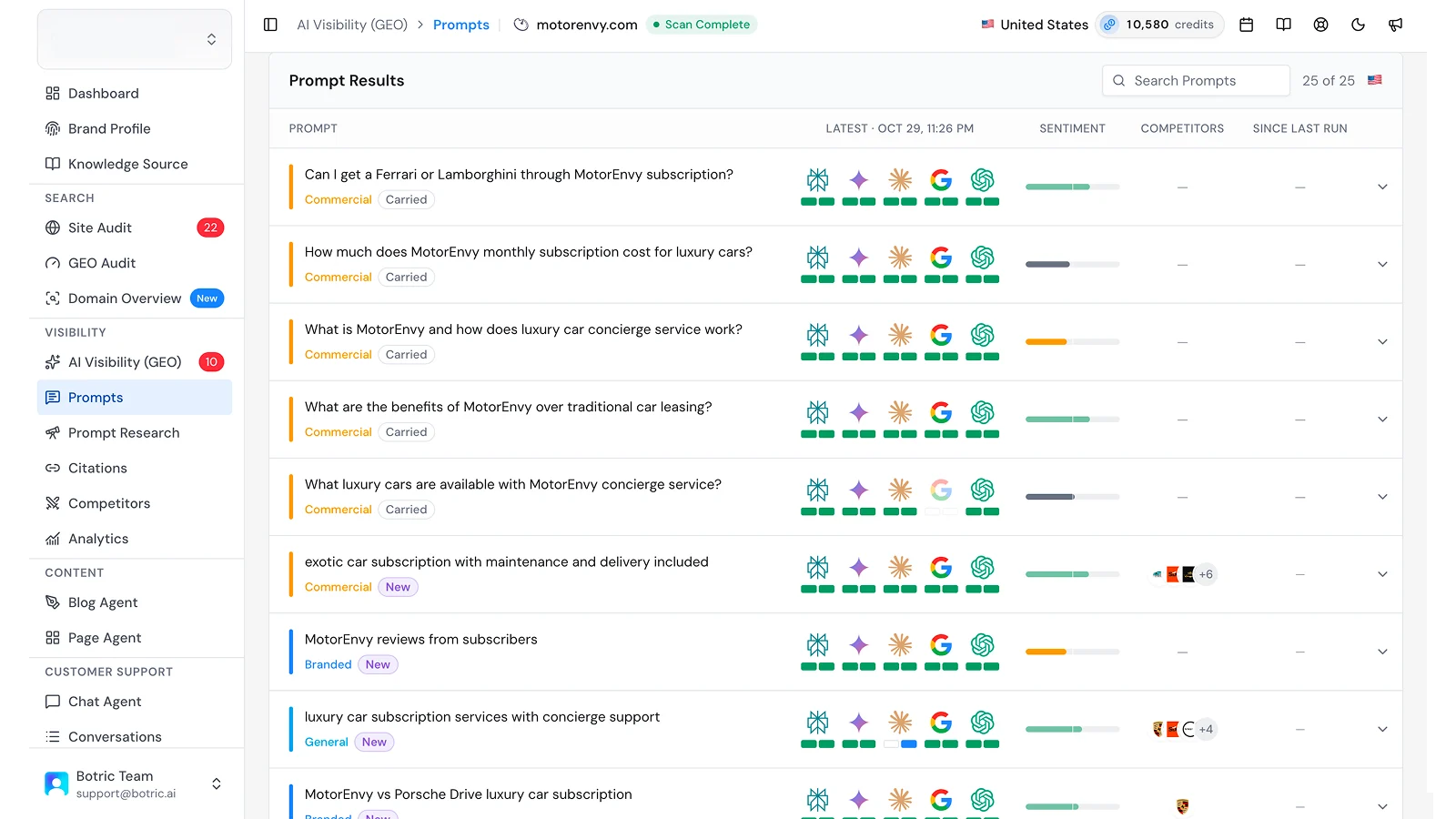
- Multi-Platform Results: Compare how your brand performs across ChatGPT, Gemini, Claude, Perplexity, and Google AI Overviews, based on the platforms included in your plan. This is useful because a brand can appear in one AI platform but be absent from another.
- Competitor Benchmarking: See which competitors AI platforms recommend for the prompts you care about. Botric helps teams identify where competitors are winning, understand the prompts behind that gap, and track changes in AI share of voice over time.
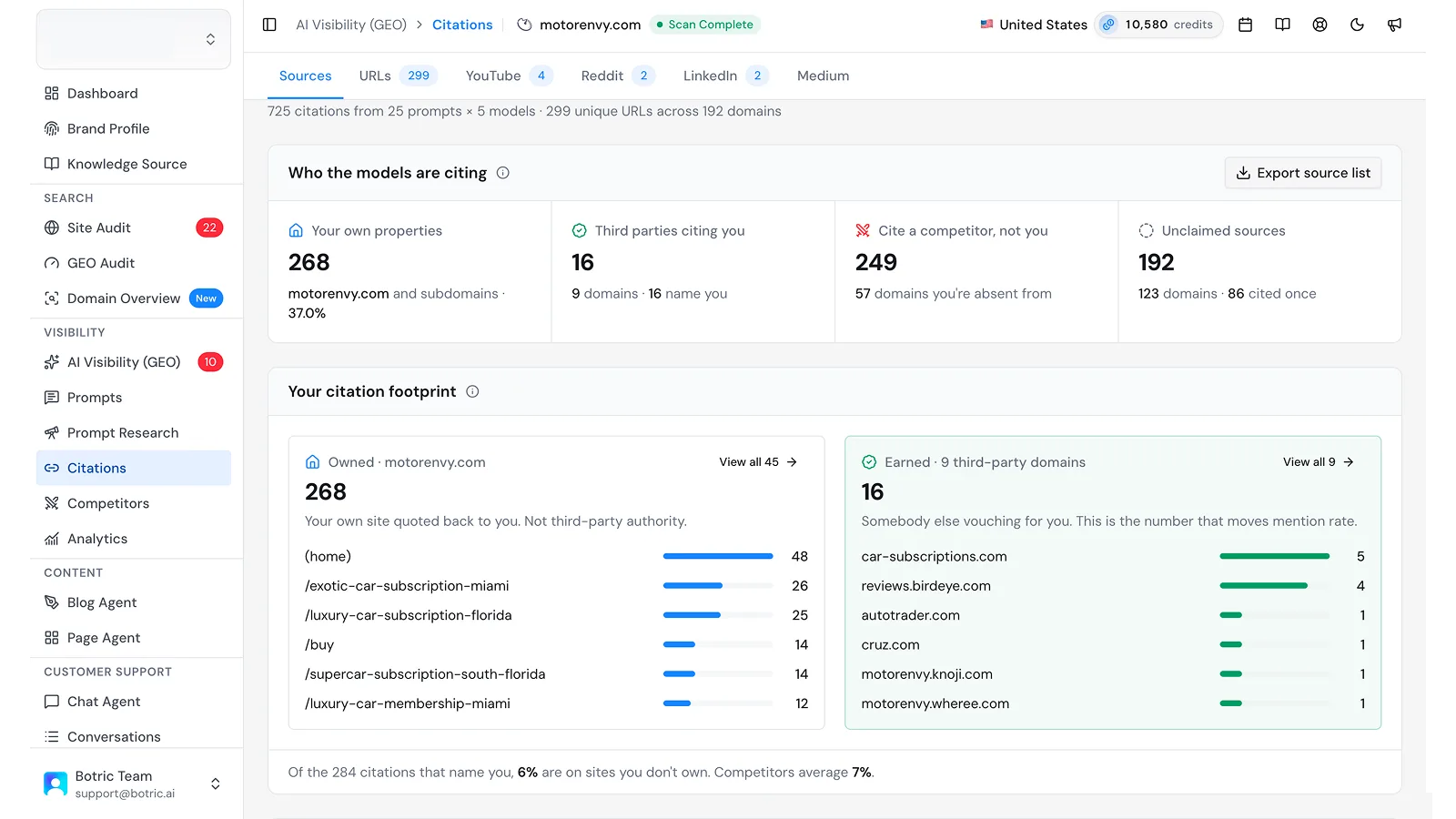
- Citation Tracking: Go beyond a total citation count. Botric separates citations from your own website, third-party sources that mention your brand, sources that cite competitors instead, and unclaimed sources where your brand has no presence.
- GEO and Site Audits: Check the technical and content factors that may affect AI visibility, including crawler access, schema, page structure, and content coverage. The audits help teams find issues that could prevent AI platforms from understanding or citing their website.
- Blog Agent and Page Agent: Turn visibility gaps into content actions. The Blog Agent can create content ideas and drafts from topics or tracked prompts, while the Page Agent helps improve existing pages. Content is grounded in your brand knowledge source before it is ready for review.
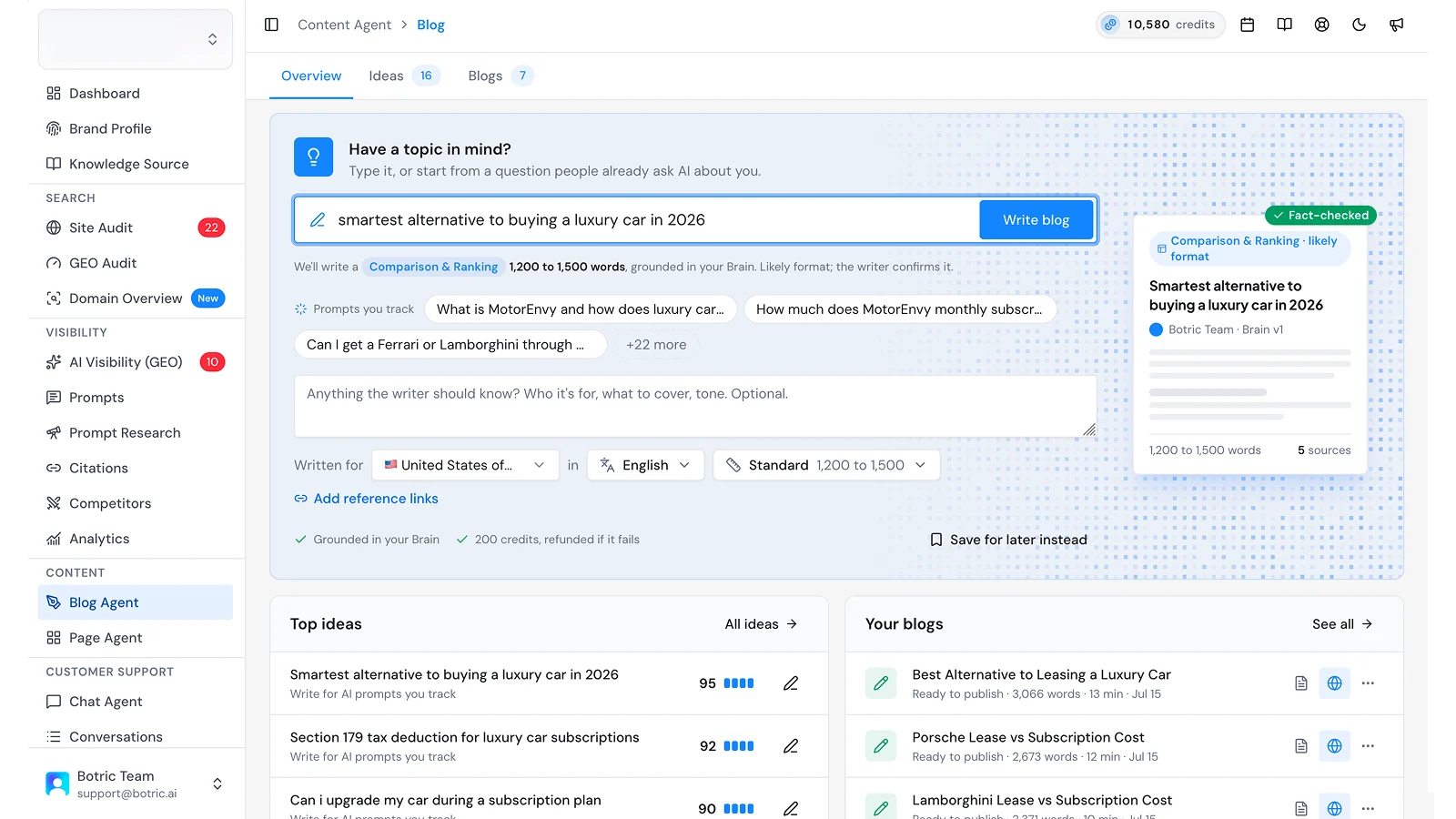
- MCP and API Access: Connect Botric with tools such as Claude Code, Claude Desktop, and Cursor through MCP to access your AI visibility, audit, and performance data directly within your existing workflow.
- Brand Profile: Botric compares your brand profile with AI-generated answers to identify inaccuracies, missing information, and misrepresentation across AI search engines. It highlights gaps in how AI platforms understand your business, products, services, and target audience, then recommends content updates to improve brand accuracy and visibility.
Pros
- Complete AEO platform: Botric combines AI visibility tracking, citations, prompt research, competitor insights, GEO audits, content tools, and AI customer support in one platform.
- Clear next steps, not just reports: The platform highlights priority fixes and content opportunities, helping teams understand what to do after finding an AI visibility gap.
- Detailed prompt tracking: Teams can track branded, commercial, and general prompts across supported AI platforms, including changes in visibility since the previous scan.
- Useful citation intelligence: Botric separates citations from your own site, third-party sites, competitor-cited sources, and unclaimed source opportunities.
- Built-in content workflows: The Blog Agent and Page Agent help teams turn prompt and citation gaps into content ideas, new articles, and page improvements.
- Technical GEO support: Site and GEO audits help identify issues with crawler access, schema, page structure, content coverage, and other factors that can affect AI visibility.
Cons
- Platform coverage depends on the plan: ChatGPT is included from the free plan, while broader coverage across Google AI Overviews, Perplexity, Claude, and Gemini requires higher plans.
- More than a simple tracking tool: Teams that only need basic AI mention monitoring may not need Botric’s broader audit, and content features.
Botric Pricing
Botric offers three self-serve plans, each with a seven-day free trial. The main difference between plans is the number of tracked AI platforms, prompts, credits, websites, seats, and Chat Agents available.
- Bit: $15/month. Best for solo marketers and small teams testing AI visibility tracking. It includes ChatGPT and Google AI Overview tracking, 15 tracked prompts, 1,500 credits per cycle, one workspace, one website, one admin seat, one Chat Agent, and 60-day conversation logs.
- Byte: $49/month. Best for small businesses that want broader AI search coverage. It adds Perplexity tracking, increases capacity to 25 prompts and 5,000 credits per cycle, includes two admin seats, one Chat Agent, and extends conversation logs to 90 days.
- Infinity: $149/month. Best for teams managing multiple websites and a larger AEO workflow. It adds Claude and Gemini tracking, 150 prompts, 15,000 credits per cycle, five workspaces, five websites, five admin seats, five Chat Agents, 120-day conversation logs, and MCP and API access.
- Enterprise: Custom pricing. Enterprise supports larger or multi-brand teams with custom onboarding, security, and strategic support.
2. LLMrefs
LLMrefs is built around a simple idea: SEO teams already know which keywords and topics matter, so they should not need to manually invent hundreds of prompts to measure AI visibility.
You enter keywords, import existing keyword lists, and LLMrefs generates related fan-out prompts based on real AI conversations. It then aggregates brand mentions, citations, positions, sources, and share of voice across AI platforms.
This makes LLMrefs especially useful for teams that want to connect traditional keyword strategy with AI search visibility. It is less focused on technical site diagnostics and more focused on measuring how a brand performs for a topic or keyword cluster.
Key Features
- Tracks ChatGPT, ChatGPT Search, Google AI Overviews, AI Mode, Gemini, Perplexity, Claude, Grok, Copilot, Meta AI, and DeepSeek
- Lets users track keywords instead of manually managing every prompt
- Automatically generates related fan-out prompts
- Reports share of voice, average position, citations, and brand rankings
- Identifies source URLs cited by AI platforms
- Supports competitor benchmarking by keyword
- Provides country and language targeting
- Includes unlimited projects, unlimited seats, API access, and CSV exports
Pros
- Excellent AI platform coverage: Covers more answer engines than many self-serve AEO tools.
- Natural fit for SEO teams: Keyword tracking makes it easy to use existing research and topic clusters.
- Source-level visibility: Shows the URLs and domains AI engines cite, helping teams identify content and outreach opportunities.
- Agency-friendly plan structure: Unlimited projects and seats remove the need to pay per client workspace.
Cons
- Less direct prompt control: Teams focused on a short, fixed list of exact buyer prompts may prefer a prompt-first platform.
- No major technical audit focus: It does not position crawlability, AI bots, or site health as a core product workflow.
- Keyword model needs good inputs: Results depend on choosing meaningful commercial and informational keywords rather than broad terms only.
LLMrefs Pricing
LLMrefs keeps its public pricing simple with one main plan.
- All in One: $79/month. 500 prompts, all supported AI engines, fan-out prompts, citation analysis, competitor tracking, exports, and unlimited projects and seats.
3. Rankscale AI
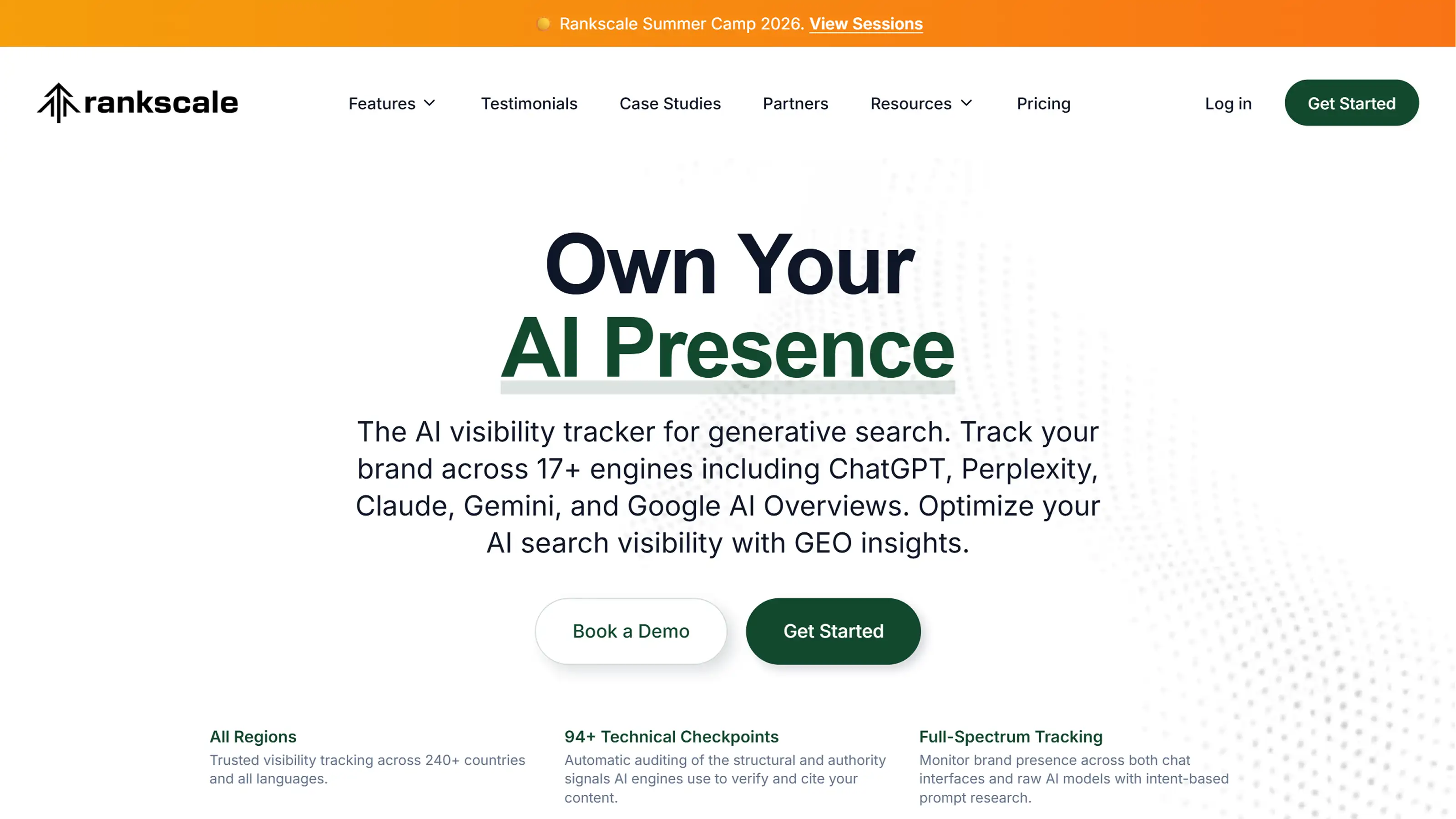
Rankscale AI is a flexible, credit-based AI visibility platform. It gives teams more control over how frequently they monitor prompts, which engines they check, where they track results, and how they present data to clients or stakeholders.
Its strength is not simplicity. Its strength is flexibility. Teams can monitor on an hourly, daily, weekly, or monthly basis, create dashboards for multiple brands, export data, connect reporting tools, and use API or MCP access on the appropriate plans.
Rankscale is therefore a strong option for agencies, consultants, and in-house teams that want a reporting layer they can shape around their workflow.
Key Features
- Tracks ChatGPT, Gemini, Perplexity, Claude, DeepSeek, Mistral, Grok, Copilot, and more
- Tracks citations, sentiment, share of voice, rankings, and competitor visibility
- Supports prompt research and query fan-out analysis
- Provides AI visibility page audits
- Includes shareable dashboards and white-label dashboard links on higher tiers
- Supports CSV exports, Google Sheets, Looker Studio, API access, and MCP
- Allows monitoring from hourly to monthly
- Includes shopping analysis and ad analytics for relevant AI search surfaces
Pros
- Highly configurable tracking: Teams can decide how often to monitor based on the importance of each prompt.
- Strong agency reporting: Shareable dashboards, white-label options, exports, and client-ready reporting are core strengths.
- Broad data access: API, MCP, Sheets, Looker Studio, and CSV access are useful for teams with existing reporting systems.
- Good competitor intelligence: Includes citations, sentiment, source analysis, and visibility benchmarking.
- Multi-brand capability: Higher plans are designed for agencies managing many client dashboards.
Cons
- Credit-based pricing adds complexity: Teams need to estimate how usage changes with more prompts, engines, regions, and refresh frequency.
- Not the simplest beginner tool: New users may need time to understand the credit model and choose the right setup.
- Advanced agency functionality costs more: White-label links, API access, and larger dashboard capacity are limited to higher plans.
Rankscale AI Pricing
Rankscale uses credits, so costs depend on the number of prompts, engines, regions, and refreshes you use.
- Essentials: $20/month. Entry-level AI visibility tracking.
- Pro: $99/month. 1,200 credits, 10 brand dashboards, 50 page audits, and shareable reporting.
- Pro+: $229/month. 3,000 credits, 25 dashboards, API access, and prompt research.
- Growth: $385/month. 5,500 credits, 50 dashboards, white-label reporting, and agency features.
- Enterprise: $780/month. 12,000 credits, 100 dashboards, and premium support.
- Custom: Custom pricing. For tailored credits, integrations, security, and support requirements.
Rankscale is worth comparing carefully because monitoring a few prompts weekly costs very differently from tracking many prompts daily across every supported AI engine.
4. OmniSEO
OmniSEO is designed for teams that want to bring traditional SEO thinking into AI search. Its workflow begins with prompt research: finding the questions people ask, estimating which prompts matter, identifying who is cited, and spotting where your brand is missing.
It then connects that research to AI visibility tracking, citation analysis, AI bot analytics, and placement recommendations. This is useful for SEO teams that want to prioritize AI search work using demand and competitive evidence, rather than simply monitoring a visibility score.
Key Features
- Tracks Google AI Overviews, AI Mode, ChatGPT, Perplexity, Gemini, Copilot, Claude, Meta AI, Grok, and DeepSeek
- Researches AI prompts and their estimated volume
- Tracks brand mentions, citations, and competitor visibility
- Monitors Google AI Overviews and AI Mode
- Identifies cited competitor pages and source domains
- Includes AI bot analytics
- Provides placement recommendations by prompt, topic cluster, and intent
- Includes a free AI Prompt Volume Checker and Query Fan-Out Generator
Pros
- Broad coverage on every plan: All listed plans include tracking across 10 AI platforms.
- Useful prompt research workflow: Helps teams identify opportunities before creating content.
- Strong Google AI focus: Includes dedicated AI Overview and AI Mode tracking.
- Clear competitor context: Shows which brands and sources appear where your brand does not.
- Actionable recommendations: Goes beyond showing gaps by offering placement recommendations.
Cons
- Prompt capacity is limited on lower plans: Starter includes 25 saved prompts, which may be restrictive for broad topic coverage.
- Advanced workflow features need higher plans: Exports, enhanced recommendations, and more seats are reserved for Professional and Enterprise.
- Requires metric familiarity: Teams should understand its prompt-volume and visibility metrics before using them as the sole basis for content decisions.
OmniSEO Pricing
OmniSEO tracks all 10 listed AI platforms on every plan. The primary differences are prompt capacity, seats, exports, support, and enterprise features.
- Starter, $45/month: Includes 25 saved prompts, 25 prompt-volume lookups, five competitors, five seats, visibility tracking, citation tracking, competitor analysis, prompt research, and placement recommendations.
- Essentials: $89/month. Four AI platforms, 50 saved prompts, five competitors, and five seats.
- Professional: $349/month. Full 10-platform coverage, 100 prompts, 10 seats, exports, and enhanced recommendations.
- Enterprise: From $899/month. 500 or more prompts, multi-brand support, custom regions, integrations, and SLA options.
5. Profound
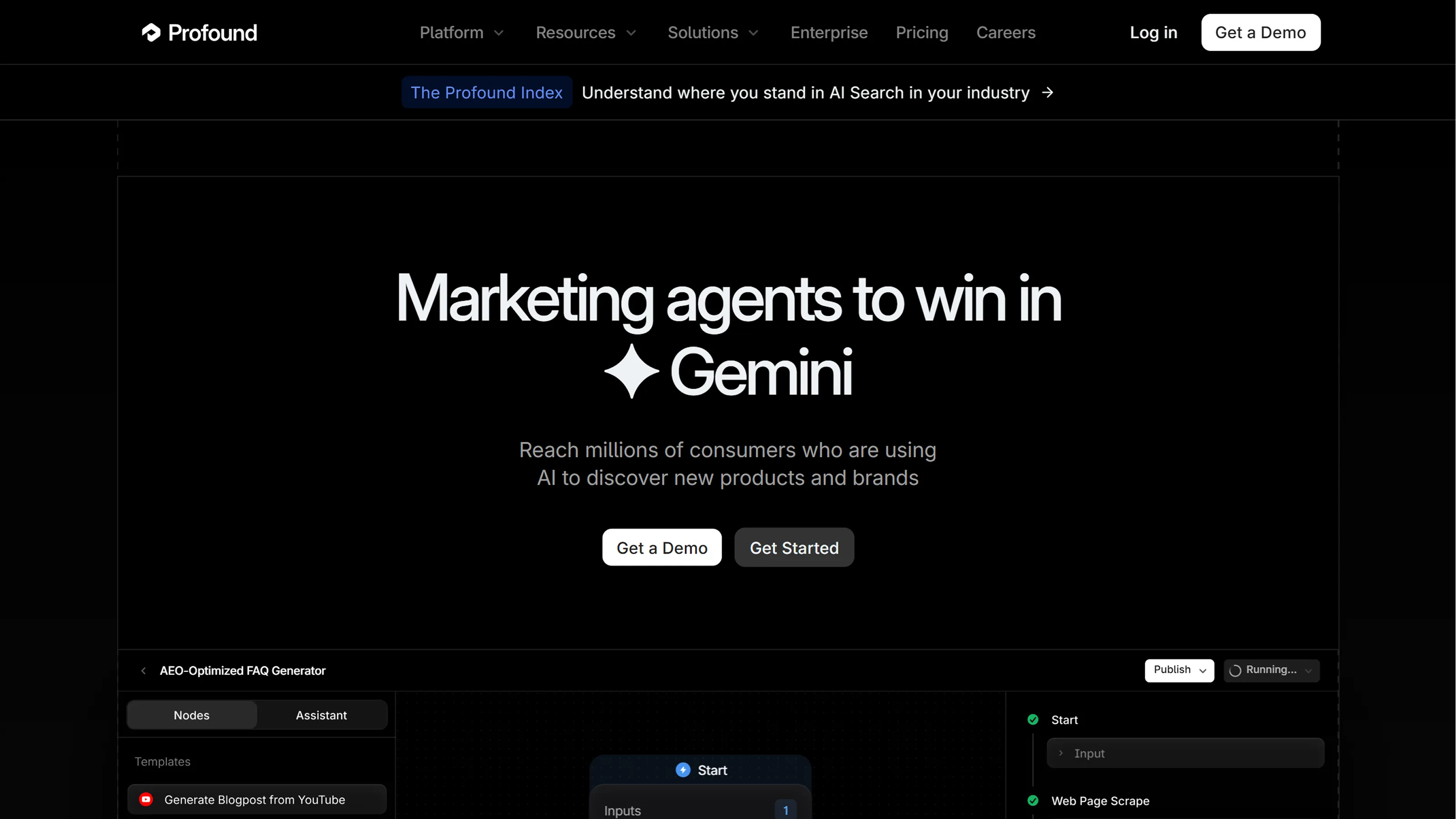
Profound is an enterprise AEO platform built for organizations that want to treat AI search as a measurable growth channel. It combines AI visibility tracking with prompt research, citations, competitor intelligence, AI crawler diagnostics, traffic attribution, and agent-based workflows.
Its biggest differentiator is Agent Analytics. This feature helps teams understand which AI crawlers reach their site, how often they visit, what they can access, and whether technical issues prevent AI systems from retrieving or citing content.
Profound is best suited to teams with enough content, traffic, technical complexity, and budget to benefit from deep data and automation.
Key Features
- Tracks brand and competitor visibility across major answer engines
- Provides prompt research through Prompt Volumes
- Tracks citations, sentiment, visibility, and competitive performance
- Includes Agent Analytics for AI crawler activity and crawlability diagnostics
- Connects AI referrals with website performance and attribution
- Supports AI Marketer, Agents, Context Manager, and Profound Sheets
- Offers API access, exports, SSO/SAML, SOC 2, and dedicated support on Enterprise
- Integrates with Cloudflare, AWS, Fastly, GA4, Vercel, WordPress, and other systems
Pros
- Deep technical AI visibility: Its crawler analytics are more detailed than those of many tracking-focused AEO tools.
- Enterprise-ready: Supports security, API access, exports, custom prompts, and support requirements.
- Connects data to action: Agents can use the platform’s AI search data inside recurring content and marketing workflows.
- Strong measurement model: Includes AI referral and attribution capabilities alongside visibility data.
- Daily tracking: Enterprise users receive ongoing daily monitoring.
Cons
- Sales-led after the trial: It is not designed as a simple low-cost, self-serve tool.
- Trial configuration is limited: Trial users receive recommended prompts rather than full prompt customization.
- Too advanced for smaller teams: The platform’s depth is valuable only if a team can act on the insights.
Profound Pricing
Profound currently uses a free trial and custom Enterprise pricing model for most brands.
- Free Trial: Seven-day trial with limited prompt and engine access.
- Enterprise: Custom pricing. Tailored prompt tracking, daily monitoring, up to nine answer engines, exports, Agent Analytics, API access, and enterprise support.
Profound is not a simple low-cost tracking product. Its pricing and feature set are designed for companies operationalizing AI search as an ongoing enterprise program.
6. Goodie AI
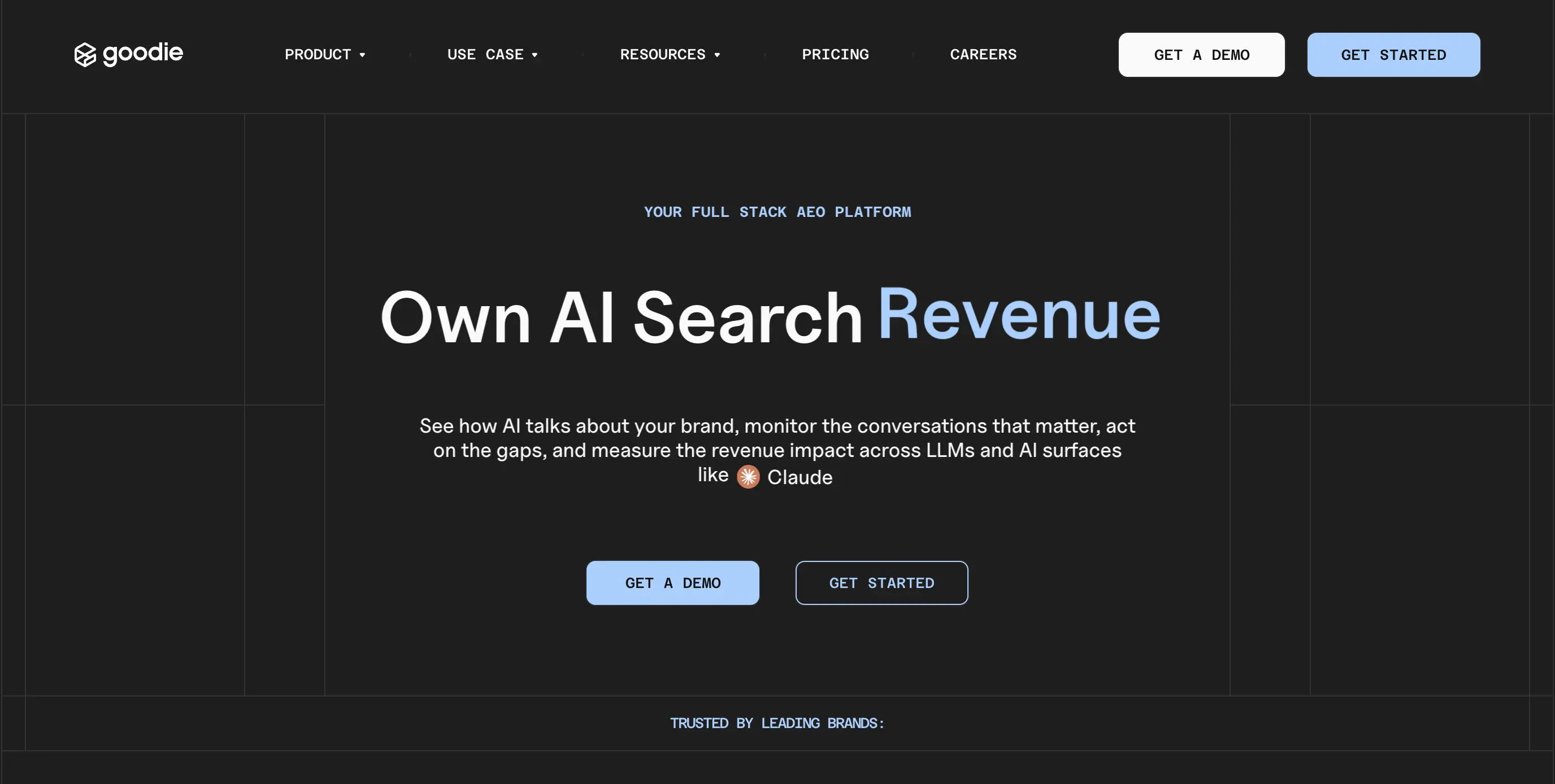
Goodie AI positions itself as a full-stack AEO platform. Its workflow is designed to take teams from prompt discovery to monitoring, action, and measurement.
Unlike tools that primarily track brand mentions, Goodie includes content optimization, blog generation, technical actions, outreach support, social workflows, agent analytics, and revenue attribution.
It is built for teams that want AEO to be an ongoing growth program rather than a reporting exercise.
Key Features
- Tracks AI visibility, citations, sentiment, and competitors daily
- Supports prompt discovery and topic research
- Includes content optimization and blog-generation tools
- Offers technical workflows for llms.txt and sitemap repair
- Includes outreach and social agents
- Tracks AI bot and crawler activity
- Supports GA4, Google Search Console, and Bing Webmaster Tools
- Includes MCP, API, strategist support, and revenue attribution
- Supports agentic commerce visibility on higher plans
Pros
- Complete AEO workflow: Covers research, tracking, content, technical actions, and reporting.
- Daily data collection: Useful for teams that want frequent visibility updates.
- Action-oriented platform: Includes optimization actions and agents, not only dashboards.
- Enterprise support structure: Unlimited seats and strategist support are included from Core.
- Strong reporting depth: Includes citation analysis, sentiment, competitor benchmarking, location analytics, and attribution.
Cons
- High entry price: Core begins at $295 per month, which may not suit small businesses or early-stage teams.
- Coverage expands by tier: Core tracks five models, while wider coverage requires Pro or Enterprise.
- Requires internal capacity: Its value depends on a team’s ability to use content, technical, and outreach recommendations consistently.
Goodie AI Pricing
Goodie AI offers a high-touch, full-stack AEO model with unlimited seats and strategist support.
- Core, $354/month: Five models, 120 prompts, five seats, 50 monthly optimization actions, and strategist support.
- Pro, $1,198.80/month: Eight models, 250 prompts, 100 monthly optimization actions, and unlimited seats.
- Enterprise: Custom pricing. Up to 13 models, tailored prompt volume, multi-brand reporting, attribution, API access, and dedicated support.
Goodie is priced for teams that want a platform and hands-on AEO support, rather than a basic AI mention tracker.
7. AEOTrack
AEOTrack is built around practical monitoring and reporting. It tracks whether AI platforms name or cite a business when customers ask relevant questions, then connects that data with Search Console, GA4, site platforms, and reporting tools.
It is a good fit for agencies because it includes multiple websites, client share links, white-label PDF reports, scheduled reporting, and clear plan limits.
It is also accessible for smaller businesses that want a structured view of AI mentions and citations without adopting an enterprise platform.
Key Features
- Tracks ChatGPT, Gemini, Claude, Perplexity, and Grok
- Measures mentions, citations, sources, competitors, and GEO topic visibility
- Includes weekly checks plus daily tracking for selected priority questions
- Connects with Google Search Console and GA4
- Supports WordPress and Shopify
- Provides AI-generated content and improvement plans
- Includes PDF reports, with API access and reporting integrations on Pro, and white-label reports and client share links on Agency.
- Offers white-label reporting on Agency
Pros
- Clear plan structure: Pricing, websites, questions, competitors, seats, and refresh limits are easy to understand.
- Strong agency functionality: White-label reports, client links, and scheduled reports are useful for client management.
- SEO and analytics integrations: Search Console and GA4 data provide useful context alongside AI visibility.
- Practical action plans: Includes a week-by-week improvement plan based on prompts, sources, and competitors.
- Affordable entry point: Starter is one of the lowest-priced self-serve AEO plans in this list.
Cons
- No Google AI Overview or AI Mode in its listed five-engine coverage: This can be a limitation for teams focused heavily on Google AI search.
- Full daily tracking is not standard: Starter, Pro, and Agency use weekly checks for most questions and daily checks for selected priority questions.
- Higher limits require upgrades: Agencies with many clients may need Agency or Enterprise quickly.
AEOTrack Pricing
AEOTrack has clear pricing for businesses, in-house teams, agencies, and enterprise organizations.
- Starter: $39/month. One website, 25 questions, weekly tracking, and daily checks for three priority questions.
- Pro: $99/month. Three websites, 75 questions, more daily checks, API access, and reporting integrations.
- Agency: $249/month. Ten websites, 250 questions, white-label reports, client links, and scheduled reporting.
- Enterprise: From $799/month billed annually. Custom capacity, daily checks, custom engines and locales, and dedicated support.
8. Conductor
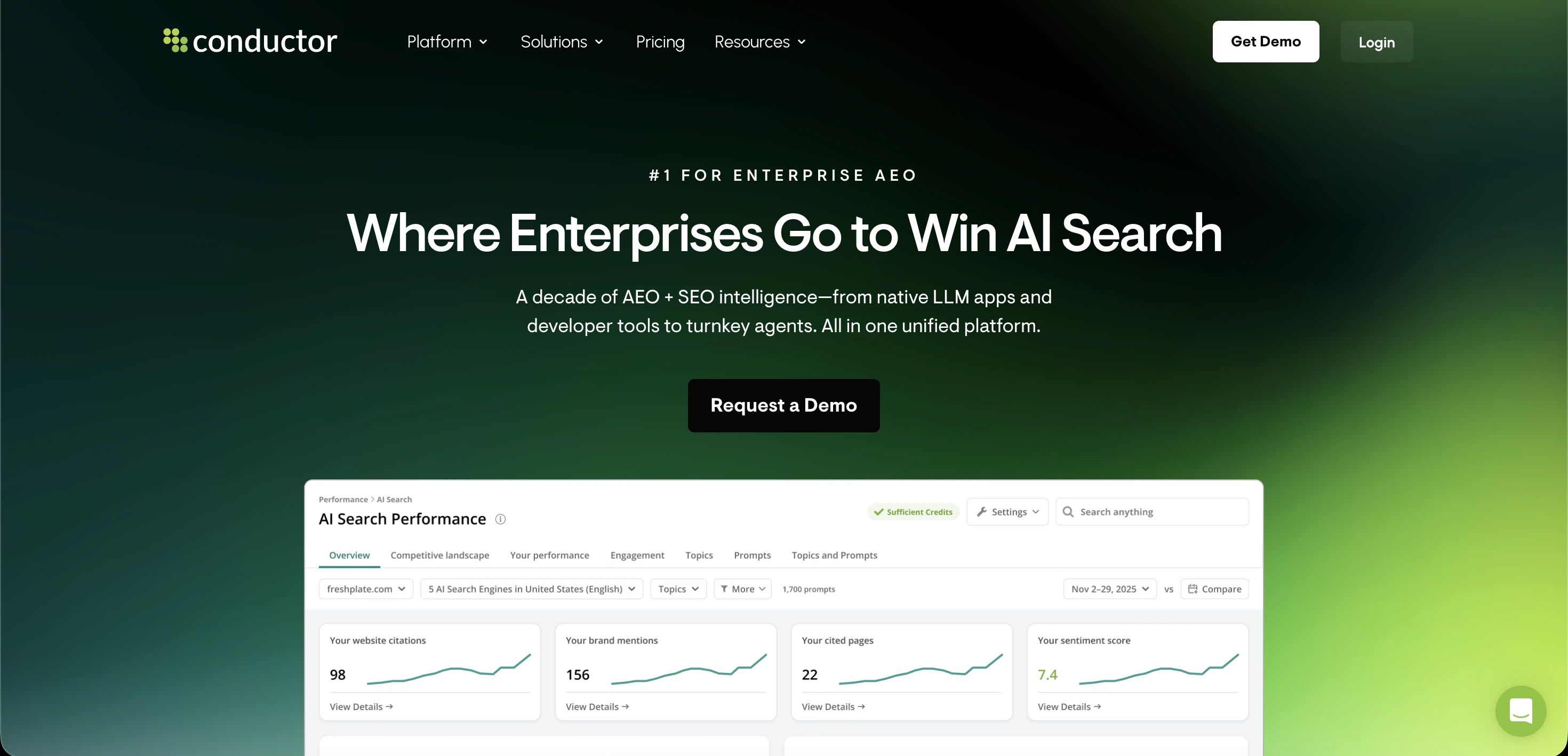
Conductor is an enterprise SEO platform that has expanded into AI search performance. It is designed for organizations that need one system for AI visibility, SEO performance, content production, technical monitoring, and enterprise reporting.
Its advantage is not a low entry price or a lightweight AI visibility dashboard. Its advantage is bringing AI search data into a much broader search and content operation.
Key Features
- Tracks brand visibility across ChatGPT, Gemini, Copilot, Claude, and traditional search
- Connects AI search performance with traffic, conversions, and revenue
- Includes enterprise content creation and optimization tools
- Monitors technical site health and AI crawler activity
- Provides AI workflow agents
- Supports API and MCP access
- Includes enterprise reporting, collaboration, and integrations
- Offers a free AI visibility report
Pros
- Built for enterprise scale: Suits global websites, complex content operations, and multiple stakeholders.
- Combines AI search and SEO: Useful for teams that do not want separate systems for traditional and AI search performance.
- Technical monitoring: Includes real-time site health and AI crawler monitoring.
- Strong integration options: API, MCP, and enterprise workflow support are useful for advanced organizations.
- Business-focused measurement: Connects visibility work with traffic, conversions, and revenue.
Cons
- No self-serve pricing: Companies need to request a demo and receive a tailored proposal.
- More platform than many teams need: Small businesses seeking a simple AI mention tracker may find it excessive.
- Requires enterprise implementation: The platform delivers most value when integrated into an existing SEO and content operation.
Conductor Pricing
Conductor does not list public dollar prices. Its plans are usage-based, so teams need to request a demo or speak with sales for a quote.
- Essentials: 1,000 pages analyzed, 500 tracked keywords, five competitors, and three websites.
- Growth: 25,000 pages analyzed, 5,000 tracked keywords, 25 competitors, AI Search Credits, and five websites.
- Enterprise: 125,000 or more pages analyzed, 60,000 or more keywords, 75 or more competitors, and 10 or more websites.
9. Surfer AI
Surfer is a content optimization platform first, with AI visibility tracking built into the broader product. This makes it particularly useful for teams whose main way of improving AI visibility is publishing and improving content.
Rather than sending users from an AI visibility dashboard into a separate content tool, Surfer connects AI mention gaps, competitor insights, topic coverage, internal linking, and content optimization in one environment.
Key Features
- Tracks AI visibility, mention gaps, sentiment, and brand performance
- Provides competitor share of voice and cited-source data
- Supports daily or weekly AI prompt tracking, depending on plan
- Includes content creation and optimization workflows
- Finds content coverage gaps
- Supports internal linking and content planning
- Includes Brand Knowledge, templates, custom voices, and collaboration
- Offers MCP and API access on higher plans
Pros
- Strong content connection: AI visibility insights can directly influence content creation and updates.
- Useful for existing SEO teams: Fits naturally into an established content optimization workflow.
- Standalone tracking available: AI Search Analytics is available without the wider content suite.
- Supports daily tracking on relevant plans: AI Search Analytics, Pro, and Peace of Mind provide daily AI prompt refreshes.
- Strong content gap features: Useful for teams building topic clusters and improving existing pages.
Cons
- Not solely an AEO tool: Teams seeking only AI tracking may pay for broader content features they do not need.
- Lower plans have limits: Standard refreshes AI prompts weekly and includes fewer tracked prompts.
- Advanced collaboration and API access require higher tiers: Larger teams may need Pro, Peace of Mind, or Enterprise.
Surfer AI Pricing
Surfer offers both AI visibility-only plans and broader content optimization plans.
- Discovery: $59/month billed annually. Content tools for teams building a baseline SEO presence.
- AI Search Analytics: $95/month. Standalone AI visibility tracking with 50 daily prompts.
- Standard: $119/month billed annually. Content tools plus 25 AI prompts refreshed weekly.
- Pro: $219/month. 50 daily AI prompts, content gap analysis, internal linking, and five brand spaces.
- Peace of Mind: $359/month billed annually. 100 daily prompts, unlimited content documents and brand spaces, API access, and onboarding.
10. HubSpot AEO
HubSpot AEO is an AI visibility product designed to fit naturally into the HubSpot ecosystem. It helps marketers understand how often their brand appears in AI answers, which competitors get more visibility, what sources influence those answers, and what to do next.
Its biggest advantage is convenience for existing HubSpot users. Instead of adding another platform, teams can connect AI visibility work with CRM data, marketing campaigns, social publishing, and HubSpot content tools.
Key Features
- Tracks AI visibility across ChatGPT, Gemini, and Perplexity
- Measures brand visibility, sentiment, and competitor share of voice
- Tracks specific AI prompts
- Analyzes citation sources, domains, pages, and content types
- Provides prioritized AEO recommendations
- Updates visibility data daily
- Connects with HubSpot CRM and Marketing Hub
- Offers a free one-time AEO Grader
Pros
- Easy for HubSpot users: Fits into existing marketing and CRM workflows.
- Clear standalone pricing: Businesses can buy the product without a full Marketing Hub subscription.
- Useful core AEO features: Includes prompts, citations, competitors, sentiment, and recommendations.
- CRM-informed recommendations: Marketing Hub users can connect AI visibility work with existing customer and campaign data.
- Simple onboarding: It is designed for marketers without deep AEO or technical expertise.
Cons
- Limited engine coverage on standalone: Tracks ChatGPT, Gemini, and Perplexity, but not every major AI platform.
- Prompt limit at entry level: The standalone plan includes 25 prompts.
- Multi-brand use adds cost: Each additional brand requires another AEO instance.
- Best value for existing HubSpot customers: Teams outside the HubSpot ecosystem may prefer a dedicated AEO platform.
HubSpot AEO Pricing
HubSpot AEO has transparent standalone pricing for teams that want AI visibility tracking without purchasing a full Marketing Hub package.
- HubSpot AEO, $50/month: Includes 25 prompts across ChatGPT, Gemini, and Perplexity, plus brand visibility, sentiment analysis, competitor share of voice, citation analysis, prompt tracking, prompt suggestions, and prioritized recommendations.
Quick Comparison of the Best AEO Tools
| Tool | Best for | Key standout feature | AI platforms tracked | Starting price |
|---|---|---|---|---|
| Botric | Teams that want a complete AEO platform to track, improve, and manage AI visibility | Turns AI visibility gaps into prioritized technical fixes, content opportunities, and page improvements. | ChatGPT, Google AI Overviews, Perplexity, Claude, and Gemini, depending on plan | $15/month with a 7-day free trial |
| LLMrefs | SEO teams and agencies | Converts tracked keywords into related fan-out prompts across AI search engines. | ChatGPT, ChatGPT Search, AI Overviews, AI Mode, Gemini, Perplexity, Claude, Grok, Copilot, Meta AI, DeepSeek | $79/mo |
| Rankscale AI | Agencies and advanced reporting teams | Lets teams set hourly, daily, weekly, or monthly AI visibility monitoring. | ChatGPT, Gemini, Perplexity, Claude, DeepSeek, Mistral, Grok, Copilot, and more | $20/mo |
| OmniSEO | SEO teams planning AI search content | Provides AI prompt volume data to help teams prioritize which prompts to target. | AI Overviews, AI Mode, ChatGPT, Perplexity, Gemini, Copilot, Claude, Meta AI, Grok, DeepSeek | $45/mo |
| Profound | Enterprise AI search programs | Agent Analytics shows how AI crawlers access, interpret, and refer traffic from your website. | Up to 9 answer engines on Enterprise | Free trial, then custom |
| Goodie AI | Teams running a full AEO program | Connects AI visibility data with optimization actions and revenue attribution. | 5 models on Core, up to 14 on Enterprise | $354/mo |
| AEOTrack | Businesses and agencies needing reporting | Combines AI visibility tracking with Search Console, GA4, WordPress, Shopify, and white-label reports | ChatGPT, Gemini, Claude, Perplexity, Grok | $39/mo |
| Conductor | Enterprise teams managing AEO and SEO at scale | Brings AI search reporting, SEO performance, content, and website monitoring into one enterprise platform. | ChatGPT, Gemini, Copilot, Claude, plus traditional search | Custom |
| Surfer AI | Content and SEO teams | Turns AI visibility gaps into content optimization, topical coverage, and internal linking work | ChatGPT, Gemini, AI Overviews, and other supported AI models | $95/mo |
| HubSpot AEO | Existing HubSpot users | Connects AI visibility, citations, and competitor data with CRM and Marketing Hub workflows | ChatGPT, Gemini, Perplexity | $50/mo |
How to Choose the Right AEO Tool
The right AEO tool depends on what your team needs to do after finding an AI visibility gap. Some platforms focus on tracking mentions and citations, while others help with prompt research, technical audits, content creation, reporting, or enterprise workflows.
Start with the problems you need to solve, the AI platforms you want to track, and the level of reporting or action your team requires.
For improving content and visibility
- For AI visibility tracking, content optimization, and AI blog writing: Botric. It tracks visibility across up to five AI platforms, identifies content and technical gaps, and provides recommendations, content optimization, and unlimited AI blogs on paid plans.
- For connecting AI visibility with business impact: Goodie AI. It combines visibility tracking, recommended actions, and attribution data to help teams assess how AI search work may influence traffic, leads, conversions, and revenue.
- For content teams improving existing pages: Surfer AI. It helps teams identify topical gaps, improve content coverage, optimize pages, and strengthen internal linking.
- For teams already using HubSpot: HubSpot AEO. It connects AI visibility, citation, and competitor data with HubSpot CRM and Marketing Hub workflows.
For tracking, research, and reporting
- For SEO teams tracking keywords across AI platforms: LLMrefs. It turns existing keywords into related AI prompts and tracks mentions, citations, sources, positions, and share of voice.
- For agencies that need flexible monitoring and reporting: Rankscale AI. It supports hourly, daily, weekly, or monthly monitoring, plus client dashboards, exports, API access, and white-label reporting.
- For finding and prioritizing AI prompts: OmniSEO. It helps teams research prompts, review estimated prompt volume, track citations, and identify content opportunities.
- For AI visibility reporting alongside SEO tools: AEOTrack. It connects AI tracking with Google Search Console, GA4, WordPress, Shopify, and client reporting workflows.
For enterprise AEO
- For enterprise AI search intelligence: Profound. It is built for large teams that need advanced visibility tracking, prompt research, citation intelligence, crawler analytics, referral attribution, and enterprise integrations.
- For enterprise SEO and AEO in one platform: Conductor. It combines AI search reporting with large-scale SEO, content, technical website monitoring, and enterprise reporting.
Conclusion: Which AEO Tool Should You Choose?
The best AEO tool depends on your goals. Choose LLMrefs for keyword-led tracking, Rankscale AI or AEOTrack for reporting, OmniSEO for prompt research, Profound or Conductor for enterprise programs, and Surfer AI for content optimization.
Choose Botric if you want a complete AEO platform to track AI visibility, identify citation and competitor gaps, and improve them through GEO audits, page optimization, and content generation.
Ready to improve how your brand appears in AI search? Start a 7-day Botric trial to track your visibility, find the gaps, and take action.
Frequently Asked Questions
What is AEO software?
AEO software helps businesses measure and improve how they appear in AI-generated answers. It can track whether AI platforms mention, recommend, or cite your brand for important customer questions.
Which AI platforms should an AEO tool track?
At a minimum, look for ChatGPT, Google AI Overviews, Gemini, and Perplexity. Claude, Copilot, Google AI Mode, and other platforms may also matter depending on your audience, industry, and where customers search for answers.
How do I compare AEO tools?
Compare AEO tools based on the AI platforms they support, the number of prompts you can track, citation and competitor data, content or technical workflows, reporting features, integrations, and pricing. The right choice should match the work your team needs to do after finding a visibility gap.
Which AEO software is best for small businesses?
Small businesses should look for AEO software with clear reporting, useful recommendations, and a price that fits their budget. Botric is a practical option for businesses that want to track AI visibility and take action on content and technical gaps without managing separate tools.
What are the best AEO tools under $50 per month in 2026?
Some of the best AEO tools under $50 per month include Botric, Rankscale AI, OmniSEO, and AEOTrack. Botric starts at $15 per month and combines AI visibility tracking with GEO audits, content generation, and citation analysis. Rankscale AI starts at $20 per month for flexible, credit-based tracking, while OmniSEO starts at $45 per month for prompt research and AI visibility tracking. AEOTrack starts at $39 per month for businesses and agencies that need reporting and SEO integrations. Compare prompt limits, platform coverage, and refresh frequency before choosing a plan.
What are the best practices for AEO?
Track the real questions your customers ask across relevant AI platforms. Review mentions, citations, competitor results, and cited sources, then use those insights to improve content, fix technical issues, and strengthen your brand information. Measure results over time because AI-generated answers can change.