
Google search isn't the only place where brands compete for visibility anymore. People increasingly use Gemini to discover products, compare software, research companies, and find recommendations.
That creates a new SEO question: how often does Gemini mention your brand, which sources does it cite, and which competitors appear instead?
A Gemini rank tracking tool helps answer those questions by monitoring a set of prompts and measuring your brand's visibility across Gemini and, depending on the platform, Google AI Overviews and AI Mode.
In this guide, we compare seven Gemini rank tracking tools based on Gemini coverage, prompt tracking, citation monitoring, competitor analysis, reporting, pricing, and optimization features.
Quick Answer: What Are the Best Gemini Rank Tracking Tools?
The best Gemini rank tracking tools to consider in 2026 are Botric, Profound, Peec AI, Rankscale, Ahrefs Brand Radar, Semrush AI Visibility Toolkit, and Otterly.ai.
These tools can help you:
- Track whether your brand appears in Gemini answers
- Monitor brand mentions and source citations
- Track Gemini prompts over time
- Compare your visibility with competitors
- Identify prompts where competitors appear but your brand doesn't
- Monitor visibility across Gemini, Google AI Overviews, and AI Mode where supported
- Understand which pages and domains Gemini uses as sources
The seven tools differ mainly in Gemini coverage, prompt-level tracking, citation monitoring, competitor analysis, reporting, and optimization features.
If you're choosing a tool, focus on whether it tracks the Gemini experience you care about and provides enough prompt-level data to understand where your brand is visible or missing.
What Is Gemini Rank Tracking?
Gemini rank tracking monitors how often your brand appears in Google Gemini responses for specific prompts.
Instead of traditional keyword positions, a Gemini tracker can measure:
- Brand mentions: Whether Gemini mentions your brand.
- Citations: Whether Gemini cites your website or content.
- Visibility: How often your brand appears across tracked prompts.
- Competitors: Which competing brands appear instead.
- Sources: Which websites Gemini uses in its answers.
Unlike traditional SEO rank tracking, Gemini tracking focuses on brand visibility within AI-generated answers, not a webpage's position in search results.
A useful Gemini rank tracker should therefore show which prompts you appear for, how competitors compare, and which sources Gemini cites.
Why Does Gemini Visibility Behave Differently From Other AI Engines?
Gemini visibility can differ from other AI engines because each platform uses its own models, retrieval systems, search sources, and methods for selecting information to include in an answer.
Gemini is closely connected to Google's search ecosystem, so its responses can be influenced by information available through Google Search and Google's broader web infrastructure. Other AI engines may rely on different combinations of web retrieval, indexes, and model-generated knowledge.
This means the same prompt can produce different answers, brand mentions, and citations across Gemini, ChatGPT, and Perplexity.
Gemini Has Multiple Search Surfaces
Gemini visibility can also vary across Google's own AI experiences, including Gemini, AI Overviews, and AI Mode. These surfaces can return different results for the same query.
For example, your website may be cited in an AI Overview but not in a Gemini response. This makes it important to track Gemini visibility at the prompt and surface level, rather than treating all AI visibility as one metric.
Google's AI ecosystem has fragmented into three distinct visibility surfaces. The Gemini chatbot lives at gemini.google.com. Google AI Overviews are the AI-generated summaries appearing directly in Search results.
Google AI Mode is the emerging deeper AI search experience that sits somewhere between the two. Each surface runs on different crawler signals and responds to different optimization levers.
AI Overviews carries roughly 100 times the daily volume of standalone Gemini, and the underlying citation signals overlap enough that work winning on one usually wins on both.
They're still not identical, though. A page that earns an AI Overview citation may be absent from the Gemini app for the same query, because the app applies its own retrieval logic on top of Google's index.
For SEO teams, this means a Gemini rank tracker should measure more than brand mentions. It should help identify which prompts trigger your visibility, which sources are cited, and which competitors appear instead.
Why ChatGPT rank doesn't equal Gemini rank
Gemini combines its training data with real-time Google Search results to generate responses. Brands with strong Google rankings, solid Knowledge Graph presence, and coverage across authoritative sources are more likely to be recommended. Unlike other AI tools, Gemini has direct access to Google's search index for up-to-date information.
That architectural difference makes Gemini tracking its own category. ChatGPT draws heavily from training data and selective web retrieval. Perplexity prioritizes live web crawl. Because Gemini is grounded in Google's own index, your Search Console signals, entity clarity, and topical authority in the Knowledge Graph are direct inputs into whether Gemini cites you.
A brand with high trust among tech journalists and strong Google indexing can appear in Gemini while being invisible in ChatGPT for the same query, and vice versa. Tools that blend these into a single "AI visibility" score hide that gap entirely.
What actually stops brands from appearing in Gemini results?
Most brands aren't missing from Gemini because of a single technical failure. Several signals compound against them at once, and the combination is what makes the problem hard to diagnose without the right tooling.
The real blockers:
Weak indexing signals. Roughly nine of ten AI Overview citations come from URLs already in Google's top 10 organic results. If your pages aren't indexed cleanly, Gemini can't cite them regardless of content quality.
Confusing generic AI tracking with Gemini-specific tracking. Many tools marketed as "Gemini visibility trackers" actually track Google AI Overviews in search results, not the Gemini chatbot itself. Others track both but report them as a single metric, masking the often significant difference between a brand's Gemini chatbot citation rate and its AI Overview appearance rate. Teams end up believing they're covered when they're not.
The fix isn't always more content. Sometimes it's deliberate entity reinforcement across review sites and comparison pages until Gemini updates its association with your brand. An agile content strategy that responds to prompt-level gaps is more effective than publishing volume alone.
How to pick the right Gemini tracking tool for your setup
Here's the comparison table, then a breakdown of each tool.
| Tool | Best For | Native Gemini Tracking | Gemini Surface Split | Prompt-Level Detail | Starting Price | Key Limitation |
|---|---|---|---|---|---|---|
| Botric | SMBs and SaaS teams wanting fix-it-not-just-track-it | Yes (Gemini + AI Overviews) | App + AIO + AI Mode | Yes, per-prompt gap analysis | $15/mo (Bit plan) | Newer platform; limited longitudinal history |
| Profound | Enterprise brands, Fortune 500 | Yes (10 AI models) | App + AIO + AI Mode (separate) | Yes, Conversation Explorer | $99/mo (ChatGPT only); $499/mo Lite | Gemini requires Growth tier ($399+); expensive for agencies |
| Peec AI | Mid-market, multilingual brands | Yes (6 engines, no add-ons) | App + AIO + AI Mode (separate) | Yes, with source classification | €89/mo | Gemini is an Enterprise add-on on some plans |
| Rankscale | Budget-conscious teams, startups | Yes (17+ engines) | App + AIO + AI Mode (separate) | Yes, prompt-level | ~$20/mo | Newer; less historical data |
| Ahrefs Brand Radar | Ahrefs power users, research-heavy teams | Yes (6 AI surfaces) | App + AIO (blended) | Aggregate + custom prompts | $828+/mo all-in | Very expensive; documented accuracy gaps |
| Semrush AI Toolkit | Teams already on Semrush | Yes (AI Overviews strong; Gemini app weaker) | AIO only (Gemini app weaker) | Aggregate score + prompt tracking | $99/mo add-on | Better for AI Overviews than Gemini chatbot |
| Otterly.ai | Freelancers, small agencies, quick setup | Yes (add-on required) | App + AIO (blended, add-on) | Yes, Brand Visibility Index | $29/mo (Lite) | Gemini is a paid add-on; 15-prompt cap on Lite |
1. Botric: Best for Improving Gemini Visibility
Botric is an AI search visibility platform that tracks brand mentions and citations across Gemini, ChatGPT, Perplexity, Claude, Google AI Overviews, and Google AI Mode.
For Gemini specifically, Botric lets teams monitor tracked prompts, see whether their brand appears in the generated answer, identify cited sources, and compare visibility with competitors.
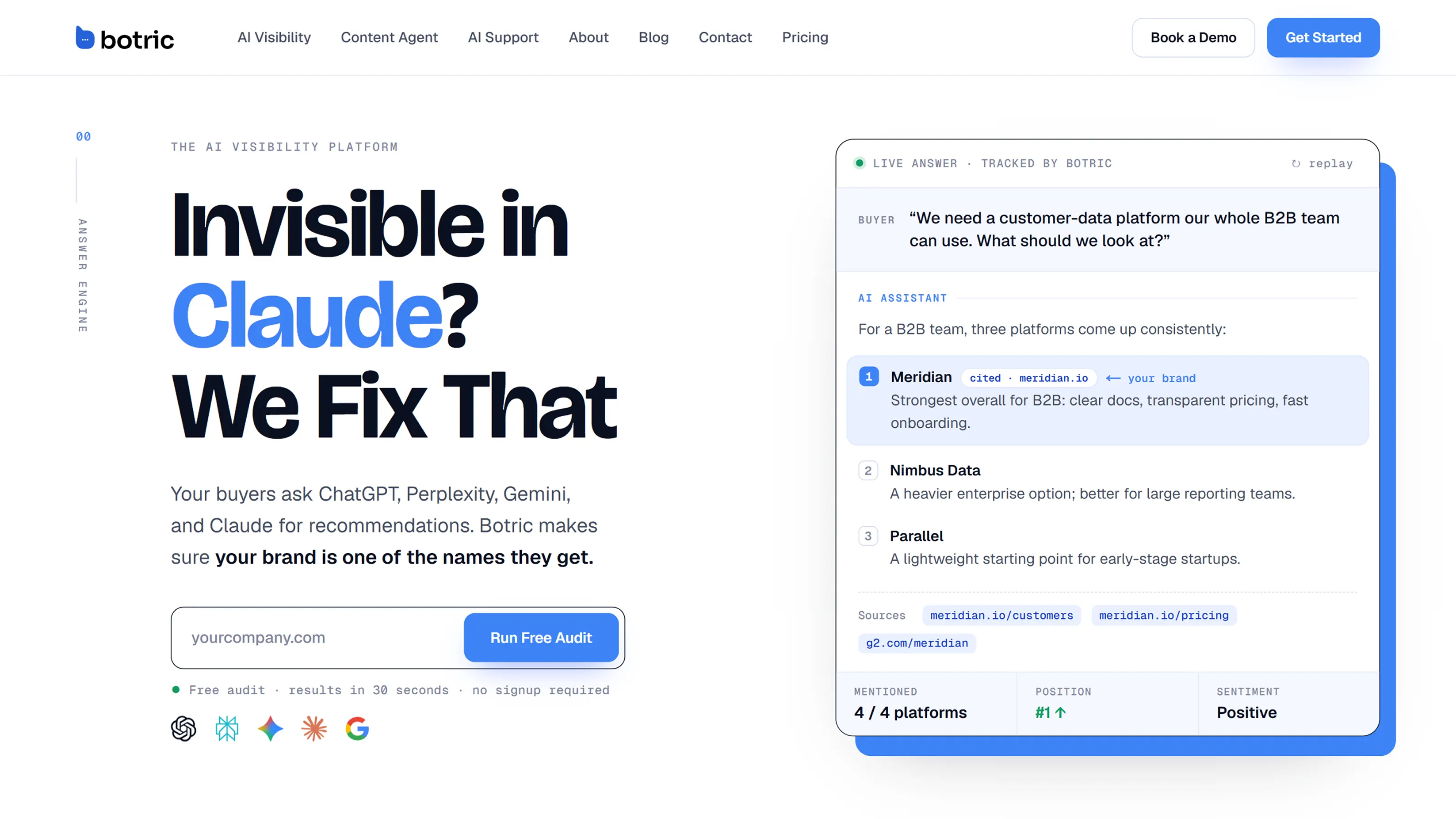
The platform also connects visibility tracking with GEO audits and content recommendations, so teams can move from identifying a visibility gap to investigating the underlying content and SEO signals.
Key features:
- Gemini visibility tracking
- Prompt-level monitoring
- Brand mention and citation tracking
- Competitor comparison
- GEO audits
- AI visibility tracking across multiple AI platforms
- Content Generation
Botric is particularly useful for businesses that don't want their Gemini tracking workflow to stop at reporting. Teams can use the visibility data to identify missing prompts, investigate citation gaps, and prioritize content improvements.
The main consideration is historical depth. As a newer platform, Botric has less long-term historical data than established SEO platforms.
Pricing: Plans start at $15/month, making Botric suitable for teams looking for an affordable way to track and improve AI search visibility.
2. Profound
Profound is a specialized GEO platform that has rapidly evolved into the category leader, securing a $96M Series C round at a $1 billion valuation led by Lightspeed Venture Partners in February 2026.
The Conversation Explorer feature surfaces real-time AI search volume data, which is genuinely useful for sizing demand before you create content.
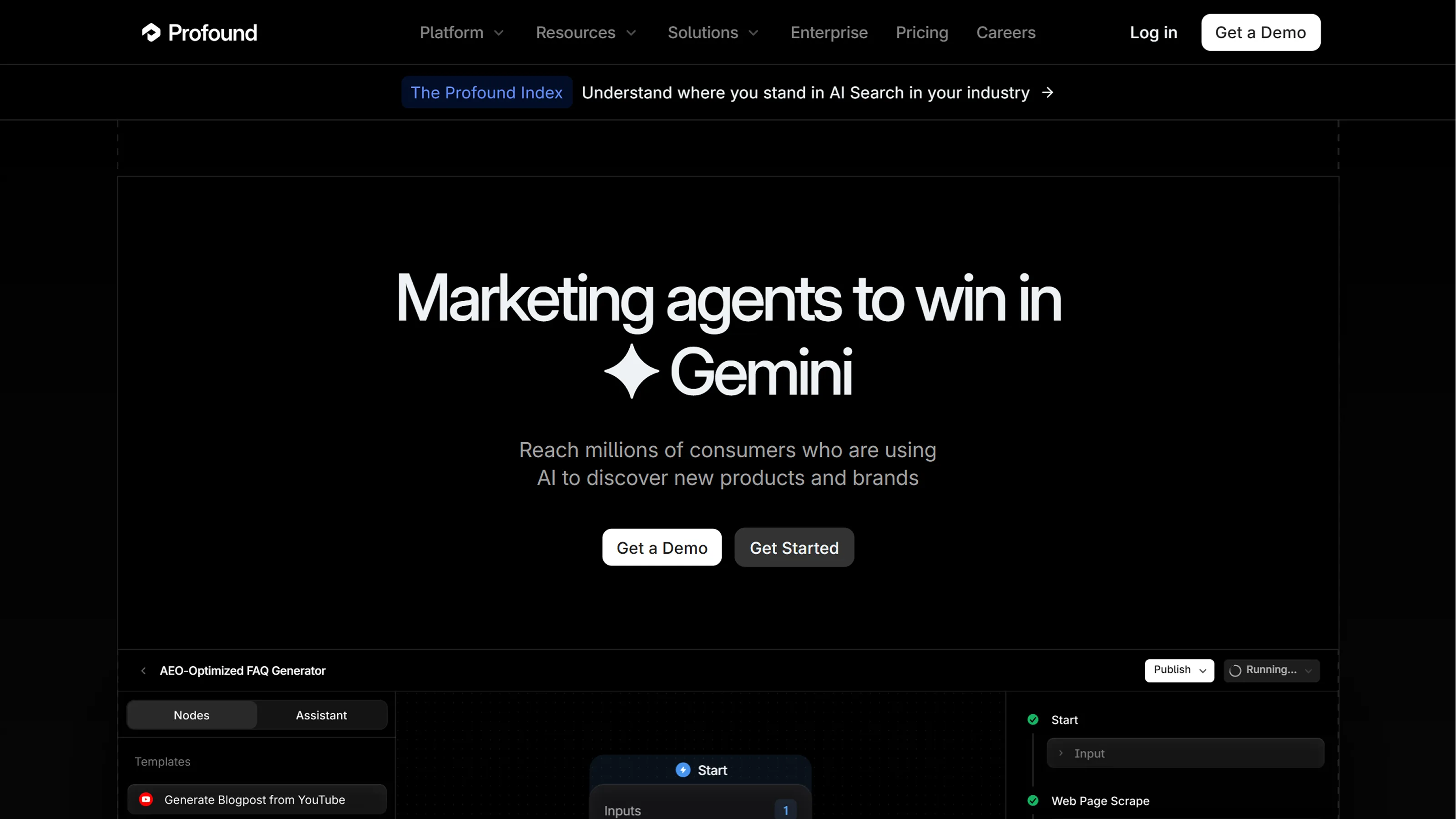
The Starter plan at $99/month covers ChatGPT only, the Growth plan at $399/month covers 3 models, and Gemini coverage requires Growth tier or above. For agencies, the per-brand pricing structure gets expensive fast. Best for Fortune 500 teams with dedicated AI visibility budgets.
3. Peec AI
Peec AI includes six engines out of the box with no add-on fees: ChatGPT, Perplexity, Google AI Overviews, Gemini, Claude, and AI Mode. Every plan includes every engine, which changes the budgeting math considerably compared to tools where Gemini costs extra.
The platform's most technically interesting feature is how it separates explicit brand mentions (the AI says your name) from source citations (the AI links to your content).
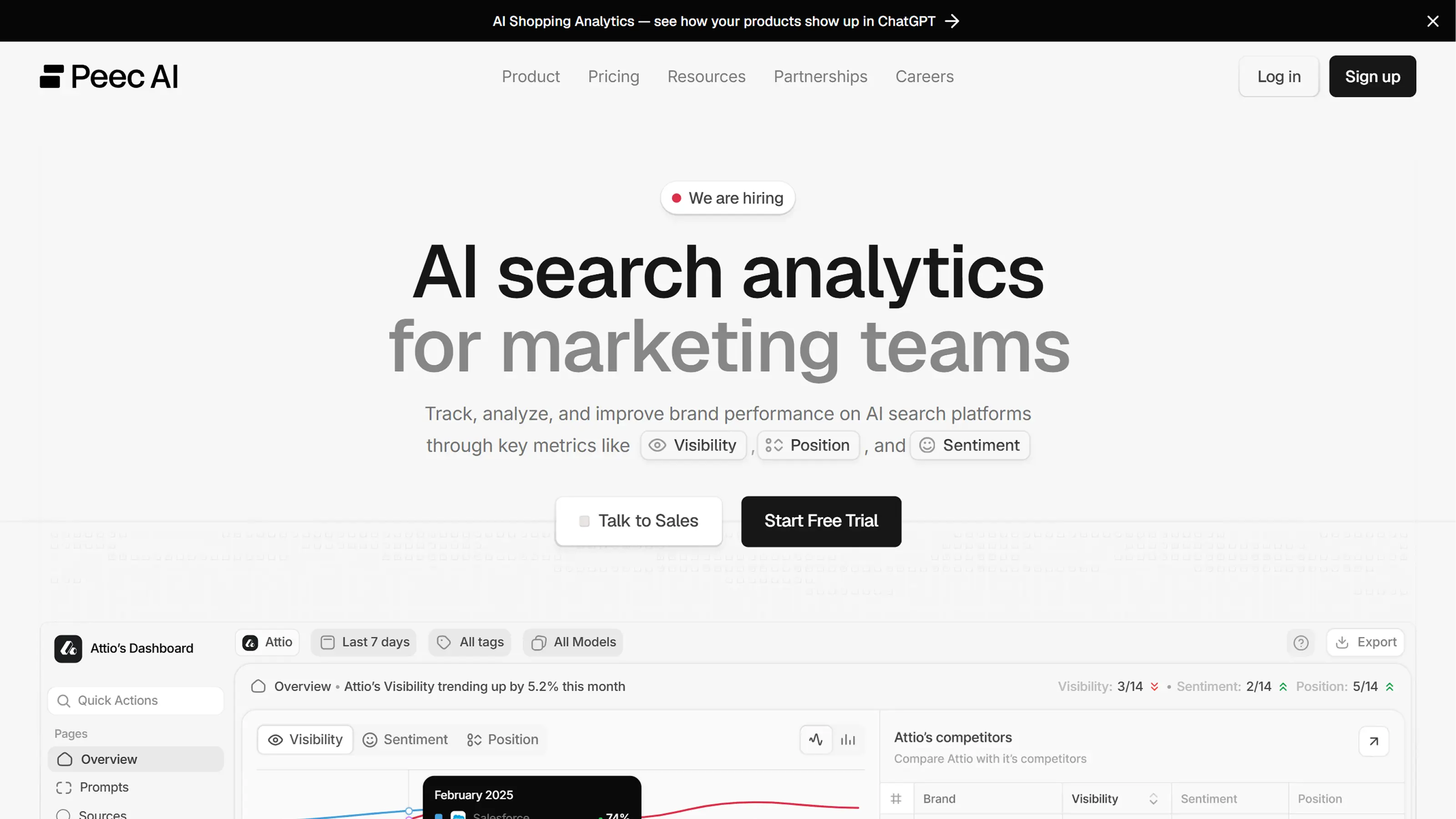
That distinction matters for diagnosing whether your content is being found but not attributed, or simply not found at all. Starts at €89/month. Best for mid-market teams running multilingual campaigns or needing Looker Studio reporting.
4. Rankscale
Rankscale covers the broadest engine list in this comparison: ChatGPT, Perplexity, Google Gemini, AI Mode, AI Overviews, Claude, DeepSeek, Mistral, Grok, Copilot, and more, 17+ engines in total. It's also the most affordable, starting at roughly $20/month per Search Influence's 2026 pricing analysis.
The platform provides AI-driven website analyses, actionable recommendations, performance tracking over time, competitor tracking, and citation analysis.
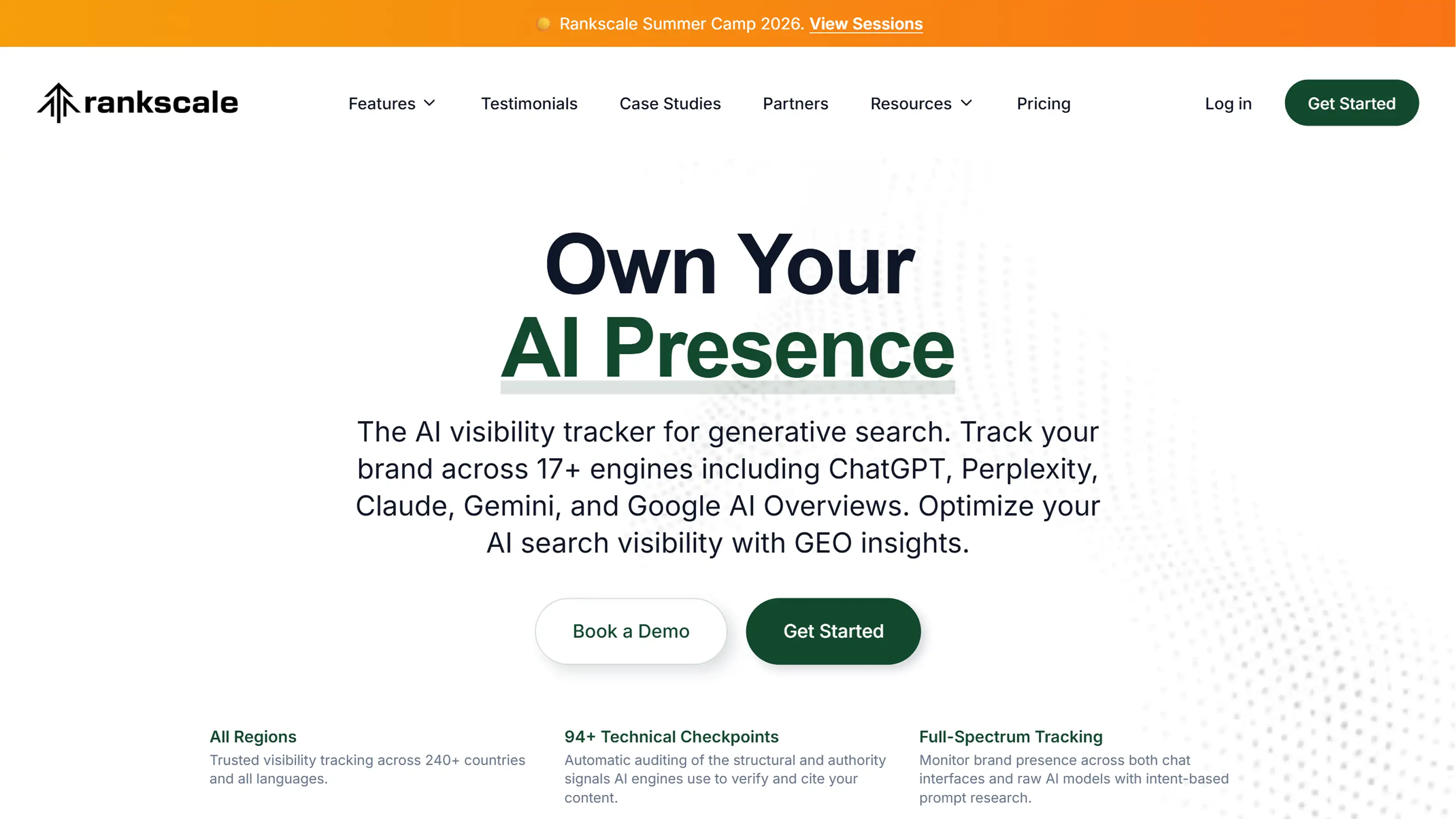
The trade-off is depth: Rankscale is a strong starting point for teams new to AI visibility tracking, but it doesn't yet match the prompt-level granularity of Peec AI or Profound for established programs.
5. Ahrefs Brand Radar
Brand Radar checks your brand against a database of 370M+ search-backed prompts, questions modeled on real keywords and People Also Ask queries. It now covers seven AI surfaces: Google AI Overviews, Google AI Mode, ChatGPT, Perplexity, Gemini, Microsoft Copilot, and Grok. The prompt corpus built from real search behavior is the genuine differentiator here; no other tool in this list has a citation database of comparable scale.
Brand Radar AI indexes are $199/month per platform individually, or $699/month for all six bundled, with a realistic minimum of $828/month to monitor across all six platforms.
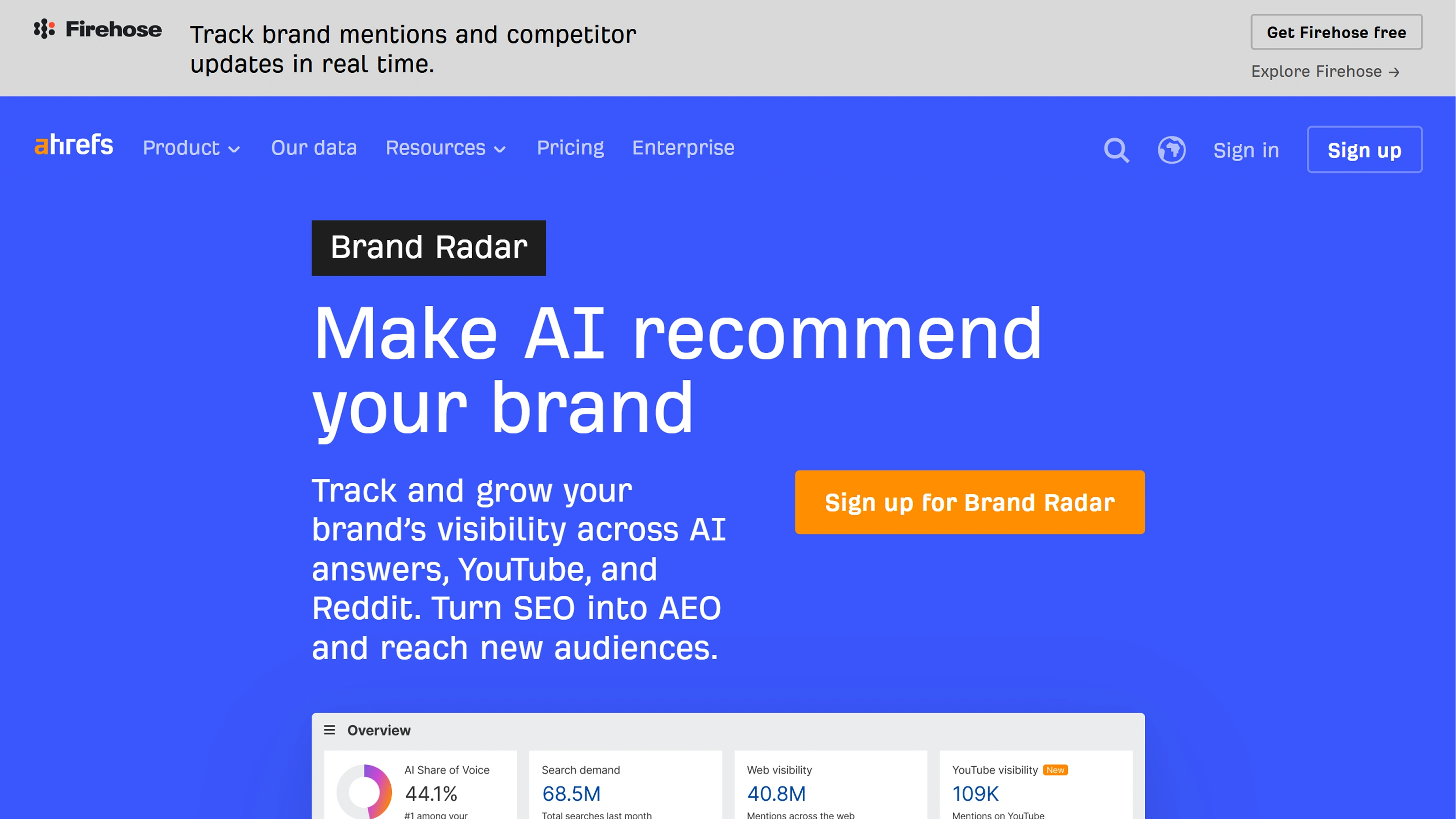
Where it loses credibility is accuracy: independent testing has flagged gaps between what Brand Radar reports and what manual inspection finds, particularly in the ChatGPT and Perplexity modules. Best for enterprise content teams already deep in Ahrefs who need research-grade prompt data and can absorb the cost.
6. Semrush AI Visibility Toolkit
Semrush's AI Visibility Toolkit drops AI tracking into the SEO suite millions already use. You track your own high-value prompts day by day across ChatGPT, Google AI Mode and AI Overviews, Perplexity, and Gemini, with Claude added more recently. The toolkit is $99/month per domain and includes 25 tracked prompts.
The honest caveat: this add-on performs well for AI Overview tracking and is weaker for conversational Gemini tracking. If the Gemini app is your priority, a dedicated tool will give you cleaner data. If you already live in Semrush and primarily care about AI Overviews, this is the lowest-friction path.
For teams exploring other options, the best tools to rank in ChatGPT and AI search guide covers the broader category.
7. Otterly.ai
Otterly.ai is one of the earliest tools built specifically for AI search visibility. It's smaller, cheaper at entry, and simpler to set up. You add prompts, it monitors them across ChatGPT, Perplexity, Google AI Overviews, AI Mode, Gemini, and Bing AI Copilot, and logs brand mentions, sentiment, link citations, and domain references over time.
The catch is that Gemini is not included in the base plans. Google Gemini and Google AI Mode are paid add-ons running $9 to $149/month depending on your plan.
The $29 Lite tier is genuinely useful for getting started, but a team that needs Gemini tracking specifically will pay more than the headline price suggests. Best for solo marketers and small agencies who want fast setup and don't need deep competitive intelligence.
Why Botric stands out for Gemini-specific visibility
Most tools in this category answer one question: "Are we visible?" Botric was built to answer the follow-up: "Which exact prompts are we missing, and what's causing it?"
Prompt isolation, not blended scores
The difference is architectural. Botric tracks Gemini-specific prompts separately from ChatGPT, Perplexity, and Claude, so you can see that your brand appears in 14 of 20 tracked Gemini prompts but only 6 of 20 ChatGPT prompts for the same category.
A blended score hides that split entirely, and the fix for each gap is different.
Tied to SEO signals, not just output monitoring
The platform starts with a full GEO audit: crawling your indexable pages, scoring structured-data health, and identifying the exact content gaps that cause AI engines to skip your domain.
One Botric site audit covering 39 pages turned up 9 error pages, the kind of technical gap that suppresses Gemini citations regardless of content quality. That root-cause layer is what most monitoring tools never surface.
Botric and AthenaHQ also provide content recommendations to improve your citation rate rather than just reporting where you currently stand. For teams running an agile content strategy that needs to respond to prompt gaps quickly, that closed loop matters.
Which Gemini Rank Tracking Tool Is Right for You?
No single platform is the best fit for every organization. The right choice depends on your budget, reporting needs, and whether your goal is simply to measure AI visibility or actively improve it.
- Botric is the strongest all-around option for businesses that want to both monitor and improve Gemini visibility. It combines rank tracking, GEO audits, prompt-level analysis, AI citation monitoring, and optimization recommendations in a single workflow.
- Profound is a strong choice for large enterprises that prioritize governance, compliance, and advanced reporting across multiple AI platforms.
- Peec AI works well for global teams that need multilingual AI visibility tracking and regional competitor insights.
- Rankscale offers broad AI engine coverage at one of the most accessible price points, making it a good option for smaller teams and growing businesses.
- Ahrefs Brand Radar is best suited for organizations that want large-scale AI search research backed by Ahrefs' extensive keyword and prompt datasets.
- Semrush AI Visibility Toolkit is a natural fit for businesses already using the Semrush ecosystem and looking to add AI visibility tracking to their existing SEO workflow.
- Otterly.ai is a practical starting point for freelancers and small agencies that want simple AI visibility monitoring without the complexity of enterprise platforms.
Conclusion
Gemini has become one of the most important AI discovery channels, but tracking visibility isn't as straightforward as monitoring a single AI score. The best Gemini rank tracking tools separate Gemini from AI Overviews and other AI platforms, helping you understand where your brand is actually being cited and where opportunities exist.
Whether you need enterprise reporting, multilingual monitoring, or prompt-level optimization, choosing the right platform depends on your goals. For teams that want to move beyond monitoring and actively improve Gemini visibility, tools that combine tracking with actionable recommendations provide the most long-term value.
Key Takeaways
-
Gemini operates across three distinct surfaces (the app, AI Overviews, AI Mode), each with different citation logic, so a single blended score obscures the gaps that actually matter for your specific channel mix.
-
Strong Google indexing is the prerequisite: most Gemini citations come from pages already ranking in organic search, which makes technical SEO and schema non-negotiable inputs.
-
SEO suite add-ons that bundle Gemini into a generic AI score are measuring the wrong thing for teams whose buyers use Google as their primary discovery channel.
-
Prompt-level tracking lets you diagnose which specific queries you're losing and why, something aggregate scoring can't do.
-
For most SMBs and SaaS teams, the right tool surfaces the root cause of each gap rather than just the gap itself: start with a dedicated platform before adding an enterprise suite.
If you've just diagnosed that your brand has little to no Gemini visibility and you want to know exactly which prompts you're missing and what's causing it.
Run your free GEO audit at Botric, it shows exactly which Gemini prompts you're missing and maps each gap to a fix, with plan options on the same page.
Frequently Asked Questions
Can you rank in Gemini without ranking in Google Search?
Rarely. Roughly nine of ten AI Overview citations come from URLs already in Google's top 10 organic results (Botric internal data, Jan–Jun 2026), which means strong traditional SEO is the foundation. Schema, entity clarity, and content structure are the additional layers on top.
What is the difference between AI Overviews and Gemini app tracking?
Consider a brand that shows up consistently in AI Overviews but barely registers in the Gemini chatbot for the same queries. Those two surfaces are optimized by different signals and measured in different systems, so a page performing well in one can have low citation rates in the other. A tool that lumps them together gives you an incomplete picture of where the real gap is.
How often should I check Gemini visibility?
Weekly works for most teams. Daily tracking makes sense only if you're actively publishing new content or competing in a category where a rival's new page could displace you within days. Quarterly structural audits should sit alongside weekly prompt checks.
Which tools have a free tier or trial for Gemini tracking?
Botric offers both a free GEO audit and a free plan, making it easy to evaluate your current Gemini visibility before upgrading. Otterly.ai offers a 7-day free trial, while Ahrefs provides a free AI visibility checker for one-time analysis. Profound requires a demo and doesn't currently offer a public free trial, while Rankscale focuses on affordable paid plans starting at around $20/month. Since pricing and trial availability can change, it's worth checking each vendor's latest plans before making a decision.
A brand appears in ChatGPT but not Gemini for the same prompt. Why?
The engines retrieve content differently. ChatGPT blends training knowledge with selective web search, while Perplexity retrieves from the live web and can pick up new content within hours. The same article can be visible on one platform and invisible on the other for weeks. Gemini adds a third variable: it grounds responses in Google's own index, so pages with indexing issues won't be cited even if ChatGPT surfaces them without trouble.
How do I track my rankings on Gemini?
Create a set of relevant prompts, run them through a Gemini tracking tool, and monitor whether your brand is mentioned or cited. Repeat the tracking regularly to identify changes in visibility and competitors appearing for the same prompts.
Can I track competitors in Gemini?
Yes. Several Gemini tracking tools, including Botric, let you track competitors alongside your own brand. This helps you identify which competitors appear for prompts where your brand is missing and uncover potential visibility gaps.
Can Gemini rankings change over time?
Yes. AI-generated responses can change as models, search results, sources, and retrieval systems change. That's why recurring prompt tracking is more useful than checking Gemini visibility only once.