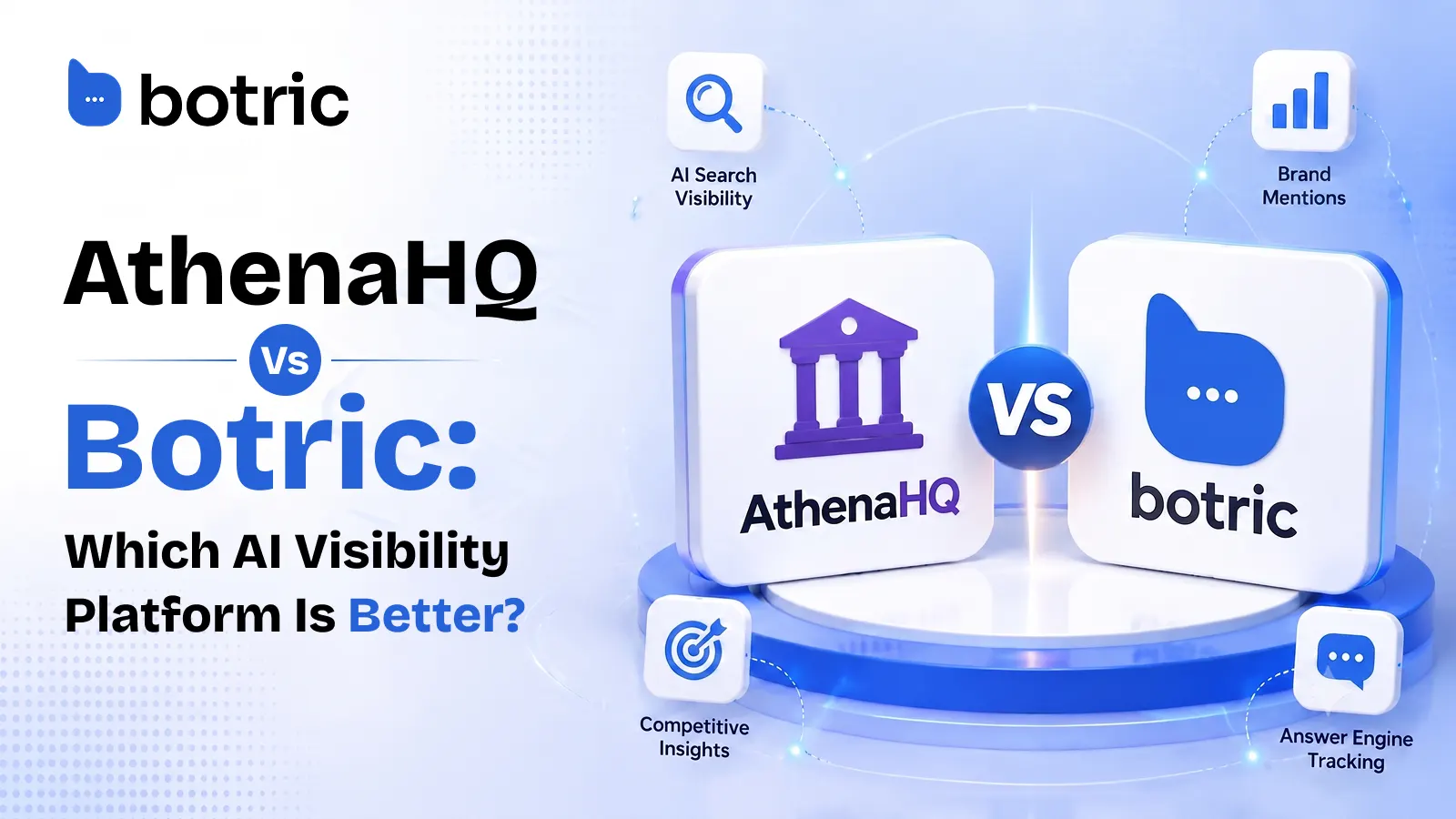
AI visibility platforms all promise to help brands appear more often in ChatGPT, Gemini, Perplexity, and other AI search engines. The difference is how they help you get there. Some focus on reporting and workflow management, while others combine diagnostics, optimization, and content creation in one platform.
This comparison breaks down AthenaHQ and Botric across AI visibility tracking, GEO audits, content workflows, enterprise capabilities, pricing, and ideal use cases so you can choose the platform that best matches your team.
Disclosure: This comparison is published by Botric, one of the two platforms compared here. Both platforms are evaluated against the same criteria.
Botric vs AthenaHQ: Quick Answer
Botric and AthenaHQ both help brands improve AI visibility, but they're built for different audiences.
Recommendation: Choose Botric if you want an all-in-one AI visibility platform with GEO audits and content optimization. Choose AthenaHQ if your organization prioritizes structured workflows and enterprise collaboration.
What Are the Core Differences in How Each Platform Tracks AI Visibility?
The key difference is what happens after insights are collected. Botric tracks what AI engines actually say about your brand right now, then drives the content work to change it. AthenaHQ tracks what AI engines say and gives you a structured workflow to act on it, but at a price point that assumes an enterprise budget from day one.
Generative Engine Optimization, or GEO, is the practice of optimizing content so that large language models can find, understand, and cite it in AI-generated answers.
Botric
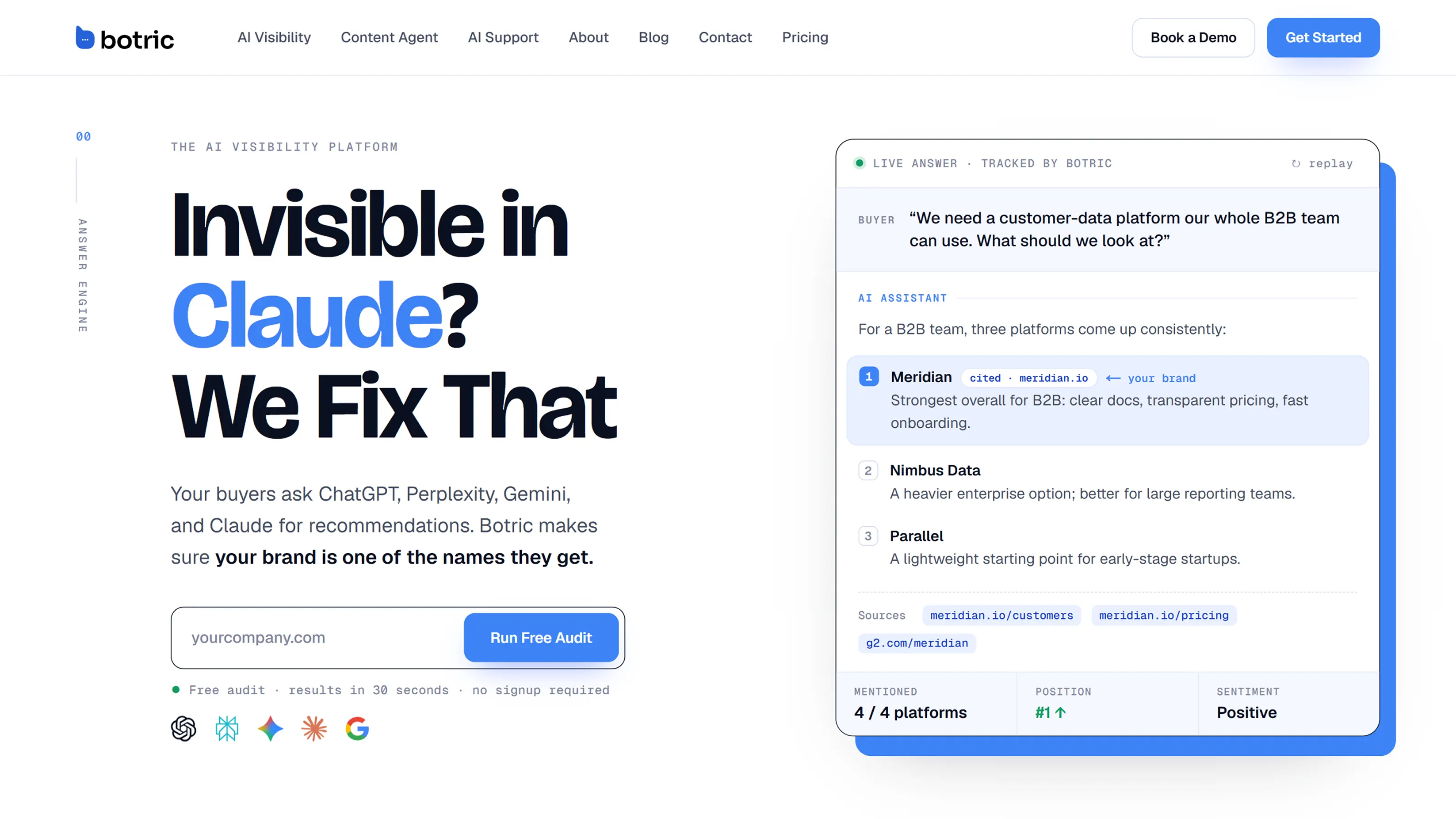
Botric combines AI visibility monitoring with content optimization in a single platform. It tracks brand mentions and citations across six AI search engines, ChatGPT, Gemini, Perplexity, Claude, Google AI Overviews, and Google AI Mode, monitors prompts by engine, analyzes competitors, identifies technical and content issues through a GEO audit, and helps teams create AI-ready content to improve visibility.
Core capabilities include:
- AI citation tracking and brand visibility monitoring across multiple AI platforms
- Prompt monitoring with engine-specific reporting
- GEO audits covering crawlability, structured data, and AI readiness
- Competitor visibility tracking
- AI-assisted content generation and optimization
- Performance reporting with optimization recommendations
Rather than presenting a single AI visibility score, Botric breaks performance down by platform so teams can identify exactly where they're being cited, where competitors are winning, and what improvements should be prioritized.
AthenaHQ
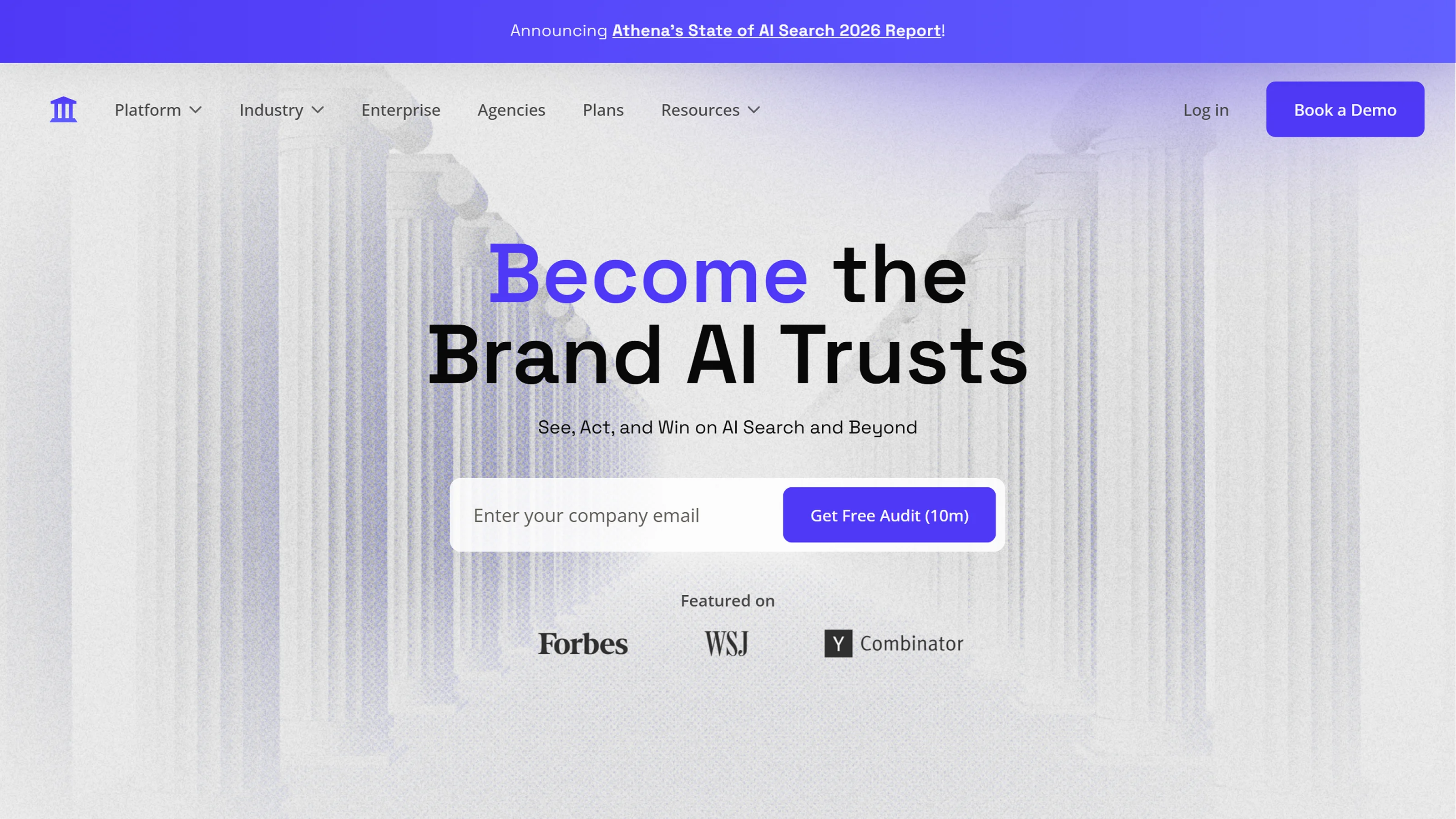
AthenaHQ focuses on AI visibility monitoring and structured optimization workflows for content teams. The platform monitors major AI engines, combines prompt tracking with competitive analysis, and translates those insights into assignable optimization tasks through its Action Center.
Key capabilities include:
- AI visibility monitoring across eight major AI platforms
- Prompt tracking and competitor benchmarking
- Share-of-voice reporting
- Action Center for structured GEO recommendations
- Workflow management designed for larger content teams
For organizations with established content operations, AthenaHQ emphasizes turning monitoring data into structured execution plans that teams can assign, prioritize, and track over time.
How Their Approach to AI Visibility Differs
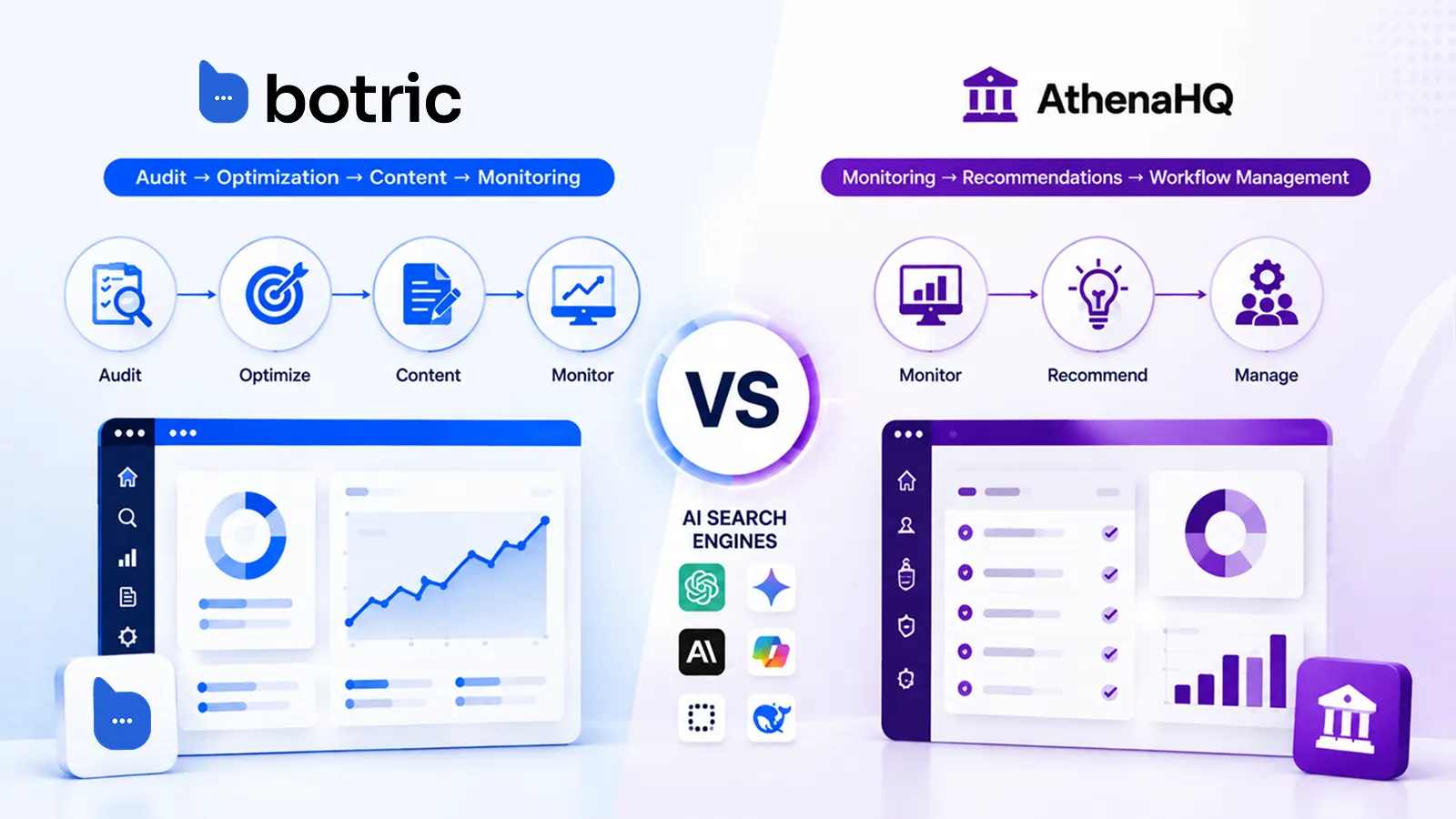
The biggest difference between these platforms isn't the number of AI engines they support. It's how they help teams improve visibility after identifying opportunities.
Botric
Botric follows an audit → optimization → content → monitoring workflow.
The platform begins with a GEO audit that evaluates crawlability, structured data, content quality, and AI readiness to identify why a website isn't appearing in AI-generated answers.
Those insights feed directly into content recommendations and AI-assisted content creation, allowing teams to move from diagnosis to implementation without switching platforms.
For businesses that want both measurement and execution in one place, this creates a continuous optimization workflow rather than a reporting dashboard.
AthenaHQ
AthenaHQ follows a monitoring → recommendations → workflow management approach.
The platform continuously monitors AI search performance across multiple engines, identifies optimization opportunities, and organizes those recommendations.
While it helps generate content, its broader focus is enabling content teams to prioritize, assign, and manage the work required to improve AI visibility.
This approach is particularly valuable for larger marketing teams that already have writers, editors, and established publishing workflows.
Where Each Platform Performs Best
Both platforms address AI visibility, but they excel in different areas. The better choice depends on which capabilities matter most to your team.
AI Visibility Tracking
Both Botric and AthenaHQ monitor how brands appear across major AI search platforms, but they present those insights differently.
Botric focuses on engine-specific visibility, allowing teams to see how their brand performs separately across ChatGPT, Gemini, Perplexity, Claude, Google AI Overviews, and Google AI Mode. Instead of combining everything into a single score, it highlights where visibility is strongest, where competitors are gaining ground, and which engines require attention.
AthenaHQ also monitors multiple AI platforms while adding competitor share-of-voice reporting. For enterprise marketing teams tracking brand perception across several competitors, these additional reporting layers can provide useful strategic context.
GEO Audits and Diagnostics
This is one of the biggest differences between the two platforms.
Botric begins with a comprehensive GEO audit that evaluates crawlability, structured data, content quality, and AI readiness. Rather than simply identifying visibility gaps, the audit explains why those gaps exist and prioritizes improvements that can increase AI citations.
AthenaHQ places less emphasis on technical diagnostics and more on helping teams act on visibility insights through structured optimization workflows. Organizations that already have strong technical SEO processes may find this workflow-oriented approach sufficient, while teams looking for a dedicated GEO audit will likely prefer Botric.
Content Optimization and Execution
Monitoring AI visibility is only useful if teams can improve it.
Botric combines audits, visibility tracking, and AI-assisted content generation in a single workflow. After identifying missing topics or optimization opportunities, users can create or improve content without moving between multiple tools.
AthenaHQ takes a different approach. Rather than generating content directly, its Action Center turns optimization recommendations into structured tasks that marketing teams can prioritize, assign, and manage within their existing publishing workflow, and it also helps with content through content agents.
The distinction is simple:
- Botric helps teams move from insight to published content.
- AthenaHQ helps larger organizations coordinate the work required to improve content authority.
Enterprise Features and Integrations
While Botric focuses on helping teams improve AI visibility from audit to content, AthenaHQ extends further into enterprise reporting and governance. AthenaHQ offers integrations with GA4, Google Search Console, Shopify, Webflow, and Framer, along with BI integrations such as Tableau, Power BI, and Looker on enterprise plans.
Botric also offers an Enterprise plan for larger teams, providing higher usage limits, advanced AI visibility tracking, collaboration features, priority support, and custom onboarding. Its focus remains on helping organizations monitor AI search visibility, identify optimization opportunities, and create AI-ready content from a single platform.
AthenaHQ additionally includes capabilities such as multi-region tracking, persona-based analysis, executive dashboards, SSO, and enterprise-grade security, making it a stronger fit for organizations with complex reporting, governance, and compliance requirements.
Reporting and Team Workflows
Botric is designed around operational reporting. Teams can monitor prompts by AI engine, track citations over time, compare competitors, and measure improvements through a centralized dashboard.
AthenaHQ places greater emphasis on workflow management and enterprise reporting. Alongside its Action Center, it offers executive dashboards, BI integrations, and governance features that help larger organizations monitor AI visibility across teams and regions.
For companies with dedicated content operations, AthenaHQ's workflow capabilities may be a deciding factor. For smaller marketing teams looking for an all-in-one platform, Botric's integrated reporting and execution workflow reduces the need for additional tools.
Botric vs AthenaHQ: Which Platform Fits Your Use Case?
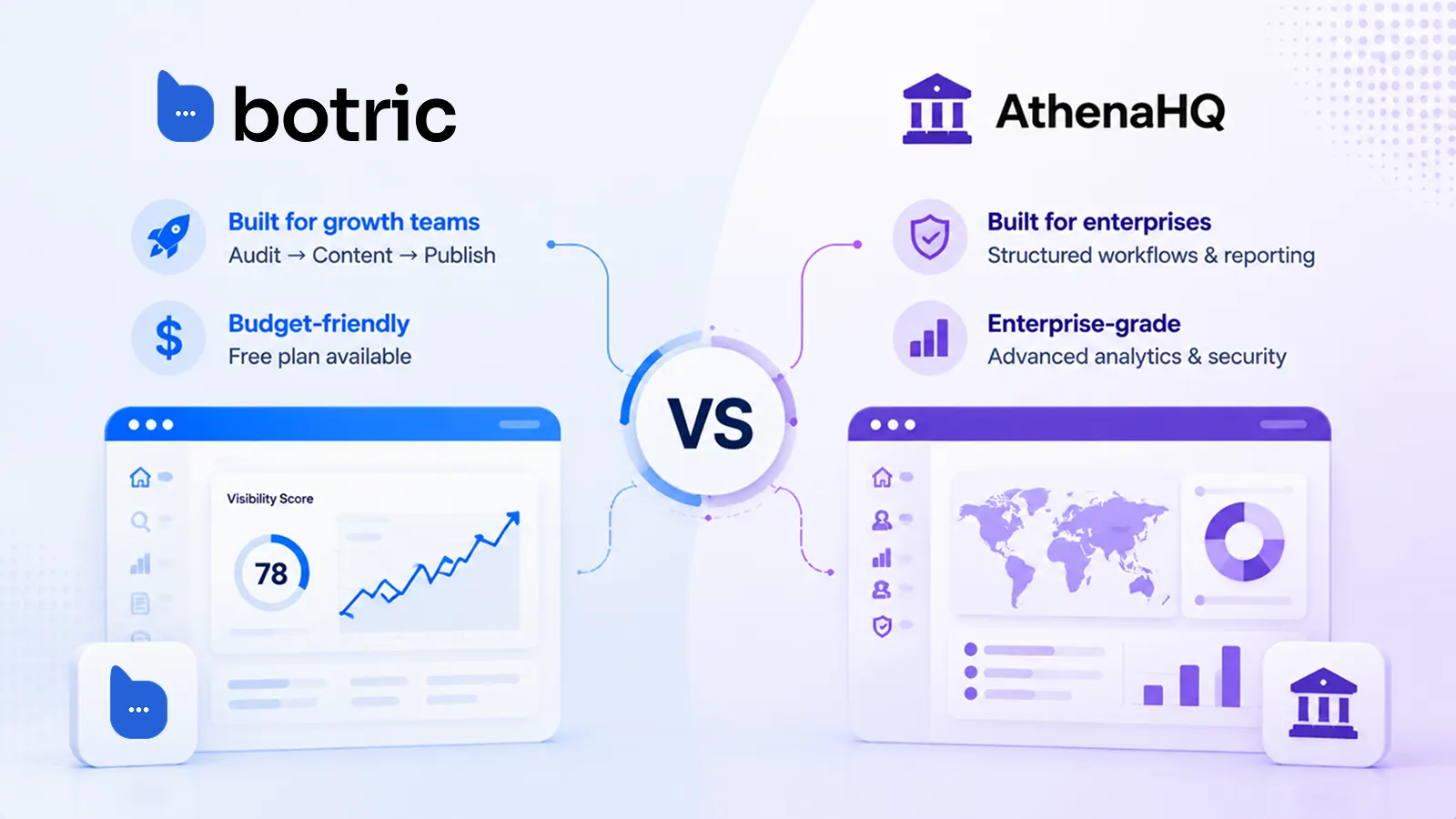
The right choice depends almost entirely on your budget ceiling and whether you need monitoring or a full production loop.
I run a SaaS team and need to build content authority fast
Botric is often the better fit for growing SaaS teams that need to identify visibility gaps and publish optimized content quickly from one platform.
AthenaHQ becomes more compelling for larger SaaS organizations with established content teams and enterprise reporting needs.
I'm at an enterprise with a procurement cycle
AthenaHQ is the stronger fit here. If you have the budget and need a comprehensive AI search optimization platform for a set of brands, the advanced feature set and enterprise support justify the investment.
Beyond AI visibility tracking, AthenaHQ integrates with tools like GA4, Google Search Console, Shopify, Webflow, Framer, Tableau, Power BI, and Looker.
Combined with features such as SSO, executive dashboards, multi-region tracking, and enterprise security, it's a strong fit for organizations with complex reporting and governance requirements.
Botric's enterprise plan supports custom deployments, but organizations with highly complex global operations should verify workspace and governance requirements directly.
I'm a solo marketer or consultant with a tight budget
Botric is generally the better fit for solo marketers because of its free plan and lower starting price. The free plan includes a site and GEO audit, five tracked prompts on ChatGPT with no credit card required.
AthenaHQ's entry point is $295/month, with a one-time credit grant as the only trial option. That's a different market segment entirely, not a pricing tier.
Pricing and Value
The pricing difference reflects the different customer segments each platform targets.
Botric offers a permanent free plan alongside paid plans starting at $15 per month, making it accessible to startups, consultants, agencies, and growing marketing teams.
The platform combines AI visibility tracking, GEO audits, content optimization, and AI-assisted content creation within a single subscription.
AthenaHQ starts at $295 per month and targets mid-market and enterprise organizations. Rather than competing on entry-level pricing, it focuses on structured workflow management, enterprise reporting, and collaboration capabilities for larger content operations.
If your primary goal is to establish AI visibility with an affordable all-in-one platform, Botric provides a lower-cost starting point. If your organization already has mature content processes and values structured execution over integrated content creation, AthenaHQ's higher investment may be justified.
How should you evaluate beyond the feature list?
A feature table tells you what a tool claims to do. These four questions tell you whether it actually delivers.
Does the platform query live AI engines or estimate from proxies?
Some tools generate AI visibility scores without querying real AI systems. The best GEO tools pull actual responses from ChatGPT, Perplexity, Gemini, and other platforms in real time. Ask both vendors specifically how visibility data is collected before you sign anything.
How quickly does the engine list update as new models launch?
The AI search landscape is fragmenting fast. A platform that covered the right engines six months ago may be missing the engines your buyers use today. Check whether new model additions require a plan upgrade or happen automatically.
What's the lag between content publication and visibility in AI results?
Publishing a page and seeing it cited in AI answers are two different timelines. A platform that can't tell you this lag is a monitoring tool, not a diagnostic one.
Can you export and act on citation data, or is it dashboard-only?
If the data lives only inside the platform's UI, your team's ability to act on it is gated by the vendor's roadmap. Exportable citation data lets you feed insights into your existing content workflow.
Run this check on your own shortlist before taking anyone's word for it, and see the best GEO tools guide for a broader look at how platforms handle data portability across the category.
Conclusion
AthenaHQ and Botric address the same shift: more buyers are discovering brands through AI search instead of traditional search engines, but they're built for different stages of the same journey.
AthenaHQ is a workflow layer for teams that already have the content operation, the headcount, and the budget to act on GEO insights through structured task management. Botric is a full-stack GEO platform for teams that need to go from "we don't know why we're invisible in AI search" to published, optimized content without additional enterprise software.
Both platforms serve different types of organizations. The better fit comes down to where your team already sits: if you need an execution layer bolted onto an existing content machine, AthenaHQ's Action Center earns its price.
If you're looking for a platform that combines AI visibility audits, tracking, and content creation in one place, Botric offers everything you need, with a free plan to help you get started.
Key Takeaways
- Botric and AthenaHQ both improve AI visibility across major AI search engines. AthenaHQ focuses on enterprise monitoring and optimization insights, while Botric combines visibility tracking with built-in content creation and optimization tools.
- Botric starts free with paid plans from $15/month; AthenaHQ starts at $295/month, putting them in different budget categories entirely.
- Agencies and solo marketers get more out of Botric's per-engine tracking and lower entry cost; enterprises with an existing content team and procurement budget tend to get more out of AthenaHQ's structured Action Center.
Want to see how your brand performs in AI search? Run a free GEO audit with Botric to discover visibility gaps across ChatGPT, Gemini, Perplexity, Claude, Google AI Overviews, and Google AI Mode, then get actionable recommendations to improve your AI presence.
Frequently Asked Questions
Is Botric or AthenaHQ better for AI visibility?
It depends on your budget and workflow. Botric suits growth teams, agencies, and solo marketers who need an audit-to-content pipeline at an accessible price point. AthenaHQ suits enterprise and mid-market brands with a $295+/month GEO budget who want structured, assignable optimization workflows and deep competitor share-of-voice data.
What's the difference between Botric and AthenaHQ?
AthenaHQ monitors AI visibility across 8+ engines and turns that data into structured content-authority workflows via its Action Center. Botric starts with a full GEO audit, tracks AI citations and brand mentions across supported AI platforms, and drives content production to close visibility gaps. Where AthenaHQ closes the loop from diagnosis to assigned task, Botric closes it from diagnosis to published content.
Which GEO platform tracks more AI engines?
AthenaHQ covers 8 platforms on all plans: ChatGPT, Claude, Gemini, Perplexity, Copilot, Google AI Overviews, Grok, and DeepSeek. Botric covers six platforms: ChatGPT, Gemini, Perplexity, Claude, Google AI Overviews, and Google AI Mode, with full multi-engine coverage on its higher tiers. Since both platforms add engines as the market evolves, verify current coverage with each vendor directly before deciding.
Which platform is better for agencies and consultants?
For most agencies and consultants, Botric is the better fit due to its free plan, lower starting price, and integrated workflow for auditing websites, tracking AI visibility, and creating AI-ready content. AthenaHQ is generally better suited to larger organizations with dedicated content teams, enterprise reporting requirements, and higher software budgets.
What should I look for when choosing an AI visibility platform?
When comparing AI visibility platforms, evaluate more than the number of supported AI engines. Look for features such as AI visibility tracking, citation monitoring, GEO audits, content optimization, competitor analysis, reporting, integrations, and pricing. The right platform should match your team's workflow, budget, and how you plan to improve your AI search visibility over time.
Do I need an enterprise AI visibility platform?
Not necessarily. Enterprise AI visibility platforms are designed for organizations that need advanced reporting, governance, collaboration, and integrations across multiple teams or regions. Smaller businesses, startups, agencies, and consultants can often achieve their AI visibility goals with a more affordable platform that combines tracking, GEO audits, and content optimization.