
Pull a citation report for almost any B2B brand today and you'll see the same uncomfortable pattern I keep running into: the brand is mentioned in AI answers, but LLM citation tracking that shows exactly which URLs are being cited, or why visibility changes from week to week, is where most tools fall short.
The five I'd shortlist for these needs in 2026 are Botric, Peec AI, Semrush AI Visibility Toolkit, Ahrefs Brand Radar, and Scrunch AI, each covering a different slice: monitoring, optimization, SEO integration, or enterprise reporting.
Which AI optimization tool I'd pick depends on what you need to improve:
- Botric: Best for teams that want AI visibility tracking, citation monitoring, GEO audits, and content optimization in one platform.
- Peec AI: Best for teams focused on detailed LLM visibility, prompt tracking, and citation monitoring.
- Semrush AI Visibility Toolkit: Best for SEO teams that want to add AI visibility tracking to their existing Semrush workflow.
- Ahrefs Brand Radar: Best for teams that want AI visibility data connected to backlinks, search performance, and competitive analysis.
- Scrunch AI: Best for enterprise teams that need AI visibility tracking alongside AI crawler and agent-traffic analytics.
The right choice ultimately depends on where your team needs the most help. If you need to move from tracking AI visibility to actually improving citations and content, an integrated GEO platform can reduce the gap between monitoring and execution. Teams that already have established SEO or content workflows may prefer a specialized monitoring tool that fits into their existing stack.
Why AI Visibility and Citation Tracking Matter More Than Traditional SEO Rankings
Your Google ranking is no longer the only factor determining whether buyers find you. AI-generated answers are becoming another discovery layer, and the bar is getting harder.
LLM visibility, meaning how often and how prominently your brand appears inside AI-generated answers across platforms like ChatGPT, Claude, Perplexity, and Gemini, is now a distinct metric from search rank.
So is AI citation tracking, which monitors which specific URLs those engines pull when they mention your brand or category. GEO, or Generative Engine Optimization, is the practice of structuring and optimizing content so AI engines are more likely to retrieve and cite it.
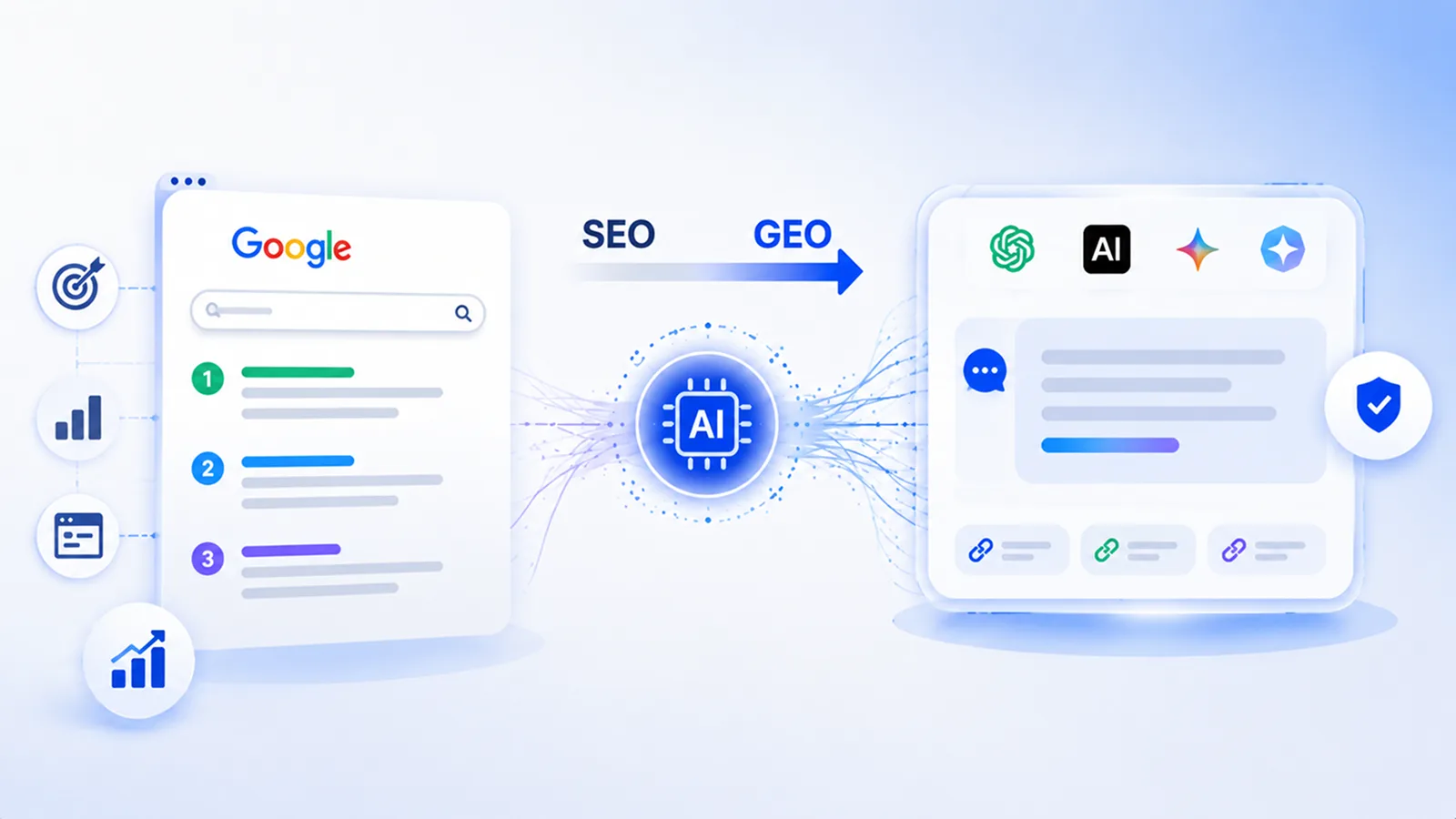
Why the stakes are real
A buyer who arrives from a ChatGPT recommendation has already been pre-sold by the model's answer. Seer Interactive's June 2025 study found LLM-referred visitors convert at 15.9% from ChatGPT, compared to a 1.76% organic search conversion rate. That gap is significant.
The catch: a brand cited in an AI answer reaches users who never click through to your site, so uncited mentions mean lost attribution. And only 30% of brands remain visible from one AI response to the next, which points to serious volatility. You cannot manage what you don't measure.
The SEO-to-GEO shift
Traditional SEO optimized for a ranked list. GEO optimizes for a synthesized paragraph. The signals overlap but diverge sharply. Analysis found that domain authority, high-quality backlinks, and mentions in "best" and "top" listicles are among the top five factors influencing AI citation, alongside total backlink volume and unique referring domains.
Your backlink profile still matters, but it now feeds a citation database rather than a rank position.
For a deeper explanation of how this shift works in practice, generative engine optimization explained walks through the mechanics in full.
What to Look For: Evaluation Criteria
The right AI optimization tool depends on whether your priority is monitoring visibility, understanding citations, improving content, or managing the entire GEO workflow. I evaluated each platform across six criteria:
- AI visibility tracking: Does it measure brand visibility across major AI search and answer engines?
- Citation tracking: Can it identify the sources and URLs cited in AI-generated answers?
- Prompt monitoring: Can you track specific prompts and high-intent queries over time?
- Competitor intelligence: Can you compare AI visibility, citations, or share of voice against competitors?
- GEO optimization: Does the platform provide audits, recommendations, content optimization, or content generation to improve AI visibility?
- Pricing: What does a realistic setup cost for the features and coverage most teams need?
Top 5 AI Optimization Tools at a Glance
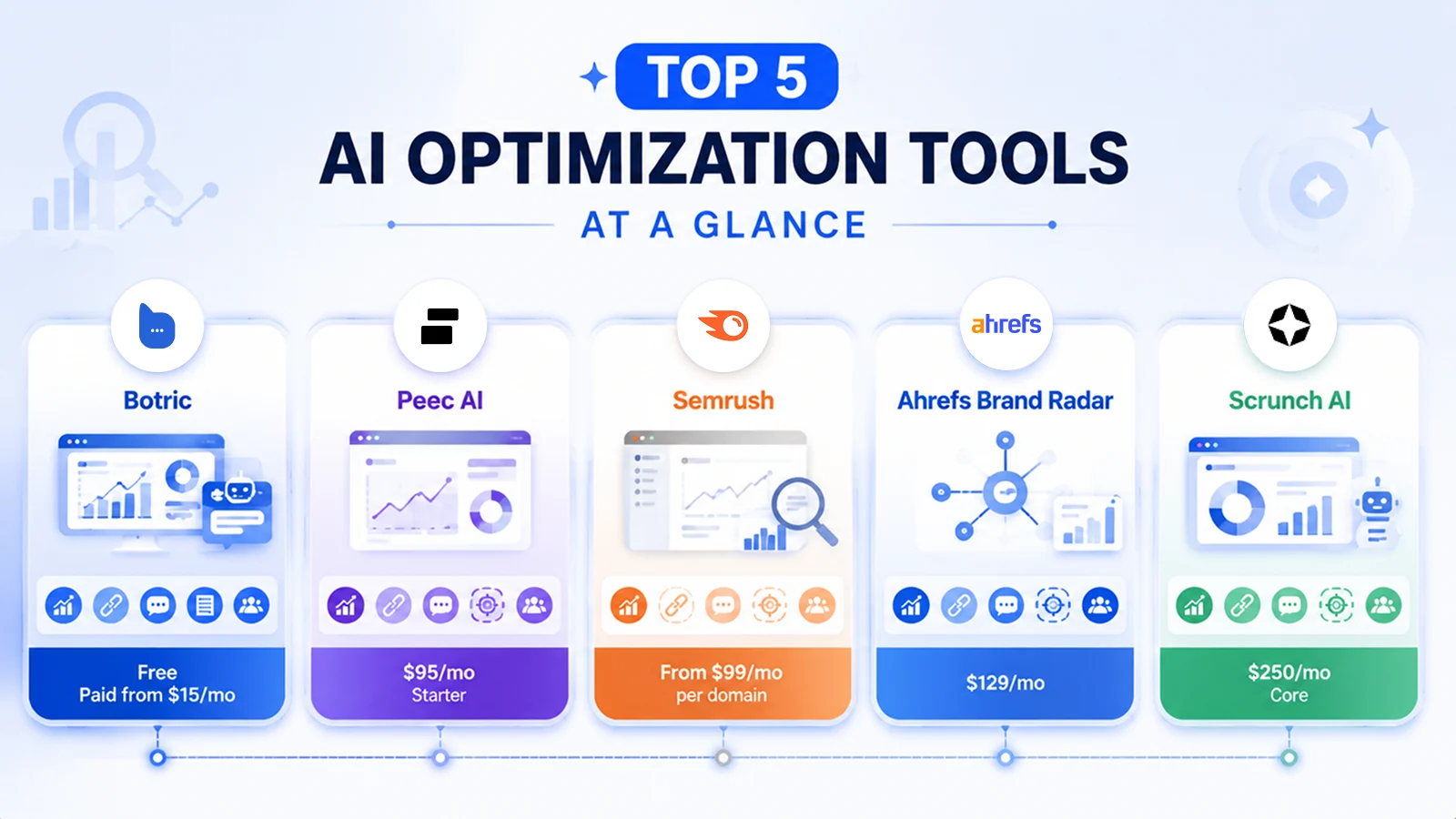
| Tool | Best Use Case | AI Visibility | Citation Tracking | Prompt Monitoring | GEO Optimization | Competitor Tracking | Starting Price |
|---|---|---|---|---|---|---|---|
| Botric | Full-loop: monitor, optimize, content production | ChatGPT, Gemini, Claude, Perplexity, AI Overviews | Yes, URL-level | Yes | Yes, content generation included | Yes | Free; paid from $15/mo |
| Peec AI | Dedicated LLM monitoring | ChatGPT, Perplexity, Google AI Overviews + add-ons | Yes | Yes | Limited | Yes, benchmarking | $95/mo (Starter) |
| Semrush AI Toolkit | SEO teams adding a GEO layer | ChatGPT, AI Overview, AI Mode | Partial | Yes | Prompt research only | Yes | From $99/mo per domain |
| Ahrefs Brand Radar | Backlink-correlated AI visibility | ChatGPT, Perplexity, Gemini, AI Overviews, Copilot | Yes, with backlink correlation | Yes | No | Yes, share of voice | $129/mo |
| Scrunch AI | Enterprise crawler + citation analytics | Multi-platform | Yes | Yes | Limited | Yes | $250/mo (Core) |
Detailed Tool Reviews: Features, Platforms, Benefits, and Tradeoffs
1. Botric
Botric is a full-stack GEO and AI visibility platform. It combines prompt tracking, citation analysis, AI-ready site audits, GEO-optimized content generation, and an AI Chat Agent that converts AI-referred visitors.
Key features: Prompt-level tracking per engine (so you can see that your brand appears in 14 of 20 Gemini prompts but only 6 of 20 ChatGPT prompts for the same category), URL-level citation tracking, content gap analysis, GEO audit scoring, and AI-ready blog generation.
AI platforms supported: ChatGPT, Gemini, Claude, Perplexity, and AI Overviews. Full multi-engine coverage is on the Infinity tier at $149/month; the entry paid plan starts at $15/month, and a free tier includes a site and GEO audit, four blog generations, and five tracked prompts on ChatGPT.
Benefits: The practical differentiator is that audit, content production, and citation tracking run in one integrated workflow, reducing the handoffs between identifying a problem and acting on it.
Tradeoffs: As a newer platform, Botric's content cluster depth is still building. Teams with large existing content libraries may find the audit-and-fix workflow more immediately useful than the generation workflow. Self-serve plans currently support up to five workspaces on the Infinity tier, so teams managing more than five workspaces or large multi-brand portfolios need to opt for an Enterprise plan.
2. Peec AI
Peec AI is an AI visibility tracking platform for SEO, content, brand, growth, and agency teams that need prompt tracking, citation analysis, competitor benchmarking, and model-specific reporting across AI search platforms.
Key features: AI search metrics, prompt discovery, competitor benchmarking, citation source analysis, and reporting integrations including CSV exports, Looker Studio, and API access. Its UI-scraping methodology queries AI platforms by simulating real browser sessions, capturing the same responses actual users see rather than sandboxed API outputs.
AI platforms supported: Each self-serve plan includes a choice of three from six standard models, with a fourth available as a paid add-on. Adding Claude, Gemini, or other engines costs roughly $35–$165 each per month.
Benefits: Daily AI visibility data, a clean UI, and unusually strong customer support for a platform in this tier. Its regional benchmarking is a genuine advantage for multi-market enterprise brands.
Tradeoffs: Peec AI stops at diagnosis. It tracks mentions but doesn't write content, build authority signals, or implement technical optimizations. Teams that need an agile content strategy connected to their citation data will need a separate tool.
3. Semrush AI Visibility Toolkit
Semrush has dominated traditional SEO for nearly two decades. With Semrush One and the AI visibility toolkit, the company is addressing Generative Engine Optimization directly. Adobe acquired Semrush for roughly $1.9 billion in April 2026, folding the platform into its martech suite.
Key features: A database of 130+ million prompts, updated monthly, provides a single dashboard for managing both Google rankings and AI visibility. The integrated workflow lets you track a keyword, see who ranks, write content to target it, and then track whether AI models cite that content, all in one place.
AI platforms supported: Brand mentions and sentiment across ChatGPT, AI Overview, AI Mode, and soon Gemini.
Benefits: For SEO teams, the value is consolidation. The toolkit is strongest in brand visibility tracking, prompt research, competitor comparison, and connecting AI visibility to familiar SEO workflows. Teams already in the Semrush ecosystem get that trust built in.
Tradeoffs: AI features are an add-on to existing Semrush plans, representing a meaningful additional investment, and the AI-specific depth still trails citation-tracking specialists. Semrush One starts at $199/month, while the standalone AI Visibility Toolkit starts at $99/month per domain.
4. Ahrefs Brand Radar
Brand Radar is Ahrefs' AI visibility add-on. It monitors how often your brand is mentioned across AI answers and across the open web, then places that data beside the keyword rankings, backlinks, and traffic you already track in Ahrefs.
Key features: With a database exceeding 300 million prompts, Brand Radar monitors brand mentions, analyzes share of voice against competitors, identifies topic gaps where competitors appear but you don't, and correlates AI citations with web mentions from Ahrefs' massive index. That backlink-to-citation correlation is the feature no other tool in this list offers at the same depth.
AI platforms supported: Six AI platforms: Google AI Overviews, AI Mode, ChatGPT, Perplexity, Gemini, and Copilot.
Benefits: The industry-leading backlink and citation database creates a feedback loop that siloed tools can't replicate. If you want to understand whether your domain authority is actually driving AI citations, Ahrefs is the only tool here that answers that question directly.
Tradeoffs: Pricing can add up quickly. Brand Radar AI starts at $199/month, while Ahrefs' main plans start at $129/month. Some users have also reported that ChatGPT and Perplexity tracking can underreport mentions or miss citations. Brand Radar primarily provides visibility and citation data, so teams looking for built-in optimization recommendations may need another tool.
5. Scrunch AI
Scrunch AI was acquired by Sitecore in June 2026 and now operates as Scrunch, a Sitecore company. It's still sold and used as a standalone AI visibility tool, with one feature few competitors match: dedicated crawler and agent-traffic analytics that show how AI bots actually access and use a site, on top of standard citation and mention tracking, sentiment analysis, and competitor benchmarking.
Key features: AI crawler analytics (which bots visit, how often, what they retrieve), citation and mention tracking, sentiment analysis, and competitor benchmarking. Most tools tell you where you were cited; Scrunch tells you whether AI agents can even read your site properly.
AI platforms supported: Multi-platform coverage across major LLMs; the specific engine list varies by plan tier.
Benefits: For enterprise teams worried about technical AI readiness alongside citation counts, Scrunch fills a gap the other four tools leave open. Understanding how AI crawlers interact with your site is foundational to any GEO effort, and it's rarely visible elsewhere.
Tradeoffs: The Sitecore acquisition introduces roadmap uncertainty for teams evaluating it as a standalone tool. Pricing starts at $250/month.
How to Choose the Right Tool for Your Brand's AI Visibility Strategy
The decision comes down to where your gap actually is, not which tool has the longest feature list.
AI Visibility vs. Citation Tracking vs. GEO Optimization
These three terms describe different layers of the same problem. AI visibility is the broadest: are you mentioned at all? Citation tracking is more specific: which URLs are being pulled, and how often?
GEO optimization is the action layer: what do you change to get cited more? A team that only monitors visibility without tracking citations is like knowing your revenue dropped without knowing which product line caused it.
Monitoring vs. Action: Which Type of Tool Do You Need
Some tools only show you where your brand is mentioned or cited and where you are missing. Others also help you act on those gaps with recommendations or content.
Peec AI focuses on monitoring. It tracks citations and gives you the data, while your team handles the next steps. Botric combines monitoring with action, using its Content Agent to turn citation gaps into content drafts.
If your team already has writers who can act on these insights, a monitoring tool may be enough. If you want the platform to help find and fix gaps, look for one that does both.
A Practical Decision Framework
| Your situation | Best fit |
|---|---|
| In-house SEO team, already on Semrush | Semrush AI Toolkit |
| Need backlink-to-citation correlation | Ahrefs Brand Radar |
| Dedicated LLM monitoring, have a content team | Peec AI |
| Need monitoring + content + pipeline conversion | Botric |
| Enterprise, need AI crawler diagnostics | Scrunch AI |
Recommended Two-Tool Stacks
For teams that already know one tool and are evaluating what to pair it with, the table below maps common needs to practical combinations.
| Primary Need | Monitoring Layer | Execution Layer |
|---|---|---|
| SEO-heavy team with backlink correlation | Ahrefs Brand Radar | Botric |
| Dedicated monitoring + content production | Peec AI | Botric |
| Enterprise full-stack with crawler diagnostics | Scrunch AI | Botric |
One thing most teams get wrong: they treat citation tracking as pure monitoring without an execution path. The citation database your tool builds is only useful if it feeds an agile content strategy, one where you can publish a new piece targeting a citation gap within days, not quarters.
Tools that stop at the dashboard create a bottleneck at exactly the point where speed matters most.
Paying extra for Ahrefs Brand Radar's full six-platform bundle rarely pays off if your primary need is content optimization rather than backlink correlation. The costly add-on makes sense for teams where the SEO-to-GEO correlation analysis is the core use case, not a nice-to-have.
Conclusion
AI visibility is now an important part of how brands get discovered and evaluated. The right tool depends on whether you need dedicated monitoring, SEO integration, citation analysis, crawler insights, or a complete GEO workflow.
Peec AI, Semrush, Ahrefs, and Scrunch each serve distinct use cases, while Botric combines visibility tracking, citation monitoring, GEO audits, and content optimization in one platform. Choose based on the AI engines you need to track, the depth of optimization you require, and how closely the tool fits your existing workflow.
- LLM-referred visitors convert at 15.9% from ChatGPT versus 1.76% from organic search, making citation tracking a revenue-critical function, not a vanity metric.
- Strong diagnostic tools like Peec AI and Ahrefs Brand Radar identify gaps clearly, but neither generates the content needed to close them.
- Ahrefs Brand Radar's backlink-to-citation correlation is one of its clearest differentiators, though its full AI platform coverage comes at a significantly higher cost.
- Semrush's AI Visibility Toolkit is the natural on-ramp for teams already in that ecosystem, though its citation-tracking depth trails dedicated specialists.
- Teams that need to move from "we know the gap" to "we fixed it and booked a meeting" are better served by a platform like Botric that runs monitoring, content production, and conversion as one integrated loop.
Run a free AI visibility audit with Botric right now to see how your brand currently appears and gets cited across ChatGPT, Gemini, Claude, and Perplexity.
Frequently Asked Questions
What is the difference between AI optimization tools and traditional SEO tools?
Traditional SEO tools optimize for ranked positions in a list of blue links. AI optimization tools track whether your brand appears inside synthesized AI-generated answers, which URLs those answers cite, and what content changes would increase your citation rate. The underlying data (backlinks, keywords) overlaps, but the output metric is completely different.
Which of these five tools has the broadest LLM platform coverage?
Ahrefs Brand Radar covers six platforms (Google AI Overviews, AI Mode, ChatGPT, Perplexity, Gemini, and Copilot) in a single add-on bundle. Botric covers six platforms, ChatGPT, Gemini, Perplexity, Claude, Google AI Overviews, and Google AI Mode, with full multi-engine tracking on its Infinity tier at $149/month. Peec AI's base plans include three platforms, with additional engines available as paid add-ons at roughly $35–$165 per model per month.
Do any of these tools offer a free tier or trial?
Botric offers a free plan with no credit card required, including a site and GEO audit, and five tracked prompts on ChatGPT. Ahrefs provides a free AI visibility checker for one-time analysis. Peec AI and Semrush don't currently offer a free tier at entry level, though Semrush offers trial periods on some plans. Scrunch AI's trial availability should be confirmed directly given the recent Sitecore acquisition.
Is a high domain authority still relevant for AI citation rates?
Yes, though the mechanism has shifted. Sites with high domain authority are cited by ChatGPT at roughly 5x the rate of lower-authority domains, according to Konabayev's 2026 AI search statistics analysis. Authority still matters; it just operates through a different channel than it did two years ago.
What is the best AI optimization tool for a small marketing team?
For a small team, the best choice depends on whether you need monitoring alone or monitoring plus optimization. Peec AI is suited to teams that primarily need LLM visibility and citation tracking, while Botric is a better fit when the same team also needs GEO audits, content optimization, and AI-assisted content creation. Teams already using Semrush or Ahrefs may prefer adding their AI visibility products to an existing workflow.
How is AI visibility different from AI citation tracking?
AI visibility measures whether and how prominently your brand appears in AI-generated answers. AI citation tracking goes a step further by identifying the sources or URLs that AI engines use to support those answers. A brand can have strong visibility but weak citation coverage, making both metrics useful for understanding how AI engines represent your business.
Is backlink tracking the same as AI citation tracking?
No. Backlink tracking measures who links to your site. Citation tracking measures whether AI engines mention or cite your brand in an answer, which can happen with zero backlink involved. Your backlink profile still matters, since it feeds credibility signals AI models pick up on, but it's an input to citation tracking, not a substitute for it.
Can I see which external sites or sources are influencing what AI says about my brand?
Yes, this is called URL-level or source-level citation tracking. Instead of just telling you that you were mentioned, it shows you the specific pages AI engines pulled from, including competitor sites, review platforms, and forums, so you can see who's shaping the narrative around your brand and where the gaps are.