Google AI Overviews are changing how people interact with search results. Your page can rank well organically but still lose clicks when an AI-generated answer appears above traditional listings.
That's why rankings alone no longer show the full picture. Tracking AI Overviews helps you see which queries trigger them, whether your website is cited, how often your brand appears, and which competitors are getting visibility instead.
In this guide, you'll learn how to track AI Overviews, measure citation rates, monitor competitor citations, and understand how AI-generated results may affect your organic traffic. We'll also cover practical tracking methods and tools you can use to monitor your AI search visibility in 2026.
To track AI Overviews, start with the search queries that matter most to your business. Check which queries trigger an AI Overview, whether your website is cited, and which competitors appear as sources.
You should track:
- AI Overview triggers: Identify which of your target queries generate an AI Overview.
- Website citations: Check whether Google cites a page from your website as a source.
- Brand mentions: Track whether your company or product is mentioned in the generated answer, even when your website isn't directly cited.
- Citation rate: Measure how often your website is cited across the AI Overview queries you're monitoring.
- Competitor citations: See which competing websites and brands are being referenced when yours isn't.
- Changes over time: AI Overviews and their cited sources can change, so track the same queries regularly rather than relying on a one-time check.
- Organic performance: Compare AI Overview visibility with rankings, impressions, clicks, and click-through rate to understand how search behavior may be changing.
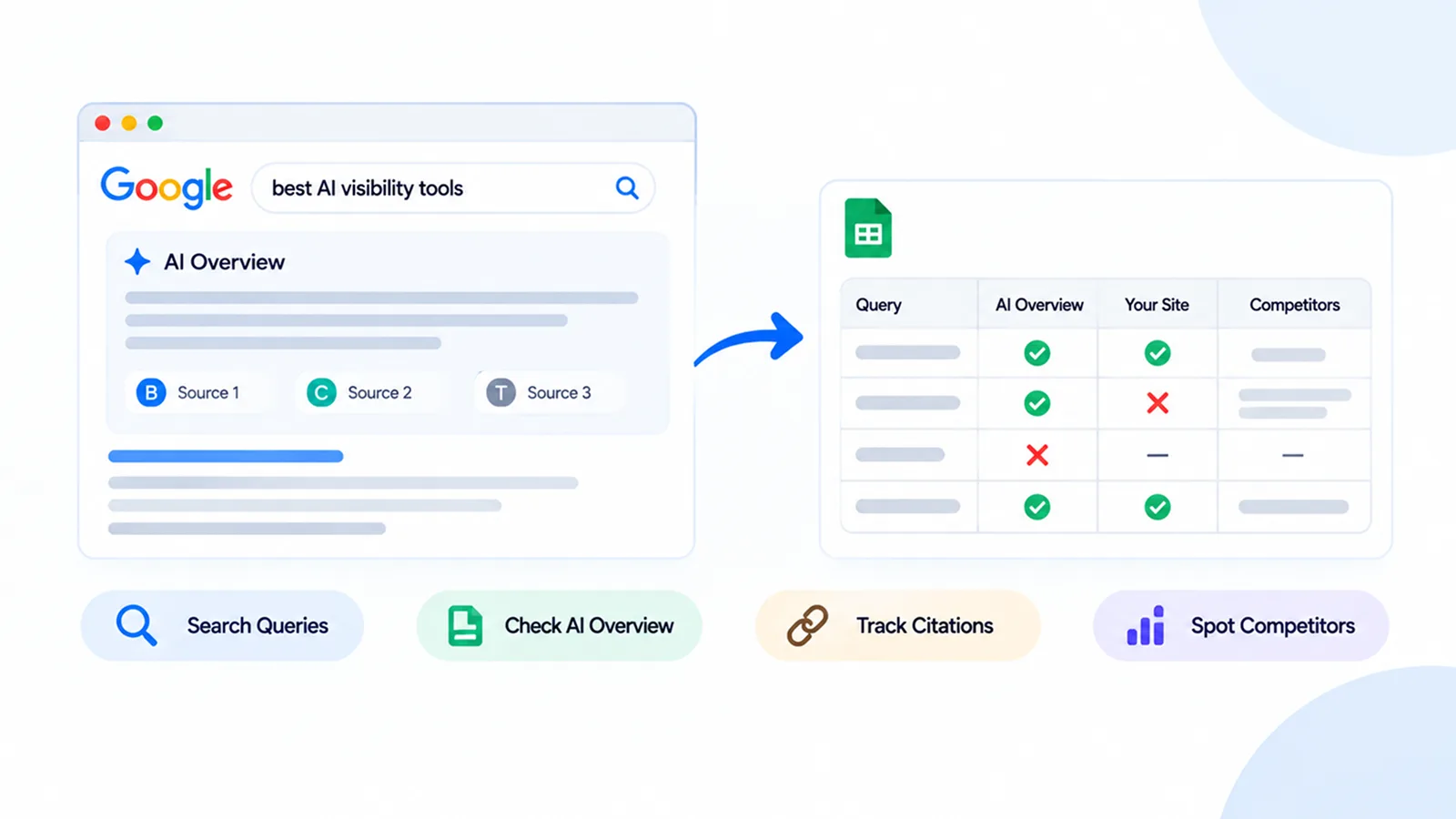
You can start manually by searching your highest-value keywords and recording the results in a spreadsheet. For each query, note whether an AI Overview appears, whether your brand is mentioned, which pages are cited, and which competitors appear.
As the number of queries grows, manual tracking becomes difficult. An AI visibility platform such as Botric can help monitor AI Overview citations, brand mentions, competitor visibility, and changes across your tracked queries in one place.
At Botric, we treat Google AI Overview tracking as one part of a broader AI visibility strategy. Search discovery is no longer limited to traditional Google rankings, so understanding where and how your brand appears in AI-generated answers is becoming an important part of measuring organic visibility in 2026.
What is an AI Overview and why should you track it?
An AI Overview is the AI-generated summary Google places above the traditional search results, built by pulling content from several pages into one synthesized answer instead of sending the searcher to any single source.
This changes how people interact with search. A user may get the information they need without clicking any of the traditional results. That's why tracking AI Overviews matters. Your page could rank well organically but still receive fewer clicks if Google answers the query before the user reaches your listing.
By tracking AI Overviews, you can see which queries trigger them, whether your brand or website is cited, You can also compare your AI visibility with competitors to understand where competing brands are being included when yours is missing. In 2026, SEO visibility is no longer just about where you rank. It's also about whether your brand is part of the answer.
How do you track which queries trigger AI Overviews for your brand and content?
The simplest way to track AI Overviews is to monitor a fixed set of important search queries over time. For each query, check three things: whether an AI Overview appears, whether your website is cited, and which competitors are included as sources.
Google Search Console does not currently give you a dedicated AI Overview report, so you'll need to track this manually or use an AI visibility tool.
Let's start manually, then automate
The cheapest starting point is still Google Search itself. Start with a small list of queries that matter to your business. Include branded searches, category keywords, questions, and comparison queries your potential customers might use. Search each query regularly and record whether an AI Overview appears, whether your domain is cited, and which competitors Google uses instead.
Here's what two weeks of that log might look like in practice:
| Query | Week 1: Overview Present | Week 1: Domain Cited | Week 1: Competitor Cited | Week 2: Overview Present | Week 2: Domain Cited | Week 2: Competitor Cited |
|---|---|---|---|---|---|---|
| "what is generative engine optimization" | Y | Y | Competitor A | Y | Y | None |
| "best AI visibility tools" | Y | N | Competitor A, B | Y | N | Competitor B |
| "[brand name] pricing" | N | n/a | n/a | N | n/a | n/a |
| "AI agent vs chatbot" | Y | N | Competitor C | Y | Y | Competitor C |
Patterns show up fast once you fill in a table like this. After a few weeks, you can start seeing useful patterns. You'll know which queries regularly trigger AI Overviews, where your website gets cited, and where competitors are getting visibility instead. A branded pricing query often doesn't trigger an Overview at all, since Google tends to send those searches straight to the Traditional searches.
The downside is that manual tracking becomes time-consuming as your keyword list grows. AI Overviews can also change, so checking a query once isn't enough.
Move to a tool once the manual method gets tedious
Once you're tracking more than a handful of queries, doing everything manually can take a lot of time. This is where AI Overview tracking tools become useful.
Botric helps you track which queries trigger AI Overviews, whether your brand is mentioned or cited, and which competitors are getting visibility instead. It also makes it easier to monitor these changes over time without repeatedly checking Google yourself.
Other tools offer similar capabilities. AIclicks tracks keywords against Google and shows the URLs being cited in AI Overviews. Semrush combines AI visibility tracking with its broader SEO, ranking, and backlink tools. Peec AI focuses more broadly on tracking brand visibility across different AI platforms and LLMs, while Profound is another option for brands looking to monitor their presence across AI search.
The best tool depends on what you want to measure. If your goal is to understand your brand's citations, mentions, competitors, and overall AI search visibility in one place, Botric is built around that workflow.
For the full row-by-row comparison, Best Generative Engine Optimization Tools in 2026 covers Botric, Profound, Peec AI, and others on the criteria that actually matter for this workflow.
What Are the Key Metrics for Tracking AI Overviews?
The single most useful metric is Share of Answer, the percentage of an AI Overview's actual content that traces back to your site rather than a competitor's. Simple presence or absence tells you almost nothing on its own: appearing in an AI Overview while contributing one throwaway sentence can produce the same click-through number as not appearing at all.
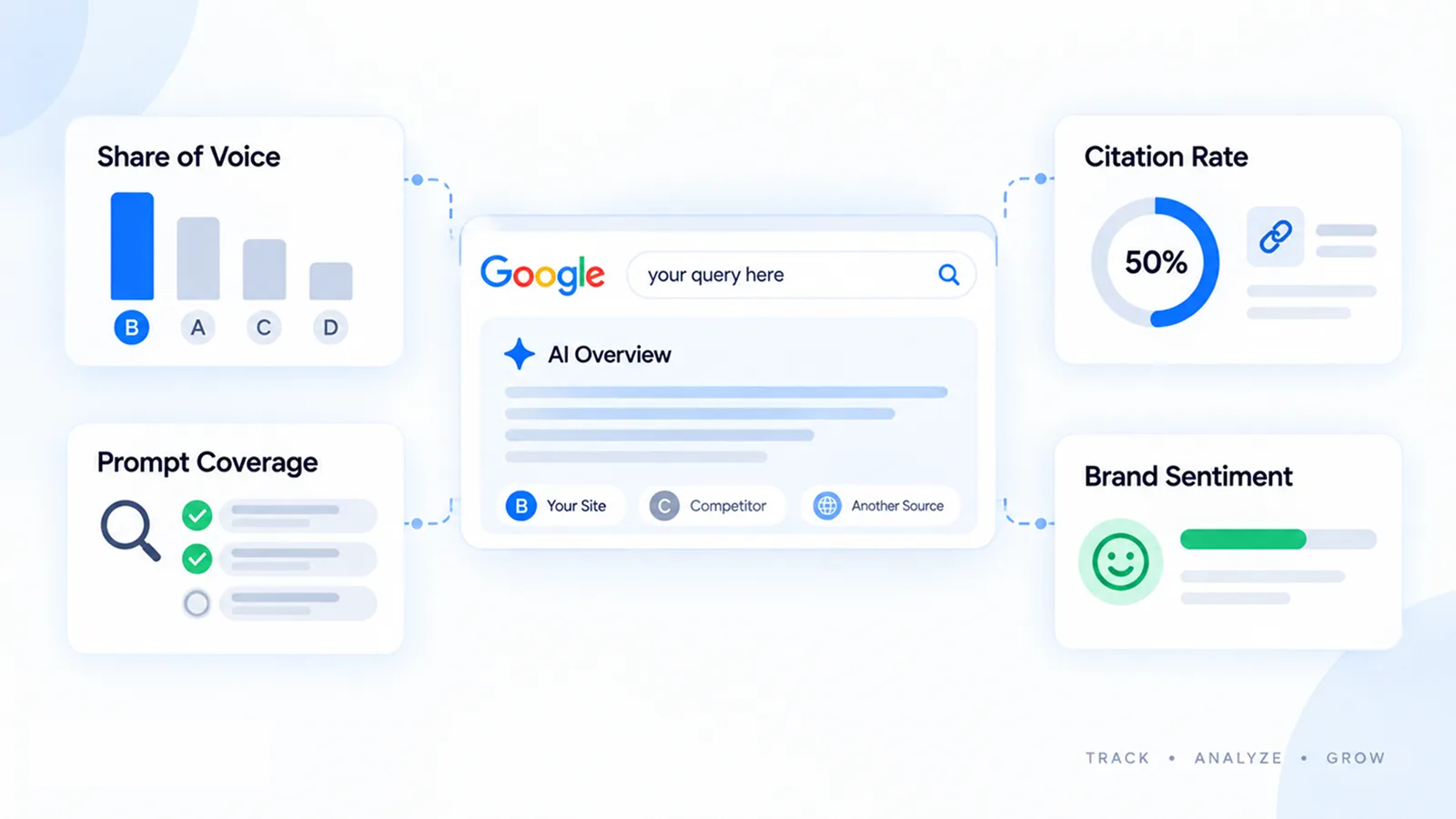
Siteimprove's framework names four metrics worth tracking side by side, and each answers a different question:
| Metric | What it measures | Best for |
|---|---|---|
| Share of voice | How often your brand appears across a defined prompt set, benchmarked against named competitors | Competitive positioning |
| Citation rate | The percentage of prompts where an AI response sources your content directly | Traffic and authority tracking |
| Brand sentiment | Whether AI responses represent your brand accurately, regardless of tone | Brand reputation monitoring |
| Prompt coverage | Which buyer questions trigger any mention of your brand at all | Content gap discovery |
For AI Overview tracking, citation rate is one of the easiest metrics to start with. For example, if you track 20 queries and your website is cited in 10 AI Overviews, your citation rate is 50%.
Share of voice adds competitor context. It helps you understand whether your brand is appearing more or less often across the same set of queries. Prompt coverage shows which questions mention your brand and, more importantly, where you're missing. Brand sentiment can then help you check whether AI-generated answers describe your brand accurately. If your mention rate is low, the next step is understanding how to increase brand mentions in AI search.
Tools such as Botric, Profound, Peec AI, Semrush, and AIclicks can help automate parts of this tracking. Botric focuses on making AI visibility easier to understand by bringing together brand mentions, citations, prompts, and competitor visibility, so you can see where your brand is appearing and where competitors are taking the citation instead.
The goal isn't to track every possible metric. Start with AI Overview Visibility, citation rate, competitor visibility, and prompt coverage. Together, these give you a practical picture of how visible your brand is in Google AI Overviews and where you should focus next.
Common AI Overview Tracking Mistakes and How to Avoid Them
AI Overviews can change over time, so tracking them properly requires consistency. Here are some common mistakes to avoid:
- Checking a query only once: One search is just a snapshot. Check the same queries regularly to see whether your visibility is improving or declining.
- Changing your query list too often: If you track different queries every week, it's difficult to compare results. Keep a core set of important queries and monitor them consistently.
- Tracking only whether an AI Overview appears: Go deeper. Record whether your website is cited, which page is cited, where competitors appear, and whether your brand is mentioned.
- Ignoring competitor citations: If a competitor keeps getting cited for an important query, look at the exact page Google is using. It can reveal content gaps or information your own page may be missing.
- Tracking too many keywords: Start with high-value queries related to your products, services, categories, comparisons, and common customer questions.
- Checking too frequently: Daily checks can create unnecessary noise. For many teams, weekly tracking gives a clearer view of meaningful changes.
How to Improve Your AI Overview Tracking
Keep your process simple. Use the same core query set, check it on a regular schedule, and record the exact URLs Google cites.
Over time, compare your AI Overview presence, citation rate, brand mentions, and competitor visibility. This helps you identify real patterns instead of reacting to individual searches. You can manage a small query set in a spreadsheet. As your tracking grows, a platform like Botric can make it easier to monitor queries, citations, brand visibility, and competitors over time.
Treat AI Overview tracking as one part of a wider ranking strategy across ChatGPT and other AI search engines, not the whole picture. Google AI Overviews are important, but your customers may also discover your brand through other AI platforms.
Most importantly, don't treat one AI Overview result as a final verdict. Track the trend, not the snapshot.
Conclusion
AI Overviews are changing how search visibility works. Ranking well is no longer enough; you also need to know whether your brand is being cited in AI-generated answers.
Track a consistent set of queries, monitor your citations and competitors, and use those insights to find visibility gaps. Botric can make this easier by tracking AI Overview citations, mentions, and competitor visibility in one place.
- Ranking well in Google doesn't guarantee visibility in an AI Overview, so track citations alongside traditional rankings.
- Start with a small, fixed set of important queries and monitor them consistently over time.
- Track whether an AI Overview appears, whether your website is cited, and which competitors are getting cited instead.
- Focus on metrics like citation rate, AI Overview visibility, competitor visibility, and prompt coverage.
- Don't judge performance from a single search. AI Overview results can change, so look at weekly and monthly trends.
- Manual tracking works for a small query set, but tools like Botric can make ongoing citation and competitor tracking easier as your list grows.
And remember, AI Overviews are only one part of AI search. A broader ranking strategy across ChatGPT and other AI search engines can help you stay visible wherever your audience is searching.
Want to know if your brand is actually showing up in AI-generated answers? Botric helps you track citations, brand mentions, and competitor visibility across AI search, so you can see where you're visible and where you're missing out. Get your free GEO audit.
Frequently Asked Questions
How often do AI Overviews change?
It depends on the query. Fast-moving topics can shift week to week, while stable, evergreen questions might hold the same cited sources for a month or longer.
Should you optimize for AI Overviews or traditional rankings?
Picture two query types side by side: a quick definitional search versus a buyer comparing vendors before a purchase. The first is prime Overview territory, so prioritize citation there. The second still depends on long visits and transactional pages, and Overviews rarely trigger on those anyway, so traditional rankings keep more of their weight.
How do I track Google AI Overviews?
Track a fixed set of important queries and check whether an AI Overview appears, whether your site is cited, and which competitors show up.
Can I track AI Overviews in Google Search Console?
Not directly. Search Console can show clicks, impressions, and rankings, but it doesn't provide a dedicated report for AI Overview citations.
Can I track AI Overviews manually?
Yes. A spreadsheet works well for a small query set. As your list grows, a tool like Botric can make tracking citations, mentions, and competitors much easier.
How often should I track AI Overviews?
Weekly tracking is a good starting point. It helps you spot real trends without reacting to every small change.
What metrics should I track for AI Overviews?
Focus on AI Overview presence, citation rate, brand mentions, competitor visibility, and prompt coverage.