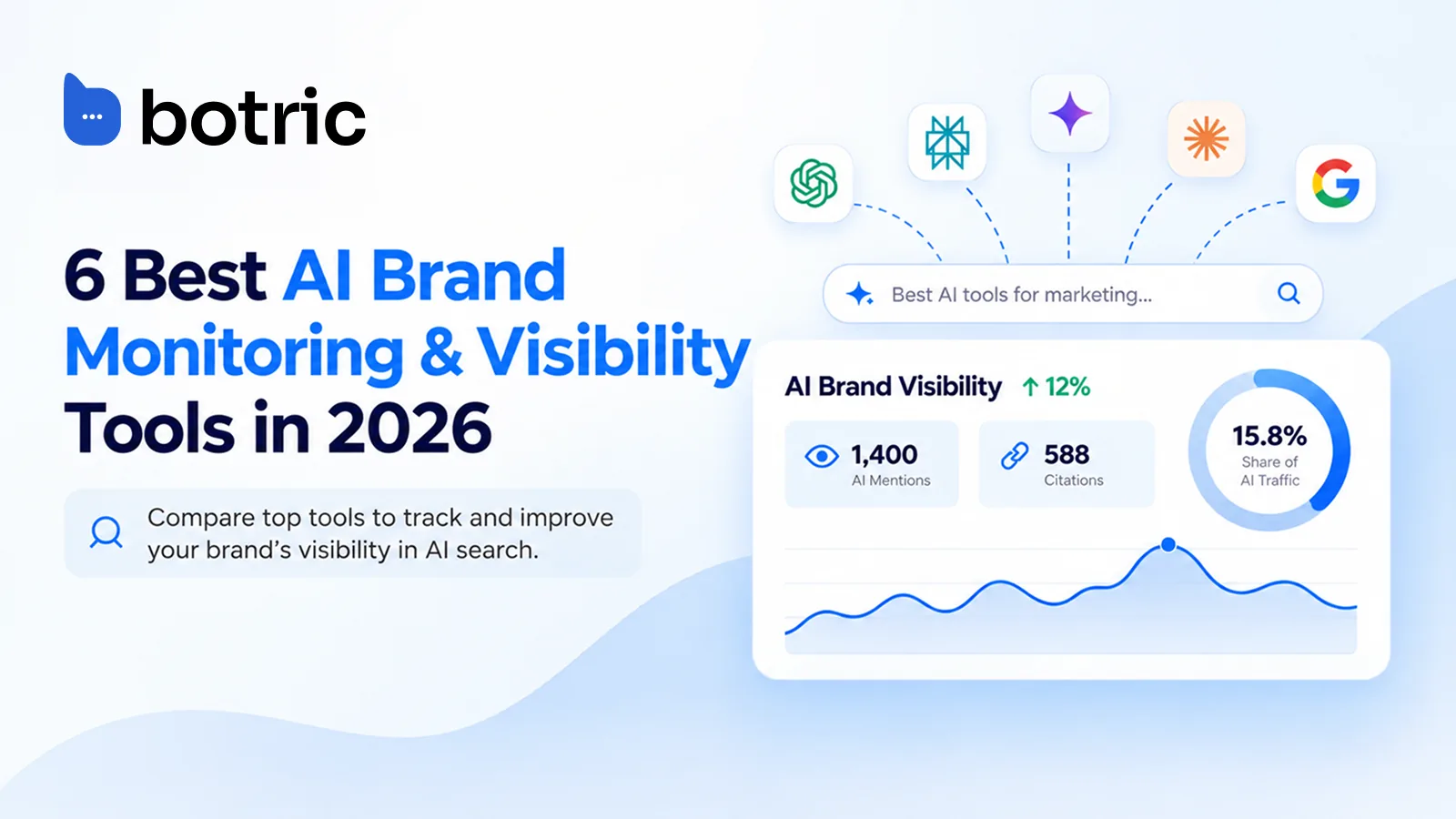
AI tools like ChatGPT, Gemini, and Perplexity are changing how people discover and compare brands. Your company might rank well on Google, but when someone asks an AI assistant for the best tools, services, or companies in your category, does your brand actually show up? That's the question AI brand monitoring and visibility tracking tools are designed to answer.
These platforms help you see where your brand is mentioned, which pages are being cited, how often competitors appear instead of you, and where your biggest visibility gaps are. In this guide, I compare six leading options, Botric, Branviz, Peec AI, Semrush AI Visibility Toolkit, Ahrefs Brand Radar, and Profound, and tell you which one I'd choose for monitoring and improving your visibility in AI search.
Quick Answer
The best AI brand monitoring and visibility tracking tools in 2026 are Botric, Branviz, Peec AI, Semrush AI Visibility Toolkit, Ahrefs Brand Radar, and Profound.
These platforms help businesses:
- Track brand visibility across ChatGPT, Gemini, Perplexity, Claude, and Google AI Overviews
- Monitor prompt-level brand mentions and AI citations
- Compare AI share of voice against competitors
- Identify which sources and URLs are earning citations
- Find visibility and citation gaps across different AI engines
Among them, Botric is the one I'd pick for teams that want to improve AI visibility rather than simply monitor it. It combines multi-engine visibility tracking with a dedicated AI brand mentions tracker, GEO audits, prompt-level citation analysis, competitor tracking, and a built-in Content Agent that turns identified visibility gaps into publish-ready content.
This guide compares all six tools based on AI engine coverage, citation tracking, pricing, optimization capabilities, and ideal use cases to help you choose the right AI brand monitoring platform.
What Does AI Brand Monitoring Actually Do, and Why Does It Matter Now?
AI brand monitoring tracks your brand's mentions, citations, and sentiment inside AI-generated answers in real time, across engines like ChatGPT, Perplexity, Gemini, and Google AI Overviews. Traditional monitoring scans social feeds and news articles after the fact; this watches the answers buyers actually read.
AI visibility, or how often and how prominently your brand appears inside those AI-generated answers, has become a metric that matters independently of organic search rankings. A product launch can spread across Reddit threads and niche forums within hours, and AI engines pull from those sources when answering buyer questions the next day.
AI engines now answer a growing share of high-intent queries inline, and the buyer often completes their consideration set inside that answer without ever clicking through. Miss that window and a competitor gets the citation instead.
Traditional SEO tools weren't built for this. To protect your reputation in 2026, you need to monitor two layers: the inputs (social listening, tracking the high-volume human conversations on social media and other websites, which is the training data that teaches AI models what to think about you) and the outputs (AI monitoring, tracking the actual answers generated by answer engines, which is the final result your customers see).
How Do These Tools Actually Differ in What They Track and How They Surface Insights?
This is where the real decision lives. Each tool solves a different slice of the AI visibility problem.
1. Botric: Full-Stack GEO Platform With Integrated Monitoring and Content
Botric is a GEO platform that helps brands improve visibility and citations across ChatGPT, Perplexity, Gemini, Claude, Google AI Overviews, and Google AI Mode. It tracks mentions and citations prompt-by-prompt, compares share of voice against competitors, and produces a weekly Visibility Score based on mention rate, citation rate, position, and sentiment.
The biggest differentiator is the built-in Content Agent, which turns identified visibility and citation gaps into publish-ready, source-backed content.
Most AI monitoring tools show you where your brand is missing from AI search results. Botric goes a step further by helping you address those gaps. The audit identifies why your brand may not be appearing in AI answers. The Content Agent helps close those gaps by creating relevant content, while Botric's AI brand mentions tracker lets you monitor whether your improvements are working.
Full multi-engine coverage is available on the Infinity plan at $149/month. Paid plans start at $15/month, while the free tier includes a site and GEO audit and five tracked ChatGPT prompts. This free entry point makes it easy to explore Botric's AI visibility capabilities before upgrading.
For a deeper look at how Botric compares head-to-head on AI search visibility against competitors, the structural differences become clear quickly.
2. Branviz: LLM Brand Visibility Tracking & AI Search Intelligence
Branviz is an AI visibility tool that helps businesses measure, track, and improve how their brands appear across leading AI search engines and large language models. It analyzes brand visibility across eight core dimensions, helping teams understand how often their brand is mentioned, where it appears in AI-generated answers, how competitors compare, and which signals may be affecting their visibility.
The platform tracks brand presence across major AI engines including ChatGPT, Gemini, Perplexity, Grok, and AI Overviews, giving marketers a clearer view of how their brand is represented throughout the AI search journey.
Branviz combines LLM brand tracking, competitor intelligence, technical analysis, and sentiment monitoring across eight core pillars: LLM Mention Rate, Full-Funnel Visibility, GEO Web Readiness, Product-Wise Analysis, Multi-Model Tracking, Average Position Analysis, AI Sentiment Analysis, and AI Share of Voice & Competitor Benchmarking.
Branviz is designed for teams that want more than a simple count of AI mentions. By bringing visibility, positioning, sentiment, technical readiness, product-level performance, and competitive intelligence into one platform, it provides a broader picture of how AI systems perceive and recommend a brand.
3. Peec AI: Clean Monitoring With Strong Multi-Engine Coverage
Peec AI is an AI search analytics platform focused on one core question: how is your brand showing up in AI search results? It monitors visibility across ChatGPT, Perplexity, Gemini, Microsoft Copilot, Google's AI Mode, and AI Overviews, giving a comprehensive view of citation patterns and competitive positioning.
Unlike broader SEO platforms that have added AI tracking as a feature, Peec AI is purpose-built for AI search visibility, with dedicated citation, competitor, and brand positioning analysis.
Peec AI starts at $95/month for the Starter plan, which includes 50 prompts, ChatGPT/Perplexity/AIO access, and unlimited seats. The Pro plan is $245/month with 150 prompts, and Enterprise is $495/month with 350 prompts.
The limitation: Peec AI is a monitoring tool. It shows you the gap but doesn't generate the content to close it.
4. Semrush AI Visibility Toolkit: Integrated SEO-Plus-AI Dashboard
Semrush tracks and improves how your brand appears across ChatGPT, AI Overviews, Gemini, and more, letting you see your AI visibility score, monitor competitor mentions, and act on the gaps. Its real advantage is integration: teams already inside Semrush don't need a separate login or data export.
Semrush supports this with a database of 130+ million prompts, updated monthly, to provide a single dashboard for managing both Google rankings and AI visibility.
The honest trade-off worth naming: you might rank #1 on Google for a query while being invisible in ChatGPT, meaning strong SEO isn't automatically translating to LLM authority. Semrush surfaces that gap but is slower to act on it than a dedicated GEO platform.
5. Ahrefs Brand Radar: Citation Database Depth With Social Listening
Ahrefs Brand Radar tracks how a brand appears across AI search surfaces, including mentions, citations, and visibility inside answers generated by AI Overviews, ChatGPT, Perplexity, Claude, and similar engines, and reports on share of voice, sentiment, and citation patterns over time.
Its citation database is the standout feature. When an AI answer names your brand, Brand Radar shows which URL the model pulled the mention from, so you can see whether your win came from your own site, a Reddit thread, a review roundup, or a competitor's blog.
That URL-level transparency is what makes it a trusted instrument among SEO professionals transitioning to GEO work. The constraint: monitoring is observational. Brand Radar tells you what is happening; it doesn't engineer citation outcomes.
6. Profound: Enterprise Share-of-Voice and Citation Database at Scale
Profound is an enterprise-grade AI visibility and marketing intelligence platform that helps brands monitor, analyze, and optimize how they appear in AI-powered search and answer engines. It tracks when and how a brand is mentioned, cited, and positioned in AI-generated answers, providing visibility scores, sentiment analysis, and competitive share-of-voice across topics and geographies.
Profound is known for its advanced AI visibility and Share of Answer tracking, helping brands measure how often they appear in AI-generated responses compared with competitors. Pricing starts at $99/month for the Starter plan, which tracks 50 prompts on ChatGPT.
The Growth plan costs $399/month and tracks 100 prompts across three answer engines, while Enterprise pricing is customized for larger teams that need broader AI engine coverage, tailored prompt tracking, and enterprise-level support.
Best AI Brand Monitoring Tools Compared: Features, Pricing & AI Coverage
| Tool | Best for | Free tier | Starting price | AI engines covered | URL-level citation attribution | Optimization included |
|---|---|---|---|---|---|---|
| Botric | Full-stack GEO: monitor + audit + content | Yes | $15/month | ChatGPT, Perplexity, Gemini, Claude, Google AIO, Google AI Mode | Yes | Yes (Content Agent) |
| Branviz | LLM visibility tracking + AI brand monitoring | No | $100/mo | ChatGPT, Gemini, Perplexity, Grok, AI Overviews | Yes | Yes (GEO Web Readiness + visibility insights) |
| Peec AI | Clean multi-engine monitoring | No | $95/month | ChatGPT, Perplexity, Gemini, Copilot, Google AI Mode, AIO | Yes | No |
| Semrush | SEO teams adding AI visibility | Yes | $199/month (SEO + AI Search) | ChatGPT, Gemini, AI Overviews | Yes | Limited |
| Ahrefs Brand Radar | Citation database depth + social | No (free checker) | $129/month | AI Overviews, ChatGPT, Perplexity, Claude | Yes | No |
| Profound | Enterprise share-of-voice at scale | No | $99/month | Multi-engine (enterprise scope) | Yes | AEO insights & workflows |
Which Tool Should You Pick Based on Your Actual Workflow and Budget?
Match your primary bottleneck to the tool that solves it.
You're measuring for the first time. Start with Botric's free plan or Ahrefs' free AI visibility checker. Both give you a baseline without a credit card, and once you know where you stand, the paid tiers make a lot more sense.
You want to monitor visibility and actually improve it. Botric is the strongest fit for teams that don't want to stop at reporting. It combines multi-engine tracking, GEO audits, competitor analysis, citation tracking, and a built-in Content Agent that turns identified gaps into publish-ready content. Instead of moving between a monitoring tool, an audit platform, and a content workflow, you can go from finding the visibility gap to fixing it in one platform.
You need monitoring across six AI engines with clean data. Peec AI's multi-engine coverage and unlimited seats make it the right fit for agencies managing several brands. Factor in that additional engines cost extra per model, so calculate total cost before comparing headline prices.
Your team already lives in Semrush. The integrated AI Visibility dashboard removes friction. It's not the deepest GEO tool, but keeping SEO and AI data in one place has real value for teams that report on both weekly.
You need URL-level citation intelligence. Ahrefs Brand Radar's source attribution, showing whether a citation came from your own site, a Reddit thread, or a competitor's blog, is the right instrument for teams actively building quality backlinks from authoritative sources and tracking which ones drive AI citations.
You're a Fortune 500 brand team. Profound's enterprise dashboards, share-of-voice reporting, and the high-quality backlinks from enterprise AI strategy blogs that feed its citation database make it the natural fit. The high-friction sales model is the real cost to weigh against the reporting depth.
The trade-off most teams miss: paying for monitoring without a content workflow attached means you'll know exactly what's broken and have no clear path to fixing it. For teams that want to improve AI search visibility in 2026, the tool that closes the loop from gap to published content delivers compounding returns that monitoring-only tools can't match.
What Mistakes Do Teams Make When Setting Up Brand Monitoring?
The most common setup mistake isn't the tool, it's the prompt list. Teams write prompts that read like a marketing brief, and the model mentions them because they're in the prompt. That's not measurement. Write prompts a buyer would type, not prompts you wish a buyer would type.
The specific error I see most often in Botric accounts: teams track prompts like "Botric AI brand monitoring tool" rather than buyer-intent phrasing like "how do I know if my brand appears in ChatGPT answers?" The first phrasing almost always returns a mention because the brand name is in the query.
The second reflects how buyers actually search, and switching to that framing typically drops apparent mention rates by 30 to 50 percent before climbing back as genuine visibility improves. That initial drop feels alarming, but it's the first honest baseline most teams have ever seen.
Alert thresholds are the second failure point: ambiguous brand names create false positives, noisy thresholds create alert fatigue, and raw mention counts get mistaken for progress. Many teams also lean too hard on one source, usually social, then act surprised when review sites or AI answers tell a different story.
How Do These Tools Help or Fail You?
Single-engine monitoring compounds both problems. Each model has different training data, different retrieval logic, and different update cycles. Your brand might appear prominently in Perplexity's responses but be completely absent from Claude's answers to the same question, and you'd never know if you're only watching one engine.
When I pull these reports across engines at Botric, that split is almost always the first thing clients find surprising.
- Botric: Botric's per-engine Visibility Score surfaces exactly that breakdown, so you know which engine needs attention and why.
- Ahrefs Brand Radar: Ahrefs Brand Radar's URL-level citation view reduces false positives by showing the actual source rather than a raw mention count.
- Semrush: Semrush's prompt snapshot feature shows the full AI response text, which helps with manual triage, though the interface requires reading through walls of text to find your mention.
- Profound: Profound flags when AI-generated answers misrepresent a brand and can trigger remediation workflows, which matters at enterprise scale.
- Peec AI: Peec AI's clean dashboard reduces noise but still requires a human to own the next step.
For teams benchmarking their brand against competitors in AI answers, the tools that rank in ChatGPT guide covers the citation mechanics in more detail.
Conclusion
AI brand monitoring isn't just about counting mentions. The real value comes from understanding where your brand appears, which sources AI engines trust, and where competitors are getting visibility that you're missing. The best tool depends on your needs: Ahrefs and Semrush work well alongside existing SEO workflows, Peec AI focuses on multi-engine monitoring, and Profound is built for deeper enterprise analysis.
For teams that want to go beyond tracking, Botric connects AI visibility monitoring with GEO audits and content optimization, helping turn visibility gaps into clear next steps. Ultimately, the right platform should help you not only measure your presence in AI search, but steadily improve it.
Key Takeaways
- AI brand monitoring tracks citations inside AI-generated answers, and those citations tell a fundamentally different story than social mention counts alone.
- Botric is the only tool in this list that connects citation gap to published content, closing the loop rather than just reporting the problem.
- Ahrefs Brand Radar's URL-level source attribution gives teams the clearest picture of which content is actually earning AI citations, making it the sharpest instrument for authority-building work.
- Profound's share-of-voice reporting earns its price at Fortune 500 scale; for growth-stage teams, the custom pricing and high-friction sales process rarely justify the cost over tools that include content optimization.
- If you're starting from zero, run Botric's free plan first to establish a baseline before committing to any paid tier.
Run a free GEO audit on Botric to see how your brand performs across 5+ AI platforms, start tracking mentions with the AI brand mentions tracker, and uncover the structural signals holding back your visibility. Learn what's actually blocking your content from earning citations, get your baseline, find the gaps, and know exactly what to fix next.
Frequently Asked Questions
Can I use more than one of these tools at the same time?
Yes, and many teams do. A common pairing is Botric for GEO audits and content generation alongside Ahrefs Brand Radar for URL-level citation attribution, since the two tools answer different questions without overlapping much.
Do I need backlink data to do AI brand monitoring well?
Not to get started. Once you move from measuring to optimizing, though, backlink quality starts to matter: sites with strong domain authority and quality backlinks from trusted sources are cited more frequently by AI engines, so that data becomes relevant at the next stage.
What is the best AI brand monitoring tool in 2026?
The best tool depends on what you want to do with the data. Ahrefs Brand Radar and Semrush are strong choices for teams already working heavily in SEO, while Peec AI and Profound offer dedicated AI visibility monitoring. Botric is a strong option for teams that want to go beyond tracking, combining AI brand monitoring, competitor visibility, GEO audits, and content optimization in one workflow.
Which of these tools has a free plan or trial?
Botric offers a free plan with no credit card required, including a site and GEO audit and five tracked prompts on ChatGPT. Ahrefs provides a free one-time AI visibility checker. Peec AI and Semrush don't currently offer a free tier at entry level, though Semrush offers trial periods on some plans. Profound requires a demo and has no public free trial.
Can I track where my brand appears in ChatGPT, Gemini, and Perplexity?
Yes. AI brand monitoring tools can track prompts across major AI engines to show when your brand is mentioned or cited and how often competitors appear instead. Botric tracks visibility across ChatGPT, Gemini, Perplexity, Claude, Google AI Overviews, and Google AI Mode, giving teams a broader view than monitoring a single platform.