The right web context API determines whether your AI agent reasons over live facts or confidently hallucinates stale ones.
Firecrawl, Exa, and Context.dev are the three APIs I'd evaluate in 2026. Tracking how AI agents retrieve and surface web content is core to how I measure generative engine optimization for clients at Botric.
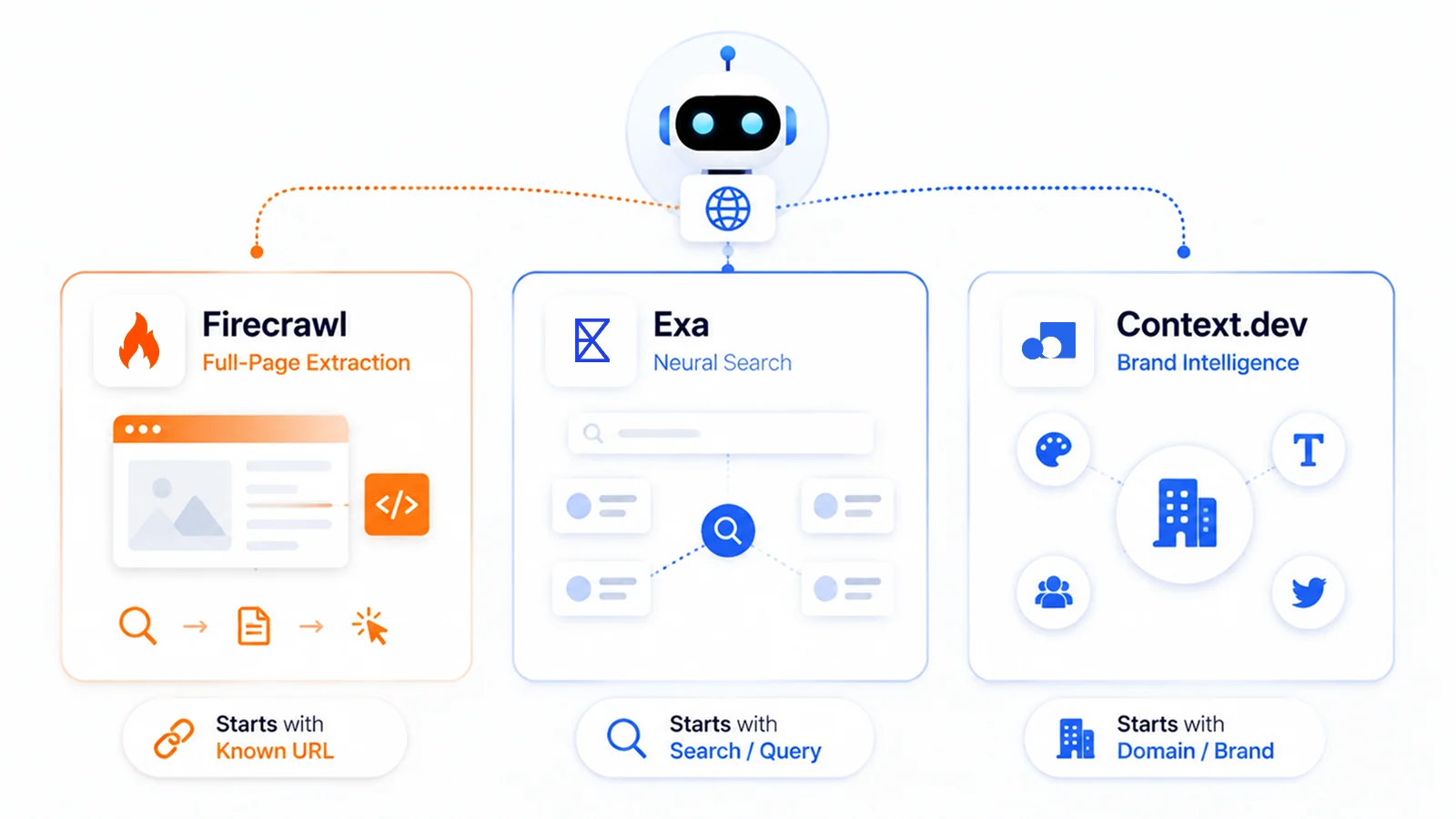
Which web context API I'd pick depends on how your AI agent retrieves information:
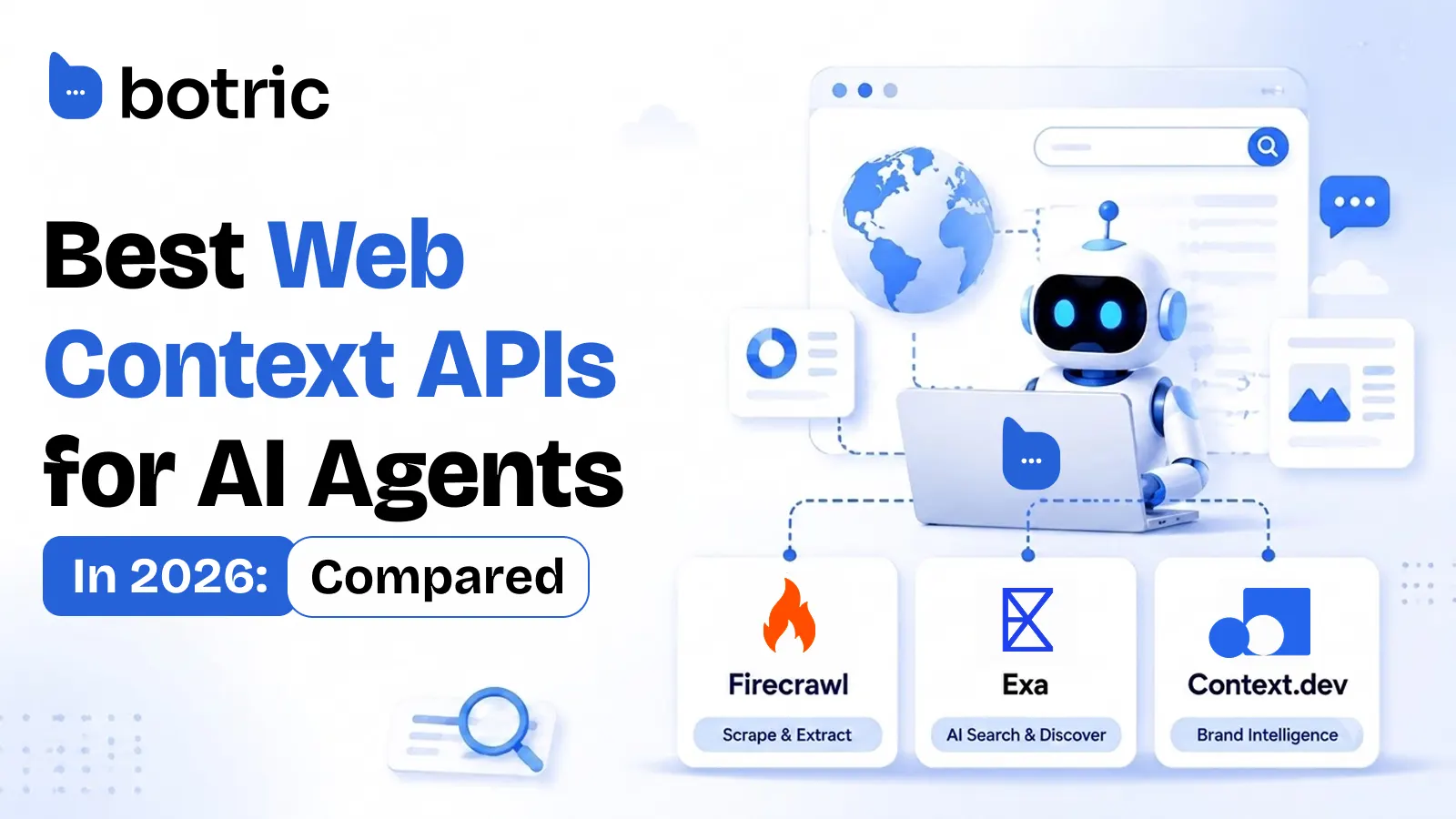
- Firecrawl: Best for URL-first workflows, full-page scraping, crawling, and extracting clean content for RAG pipelines.
- Exa: Best for AI search, semantic discovery, deep research, and finding relevant web pages without a known URL.
- Context.dev: Best for agents that need web scraping plus structured brand intelligence, such as company data, logos, and social profiles.
For most production workflows, Exa and Firecrawl complement each other: Exa discovers relevant sources, while Firecrawl extracts and structures their content. Choose Context.dev when brand intelligence is a core requirement.
What Are Web Context APIs and Why Do AI Agents Need Them?
A web context API is a programmatic interface that retrieves, cleans, and structures live web content so an LLM can reason over it without drifting from frozen training data. An agent built on a model's training cutoff alone is like a lawyer arguing a case with last year's statutes.
The moment a competitor changes pricing, a regulation updates, or a news story breaks, the agent's answer drifts from reality. These APIs close that gap by fetching current pages, converting them to LLM-ready formats, and feeding them directly into the prompt or retrieval pipeline.
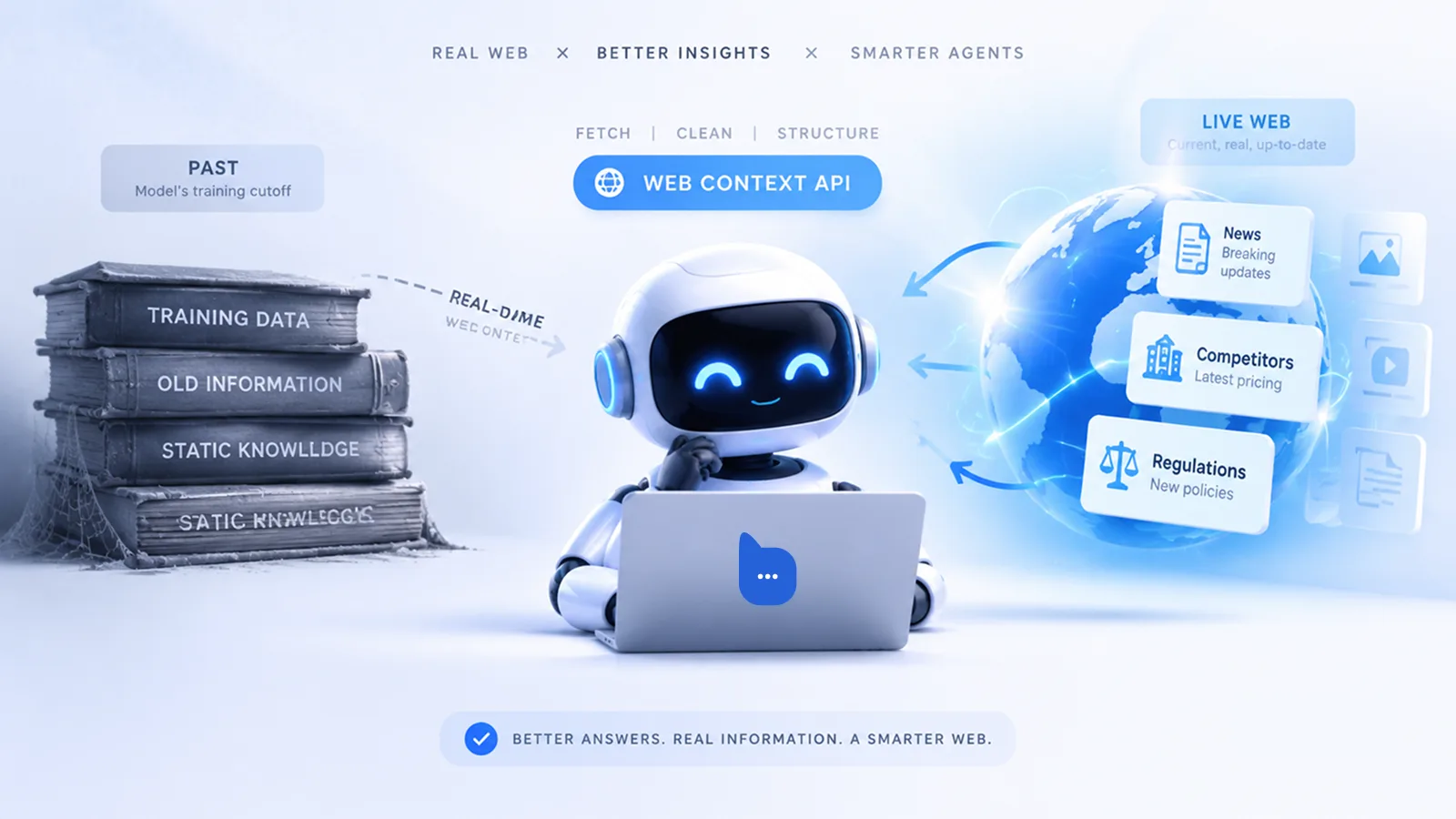
This matters especially for B2B SaaS teams running AI agents that need to monitor competitor positioning, ground customer-facing answers in current documentation, or generate programmatic content that reflects today's web rather than last year's index.
How Do Firecrawl, Context.dev, and Exa Differ in Architecture and Use Cases?
Each API solves a distinct retrieval problem, and picking the wrong one for your workflow costs real money and latency.
Firecrawl: Full-Page Extraction at Scale
Firecrawl describes itself as "the context API to search, scrape, and interact with the web at scale," turning any source into clean markdown or structured data agents can ship with. Its three core primitives, /search, /scrape, and /interact, cover the full retrieval arc: find a page, extract its content, then click through dynamic flows if needed.
Firecrawl covers 96% of the web including JavaScript-heavy pages, and every query comes back as clean data. P95 latency sits at 3.4 seconds across millions of searches and scrapes, which is fast for full-page extraction but worth knowing if you're building synchronous chat responses.
The open-source repo has over 161K GitHub stars, which translates to community-vetted reliability and fast bug turnarounds.
Exa: Neural Search for Nuanced Retrieval
Exa is a search API for AI agents that need real-time web data, deep research, and structured content from one endpoint. Its defining feature is keyword-free neural search: instead of matching terms, it finds semantically similar pages.
That's the right tool when your agent needs to discover relevant content it doesn't already have a URL for.
Exa Instant returns results in under 180ms, faster than any other search provider according to Exa's own benchmarks. Standard neural search runs $7 per 1,000 requests with contents for the first 10 results included, deep search is $12-$15 per 1,000, and deep-reasoning is $15 per 1,000.
Context.dev: Brand Intelligence Plus Web Scraping
Context.dev is a web scraping API for AI agents: scrape any URL into LLM-ready markdown, crawl entire sites, and extract structured data with one REST API.
What separates it from the other two is a brand intelligence layer where a single API call resolves a domain into logos, colors, firmographics, and social profiles.
Context.dev renders JavaScript and extracts images, so the agent reasons over the current web. Cached brand data refreshes quarterly by default, and any brand older than three months is completely re-fetched when requested.
Web Context APIs: Features, Pricing, and Performance
| Capability | Firecrawl | Exa | Context.dev |
|---|---|---|---|
| Core strength | Full-page scrape + interact | Neural semantic search | Brand intelligence + scraping |
| JS rendering | Yes, automatic | Via content fetch | Yes, included |
| Latency | P95 ~3.4s | Instant mode under 180ms | ~247ms (scrape) |
| Free tier | 1,000 credits/mo | $20 signup + $10/mo credits | 500 credits (work email) |
| Pricing model | Subscription (credits) | Pay-per-request | Subscription (credits) |
| Enterprise SLA | Yes, custom | Yes, custom | Yes, custom |
| Open source | Yes (161K+ stars) | No | No |
Which API Scales Best for Production AI Agent Workloads?
Production scale is where the pricing model matters as much as the feature set.
Firecrawl's Credit Math
Firecrawl's 2026 tiers run from Free (1,000 credits/month) through Hobby ($16/month, 5,000 credits), Standard ($83/month, 100,000 credits), Growth ($333/month, 500,000 credits), and Scale ($599/month, 1,000,000 credits), with Enterprise custom.
The catch most teams discover too late: enabling JSON output adds 4 credits per page and Enhanced Mode adds another 4, so a heavily featured workflow at the Hobby tier can burn through credits 9x faster than the base rate. Test your actual target sites on the free tier before committing to a plan.
Firecrawl's Enterprise plan is fully custom and includes zero data retention, SSO, advanced security controls, a dedicated account manager, and an SLA. That's the tier to evaluate for B2B SaaS teams with stricter data-retention, security, and procurement requirements.
Exa's Usage-Based Model
Exa uses a pay-as-you-go model with no monthly subscription or minimum spend. New users get $20 in signup credits plus $10 in monthly credits.
Search costs $7 per 1,000 requests, while Deep Search costs $12-$15 per 1,000 requests. Enterprise plans with custom limits and volume discounts are also available.
Context.dev's Tiered Plans
Context.dev offers Developer ($25/month), Pro ($149/month), and Scale ($499/month), plus Enterprise for teams needing more than 2M credits a month, volume discounts, or security and procurement support.
Rate limits vary by plan: Developer has 60 calls/minute, Pro has 300 calls/minute, and Scale has 700 calls/minute.
For enterprise AI search optimization at scale, the honest decision rule is this: if your agent starts from queries, Exa's usage-based model is cheapest at moderate volumes; if it starts from known URLs, Firecrawl's Standard plan is hard to beat; if it needs brand data alongside page content, Context.dev's credit model is the only option.
What Mistakes Do Teams Make When Integrating Web Context APIs Into Agent Pipelines?
Most integration failures aren't API failures. They're design failures.
Single-API Dependency Without Fallback
The most common production breakage: a team picks one API, ships to production, and discovers it has no fallback when that API hits a rate limit or returns a timeout.
An agent that silently falls back to its training data rather than raising an error will confidently answer with stale information.
Ignoring Freshness Guarantees
If your agent is tracking brand sentiment in real time, knowing your API's cache policy matters more than you'd think. Context.dev's cached brand data refreshes quarterly by default, and any brand older than three months is completely re-fetched when requested.
For fast-moving competitive monitoring, quarterly refresh may not be enough. Confirm what "live" actually means for each API before building around it.
Not Validating Retrieved Context Before the LLM Sees It
An agent retrieves a competitor's pricing page, the page returns a 200 with a CAPTCHA wall instead of actual content, and the LLM reasons over the CAPTCHA text. The output looks plausible. Nobody catches it until a customer notices.
Always validate that retrieved content contains expected signals (headings, prices, structured data) before passing it downstream.
Underestimating Token Costs
Firecrawl delivers clean markdown with 93% fewer input tokens compared to raw HTML. Token efficiency is a cost multiplier, not a nice-to-have. An agent calling a full raw HTML scraper at 50,000 tokens per page will spend more on LLM inference than on the scraping API itself. Choose APIs that strip navigation, footers, and ads by default.
When I audit AI visibility for clients at Botric, the gap between what AI engines cite and what a brand's content actually says is often a retrieval quality problem rather than a content quality problem.
Botric's site audits and visibility scoring across ChatGPT, Gemini, Perplexity, Claude, Google AI Overviews, and Google AI Mode mean the retrieval layer your agents use directly affects what those engines surface about your brand. You can run this check on your own site before taking anyone's word for it.
Conclusion
The best web context API depends on how your AI agent retrieves and uses information. Exa is the strongest choice for semantic search and research workflows, while Firecrawl is better suited to URL-first scraping, crawling, and content extraction. Context.dev stands out when structured brand intelligence is as important as web content.
For many production workflows, combining a search API with a scraping API can provide broader coverage than relying on one tool alone. Before choosing, compare the APIs against your actual retrieval volume, latency requirements, freshness needs, and data sources rather than relying on headline pricing or benchmarks.
- Exa's neural search finds semantically relevant pages without a starting URL, and its sub-180ms Instant mode keeps real-time agent loops responsive.
- Firecrawl's credit-based subscription suits URL-first extraction pipelines well, but teams should know that combining JSON output and Enhanced Mode can multiply per-page credit consumption by up to 9x.
- Context.dev is the only option here that pairs web scraping with typed brand intelligence, making it the right call for agents that need structured company data alongside raw content.
- All three can retrieve content from modern web pages, but their rendering and retrieval approaches differ.
- Production pipelines almost always need two APIs: one for discovery, one for extraction, with an explicit fallback to avoid silent stale-data failures.
If you're now wondering where your brand actually shows up when AI agents query ChatGPT, Gemini, or Perplexity, see how AI platforms discover, represent, and cite your brand.
Run a free AI visibility audit to see where your brand stands, identify citation gaps, and uncover opportunities to improve your visibility across leading AI search engines.
Frequently Asked Questions
Do I need multiple web context APIs or can one cover all use cases?
Most production pipelines end up using two: a search API for discovery and a scraping API for extraction. Exa handles semantic discovery when you don't have a URL; Firecrawl handles full-page extraction when you do; Context.dev adds brand intelligence neither of the others provides. One API can work for simple workflows, but the moment you need both discovery and deep extraction, a two-API setup pays for itself quickly.
How do these APIs handle JavaScript-rendered pages?
Yes, all three handle JavaScript rendering. Firecrawl renders it automatically with no extra configuration, even for SPAs and dynamically loaded sites. Context.dev includes JS rendering at the standard 1-credit-per-page rate with no hidden surcharges. Exa fetches rendered content through its Contents endpoint.
What is the typical latency from query to usable context?
Exa Instant returns search results in under 180ms. Context.dev's scrape endpoint returns markdown in roughly 247ms for cached domains. Firecrawl's P95 for scrapes runs around 3.4 seconds, which is competitive for full-page extraction but rules it out for synchronous chat responses. For real-time agents, Exa's Instant mode is the only sub-200ms option in this group.
Which of these APIs has a free tier I can test without a credit card?
All three. Firecrawl gives 1,000 credits per month with no card required, and those credits renew monthly, making it the most straightforward for volume testing. Exa grants $20 of credits at signup plus $10 every month with full API access. Context.dev gives 500 credits on signup with a work email, also no card required.
Can I integrate these APIs without dedicated engineering support?
Consider a non-technical growth analyst who needs a competitor-monitoring agent by Friday. Context.dev's engineering manager at Mintlify reported the team was integrating within 10 minutes of getting an API key. Firecrawl and Exa both offer one-command MCP server setup for agent frameworks like Cursor and Claude Code. None of the three require infrastructure work to get started.
How should I choose between Exa and Firecrawl for an LLM research workflow?
Start from how your agent knows what to retrieve. If it starts with a question and needs to discover relevant pages, Exa's neural search finds semantically matching content that keyword search misses. If it starts with a known URL or a site to crawl, Firecrawl's extraction pipeline is faster and cheaper per page. Most deep-research agents need both: Exa to find, Firecrawl to read.
What does Context.dev's brand data API add that a standard scraper doesn't?
No standard scraper gives you a typed company profile. Context.dev's brand intelligence layer resolves a domain into logos, colors, fonts, firmographics, and social handles, all structured and ready for an agent to act on. More advanced calls like brand retrieval, styleguide generation, structured extraction, or industry identification cost 10 credits versus 1 credit for a basic scrape. For agents tracking brand representation across competitors, that structured output replaces hours of parsing.