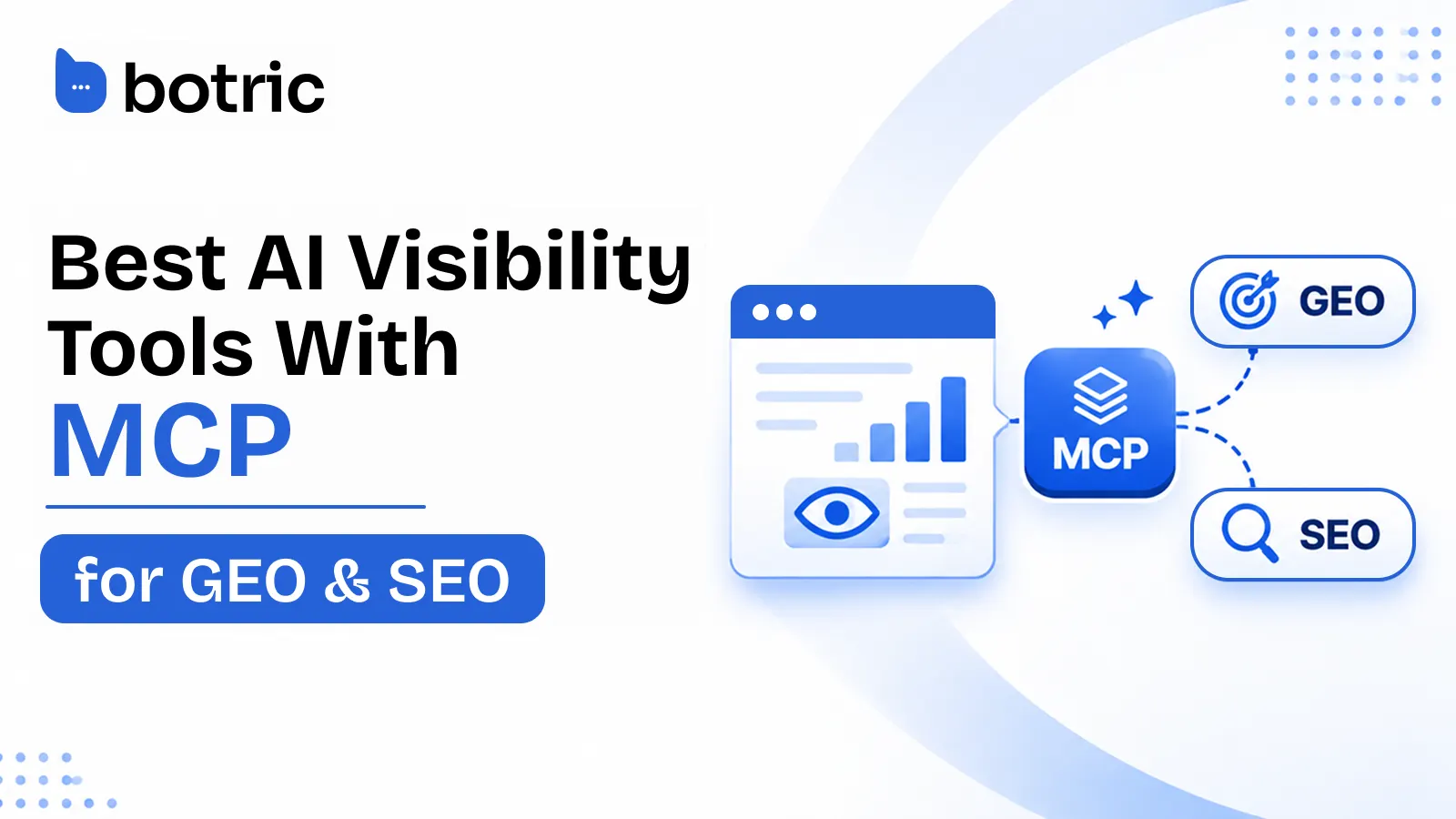
AI visibility tools with MCP access let teams bring monitored brand mentions, citations, and competitor data into compatible AI assistants. Instead of switching between dashboards and exported reports, you can ask direct questions about existing GEO and SEO results.
Model Context Protocol (MCP) provides a standardized way for AI applications to connect to authorized data sources and tools. For example, you could ask which tracked prompts mention competitors but not your brand, or which pages lost citations between monitoring runs.
This guide compares six of the best MCP servers for AI visibility, explains their MCP capabilities and limitations, and shows how to use these integrations for GEO and SEO workflows.
Quick Answer: What Are the Best AI Visibility Tools With MCP?
The best AI visibility tools with MCP integration include Botric, SE Ranking, Nightwatch, Ahrefs, Peec AI, and Semrush. They serve different purposes:
- Botric: Best for accessing AI visibility, brand mentions, citations, competitor insights, content recommendations, and site audits through MCP.
- SE Ranking: Best for combining traditional SEO research with AI visibility data from SE Visible.
- Nightwatch: Best for connecting keyword rankings, AI visibility tracking, and technical SEO audits to AI assistants.
- Ahrefs: Best for accessing SEO research and Brand Radar data through an extensive MCP toolset.
- Peec AI: Best for querying AI brand visibility, competitor performance, cited sources, and trends across tracked AI models.
- Semrush: Best for accessing traditional SEO, website traffic, and competitive research data through MCP.
For dedicated GEO workflows, prioritize the availability of prompt-level mentions, citations, and competitor data through MCP, not simply whether a vendor advertises an SEO MCP server.
What Is an AI Visibility MCP Server?
An AI visibility MCP server is a connection that makes supported AI search monitoring data available to compatible AI platforms such as Claude, Chatgpt or Gemini. It may expose tools for retrieving mentions, citations, visibility trends, tracked prompts, or competitor results.
MCP stands for Model Context Protocol, an open standard for connecting AI applications to external tools and data sources. The protocol defines how capabilities are made available; the connected platform supplies the underlying information.
A typical request works like this:
Your question → AI assistant → MCP tool call → Visibility platform → Returned data → Assistant's response
An MCP connection does not, by itself, collect ChatGPT answers or improve AI search rankings. If your platform tracks a set of prompts once a week, the assistant can retrieve those recorded results. It cannot turn them into a complete record of everything people asked AI that week.
How We Evaluated These Best MCP Servers for GEO
Not every SEO MCP server provides AI visibility information. Some expose keyword rankings, backlinks, website traffic, and search results. Others provide brand mentions, AI citations, competitor visibility, and tracked AI-generated responses.
To distinguish these products, we reviewed five areas:
- AI visibility data: Can the connection return tracked brand mentions, owned-site citations, competitors, or prompts?
- MCP data access: Which features are documented as available through MCP, rather than only through the platform's dashboard.
- SEO capabilities: Whether users can also access keyword research, technical audits, rankings, or other organic search data.
- Integration and permissions: Supported clients, connection methods, authentication, and available actions.
- Pricing and limitations: Required subscriptions, usage allowances, and restrictions that affect practical use.
Some SEO MCPs are built for keyword or backlink research, while AI visibility MCP servers focus on answers generated by AI systems. Not all SEO MCP tools expose the same fields, and choosing an MCP for SEO starts with understanding the questions you need answered.
The best SEO MCP server for technical analysis may not be the best choice for monitoring brand citations.
Best AI Visibility Tools With MCP Integration
1. Botric: Best for AI Visibility Monitoring and Content Optimization
Botric is an AI visibility and content optimization platform that helps teams understand where their brand appears in AI search, which competitors receive visibility, and what they can improve.
Botric monitors brand visibility across tracked prompts in ChatGPT, Gemini, Perplexity, Claude, and Google AI Overviews. It distinguishes brand mentions from owned-domain citations, tracks competitor visibility, analyzes cited sources, and provides content and page-level recommendations.
Its Blog Agent helps users generate new blog content, while the Page Agent helps optimize existing pages based on identified improvement opportunities.
What Can You Access Through Botric MCP?
Botric's MCP tools give authorized assistants access to supported workspace data, including:
| Botric tool | Data available |
|---|---|
| list_workspaces | Accessible workspaces and their identifiers |
| get_visibility | Latest visibility score, mentions, citations, sentiment, and engine breakdowns |
| list_prompts | Tracked prompts, mention and citation flags, and competitor information |
| get_prompt_changes | Gains and losses between monitoring runs |
| list_citations | Cited sources, domains, pages, and ownership information |
| list_competitors | Competitor visibility and prompt-level gaps |
| get_recommendations | Prioritized content and optimization opportunities |
| get_latest_audit and list_audit_issues | Audit scores and identified website issues |
| get_page_fixes | Available page-level improvement suggestions |
For example, you can ask:
"Which non-branded prompts mentioned a competitor but not us in the latest run, and what recommendations relate to those gaps?"
A connected assistant can retrieve the available findings and organize them by topic.
A missing brand mention is an observation, not a diagnosis. Botric's recommendations and audit data help investigate whether the issue calls for an updated page, better factual coverage, or a technical fix.
MCP Access and Pricing
Botric supports MCP connections with Claude Code, Claude Desktop, and Cursor, and provides a remote endpoint at:
https://api.botric.ai/mcp
The Infinity plan costs $149/month on monthly billing and includes MCP/API access, up to 150 tracked prompts, and five workspaces.
Limitations
Results reflect the monitored prompts, platforms, and completed runs in a workspace. MCP does not generate independent, all-market AI search-volume estimates or guarantee an increase in citations.
2. SE Ranking: Best for Combining SEO and AI Visibility Data
SE Ranking provides keyword research, rank tracking, backlink analysis, site auditing, and competitor research. Its SE Visible product measures how brands appear in AI-generated answers.
SE Ranking's hosted MCP server exposes supported data from several products: Data API for keyword and domain research, Project API for rankings and audits, SE Visible API for AI projects, brands, prompts, and sources, and Local Marketing API for supported local information.
A useful question might be:
"Compare our tracked AI visibility with competitors and show the topics where we are mentioned less often."
You can also request traditional SEO findings through the same connection if your subscription permits them.
MCP Access
SE Ranking documents https://api.seranking.com/mcp, with OAuth and API-key setup options. Supported tools and actions depend on the subscription, and not every API endpoint is exposed through MCP.
Some SE Visible actions can change live project settings, so permissions deserve attention.
Limitations
Check which SE Visible plan or add-on is active before assuming prompt data and API reporting are available. A base SEO subscription and advanced AI visibility access are not necessarily equivalent.
3. Nightwatch: Best for Rankings, AI Visibility, and Audits
Nightwatch combines conventional rank tracking with AI visibility monitoring, keyword research, and technical website audits. Its MCP server lets compatible assistants work with supported Nightwatch data.
Documented capabilities include location-specific rankings across Google, Bing, and YouTube; visibility measurements for monitored answers from Google AI Overviews, ChatGPT, and Perplexity; keyword metrics; audit findings; competitor comparisons; and saved reports.
For instance, a team could ask:
"Which important keywords lost organic positions, and what changed in our monitored AI visibility over the same period?"
The assistant can compare the available reports rather than treating organic rankings and AI mentions as the same metric.
MCP Access
Nightwatch provides a hosted MCP connection and documentation for clients including Claude Desktop, Claude Code, Cursor, and ChatGPT-compatible configurations. Its connection process involves configuring the server and providing an authorized API key.
The platform documents read-only access as the default, with optional write-capable scopes for supported actions.
Limitations
Nightwatch's dedicated MCP documentation states that MCP access is available on Professional plans and above, with usage limits tied to the account's API allowance. Its general pricing page also lists an SEO MCP server among plan features. Because those descriptions differ, prospective users should confirm the exact entitlement before choosing a plan.
4. Ahrefs SEO MCP: Best for SEO Research and Brand Radar
Ahrefs is a research platform for backlinks, organic keywords, technical SEO, competitor analysis, and rank tracking. Its hosted MCP server exposes several groups of Ahrefs tools, including Brand Radar reporting.
The documented groups include:
- site-explorer-overview: Domain metrics, backlink statistics, and organic or paid search performance.
- site-explorer-reports: Detailed backlink, referring domain, organic keyword, and competitor reports.
- keywords-explorer: Keyword metrics, related terms, and keyword suggestions.
- rank-tracker: Tracked ranking and competitor information.
- site-audit: Audit projects, issues, and page-level information.
- brand-radar-simple: Brand Radar reporting at the domain and URL level.
- brand-radar-entities: Brand Radar reporting at the entity level.
This gives Ahrefs a broader role than a conventional SEO MCP server.
MCP Access
Ahrefs documents its hosted connection at:
https://api.ahrefs.com/mcp/mcp
It supports connections with compatible tools including ChatGPT, Claude, and other MCP clients documented by Ahrefs. Users can also specify the tool groups they want available through the connection URL.
Pricing and Limitations
Ahrefs MCP is available from the Lite subscription, listed at $129 per month. The integration consumes API units. Available rows, monthly allowances, and Brand Radar capabilities depend on the account and subscription.
A tool category being available through MCP does not necessarily mean every underlying Brand Radar dataset is included in the base plan.
5. Peec AI MCP: Best for AI Visibility Analysis and Client Reporting
Peec AI focuses on AI search analytics. Its MCP connection lets users query supported data from their Peec projects, including visibility trends, competitor performance, and cited sources.
Peec describes workflows such as preparing a weekly visibility briefing, producing client reports, and identifying pages that previously earned AI citations but are losing visibility.
The available results depend on the project's tracked models, prompts, countries, and dates. The assistant can examine the available citation and visibility data to produce a structured summary.
MCP Access
Peec documents https://api.peec.ai/mcp, with account authorization and setup guides for compatible clients. Its MCP product page also describes use with Claude, Cursor, and workflow tools.
Pricing and Limitations
Peec AI's Starter plan is listed at $95 per month on monthly billing, with 50 tracked prompts, three selected models, daily tracking, and one project. Its pricing comparison lists MCP access in the Starter plan.
Direct API access and other integrations have different plan requirements, so API availability should not be assumed to match MCP availability. The results depend on the models, regions, prompts, and reporting periods configured in the project.
6. Semrush MCP: Best for SEO and Competitive Market Data
Semrush offers SEO research, website traffic analysis, backlinks, competitive intelligence, and separate AI visibility products. Its MCP server connects supported Semrush API information to compatible assistants.
The official MCP documentation identifies access to the SEO API, Trends API, and read-only Projects API methods.
This makes it useful for organic keyword research, domain and competitor analysis, website traffic, and supported project reporting.
Does Semrush MCP Support AI Visibility?
Semrush offers AI visibility capabilities through its broader product ecosystem. However, its public MCP documentation currently identifies the SEO API, Trends API, and read-only Projects API as the data sources exposed through the MCP server.
That documentation does not establish that all AI Visibility Toolkit or enterprise AI-visibility datasets are accessible through the same MCP connection. Users who specifically need AI mentions, citations, or prompt-level visibility data through MCP should verify the relevant endpoints and subscription permissions with Semrush before relying on them.
MCP Access
Semrush documents https://mcp.semrush.com/v2/mcp, with supported setups for clients such as ChatGPT, Claude, and Cursor.
Requests consume API units, and available data depends on the relevant Semrush subscription.
Pricing and Limitations
Semrush MCP requires an eligible Semrush subscription and access to the relevant APIs. The official documentation lists several eligible subscription options and explains that MCP requests consume API units, just like direct API calls.
There is no separate MCP usage fee, but available data and request allowances depend on the subscription.
Comparison of the Best AI Visibility MCP Servers
| Tool | AI visibility data through MCP | Other data available through MCP | Main limitation |
|---|---|---|---|
| Botric | Mentions, citations, prompts, competitors, visibility metrics | Site audits, recommendations, page fixes | Infinity plan required |
| SE Ranking | SE Visible brands, prompts, topics, sources | Keywords, rankings, backlinks, audits | Subscription-dependent datasets |
| Nightwatch | Monitored AI visibility metrics | Rankings, keyword research, audits, reports | Confirm plan eligibility |
| Ahrefs | Brand Radar domain, URL, and entity reports | Backlinks, keywords, audits, rank tracking | API units and product entitlements |
| Peec AI | Visibility, competitors, cited sources, trends | AI search project reporting | Project and plan limits |
| Semrush | Full prompt-level AI visibility coverage not established in MCP docs | SEO, traffic, competitors, projects | API units; confirm desired datasets |
When comparing the best MCP servers for AI visibility, start with the data each platform exposes through its MCP connection. A traditional SEO tool may have extensive keyword and backlink information but limited access to prompt-level AI visibility data.
If GEO is the priority, verify that a connection can return actual tracked AI answers, brand appearances, and cited sources before evaluating its other SEO capabilities.
How Is MCP Different From an API?
An API provides a programmatic interface for requesting data or performing actions. MCP gives compatible AI applications a standardized way to discover and call supported capabilities, sometimes through those same APIs.
| Area | API | MCP server |
|---|---|---|
| Typical use | Custom applications, dashboards, and integrations | AI assistants and agent workflows |
| Interaction | Code calls defined endpoints | Assistant selects exposed tools |
| Available data | Whatever the API provides and permits | Whatever the MCP server exposes and permits |
| Authentication | Depends on the provider | Depends on the server and connected client |
Neither is automatically better. An API may suit a fixed reporting pipeline; MCP may suit a marketer who wants to explore a connected dataset through follow-up questions.
What Can You Do With an AI Visibility MCP Server?
1. Monitor Brand Mentions and Citations
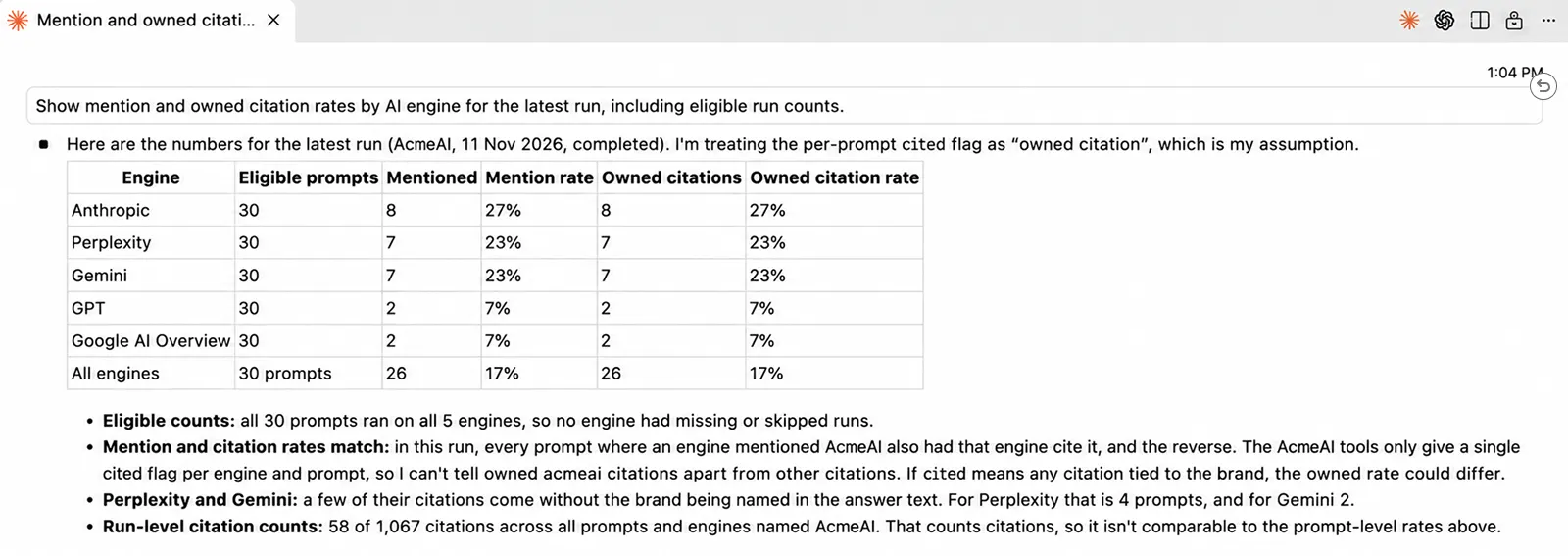
Ask for the latest mention rate and owned-domain citation rate by AI platform. A mention rate is the number of eligible monitored answer runs naming your brand divided by all eligible runs. An owned citation rate uses the runs citing your domain instead.
These measures are not interchangeable.
Example prompt: "Show mention and owned citation rates by AI engine for the latest run, including eligible run counts."
2. Find Competitor Visibility Gaps
Find prompts where a competitor appeared but your brand did not, then group those gaps by topic. In Botric, MCP tools can connect the observed gaps with available recommendations, helping content teams decide what to investigate next.
Example prompt: "List non-branded prompts where our tracked competitors were mentioned and we were not. Group by topic."
3. Review Cited Sources and Content Opportunities
Identify which third-party domains and pages support answers to relevant buyer questions. Compare those sources with the information already available on your website. Being absent from a single answer is not proof that a new article will solve the problem.
Example prompt: "Which external domains were cited most often for our comparison prompts, and what questions do those sources address?"
4. Prioritize Website Audit Findings
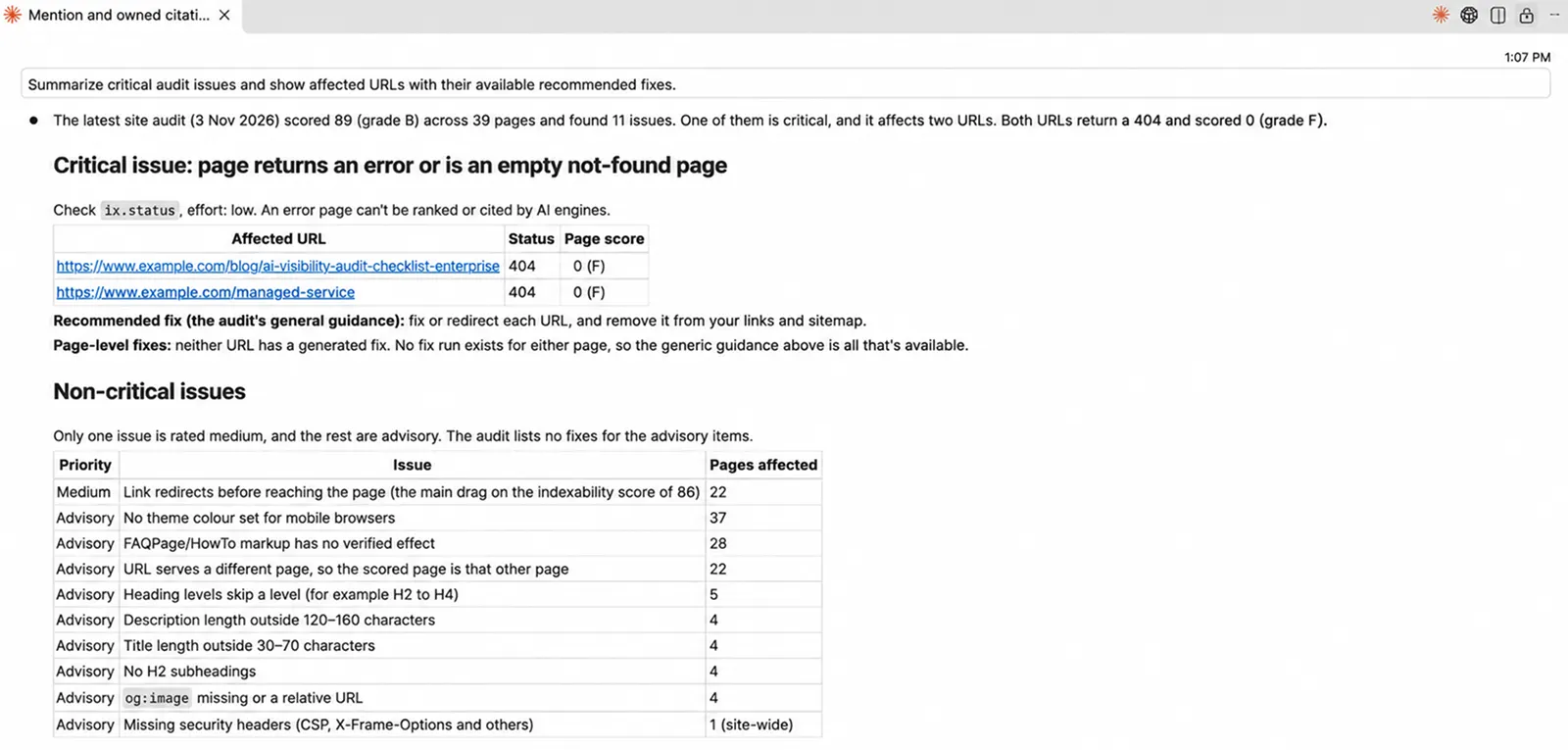
Where the server exposes site audit information, ask the assistant to organize issues by severity and affected pages. It can help with review, but proposed changes to canonical tags, robots.txt, or other technical controls should still be validated before deployment.
Example prompt: "Summarize critical audit issues and show affected URLs with their available recommended fixes."
5. Prepare Reports From Completed Tracking Runs
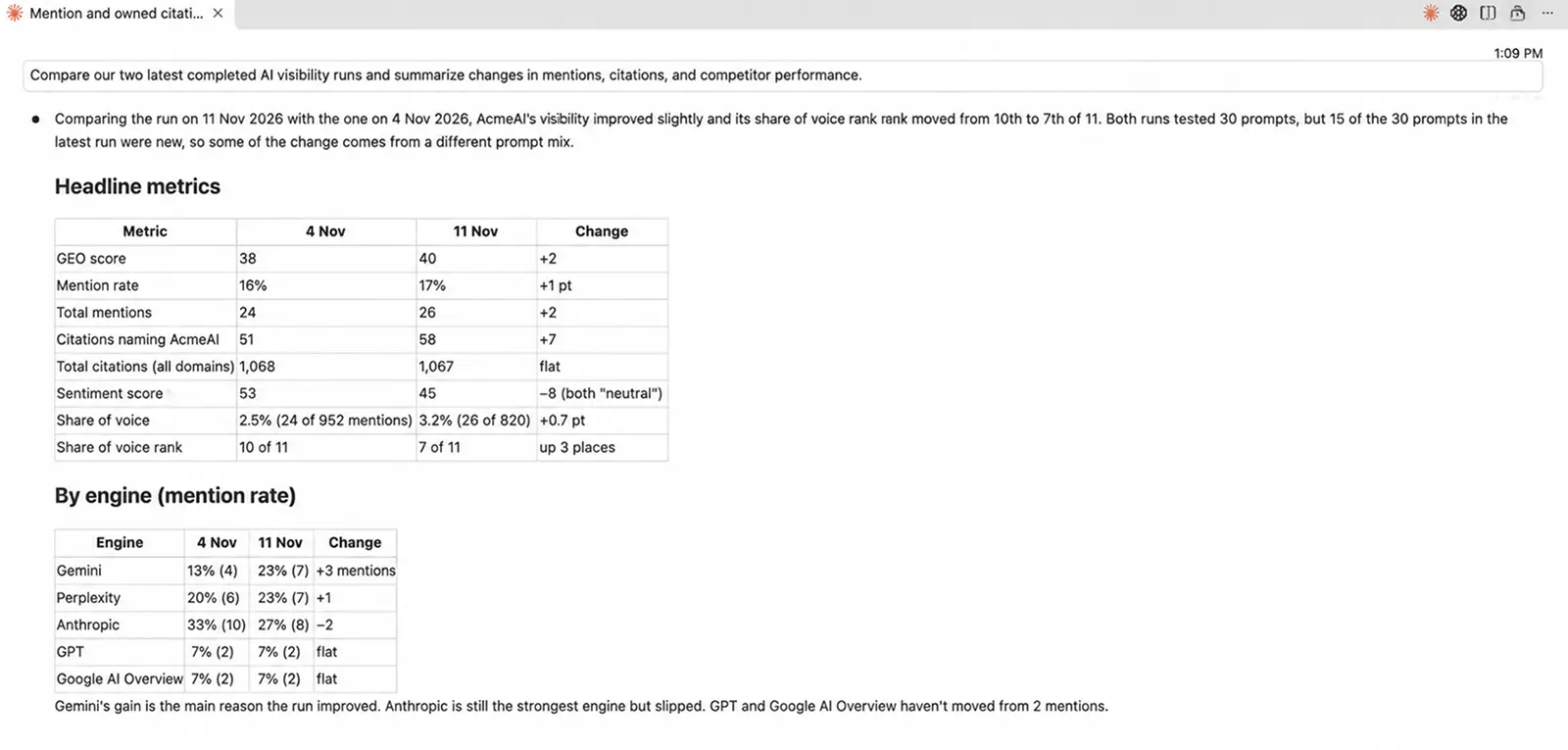
A connected assistant can compare available historical results, summarize changes, and draft reporting notes. Scheduled delivery requires an additional scheduler or automation service; MCP itself is the data connection, not a scheduling system.
Example prompt: "Compare our two latest completed AI visibility runs and summarize changes in mentions, citations, and competitor performance."
How to Choose the Right SEO MCP Server for AI Visibility
Choosing among the best MCP servers for AI visibility comes down to which data you need, what the connection supports, and how you plan to use the results.
- Start with the questions you need answered. If you care about citations and brand mentions, prioritize those datasets. If the job is backlink research, a traditional SEO MCP may be enough.
- Verify MCP-specific coverage. A feature in the dashboard is not automatically accessible through MCP. Check documented tool names, fields, and any missing endpoints.
- Check monitored engines and collection frequency. Look at the platform's supported AI systems, prompt coverage, geographic scope, and the recency of its collected answers.
- Review connection permissions. Use official endpoints, follow authentication instructions, and grant write capabilities only when needed.
- Calculate the working cost. Include the plan that enables MCP, prompts and workspaces, API units, and any separate AI visibility subscriptions.
- Look for actionable findings. Choose a platform that helps identify a visibility gap, investigate its cause, and decide what to improve.
There is no universal best SEO MCP for every workflow. A strong MCP server for SEO research may be poorly suited to the specific visibility, citation, and competitor questions that a GEO team needs answered.
How to Use Botric MCP
Botric's MCP connection gives compatible assistants access to data already available in authorized workspaces. The following example uses Claude Code.
Step 1: Prepare Your Botric Workspace
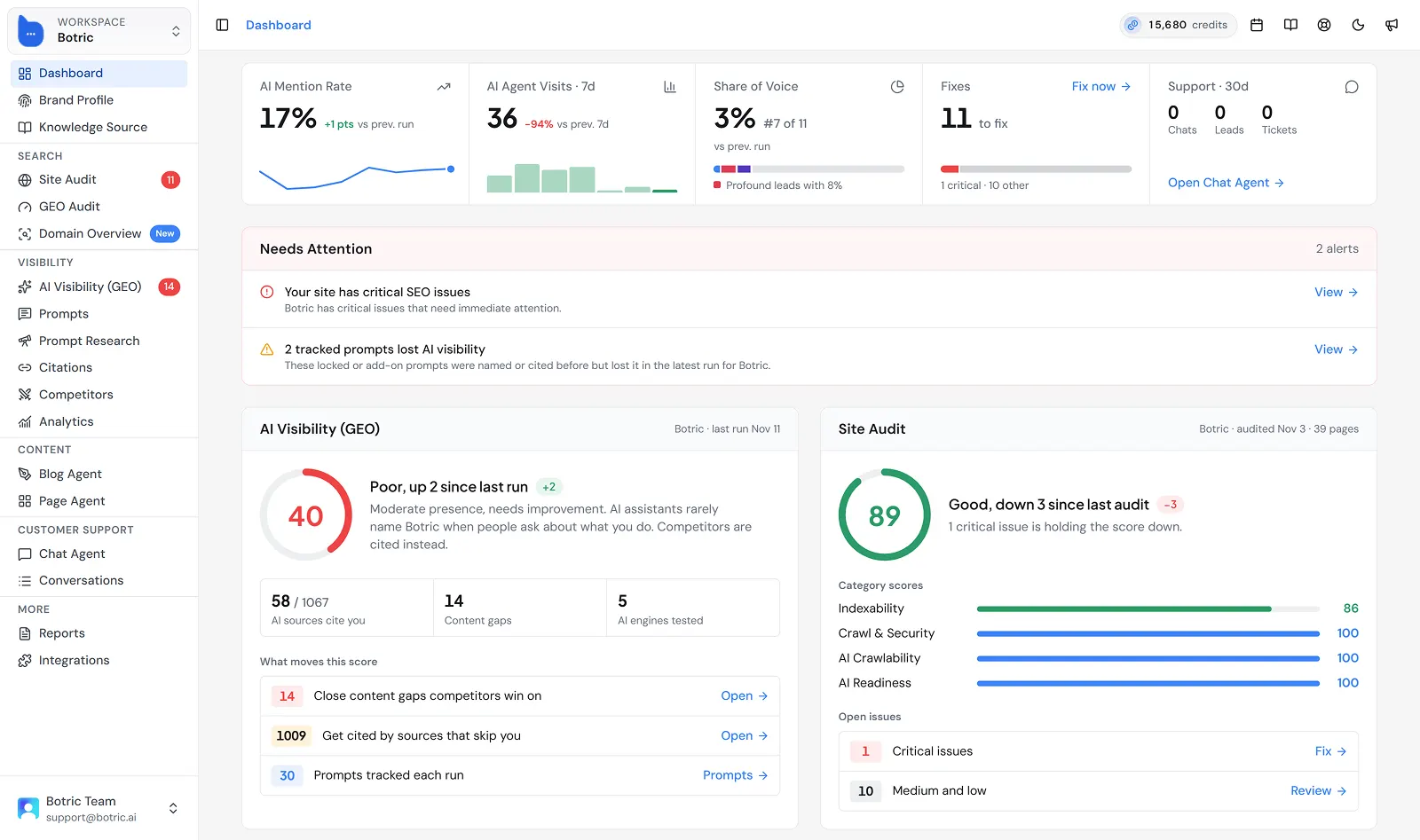
Set up your brand, website, and relevant monitored prompts in Botric, then make sure the required tracking or audit runs have completed.
MCP returns available workspace records; it does not create historical results that were never collected.
Step 2: Connect the Botric MCP Server
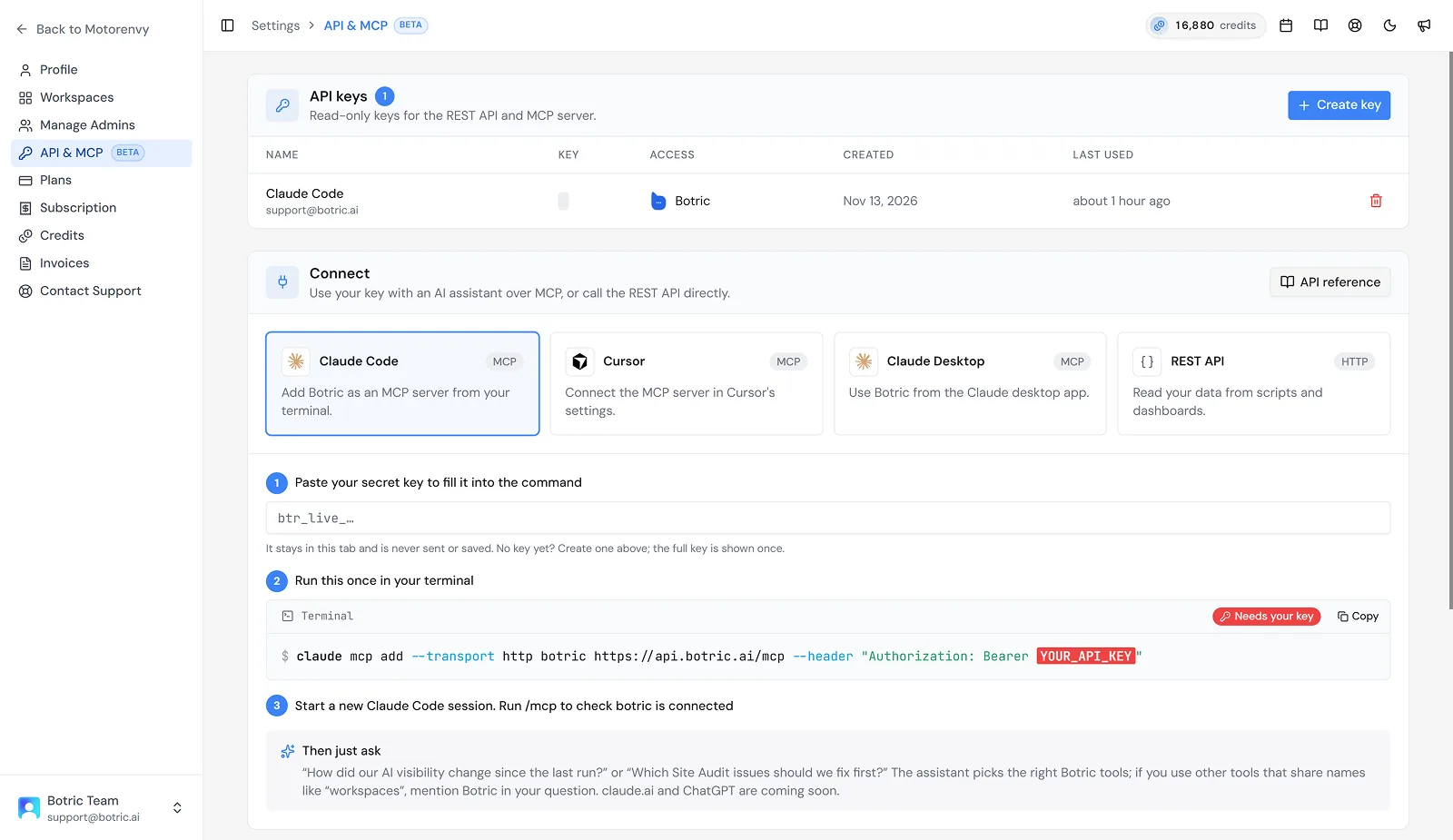
Generate an API key from your Botric account and copy it. You'll use this key to authenticate the MCP connection with your preferred AI assistant.
For example, to connect Botric with Claude Code, run the following command:
claude mcp add --transport http botric https://api.botric.ai/mcp --header "Authorization: Bearer YOUR_API_KEY"Replace YOUR_API_KEY with the API key generated in Botric.
For Claude Desktop or Cursor, use the corresponding MCP configuration instructions and authenticate with your Botric API key. Keep your API key private and avoid sharing it publicly.
Step 3: Find the Correct Workspace
Ask:
"List my available Botric workspaces."
The assistant can use list_workspaces to retrieve accessible workspaces and obtain the identifier needed for subsequent requests.
This is particularly important for agencies managing several websites.

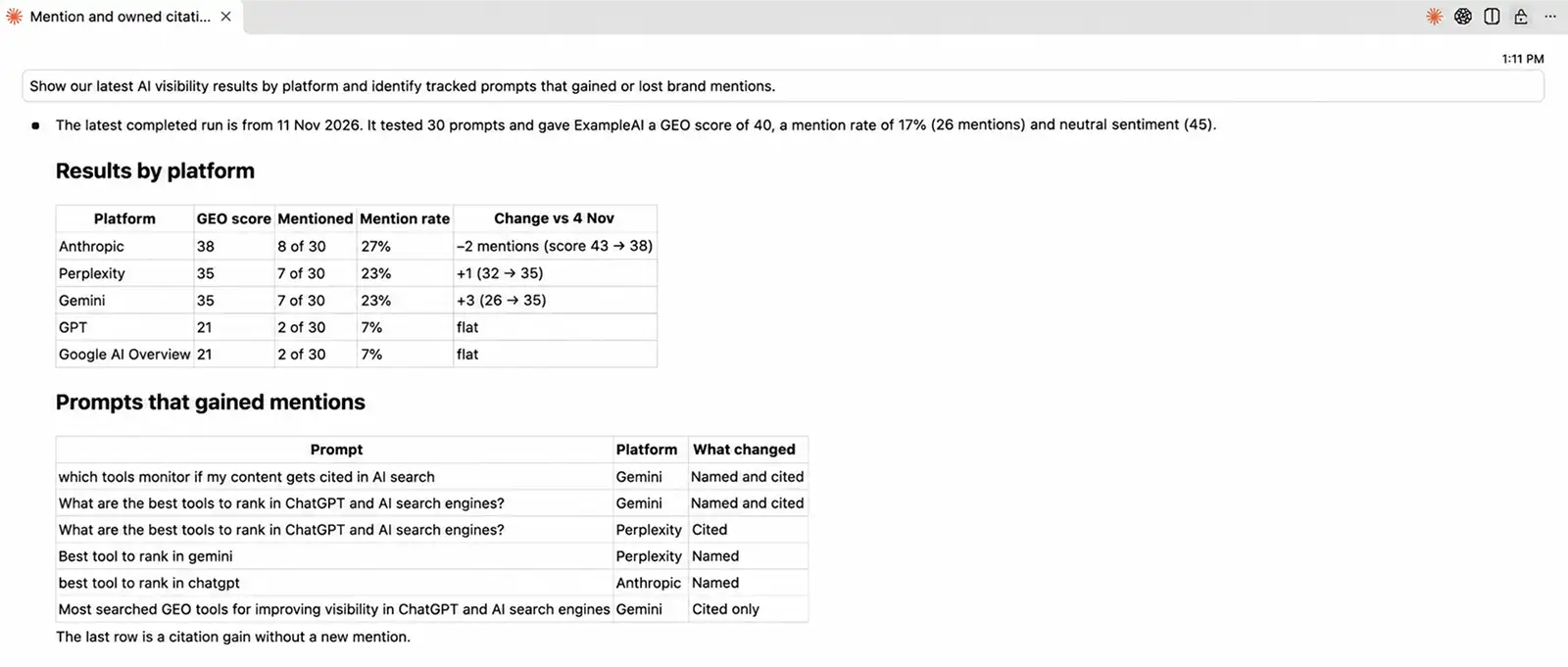
Step 4: Examine Visibility and Prompt Changes
Ask:
"Show our latest AI visibility results by platform and identify tracked prompts that gained or lost brand mentions."
The assistant can request the relevant get_visibility and get_prompt_changes information, with follow-up prompt details when needed.
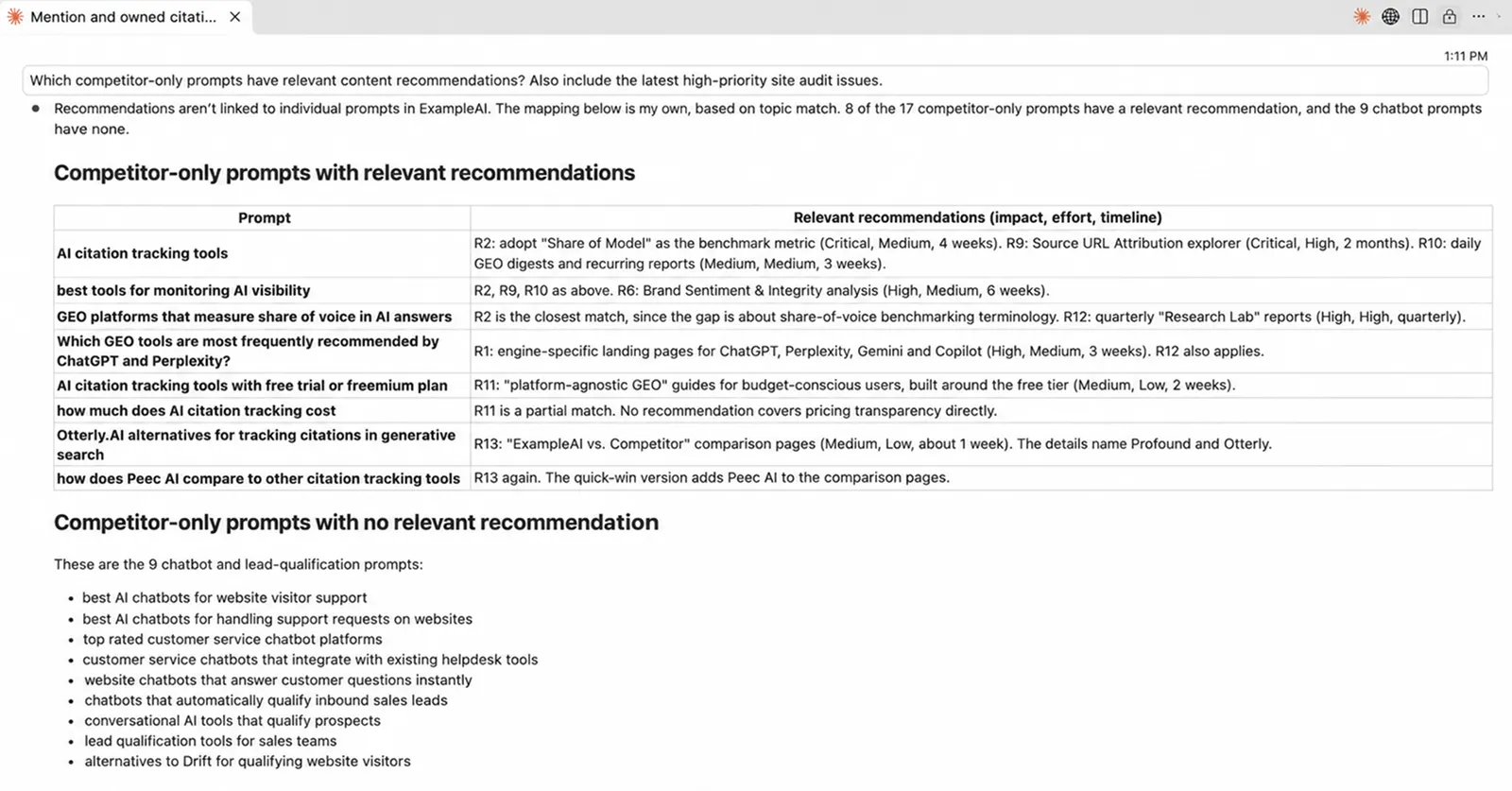
Step 5: Identify Content and Audit Priorities
Ask:
"Which competitor-only prompts have relevant content recommendations? Also include the latest high-priority site audit issues."
Botric's connected tools can help the assistant combine competitor findings, recommendations, and audit results into a structured review.
Review each proposed change before publishing content or modifying technical website settings.
This workflow connects monitoring, investigation, and prioritization without manually copying findings from multiple reports.
Botric's Blog Agent can help create new articles, while Page Agent focuses on improving existing pages. The insights retrieved through MCP can inform the editorial decisions behind both workflows.
Conclusion
MCP connects AI assistants to external data and tools. For GEO, the most valuable connection is the one that provides the brand mentions, citations, competitors, prompts, and recommendations needed to understand AI search performance.
Botric, SE Ranking, Nightwatch, Ahrefs, Peec AI, and Semrush each offer MCP capabilities, but their AI visibility coverage and subscription requirements differ.
Botric combines AI visibility monitoring, competitor analysis, website audits, and content recommendations. Its MCP integration makes supported workspace data accessible through compatible AI assistants.
Try Botric for free to track your brand across AI search, identify content opportunities, and connect visibility insights to your existing workflows.
Frequently Asked Questions
What Is the Best MCP Server for AI Visibility?
The best MCP server for AI visibility depends on the data you need. Botric provides monitored mentions, citations, competitors, and GEO recommendations through MCP; Peec AI focuses on AI search analytics; SE Ranking and Nightwatch combine AI visibility with SEO information; and Ahrefs documents Brand Radar access. Compare tracked engines, available tools, plan requirements, and reporting limits before deciding.
What Are the Best MCP Servers for AI Visibility and SEO?
Botric, SE Ranking, Nightwatch, Ahrefs, and Peec AI offer documented ways to access AI visibility information through MCP, while Semrush is useful for supporting SEO, market, and project data. Some tools provide both GEO and traditional SEO information, but the specific datasets and permissions vary by subscription.
What Is the Difference Between an SEO MCP Server and an AI Visibility MCP Server?
An SEO MCP server commonly exposes keyword rankings, backlinks, technical audits, or organic traffic research. An AI visibility MCP server focuses on observed brand mentions, citations, tracked prompts, and competitors in AI-generated answers. A single provider can support both, but dashboard features do not always map directly to MCP tools.
Can I Use AI Visibility MCP Servers With ChatGPT or Claude?
Yes, when the vendor offers a compatible connection and the client supports its required transport and authorization method. Check the provider's current setup documentation rather than assuming that every remote MCP endpoint works in every ChatGPT or Claude environment. Botric documents integrations for Claude Code, Claude Desktop, and Cursor.
Does Botric Provide MCP and API Access?
Yes. Botric's Infinity subscription includes MCP and API access at $149 per month on monthly billing, with up to 150 tracked prompts and five workspaces. MCP makes supported Botric workspace data accessible to compatible assistants, while API access supports programmatic integrations.
Can MCP Track AI Brand Mentions Automatically?
MCP can retrieve brand-mention data collected by a connected visibility platform, but the platform handles monitoring and data collection. The returned results depend on tracked prompts, selected AI engines, and completed runs. A recurring report also needs a scheduling or automation mechanism; the MCP connection alone does not schedule it.
Is MCP Better Than an API for SEO and GEO?
MCP is useful when you want an AI assistant to discover supported tools and answer follow-up questions using connected data. An API is often better for fixed integrations, custom applications, and predictable automated requests. Many vendors offer both because the two interfaces serve different workflows.
Does an SEO MCP Server Improve AI Citations or Google Rankings?
Not directly. An SEO MCP server gives an AI assistant access to supported data and actions; it does not change how Google or AI search platforms select sources. It can help identify missing mentions, cited sources, and technical problems, but any content or website changes still require implementation and measurement.