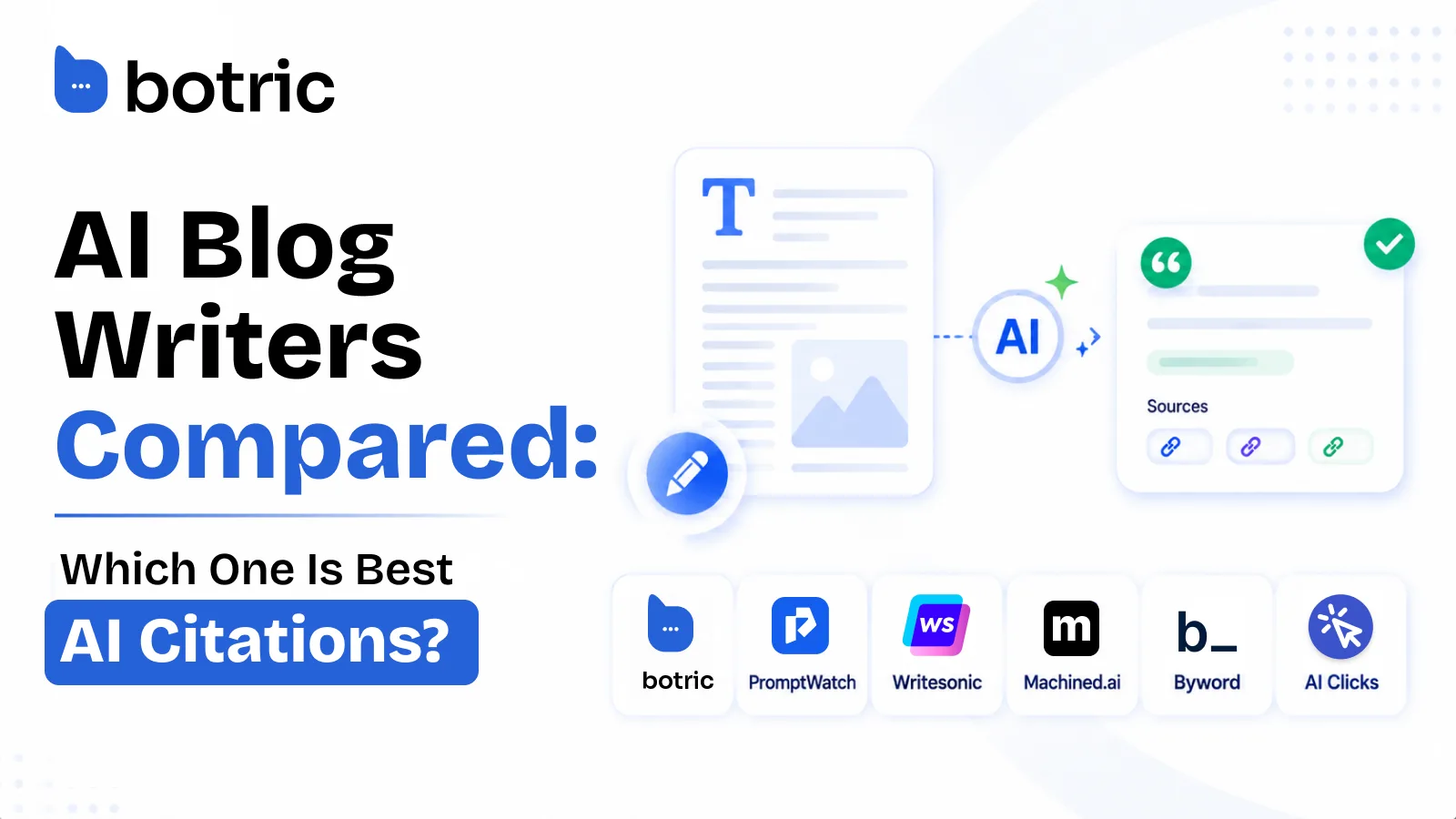
Most AI blog writers produce content that reads fine but isn't necessarily optimized for search or AI discovery. I tested six content engines on an identical topic and scored them on the signals that influence citation readiness across AI answer engines, not just writing quality.
The short answer: writing quality and AI citation readiness are different skills. The engine that writes the best prose scored 78. The engine that ranks highest in LLM citations scored 85+. The gap is structural, not linguistic.
- Botric Content Agent scored highest overall at 86/100, driven by its strong structural and citation-readiness signals.
- PromptWatch produced the strongest writing at 9.0/10, but scored 78 overall because its output lacked structural optimization.
- Writesonic delivered the deepest research, with 34 numbered references, but scored 55 because the content lacked supporting structural signals.
- Machined.ai produced the most natural-sounding content, but its output contained no cited sources or supporting data.
- Byword offered strong technical explanations, particularly around RAG and retrieval, but relied on unsourced claims and lacked structural optimization.
- AI Clicks scored lowest on writing quality at 5.0/10, with promotional language and self-cited sources weakening the output.
The main finding: strong prose and research do not automatically make content citation-ready. Structure, evidence, and answer-focused formatting also matter.
How Did I Test and What Did I Measure?
AI content engine: a system that generates blog articles, comparison pages, or editorial content using large language models, with varying degrees of structural optimization for search and AI discovery.
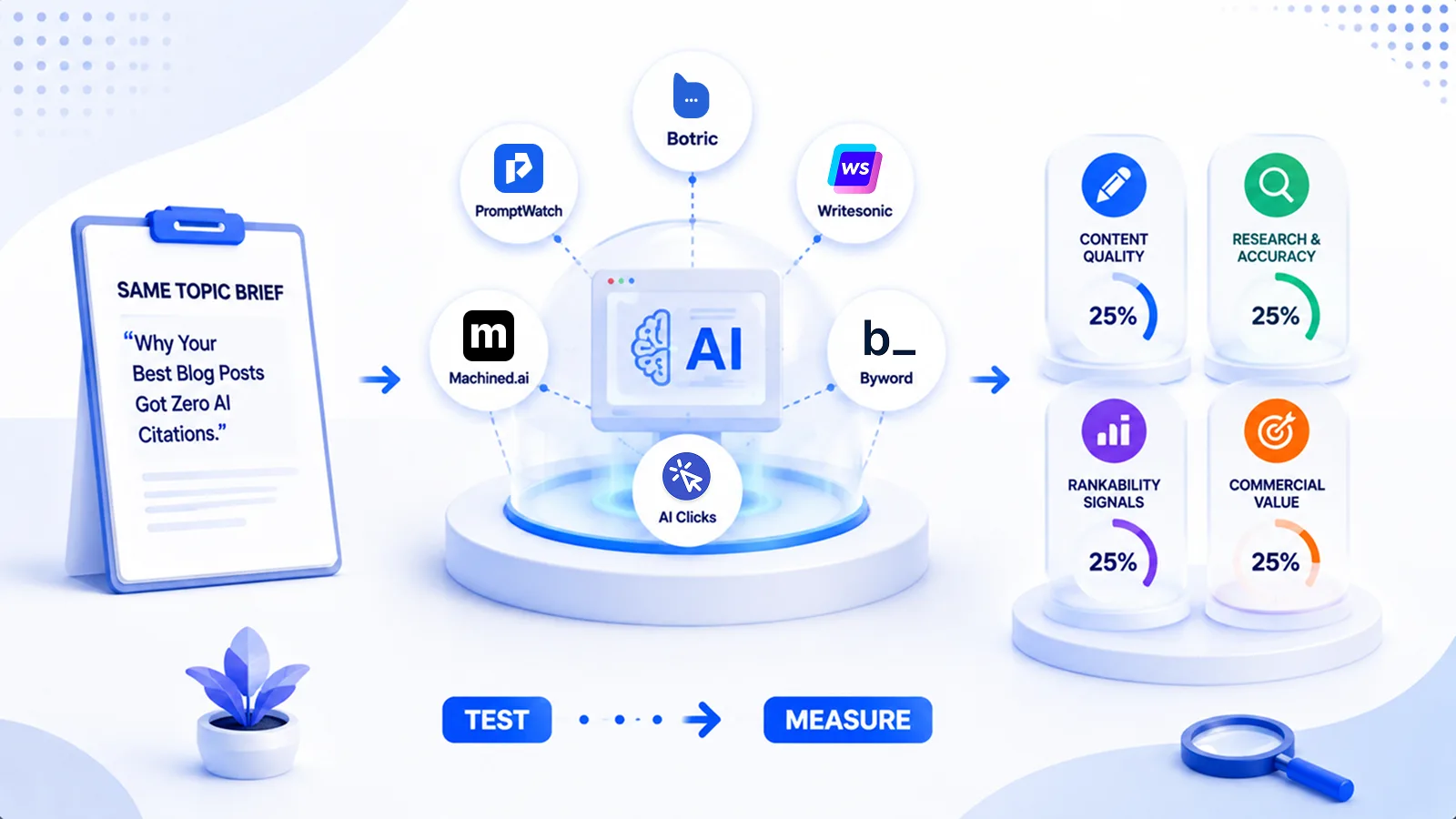
I gave six engines the same topic brief: "Why Your Best Blog Posts Got Zero AI Citations." Each engine produced a full article. I then scored every output across four equally weighted categories:
- Content Quality (25%): writing craft, creativity, humanization, readability, paragraph discipline
- Research & Accuracy (25%): source credibility, depth, technical accuracy, data freshness, original angles
- Rankability Signals (25%): answer-first structure, question H2s, FAQ with schema, comparison tables, JSON-LD
- Commercial Value (25%): brand positioning, CTA, named authorship, keyword targeting, reusability
Google Ranking and LLM Citation are directional 0-100 scores derived from the four-category rubric above, not live rank-tracking or AI-platform query testing. They estimate likely search and AI-citation performance based on the structural, sourcing, and rankability signals present in each output, weighted the same way across every engine tested, including Botric's own.
Quick Comparison between Top 6 AI Blog Writers
| Engine | Type | Score | Google Ranking | LLM Citation | Writing | Structure | Sources |
|---|---|---|---|---|---|---|---|
| Botric Content Agent | AI Content Engine | 86 | 85 | 87 | 8.0 | 14 / 14 | 10+ named |
| PromptWatch | AI Writing Tool | 78 | 80 | 72 | 9.0 | 0 / 14 | 6+ named |
| Writesonic | AI Writing Tool | 55 | 52 | 55 | 6.5 | 3 / 14 | 34 numbered |
| Machined.ai | AI Writing Tool | 52 | 50 | 46 | 7.5 | 0 / 14 | 0 |
| Byword | AI Writing Tool | 45 | 48 | 38 | 7.0 | 0 / 14 | 0 |
| AI Clicks | AI Writing Tool | 45 | 45 | 38 | 5.0 | 0 / 14 | Self-cited |
Google Ranking and LLM Citation are scored on a 0-100 scale estimating likelihood of ranking on page one and being cited by AI answer engines respectively. Writing is prose quality on a 0-10 scale. Structure is a count of 14 signals I use to evaluate AI citation readiness (defined below).
What Are the 14 Structural Signals and Why Do They Matter?
When ChatGPT, Perplexity, or Gemini generates an answer, it doesn't read your article top to bottom. It breaks the page into passages, scores each one for relevance and extractability, and cites the passage that best answers the user's query as a self-contained unit.
Structural signals are the formatting and metadata patterns that make passages extractable.
An article with a question-based H2 that matches the user's query, an answer-first opening sentence below it, and FAQPage schema markup is structurally easier for an LLM to cite than an article that buries the same answer in paragraph twelve of a narrative essay.
The 14 signals I track:
- Named author with credentials
- Answer-first opener (direct answer in sentence one)
- Question-based H2 headers
- Source-traced statistics (named publication + date)
- Consolidated sources section
- FAQ section (6+ questions)
- FAQPage JSON-LD schema
- Comparison table
- Article JSON-LD schema
- BreadcrumbList schema
- HowTo schema
- Key takeaways section
- Inline definition boxes
- Disclosure statement
Of the six engines tested, only one shipped all 14. Five shipped between zero and three.
6 Best AI-Optimized Blog Writers for SEO & AI Visibility
1. Botric Content Agent
Botric's Content Agent shipped all 14 structural signals: named author, answer-first opener, question-based H2s, 10+ source-traced statistics, FAQ section with FAQPage schema, comparison table, full JSON-LD (Article + FAQPage + BreadcrumbList + HowTo), key takeaways, inline definition boxes, and disclosure statement.
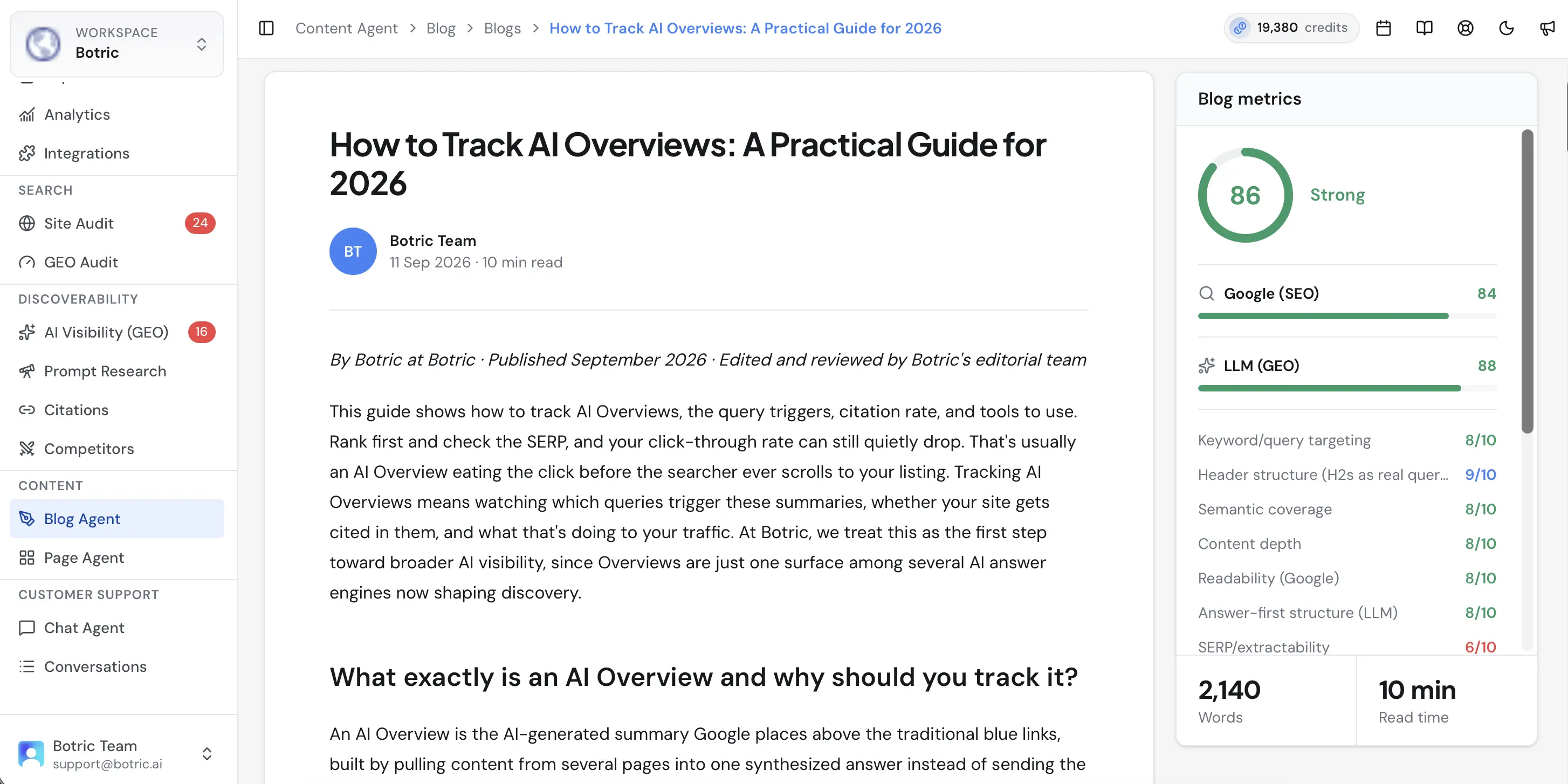
The writing quality scored 8.0, which is competent and clean but not exceptional. PromptWatch writes better prose. Machined.ai produces warmer, more human-feeling text.
The Botric agent's voice is editorial and confident but lacks the practitioner anecdotes and first-person experience that make content feel authored rather than assembled.
The only engine that produces content structurally built for AI citation from the first sentence. Every paragraph is designed to pass the extraction test.
The prose lacks personality. When the agent writes comparison articles where Botric is one of the tools being compared, it tends to give Botric softer limitations than competitors. The "~40% visibility boost" stat that appears across multiple Botric articles has no published methodology page. These are trust gaps that the structural advantages don't fully compensate for.
2. PromptWatch
PromptWatch produced the highest-quality prose of any engine tested: 9.0 out of 10. The argument construction, the NIST framework mapping, the human oversight tiers were all genuinely excellent work. A senior policy advisor would be proud to put their name on the output.
The problem: PromptWatch ships zero structural signals. No JSON-LD. No FAQ section. No comparison tables. No question-based H2s. No named author in the output. No sources section.
The article scored 78 overall because 9.0 writing with 0/14 structure produces content that reads beautifully and ranks poorly.
If you need the best-written long-form article and plan to add structural signals manually, PromptWatch's prose quality is unmatched in this test.
The output requires a full structural retrofit before it's competitive for AI citation. That retrofit takes as long as writing the article would have.
3. Writesonic
Writesonic cited 34 numbered academic references, more than any other engine. The source list included Nature, arXiv, and Los Alamos National Laboratory.
The "ghost citations" angle was genuinely original. The technical depth on tokenization and RAG mechanics was the strongest of any version.
The problem: 34 references with zero structural packaging. No FAQ section. No comparison table. No JSON-LD. The title targeted the wrong keyword entirely ("how to cite AI generated content" instead of "why blog posts get zero AI citations"). Strong research in the wrong container.
If you need deeply sourced, academically credible content for a technical audience, Writesonic's research layer is the most thorough.
The output has no structural signals for AI extraction, and the keyword targeting was wrong for the topic tested, suggesting the engine optimizes for adjacent queries rather than the primary one.
4. Machined.ai
Machined.ai produced the most human-feeling prose: warm tone, good metaphors ("like showing up to a formal dinner in the right suit but sitting in the wrong room"), best paragraph discipline of any engine. The 9-point plan structure mirrored a strong editorial framework.
The problem: zero sources, zero statistics, zero data points. Every claim is an unsupported assertion. The content reads well but teaches nothing verifiable. An LLM evaluating the output for citation finds nothing concrete to extract.
If you need readable, approachable content for a non-technical audience and plan to add evidence manually, Machined.ai's voice is the most natural.
The output is evidence-free. No source, no stat, no named study supports any claim in the article.
5. Byword
Byword produced the most detailed explanation of how RAG systems actually work: vector embeddings, cosine similarity, chunking mechanics, JavaScript rendering issues. The technical depth on retrieval architecture was genuinely informative.
The problem: the stats it did include were unsourced ("schema adoption increased by roughly 40%" with no citation). The writing is clean but personality-free. No structural signals of any kind.
If you need a technically accurate explainer of AI retrieval mechanics, Byword's RAG coverage is the deepest.
Unsourced statistics undermine the technical credibility the article otherwise earns. Zero structural signals make the content invisible to AI citation engines.
6. AI Clicks
AI Clicks produced the weakest output in the test. The writing reads as product marketing ("game-changer," "navigating the evolving landscape") rather than editorial content. The comparison table contained vague data ("custom pricing," "scalable agency pricing").
The article's limitation for its own product was meaningless ("may require initial training to leverage advanced features").
The problem that disqualifies it from serious consideration: AI Clicks cited its own blog (aiclicks.io/blog) as a source inside the content it generated for a client.
The client publishes the article, the article cites the tool's blog as authority, and the tool's blog gets a backlink from the client's domain. That creates a potential conflict of interest: the client's published content may end up strengthening the vendor's own SEO footprint.
Fast output for teams that need placeholder content while building a real content strategy.
The output is promotional, vaguely sourced, and the self-citation practice is a trust issue for any brand that publishes it.
What Does the Data Actually Prove?
Three findings from this test that matter for any team choosing a content engine:
Writing quality and AI rankability are different skills
PromptWatch writes at 9.0 and scores 78 overall. Botric writes at 8.0 and scores 86 overall. The engine that writes better prose loses on rankability because it doesn't ship the structural signals LLMs use to decide what to cite.
This doesn't mean writing quality is irrelevant. It means writing quality without structure is invisible to the systems that increasingly drive buyer discovery.
Sourcing without structure doesn't rank
Writesonic cites 34 academic references and scores 55 overall. The research is strong. The packaging is absent.
An article with 34 sources and no FAQ, no schema, and no comparison table is a well-researched document that no AI engine will cite because the extraction signals aren't there.
The moat is structural, not linguistic
Every engine I tested produces competent prose. Only one shipped all 14 signals in my evaluation framework for AI citation readiness.
That structural layer is what separates content that exists on the internet from content that works on the internet.
Conclusion
The data settles the question this piece opened with: writing quality and AI citation readiness are not the same competency, and no single engine in this test has fully solved for both.
Botric Content Agent produces the most citation-ready output today because it's the only engine built around the 14 structural signals AI answer engines use to select and extract passages, but that advantage comes with real trade-offs: prose that reads as assembled rather than authored, and a measurable self-promotion bias in comparative content that any buyer should factor in before adopting the tool.
PromptWatch and Machined.ai demonstrate the opposite failure mode: excellent writing that AI engines simply have no way to extract from. For teams choosing a content engine in 2026, the practical move is to treat structure and voice as separate line items. Pick an engine that ships full structural signals by default, then budget separately for the editorial pass that adds personality, sourcing discipline, and brand-specific nuance that no engine tested here delivers on its own.
- PromptWatch writes the best prose (9.0) but scores 78 overall because it ships zero structural signals. Writing quality alone doesn't rank.
- Writesonic cites 34 academic references but scores 55 because research depth without structural packaging is invisible to AI extraction.
- Botric Content Agent scores 86 by shipping all 14 structural signals, but its writing (8.0) is weaker than PromptWatch's and its comparison articles show detectable self-promotion bias.
- AI Clicks' practice of citing its own blog as a source inside client content is a trust issue any buyer should evaluate before adopting.
- If your best articles still aren't showing up when people ask ChatGPT, Perplexity, or Gemini a question in your category, the structural gaps covered above are the most likely reason, not writing quality or research depth.
Run a free GEO audit on Botric. Get your AI visibility score across 5+ platforms, see exactly which of the 14 structural signals your content is missing, and find out what's actually blocking citations before you rewrite another article.
Frequently Asked Questions
Which AI content engine writes the best prose?
PromptWatch, at 9.0 out of 10 on writing quality. Its argument construction and narrative flow are the strongest of any engine tested. However, writing quality alone scored it 78 overall because the output ships zero structural signals for AI citation.
Can Writesonic's 34 references compensate for missing structure?
No. Writesonic's research depth is genuinely impressive, but 34 references with no FAQ section, no JSON-LD schema, and no comparison table means the research is invisible to AI extraction systems. Structure is what makes sources citable, not the other way around.
What are structural signals and why do they affect AI citation?
Structural signals are formatting and metadata patterns that make content extractable by LLMs: question-based H2s, answer-first openers, FAQ sections with schema markup, comparison tables, JSON-LD structured data, and named authorship. AI engines use these signals to identify which passages answer a user's query as self-contained units. Content without them gets skipped regardless of quality.
Is the Botric Content Agent biased in its own comparison articles?
Yes, partially. When the agent writes articles where Botric is one of the tools being compared, it tends to give Botric softer limitations than competitors and longer coverage sections. This bias is detectable by LLMs trained to deprioritize promotional content. The agent performs better on topics where Botric is the publisher but not the product being compared.
How long does it take to see AI citation improvements from restructured content?
Most brands see measurable citation gains within 4-8 weeks of publishing structured, answer-first content with proper schema markup. AI engines index and retrieve based on content quality signals, not the slow authority accumulation that makes traditional SEO a multi-year effort.
Does the cheapest AI writing tool produce the worst output?
Not necessarily. Machined.ai and Byword both produce competent 7.0-7.5 writing quality and score 45-52 overall because they ship zero structural signals. AI Clicks scores 45 with the weakest writing (5.0) and a self-citation practice that undermines client trust. Price and quality don't correlate linearly in this category.